Study guide · 2026 Edition
U.S. Citizenship Civics Test — Complete Study Guide (2026)
PrepPass's independent 2026 study guide for the U.S. Citizenship Civics Test exam is 46 pages including 55 practice questions with a full answer key, PDF + EPUB, $9.99 one-time; it is not affiliated with the exam provider. The book does not include PrepPass's separate online timed mock for this exam (20 questions, 15 minutes).
- Length
- 46 pages
- Practice questions in the book
- 55
- PrepPass online timed mock
- 20 questions · 15 min
- Exam facts last checked
- September 2026
- File last updated
- October 2026
- Delivery
- PDF + EPUB · English · instant download
What is in the U.S. Citizenship Civics Test study guide?
The real exam: U.S. Naturalization Civics Test (2025 version) — Questions: Up to 20 questions · Time limit: No time limit: an oral test within the naturalization interview. · Passing score: 12 of 20 correct.
The USCIS naturalization civics test — American government, history, and civics — covering both the 2008 (100-question) and 2025 (128-question) versions and which one applies to you.
Exam facts, who it suits and what changed
About the exam itself
| Administering body | U.S. Citizenship and Immigration Services (USCIS) Source: USCIS — Study for the Test (naturalization English and civics test) |
|---|---|
| Questions | Up to 20 questions Source: USCIS — Study for the Test (naturalization English and civics test) |
| Time limit | No time limit: an oral test within the naturalization interview. What we read and found nothing in: USCIS — Study for the Test (naturalization English and civics test) |
| Passing score | 12 of 20 correct Source: USCIS — Study for the Test (naturalization English and civics test) |
| Fees | Not checked |
| Languages offered | Not published by USCIS What we read and found nothing in: USCIS — Study for the Test (naturalization English and civics test) |
Look inside the book
Three real pages, rendered straight from the PDF you download — a reference page, a teaching page, and a worked question, always in that order. Nothing here was redrawn to look better.
- Quick referenceChapter 1 — American Government · PDF page 22
A page you can turn back to: the numbers, deadlines or terms gathered in one place.
- How it's taughtChapter 1 — American Government · PDF page 12
An explanation page: the material taught in prose, in the order the exam tests it.
- A question, workedChapter 1 — American Government · PDF page 16
A practice question with its answer and the reasoning behind it — not just a key.
Exam inside two weeks?
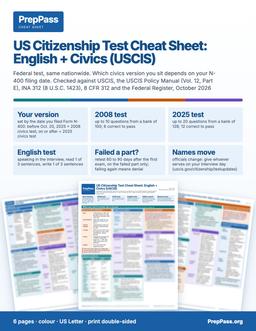
This guide is the teaching, read over weeks. If your exam is inside two weeks, the printable colour cheat sheet is the other product: the figures the exam turns on, laid out by section.
See the U.S. Citizenship Civics Test cheat sheet PDF — $9.99 →
6 pages · US Letter · printable PDF · yours to keep
What's included — and what isn't
Included
- Both test versions (2008 100-Q and 2025 128-Q) and which applies to you
- American Government: Constitution, branches, Congress, rights & duties
Not included
- No printed copy is shipped — this is a file you download and can print yourself
- No video course, instructor or tutoring comes with the book — the free videos on the site are separate
Everything included, and everything that isn't
Included
- American History: independence, the 1800s, the Civil War, recent history
- Integrated Civics: geography, symbols, and holidays
- Moving answers (officials) taught as 'look up current at uscis.gov'
- 55 practice questions with answer explanations · PDF + EPUB
Not included
- Not your exam registration or the testing centre's fee, which you still pay to the official body
Contents
See 4 sections and the page each one starts on
- Chapter 1 — American Governmentp. 9
- Chapter 3 — Symbols and Holidays About 8% of the 128 civics questions (Q119–128) — the smallestp. 25
- Practice Exam — 55 Questionsp. 29
- Answer Key with Explanationsp. 40
Taken from the PDF you download, with the page each one starts on — not typed here.
Read a chapter free, in full
One complete chapter, exactly as it ships in the eBook. Scroll the window to read it right here; no download, no email.
Read chapter 2 here, without leaving the page
We didn't give you the easy intro — the free chapter opens on one of the hardest-working parts of the book, so you can judge the teaching where the exam gets difficult.
About 36% of the 128 civics questions (Q73–118) — the second-largest component, in three sub-sections: Colonial Period and Independence, The 1800s, and Recent American History.
The history questions run in a rough timeline: the colonial era and independence, the 1800s and the Civil War, and the 1900s to recent history. Almost every history answer is a fixed fact — a name, a document, a date, a war — that does not change with elections. The 2025 test goes deeper than the old 100-question test here: it adds "name one important event" questions (of the Revolution and of the Civil War), individual "famous for" questions about several founders, and several new "why did the U.S. enter this war" questions. Anchor everything to a few dates: 1776 (Declaration), 1787 (Constitution written), 1803 (Louisiana Purchase), 1861–1865 (Civil War), 1929 (Great Crash), 1941 (Pearl Harbor).
2.1 Colonial Period and Independence
Before the Europeans arrived, American Indians (Native Americans) already lived in America. Colonists later came for many reasons — freedom, political liberty, religious freedom, economic opportunity, and to escape persecution. Africans (people from Africa) were taken and sold as slaves.
The war the Americans fought to win independence from Britain was the American Revolution (the Revolutionary War / War for Independence). Reasons the Americans declared independence include high taxes, taxation without representation, British soldiers staying in Americans' houses (quartering), a lack of self-government, and specific sparks such as the Boston Massacre, the Boston Tea Party, the Stamp Act, the Sugar Act, the Townshend Acts, and the Intolerable (Coercive) Acts.
Thomas Jefferson wrote the Declaration of Independence, which was adopted on July 4, 1776. The American Revolution had many important events — you can name any one: the Battle of Bunker Hill, the Declaration of Independence, Washington crossing the Delaware (Battle of Trenton), the Battle of Saratoga, the Valley Forge encampment, or the Battle of Yorktown (the British surrender that effectively ended the war).
There were 13 original states along the Atlantic coast, and the 2025 test asks you to name five: New Hampshire, Massachusetts, Rhode Island, Connecticut, New York, New Jersey, Pennsylvania, Delaware, Maryland, Virginia, North Carolina, South Carolina, and Georgia.
The founders. The founding document written in 1787 was the Constitution. The Federalist Papers — written by James Madison, Alexander Hamilton, and John Jay (under the pen name Publius) — were important because they helped people understand the Constitution and supported passing it. The 2025 test adds individual "famous for" questions about several founders:
- Benjamin Franklin — founded the first free public libraries, was the first Postmaster General, helped write the Declaration of Independence, was an inventor, and a U.S. diplomat.
- George Washington — the "Father of Our Country," the first President, General of the Continental Army, and President of the Constitutional Convention.
- Thomas Jefferson — writer of the Declaration of Independence, the third President, the man who doubled the size of the country (the Louisiana Purchase), the first Secretary of State, and founder of the University of Virginia.
- James Madison — the "Father of the Constitution," the fourth President, President during the War of 1812, and one of the writers of the Federalist Papers.
- Alexander Hamilton — the first Secretary of the Treasury, one of the writers of the Federalist Papers, a helper in establishing the First Bank of the United States, an aide to General Washington, and a member of the Continental Congress.
2.2 The 1800s
The 1800s brought expansion and then a great crisis. In 1803, the United States bought the Louisiana Territory from France (the Louisiana Purchase), nearly doubling the country's size. Wars fought in the 1800s include the War of 1812, the Mexican-American War, the Civil War, and the Spanish-American War.
The U.S. war between the North and the South was the Civil War. The Civil War had many important events — name any one: the Battle of Fort Sumter, the Emancipation Proclamation, the Battle of Vicksburg, the Battle of Gettysburg, Sherman's March, the surrender at Appomattox, the Battle of Antietam (Sharpsburg), or Lincoln's assassination.
Abraham Lincoln is famous for many things: he freed the slaves (the Emancipation Proclamation), saved (preserved) the Union, led the United States during the Civil War, was the 16th President, and delivered the Gettysburg Address. The Emancipation Proclamation freed the slaves — specifically the enslaved people in the Confederate (Southern) states. The U.S. war that ended slavery was the Civil War.
The 14th Amendment says that all persons born or naturalized in the United States, and subject to its jurisdiction, are U.S. citizens. All men got the right to vote after the Civil War, during Reconstruction — with the 15th Amendment, in 1870. Leaders of the women's rights movement in the 1800s include Susan B. Anthony, Elizabeth Cady Stanton, Sojourner Truth, Harriet Tubman, Lucretia Mott, and Lucy Stone.
2.3 Recent American History and Other Important Information
Wars of the 1900s include World War I, World War II, the Korean War, the Vietnam War, and the (Persian) Gulf War. The United States entered World War I because Germany attacked U.S. (civilian) ships — and to support the Allied Powers against the Central Powers. All women got the right to vote in 1920 — after World War I, with the 19th Amendment.
The Great Depression was the longest economic recession in modern history; it started with the Great Crash — the stock market crash of 1929. Franklin Roosevelt was President during the Great Depression and World War II. The United States entered World War II because of the Japanese attack on Pearl Harbor — and to support the Allied Powers against the Axis Powers (Germany, Italy, and Japan). Dwight Eisenhower was a general during World War II, was President during the Korean War, was the 34th President, and signed the Federal-Aid Highway Act of 1956 that created the Interstate System.
During the Cold War, the United States' main rival was the Soviet Union (the USSR). One main concern was the spread of communism (and the threat of nuclear war). The U.S. entered both the Korean War and the Vietnam War for the same reason: to stop the spread of communism. It entered the Persian Gulf War to force the Iraqi military out of Kuwait.
The civil rights movement fought to end racial discrimination. Martin Luther King, Jr. fought for civil rights and worked for equality for all Americans. On September 11, 2001, terrorists attacked the United States — hijacking planes that struck the World Trade Center and the Pentagon, with a fourth crashing in Pennsylvania. U.S. military conflicts after 9/11 include the (Global) War on Terror, the War in Afghanistan, and the War in Iraq.
You may be asked to name one American Indian tribe — acceptable examples include the Cherokee, Navajo, Sioux, Apache, Cheyenne, Chippewa, Choctaw, Creek, Hopi, Lakota, Mohawk, Oneida, Pueblo, Seminole, Seneca, Shawnee, and many more (for the full list, USCIS points to bia.gov). Finally, the 2025 test adds a question on American innovation — examples include the light bulb, the automobile, skyscrapers, the airplane, the assembly line, landing on the moon, and the integrated circuit.
### Key Facts — Chapter 2 (all fixed facts — memorize) - Lived here first: American Indians (Native Americans). Taken and sold as slaves: Africans. Colonists came for freedom / religious freedom / economic opportunity / to escape persecution. - War for independence = the American Revolution. Reasons to declare independence = taxation without representation / high taxes / quartering soldiers / no self-government. - Declaration of Independence: written by Thomas Jefferson, adopted July 4, 1776. Name one Revolution event: Bunker Hill, Trenton, Saratoga, Valley Forge, Yorktown. - 13 original states — be ready to name five (e.g., Virginia, Massachusetts, New York, Pennsylvania, Georgia). - Constitution written 1787; Federalist Papers (Madison, Hamilton, Jay / "Publius") helped people understand and support the Constitution. - Founders "famous for": Washington (Father of Our Country, 1st President, General), Jefferson (wrote the Declaration, 3rd President, Louisiana Purchase), Madison ("Father of the Constitution," 4th President), Hamilton (1st Treasury Secretary), Franklin (first Postmaster General, U.S. diplomat, inventor). - Louisiana Purchase (1803) — bought from France. Name one 1800s war: War of 1812, Mexican-American, Civil War, Spanish-American. - Civil War = North vs. South; name one Civil War event: Fort Sumter, Gettysburg, Vicksburg, Appomattox, Emancipation Proclamation. Lincoln freed the slaves & saved the Union; the Civil War ended slavery. - Emancipation Proclamation freed slaves in the Confederate states. 14th Amendment = citizenship to all born/naturalized in the U.S. All men got the vote with the 15th (1870); all women with the 19th (1920). - WWI: U.S. entered because Germany attacked U.S. ships. Great Depression = longest modern recession, began with the 1929 crash; President Franklin Roosevelt. - WWII: U.S. entered after Japan attacked Pearl Harbor. Eisenhower = WWII general, 34th President, built the Interstate System. - Cold War rival = Soviet Union (USSR); concern = communism / nuclear war. Korea & Vietnam = to stop the spread of communism; Persian Gulf War = to force Iraq out of Kuwait. - Civil rights movement fought to end racial discrimination; leader = Martin Luther King, Jr. September 11, 2001 — terrorists attacked the U.S.; post-9/11 conflicts = War on Terror, Afghanistan, Iraq. - Name one American Indian tribe (Cherokee, Navajo, Sioux, Apache…) and one American innovation (light bulb, airplane, moon landing…).
Worked Example
Officer asks: "Why did the United States enter World War II?"
Reach for your date anchors. World War II = 1941, Pearl Harbor. The one-line answer the officer wants is "Because Japan attacked Pearl Harbor" (you could also say "to support the Allied Powers" or "to oppose the Axis Powers"). Now feel the trap: World War I has a different cause — Germany attacked U.S. (civilian) ships. The test deliberately offers "Germany attacked U.S. ships" as a choice on a World War II question to catch a memorized-but-mismatched answer. Tie each cause to its war: WWI → German attacks on U.S. ships; WWII → Japan attacks Pearl Harbor. And keep the two Cold War wars straight — the U.S. entered both Korea and Vietnam to stop the spread of communism.
Exam Traps
- WWI vs. WWII causes. WWI: Germany attacked U.S. ships. WWII: Japan attacked Pearl Harbor. Don't cross them.
- Which document did which job. The Declaration of Independence (1776) announced independence; the Constitution (1787) set up the government; the Emancipation Proclamation freed enslaved people in the Confederacy. Match the document to its action.
- Who "freed the slaves" vs. "first President." Lincoln freed enslaved people and saved the Union; Washington was the first President and "Father of Our Country." The test offers both names on both questions — and the new "famous for" questions about Jefferson, Madison, and Hamilton invite the same mix-ups (Jefferson wrote the Declaration; Madison is "Father of the Constitution"; Hamilton was first Treasury Secretary).
- All men (15th, 1870) vs. all women (19th, 1920). Two different amendments, two different dates — the 2025 test asks each separately.
- "Name one" (or "name five") means give exactly what's asked. For "name one event / one tribe / one war," a single correct example is a full answer — but the 13-original-states question asks you to name five, so have five ready. Make sure each example is correct (Texas and California were not original states; the Aztec and Maya were not U.S. tribes).
Questions buyers ask
How do I get it?
Pay, and the download appears on this page straight away. The links are also emailed to you. No account is required.
What if it isn't for me?
Email us within 14 days for a full refund, no questions asked.
Is the free practice going away?
No. Every practice question, the timed mock and the free chapters on this site stay free. This book is the studying half, not a gate around the free half.
More questions (15)
Can I read it on my phone?
Yes — the EPUB is for phones and e-readers, the PDF is for printing and tabbing. You get both.
Is a study guide enough for the U.S. Citizenship Civics Test exam, or do I need a course?
A book is exam review: it does not replace any education, training or experience U.S. Citizenship and Immigration Services (USCIS) requires before you may sit the exam, so check those requirements first. For the exam content itself, this 46-page guide teaches the material chapter by chapter with 55 practice questions and explanations inside, and 128 more practice questions are free on PrepPass. A prep course adds live instruction and a set schedule; whether you need one beyond any required education is your call.
What is the cheapest way to prepare for the U.S. Citizenship Civics Test exam?
Start with what costs nothing: 128 practice questions on PrepPass, with explanations and no signup. If you want it taught in one file you keep, the full study guide is $9.99 once; the printable cheat sheet for the last days is $9.99. No subscription on any of them.
Who administers the U.S. Naturalization Civics Test (2025 version)?
U.S. Citizenship and Immigration Services (USCIS). Given orally by a USCIS officer at the naturalization interview. Applicants who filed Form N-400 before Oct. 20, 2025 take the 2008 test instead: up to 10 questions from a list of 100, with 6 correct to pass. The English test is separate: read 1 of 3 sentences and write 1 of 3 sentences correctly.
How many questions are on the U.S. Naturalization Civics Test (2025 version)?
Up to 20 questions. Oral questions drawn from the list of 128 civics questions. The officer stops once you have 12 correct or 9 incorrect, so many interviews end before question 20. Applicants who filed before Oct. 20, 2025 take the 2008 test instead: up to 10 questions from a list of 100.
How long is the U.S. Naturalization Civics Test (2025 version)?
No time limit: an oral test within the naturalization interview.
What is the passing score for the U.S. Naturalization Civics Test (2025 version)?
12 of 20 correct. You fail if you answer 9 of the 20 incorrectly.
How much does the U.S. Naturalization Civics Test (2025 version) cost?
Not checked. There is no separate test fee; USCIS points to its fee schedule for the Form N-400 filing fee, which could not be read as text, so PrepPass states no amount.
What languages is the U.S. Naturalization Civics Test (2025 version) offered in?
Not published by USCIS. USCIS's page does not name a language for the civics test itself; it separately tests reading, writing and speaking English. It says applicants 65 or older with 20 or more years as a permanent resident take 10 questions from a special set of 20 and may take the test in the language of their choice.
Does the U.S. Citizenship Civics Test study guide come as a PDF?
Yes — U.S. Citizenship Civics Test — Complete Study Guide (2026) downloads as PDF and EPUB, 46 pages. The download link is emailed the moment payment clears and does not expire.
How much does the U.S. Citizenship Civics Test study guide cost?
$9.99, once. There is no subscription and no account to create; the PDF and EPUB files are yours to keep.
Are there free U.S. Citizenship Civics Test practice questions?
Yes — 128 of them, free to use with no signup and an explanation on every one. They are separate from this study guide, which is what you are buying here. The same free, no-account system also has practice modes (adaptive, new questions, spaced review of misses, weak-topic focus, saved, my mistakes); a timed mock exam (20 questions, 15 minutes) with a score report by topic; a 10-question readiness check (about 5 minutes); 3 study chapters. None of it needs this study guide.
Can I read part of the U.S. Citizenship Civics Test study guide before buying?
Yes. A full chapter is free to read on this page — not a summary of one, the chapter itself.
What is the difference between the U.S. Citizenship Civics Test study guide and the cheat sheet?
The study guide ($9.99) teaches the material chapter by chapter and is meant to be read over weeks. The cheat sheet ($9.99, 6 pages) drops the teaching and keeps the figures: every number on the exam grouped by value so the confusable ones sit together, each reference page paired with a recall page that blanks the answers, and four routes by days left — 14, 7, 3, or tonight. They are separate purchases; neither replaces the other.
Is this the official U.S. Citizenship Civics Test study guide?
No. This is an independent study guide and is not affiliated with or endorsed by the exam's awarding body. It is written from official USCIS civics questions / uscis.gov (2008 + 2025 civics tests). Always confirm current requirements with the body that issues your licence.
Why buy the book when the practice is free?
Our practice questions and timed mock stay free — nothing on the site moves behind this book. The $9.99 book is the studying half: the material itself, taught in order, in a file you own.
- Systematic teaching — every exam section explained chapter by chapter, start to finish, not just questions
- Print it & tab it — a paper-ready PDF you can highlight, mark up, and bring to your study table
- Study anywhere, offline — EPUB on your phone or e-reader; no wifi, no browser tabs
- Everything in one place — the chapters and the practice questions in one file
- Yours for life — one-time $9.99, instant download, no subscription
The details
- Verified from the official source(official USCIS civics questions / uscis.gov (2008 + 2025 civics tests))
- 128 free practice questions
Also free on PrepPass for U.S. Citizenship Civics Test
Beside this guide, PrepPass has a free study system for the same exam. It needs no account, and buying the guide does not unlock or change it: 128 practice questions with explanations; practice modes (adaptive, new questions, spaced review of misses, weak-topic focus, saved, my mistakes); a timed mock exam (20 questions, 15 minutes) with a score report by topic; a 10-question readiness check (about 5 minutes); 3 study chapters.
Progress is saved in your browser; a free account keeps it across devices. The readiness gauge reflects your own practice, not a prediction of the real exam result. How the practice works
One-time purchase, lifetime access to the download. The eBook is the full U.S. Citizenship Civics Test study guide in PDF and EPUB. Educational summary, not professional or legal advice — always confirm the current rules with the official source. Last updated: October 2026.