Study guide · 2026 Edition
Dental Assisting: Radiation Safety & Infection Control — Study Guide (2026)
PrepPass's independent 2026 study guide for the Dental Assisting exam is 70 pages including 55 practice questions with a full answer key, PDF + EPUB, $14.99 one-time; it is not affiliated with the exam provider. The book does not include PrepPass's separate online timed mock for this exam (100 questions, 75 minutes).
- Length
- 70 pages
- Practice questions in the book
- 55
- PrepPass online timed mock
- 100 questions · 75 min
- Exam facts last checked
- September 2026
- File last updated
- October 2026
- Delivery
- PDF + EPUB · English · instant download
What is in the Dental Assisting (Radiation & Infection Control) study guide?
The real exam: DANB Radiation Health and Safety (RHS®) and Infection Control (ICE®) Exams — 75 questions · 60 minutes · Passing score: Scaled score of 400 on a 100–900 scale.
The DANB RHS (Radiation Health & Safety) and ICE (Infection Control) domains — sterilization, radiation safety, radiographic technique, and OSHA/CDC rules. (This edition covers RHS + ICE, not General Chairside.)
Exam facts, who it suits and what changed
To prepare for the Dental Assisting (Radiation & Infection Control) exam, cover every topic on the exam body's current content outline and practise with timed questions. The exam itself (DANB Radiation Health and Safety (RHS®) and Infection Control (ICE®) Exams): 75 questions, 60 minutes, scaled score of 400 on a 100–900 scale to pass.
About the exam itself
| Administering body | Dental Assisting National Board, Inc. (DANB) — exam delivered by Pearson VUE |
|---|---|
| Questions | 75 questions Source: DANB — Radiation Health and Safety (exam detail page) |
| Time limit | 60 minutes Source: DANB — Radiation Health and Safety (exam detail page) |
| Passing score | Scaled score of 400 on a 100–900 scale Source: DANB — Radiation Health and Safety (RHS®) Exam Outline and References (PDF, effective 03/12/2025) |
| Fees |
|
| Languages offered | English · Spanish Source: DANB — Radiation Health and Safety (exam detail page) |
Look inside the book
Three real pages, rendered straight from the PDF you download — a reference page, a teaching page, and a worked question, always in that order. Nothing here was redrawn to look better.
- How it's taughtPart II — Full Practice Exam · PDF page 66
An explanation page: the material taught in prose, in the order the exam tests it.
- How it's taughtPart II — Full Practice Exam · PDF page 69
An explanation page: the material taught in prose, in the order the exam tests it.
- A question, workedPart II — Full Practice Exam · PDF page 61
A practice question with its answer and the reasoning behind it — not just a key.
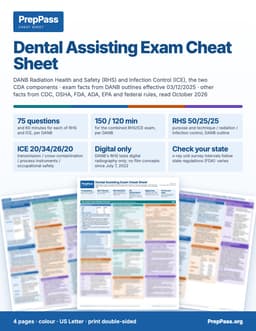
Exam inside two weeks?
This guide is the teaching, read over weeks. If your exam is inside two weeks, the printable colour cheat sheet is the other product: the figures the exam turns on, laid out by section.
See the Dental Assisting cheat sheet PDF — $9.99 →
4 pages · US Letter · printable PDF · yours to keep
What's included — and what isn't
Included
- Infection control: sterilization, spore testing, Spaulding, waterlines
- OSHA Bloodborne Pathogens & Hazard Communication essentials
Not included
- No printed copy is shipped — this is a file you download and can print yourself
- No video course, instructor or tutoring comes with the book — the free videos on the site are separate
Everything included, and everything that isn't
Included
- Radiation safety: ALARA, dose limits, apron/collar, film speed, collimation
- Radiographic technique and common image errors
- Scope of practice flagged as state-set throughout (not a universal list)
- 55 practice questions with answer explanations · PDF + EPUB
Not included
- Not your exam registration or the testing centre's fee, which you still pay to the official body
Contents
See 1 sections and the page each one starts on
- Part II — Full Practice Examp. 47
Taken from the PDF you download, with the page each one starts on — not typed here.
Read a chapter free, in full
One complete chapter, exactly as it ships in the eBook. Scroll the window to read it right here; no download, no email.
Read chapter 1 here, without leaving the page
Introduction
Infection control is the heart of the ICE exam and about a third of the RHS/ICE material overall, and it is built on one idea you can carry through every question: disease spreads along a chain, and your entire job is to break a link in that chain. Almost everything in this chapter — why you glove, why instruments run dirty-to-clean, why a spore test matters, why the employer must offer you a hepatitis B vaccine — is a specific way of removing one link so that a microorganism cannot travel from a reservoir to a susceptible host. Learn the chain first, and the rest of the chapter stops being a pile of rules and becomes a set of moves against a single target.
The reason infection control is weighted so heavily is that a dental operatory is an unusually efficient place to move microorganisms. Handpieces and ultrasonic scalers generate aerosols and spatter, instruments are sharp and blood-contaminated, and the same surfaces are touched by gloved hands all day. The federal government treats this as an occupational-safety problem serious enough to regulate directly, which is why so much of this chapter is not merely good practice but law — the OSHA Bloodborne Pathogens Standard at 29 CFR 1910.1030 — layered on top of the CDC's clinical recommendations. When a question asks what you should do, it is usually asking what the CDC recommends; when it asks what the office must do, it is usually asking what OSHA requires.
The chain of infection and standard precautions
Disease transmission requires six links, all present at once: an infectious agent, a reservoir where it lives, a portal of exit from that reservoir, a mode of transmission, a portal of entry into the next host, and a susceptible host. Remove any single link and the chain breaks. Sterilizing an instrument removes the agent; a mask covers a portal of entry; hepatitis B vaccination removes host susceptibility. Every control in this chapter maps to one of those six links.
Because you can never be certain which patient carries a bloodborne pathogen — many carriers are asymptomatic and unaware — dentistry applies standard precautions: treat the blood, saliva, and every other body fluid (except sweat) of every patient as potentially infectious, regardless of diagnosis or appearance. This is the single most important concept in the chapter, because it converts "protect yourself from sick patients" into "protect yourself and every patient, all the time." In dentistry the routes you are guarding against are direct contact with blood or saliva, indirect contact through contaminated instruments and surfaces, droplet spatter to the eyes, nose, or mouth, and inhalation of aerosols from handpieces and scalers.
OSHA turns standard precautions into a written obligation. Every practice must keep a written exposure control plan, review and update it at least annually and whenever new tasks or safer devices change exposure, and make it available to employees.
Key numbers & facts — the chain and standard precautions - Six links of the chain: agent → reservoir → portal of exit → mode of transmission → portal of entry → susceptible host. Break one, stop transmission. - Standard precautions: every patient, every fluid except sweat, treated as infectious — no exceptions for a clean history. - Four transmission routes in dentistry: direct contact, indirect contact, droplet spatter, aerosol inhalation. - Written exposure control plan: required by OSHA 29 CFR 1910.1030; reviewed at least annually and when tasks/devices change. - Bloodborne pathogens training: at initial assignment and at least annually, during work hours, at no cost.
Worked example — reason from the chain. A question tells you that an instrument was sterilized, the assistant wore a mask and eyewear, and the patient was vaccinated against hepatitis B, then asks which link of the chain each control removed. Sterilization eliminated the infectious agent; the mask and eyewear blocked portals of entry; the vaccine removed host susceptibility. If an answer choice claims a control removed the "reservoir," check it against the definition — the reservoir is where the agent lives (a person, water, a surface), and none of those three controls touched a reservoir. Reading the scenario as links rather than as a list is the fastest way to the answer.
Common traps in this section
- "The patient's history is negative, so I can relax." Standard precautions do not bend for a clean history or a healthy appearance; that is the whole point of the word standard.
- Sweat. Standard precautions cover all body fluids except sweat — a favorite distractor.
- "Should" versus "must." CDC recommends; OSHA requires. When a question stresses a legal obligation of the employer, the answer is usually the OSHA rule.
Hand hygiene and personal protective equipment
Hand hygiene is the single most effective way to prevent transmission in any clinical setting, and the exam tests two things about it: when to do it and which method to use. Perform hand hygiene before and after every patient, before donning and after removing gloves, and any time hands are visibly soiled. The method depends on soil: wash with soap and running water when hands are visibly soiled or contaminated with blood; otherwise an alcohol-based hand rub is acceptable and generally lowers bacterial counts more effectively. The one you must not mix up is the surgical case: before an oral surgical procedure, perform surgical hand antisepsis — an antimicrobial soap scrub or a surgical alcohol preparation with persistent (residual) activity — covering hands and forearms.
Personal protective equipment adds a barrier, and the order you put it on and take it off decides whether contamination reaches your skin. Don in the order gown → mask → eyewear → gloves, so gloves go on last and cover the gown cuffs. Remove in the order gloves → eyewear → gown → mask, with hand hygiene immediately after; the mask comes off last because its ties are considered clean. OSHA makes PPE the employer's financial responsibility: the employer must provide, launder, repair, replace, and dispose of all required PPE at no cost to the employee, and contaminated clothing may never be taken home.
Key numbers & facts — hand hygiene and PPE - Visibly soiled or bloody hands → soap and water. Not visibly soiled → alcohol rub is fine. - Surgical procedure → surgical hand antisepsis (antimicrobial soap or alcohol with persistent activity), hands and forearms. - Donning order: gown → mask → eyewear → gloves last. - Removal order: gloves → eyewear → gown → mask last (ties are clean), then hand hygiene. - Employer pays for all PPE and laundering; contaminated PPE never goes home (OSHA 29 CFR 1910.1030).
Worked example — pick the method. An assistant has just degloved after a routine restoration and her hands are visibly smeared with saliva; the next step is another patient. Soap and water or alcohol rub? Because the hands are visibly soiled, the answer is soap and running water — alcohol rubs do not remove organic material and lose effectiveness in its presence. Change one detail — hands not visibly soiled between two glove changes — and the alcohol rub becomes acceptable. The exam lives on that single distinction.
Common traps in this section
- Alcohol rub on visibly soiled hands. Wrong every time — soap and water is required when soil or blood is visible.
- Reversing the removal order. Gloves off first (they are dirtiest), mask off last (ties are clean).
- Routine wash for surgery. A surgical procedure demands surgical antisepsis with persistent activity, not a 15-second plain-soap wash.
- "The assistant should buy her own gloves." No — the employer must supply and launder all PPE at no cost.
The instrument-processing workflow
Contaminated instruments move through the processing area in one direction, dirty to clean, so a processed item is never re-contaminated. The workflow has five steps, and the exam tests both their order and the safety rule attached to each:
- Holding. If instruments cannot be cleaned right away, place them in a holding solution or a covered container of detergent or enzymatic cleaner. The purpose is narrow but important: keep blood and debris moist so they do not dry and harden onto the instruments, which would make cleaning far harder. A holding solution does not clean, disinfect, or sterilize.
- Cleaning. Remove all bioburden with an ultrasonic cleaner or an instrument washer, not by hand scrubbing — because mechanical cleaning sharply reduces the risk of a puncture injury from handling contaminated sharps. Cleaning must precede sterilization, because debris shields microorganisms from the sterilant.
- Packaging. Dry, inspect, and wrap or pouch instruments in packaging cleared for the sterilizer being used, with an external process indicator on each package.
- Sterilization. Load packages loosely so steam or vapor reaches every surface; run the full manufacturer's cycle; let packages dry before handling.
- Storage. Store sterilized packages in a clean, dry, closed cabinet away from sinks and traffic. A package stays sterile until it is opened, torn, wet, or dropped — sterility is event-related, not time-related.
Heavy-duty utility gloves, a mask, eyewear, and a gown are worn for every step through packaging. Physically, the area is divided into contaminated receiving, preparation and packaging, sterilization, and clean storage, and you always work from the contaminated end toward the clean end.
Key numbers & facts — instrument processing - One-way flow: contaminated receiving → cleaning → prep/packaging → sterilization → clean storage. Never backward. - Holding solution keeps debris moist; it does not clean, disinfect, or sterilize. - Clean before you sterilize — bioburden shields microbes from the sterilant. - Mechanical cleaning (ultrasonic/washer) preferred over hand scrubbing to cut puncture-injury risk. - Heavy-duty utility gloves for processing — not thin exam gloves, not sterile surgical gloves. - A package is sterile until opened, torn, wet, or dropped (event-related sterility).
Worked example — order the steps. A question lists four steps out of order: package, clean, sterilize, hold. The correct sequence is hold → clean → package → sterilize (then store). If an answer choice puts package before clean, it is wrong no matter what else it gets right, because packaging a debris-covered instrument seals contamination inside where the sterilant cannot reach it. Reason it as "you cannot wrap what you have not cleaned," and the trap answers fall away.
Common traps in this section
- Packaging before cleaning. The most common ordering trap — cleaning always comes first.
- "The holding solution disinfects." It only keeps debris moist.
- Wrong gloves. Instrument processing uses puncture-resistant utility gloves, not exam or surgical gloves.
- "The package expired, so it is no longer sterile." Dental sterility is event-related — a package is compromised by being opened, torn, wet, or dropped, not by a date alone.
Sterilization, disinfection, and monitoring
The distinction the exam returns to again and again is sterilization versus disinfection. Sterilization destroys all microorganisms, including bacterial spores; disinfection reduces microorganisms but does not reliably kill spores. Which one an item needs comes from the Spaulding classification: critical items that penetrate soft tissue or bone (scalpels, chisels, surgical burs) and semicritical items that contact mucous membranes but do not penetrate (mirrors, impression trays) must be heat sterilized; noncritical items that touch only intact skin (a blood-pressure cuff) need only intermediate- or low-level disinfection.
Heat is the workhorse. The steam autoclave is the most common dental method: a typical cycle runs about 250°F (121°C) at 15 psi for roughly 15 to 30 minutes, or about 132°C at higher pressure for a shorter cycle. Pressure is what lets steam climb above boiling so it can kill spores — boiling water at 212°F does not sterilize. Steam can dull or rust non-stainless items, so two alternatives exist: unsaturated chemical vapor sterilizers (heat an alcohol-formaldehyde solution under pressure; do not rust instruments, but need ventilation) and dry heat (about 320°F/160°C for one to two hours; gentle on sharp cutting edges and on carbon steel that would rust in steam).
Monitoring proves the process actually worked, and it comes in three kinds that are easy to confuse:
- Mechanical monitoring — reading the sterilizer's own gauges or printout every cycle.
- Chemical indicators — heat-sensitive tape or strips, placed inside and outside packages, that change color when exposed to the process.
- Biological monitoring (spore testing) — the only method that verifies spores were killed, run at least weekly and with every load containing an implantable device. Steam and chemical-vapor sterilizers are challenged with Geobacillus stearothermophilus spores; dry heat and ethylene oxide use Bacillus atrophaeus.
The trap that mechanical and chemical monitors set is that a color change or a normal gauge reading confirms the package was exposed to conditions, not that sterilization was achieved. Only the spore test does that. And when a spore test fails, the response is specific: take the sterilizer out of service, recall and reprocess items back to the last negative test, find and correct the cause, and do not use the unit until it passes.
Key numbers & facts — sterilization and monitoring - Steam autoclave: ~250°F (121°C), 15 psi, 15–30 min (or ~132°C, higher psi, shorter). Pressure raises steam above boiling. - Dry heat: ~320°F (160°C) for 1–2 hours — for carbon steel and sharp edges that rust in steam. - Chemical vapor: alcohol-formaldehyde under pressure; does not rust; needs ventilation. - Spore (biological) test: at least WEEKLY, plus every implantable-device load — the only proof of sterility. - Spore organism: Geobacillus stearothermophilus (steam & chemical vapor). - Critical/semicritical → heat sterilize. Noncritical → disinfect (Spaulding). - Failed spore test: unit out of service → recall to last negative test → fix cause → re-test before reuse.
Worked example — the color-change tell. An assistant sees the tape on a pouch has changed color and tells you the instruments are sterile. Is she right? No. External chemical indicator tape responds to a single parameter (usually heat) and only distinguishes a processed package from an unprocessed one; it does not confirm that time, temperature, and pressure all combined to kill spores. The only statement that proves sterility is "the weekly spore test was negative." On the exam, "the tape turned, so it is sterile" is a wrong answer nearly every time.
Common traps in this section
- Chemical indicator = sterile. No — it means exposed to the process, not sterile. Only a spore test proves sterility.
- Spore-test frequency. It is weekly (plus implant loads), not monthly, not annually, not "only after repair."
- Boiling = sterilizing. Boiling water (212°F, no pressure) does not sterilize; you need pressurized steam or dry heat.
- Sterilization vs disinfection. Anything that penetrates tissue or touches mucosa is sterilized; disinfection is for surfaces and skin-contact items.
- Wrong sterilizer for the metal. Carbon-steel cutting edges that rust in steam go to dry heat or chemical vapor.
Questions buyers ask
How do I get it?
Pay, and the download appears on this page straight away. The links are also emailed to you. No account is required.
What if it isn't for me?
Email us within 14 days for a full refund, no questions asked.
Is the free practice going away?
No. Every practice question, the timed mock and the free chapters on this site stay free. This book is the studying half, not a gate around the free half.
More questions (15)
Can I read it on my phone?
Yes — the EPUB is for phones and e-readers, the PDF is for printing and tabbing. You get both.
Is a study guide enough for the Dental Assisting (Radiation & Infection Control) exam, or do I need a course?
A book is exam review: it does not replace any education, training or experience Dental Assisting National Board, Inc. (DANB) requires before you may sit the exam, so check those requirements first. For the exam content itself, this 70-page guide teaches the material chapter by chapter with 55 practice questions and explanations inside, and 300 more practice questions are free on PrepPass. A prep course adds live instruction and a set schedule; whether you need one beyond any required education is your call.
What is the cheapest way to prepare for the Dental Assisting (Radiation & Infection Control) exam?
Start with what costs nothing: 300 practice questions on PrepPass, with explanations and no signup. If you want it taught in one file you keep, the full study guide is $14.99 once; the printable cheat sheet for the last days is $9.99. No subscription on any of them.
Who administers the DANB Radiation Health and Safety (RHS®) and Infection Control (ICE®) Exams?
Dental Assisting National Board, Inc. (DANB) — exam delivered by Pearson VUE. DANB states its exams are delivered by Pearson VUE. RHS and ICE are two separate DANB exams: each can be taken on its own, in person at a Pearson VUE test center or through online remote proctoring, or the two can be taken together as the combined RHS/ICE exam, for which DANB lists test-center delivery only.
How many questions are on the DANB Radiation Health and Safety (RHS®) and Infection Control (ICE®) Exams?
75 questions. Per exam: DANB lists 75 multiple-choice questions for RHS and 75 for ICE, so a candidate who needs both answers 150 in total — the figure DANB lists for the combined RHS/ICE exam. DANB states a small number of unscored pretest questions may appear on each exam; it does not say how many, so no scored count is given here.
How long is the DANB Radiation Health and Safety (RHS®) and Infection Control (ICE®) Exams?
60 minutes. Per exam: 60 minutes for RHS and 60 minutes for ICE. Taken together as the combined RHS/ICE exam, DANB lists 120 minutes.
What is the passing score for the DANB Radiation Health and Safety (RHS®) and Infection Control (ICE®) Exams?
Scaled score of 400 on a 100–900 scale. The same rule for each exam, stated in both the RHS and the ICE outline: a scaled score of 400 or higher, on a scale of 100 to 900. DANB is explicit that the scaled score is neither a number correct nor a percent correct: the exams are computer-adaptive and scored on the difficulty of the questions answered correctly, and DANB says the average candidate answers around half the questions correctly. PrepPass states no percentage for this exam.
How much does the DANB Radiation Health and Safety (RHS®) and Infection Control (ICE®) Exams cost?
$270 — RHS exam (taken on its own) (DANB, per attempt); $270 — ICE exam (taken on its own) (DANB, per attempt); $375 — Combined RHS/ICE exam (both in one appointment) (DANB, per attempt). DANB's Candidate Handbook states there is no limit on retakes of a failed exam, but each retake means reapplying and paying the full exam fee. Refunds are reduced by DANB's processing and cancellation fees, which are listed in the handbook. Whatever a state charges for its own dental-assisting permit or registration is set by that state, not by DANB.
What languages is the DANB Radiation Health and Safety (RHS®) and Infection Control (ICE®) Exams offered in?
English · Spanish. DANB's RHS, ICE and combined RHS/ICE pages each say: “This exam is also offered in Spanish.” DANB separately lists Oregon state exams in Spanish and Vietnamese; those are Oregon's own exams, not RHS or ICE.
Does the Dental Assisting (Radiation & Infection Control) study guide come as a PDF?
Yes — Dental Assisting: Radiation Safety & Infection Control — Study Guide (2026) downloads as PDF and EPUB, 70 pages. The download link is emailed the moment payment clears and does not expire.
How much does the Dental Assisting (Radiation & Infection Control) study guide cost?
$14.99, once. There is no subscription and no account to create; the PDF and EPUB files are yours to keep.
Are there free Dental Assisting (Radiation & Infection Control) practice questions?
Yes — 300 of them, free to use with no signup and an explanation on every one. They are separate from this study guide, which is what you are buying here. The same free, no-account system also has practice modes (adaptive, new questions, spaced review of misses, weak-topic focus, saved, my mistakes); a timed mock exam (100 questions, 75 minutes) with a score report by topic; a 10-question readiness check (about 5 minutes); 4 study chapters. None of it needs this study guide.
Can I read part of the Dental Assisting (Radiation & Infection Control) study guide before buying?
Yes. A full chapter is free to read on this page — not a summary of one, the chapter itself.
What is the difference between the Dental Assisting (Radiation & Infection Control) study guide and the cheat sheet?
The study guide ($14.99) teaches the material chapter by chapter and is meant to be read over weeks. The cheat sheet ($9.99, 4 pages) drops the teaching and keeps the figures: every number on the exam grouped by value so the confusable ones sit together, each reference page paired with a recall page that blanks the answers, and four routes by days left — 14, 7, 3, or tonight. They are separate purchases; neither replaces the other.
Is this the official Dental Assisting (Radiation & Infection Control) study guide?
No. This is an independent study guide and is not affiliated with or endorsed by the exam's awarding body. It is written from CDC dental infection-control guidelines / OSHA 1910.1030 & 1910.1200 / NCRP / FDA-ADA. Always confirm current requirements with the body that issues your licence.
Why buy the book when the practice is free?
Our practice questions and timed mock stay free — nothing on the site moves behind this book. The $14.99 book is the studying half: the material itself, taught in order, in a file you own.
- Systematic teaching — every exam section explained chapter by chapter, start to finish, not just questions
- Print it & tab it — a paper-ready PDF you can highlight, mark up, and bring to your study table
- Study anywhere, offline — EPUB on your phone or e-reader; no wifi, no browser tabs
- Everything in one place — the chapters and the practice questions in one file
- Yours for life — one-time $14.99, instant download, no subscription
The details
- Verified from the official source(CDC dental infection-control guidelines / OSHA 1910.1030 & 1910.1200 / NCRP / FDA-ADA)
- 300 free practice questions
A dental assisting RHS course runs $200–$800. This book teaches the same exam — same rules, verified to current standards — for a one-time $14.99 you keep for life.
Also free on PrepPass for Dental Assisting (Radiation & Infection Control)
Beside this guide, PrepPass has a free study system for the same exam. It needs no account, and buying the guide does not unlock or change it: 300 practice questions with explanations; practice modes (adaptive, new questions, spaced review of misses, weak-topic focus, saved, my mistakes); a timed mock exam (100 questions, 75 minutes) with a score report by topic; a 10-question readiness check (about 5 minutes); 4 study chapters.
Progress is saved in your browser; a free account keeps it across devices. The readiness gauge reflects your own practice, not a prediction of the real exam result. How the practice works
One-time purchase, lifetime access to the download. The eBook is the full Dental Assisting (Radiation & Infection Control) study guide in PDF and EPUB. Educational summary, not professional or legal advice — always confirm the current rules with the official source. Last updated: October 2026.