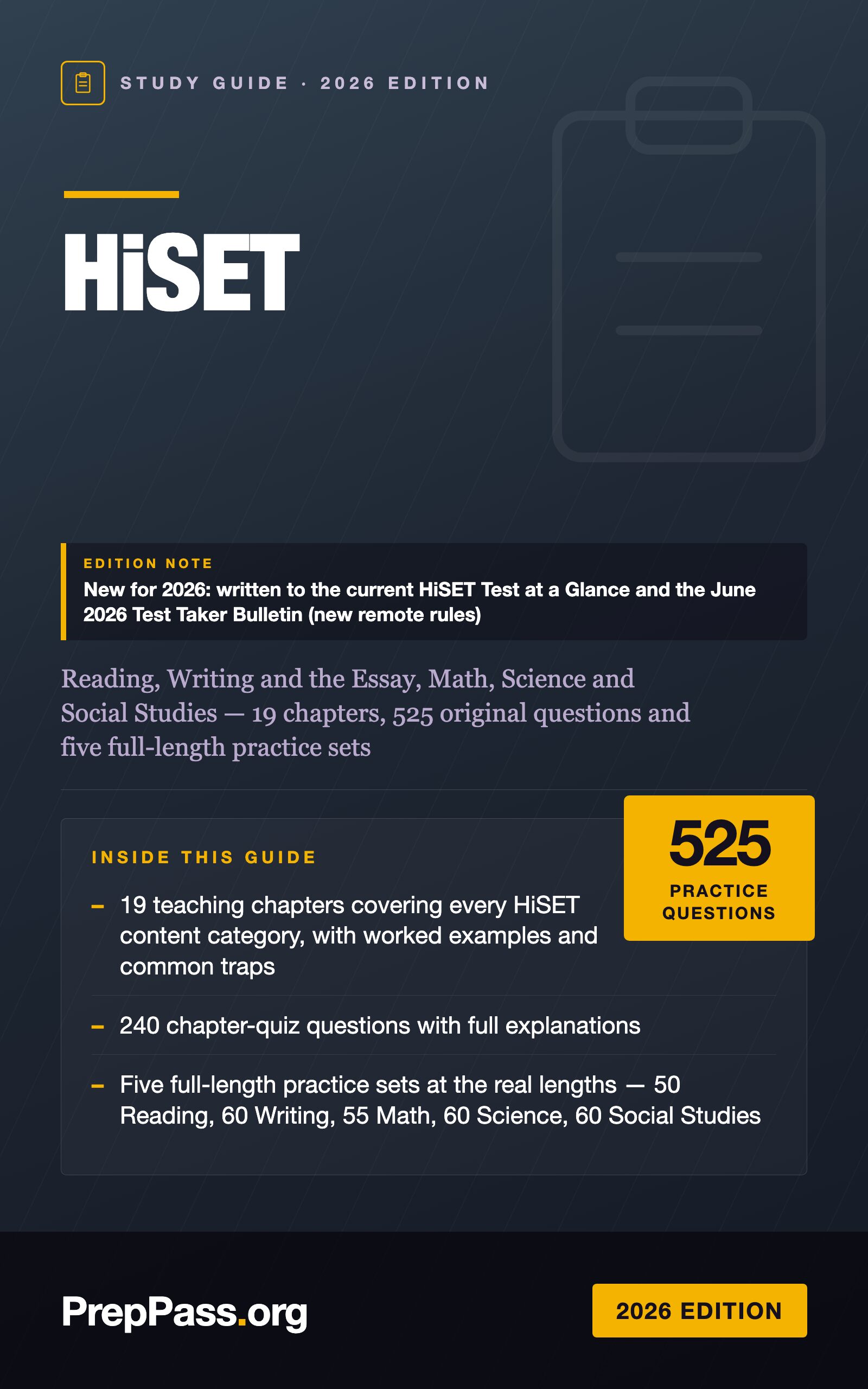
HiSET (High School Equivalency Test) · 2026 Edition
HiSET Study Guide — 2026 Edition
Edition noteNew for 2026: written to the current HiSET Test at a Glance and the June 2026 Test Taker Bulletin (new remote rules)
Reading, Writing and the Essay, Math, Science and Social Studies — 19 chapters, 525 original questions and five full-length practice sets
- 525 original HiSET practice questions, each with a worked explanation, in one PDF + EPUB you keep
PDF + EPUB · English · 377 pages · $19.99 one-time
This book is written in English.
Instant download after payment — no account needed, no subscription.
14-day money-back guarantee: not satisfied for any reason? Email support@preppass.org within 14 days of purchase for a full refund. Refund policy
Look inside the book
Three real pages, rendered straight from the PDF you download — a reference page, a teaching page, and a worked question, always in that order. Nothing here was redrawn to look better.
- Quick referenceAppendix D — Test-day checklist Before test day · PDF page 363
A page you can turn back to: the numbers, deadlines or terms gathered in one place.
- How it's taughtChapter 1 — Reading Literary Texts · PDF page 27
An explanation page: the material taught in prose, in the order the exam tests it.
- A question, workedChapter 1 — Reading Literary Texts · PDF page 20
A practice question with its answer and the reasoning behind it — not just a key.
About the HiSET exam
Adults and young people without a high school diploma who plan to earn a state high school equivalency credential through the HiSET. This independent guide teaches all five subtests with quizzes and full-length practice sets. It is not affiliated with PSI or any state, offers no online practice, and state requirements vary.
Outline changes: The current Test at a Glance adds three Writing process categories that the 2022 edition did not list, while question counts, time limits and content percentages are unchanged. The 2026 Test Taker Bulletin (June 1, 2026) tells remote-proctored test takers to be prepared to set up a second camera using a smartphone.
| Awarding body | The state or territory where you test awards the high school equivalency credential; PSI Services LLC owns and delivers the HiSET exam |
|---|---|
| Questions | Five subtests: Reading 50 multiple-choice questions; Writing 60 multiple-choice questions and 1 essay; Mathematics 55; Science 60; Social Studies 60. Each subtest may contain some questions that do not count toward the score. |
| Time limit | Reading 65 minutes (80 in Spanish); Writing 120 minutes; Mathematics 90 minutes; Science 80 minutes; Social Studies 70 minutes. Taking all five in one day is 7.5 hours of testing. |
| Passing rule | Each subtest is scored 1–20. To pass the battery: at least 8 on each of the five subtests, at least 2 out of 6 on the Writing essay, and a combined score of at least 45. |
| Fees | Test costs vary by state or territory and test site; no single national fee is published. Fees include two free retests within 12 months of the original subtest purchase date. |
| Delivery | Options vary by state: in person at a test center or online with a remote proctor, on computer or paper. Remote-proctored tests require a second camera using a smartphone. |
| Eligibility | Set by each state or jurisdiction — for example minimum age, residency, or a preparation course. U.S. citizenship is not required. |
| Retakes | Two free retests within a 12-month period of the original subtest purchase date; wait at least 24 hours after an unsuccessful attempt to reschedule. State retest rules may vary. |
| Languages | English or Spanish, depending on state options; Reading allows 80 minutes in Spanish. |
| Content outline | HiSET Test at a Glance (TAAG), Copyright 2025 edition, as posted on hiset.org (retrieved 2026-09-24); read with the Test Taker Bulletin 2026, version 2.0 (2026-06-01) |
| Domains |
|
Questions buyers ask
- How many questions are on the HiSET and how long is it?
- The HiSET has five subtests: Reading (50 questions, 65 minutes), Writing (60 multiple-choice questions plus an essay, 120 minutes), Mathematics (55, 90 minutes), Science (60, 80 minutes) and Social Studies (60, 70 minutes). You can take them in any order; all five in one day is 7.5 hours.
- What score do you need to pass the HiSET?
- You need at least 8 out of 20 on each of the five subtests, at least 2 out of 6 on the Writing essay, and a combined score of at least 45. Your state may add requirements of its own for the credential.
- What content does each HiSET subtest cover, and how is it weighted?
- The Test at a Glance gives approximate shares: Reading is 40% literary and 60% informational texts; Writing is 22% Organization of Ideas, 43% Language Facility and 35% Writing Conventions; Mathematics is 45% Algebraic Concepts; Science is 49% Life Science; Social Studies is 35% History and 35% Civics.
- Which edition of the HiSET content outline is current?
- The current edition is the Test at a Glance posted on hiset.org with a 2025 copyright. Compared with the 2022 edition, it adds three Writing process categories; question counts, times and content percentages are unchanged.
- Who is eligible to take the HiSET?
- Eligibility is set by each state or jurisdiction, which may require a minimum age, residency, or a preparation course. U.S. citizenship is not required. Some states let out-of-state test takers sit the exam.
- How much does the HiSET cost, and can I retake a subtest?
- Fees vary by state or territory and test site. The fee includes two free retests within 12 months of your original subtest purchase date, and you must wait at least 24 hours after an unsuccessful attempt before rescheduling.
- How is this HiSET study guide organized?
- It has nineteen teaching chapters covering every content category, a quiz after each chapter, and five full-length practice sets at the real subtest lengths, 285 questions in all plus an essay prompt. Every one of the 525 questions has an explanation.
- What changed on the HiSET in 2026?
- The Test Taker Bulletin was reissued as version 2.0 on June 1, 2026, and it tells remote-proctored test takers to be prepared to use a smartphone as a second camera and a whiteboard instead of scratch paper. The subtests' question counts and times did not change.
- Is a study guide enough for the HiSET (High School Equivalency Test) exam, or do I need a course?
- Check eligibility first — per The state or territory where you test awards the high school equivalency credential; PSI Services LLC owns and delivers the HiSET exam: set by each state or jurisdiction — for example minimum age, residency, or a preparation course. U.S. citizenship is not required. A book does not replace those requirements. For the exam content itself, this 377-page guide teaches the material chapter by chapter with 525 practice questions and explanations inside. A prep course adds live instruction and a set schedule; whether you need one beyond any required education is your call.
- Does the HiSET (High School Equivalency Test) study guide come as a PDF?
- Yes — HiSET Study Guide — 2026 Edition downloads as PDF and EPUB, 377 pages. The download link is emailed the moment payment clears and does not expire.
- How much does the HiSET (High School Equivalency Test) study guide cost?
- $19.99, once. There is no subscription and no account to create; the PDF and EPUB files are yours to keep.
- Can I read part of the HiSET (High School Equivalency Test) study guide before buying?
- Yes. A full chapter is free to read on this page — not a summary of one, the chapter itself.
- Is this the official HiSET (High School Equivalency Test) study guide?
- No. This is an independent study guide and is not affiliated with or endorsed by the exam's awarding body. It is written from HiSET Test at a Glance (PSI, © 2025) and Test Taker Bulletin 2026 v2.0 (June 1, 2026), hiset.org, read September 24, 2026. Always confirm current requirements with the body that issues your licence.
What's included — and what isn't
Included
- 19 teaching chapters covering every HiSET content category, with worked examples and common traps
- 240 chapter-quiz questions with full explanations
- Five full-length practice sets at the real lengths — 50 Reading, 60 Writing, 55 Math, 60 Science, 60 Social Studies
- An original two-passage essay prompt with a scoring checklist built on the official rubric's criteria
- A "What's new for 2026" page: the June 2026 bulletin's remote-testing rules and the revised Test at a Glance
- PDF + EPUB you keep
Not included
- No printed copy is shipped — this is a file you download and can print yourself
- No video course, instructor, tutoring or online question bank comes with the book — everything is in the file
- Not your exam registration or the testing centre's fee, which you still pay to the official body
Contents
See 29 sections and the page each one starts on
- Part 1 — Language Arts – Readingp. 12
- Chapter 1 — Reading Literary Textsp. 14
- Chapter 2 — Reading Informational Textsp. 29
- Part 2 — Language Arts – Writingp. 44
- Chapter 3 — Organization of Ideasp. 46
- Chapter 4 — Language Facilityp. 56
- Chapter 5 — Writing Conventions Writing Conventions is 35 percent of the Writing multiple-choicep. 70
- Chapter 6 — The HiSET Essayp. 85
- Part 3 — Mathematicsp. 97
- Chapter 7 — Number and Operations on Numbersp. 99
- Chapter 8 — Measurement and Geometryp. 109
- Chapter 9 — Data Analysis, Probability and Statisticsp. 120
- Chapter 10 — Algebraic Concepts, Part 1: Expressions, Equations and Inequalitiesp. 130
- Chapter 11 — Algebraic Concepts, Part 2: Functions, Graphs and Quadraticsp. 141
- Part 4 — Science The Science subtest has 60 multiple-choice questions and an 80-minutep. 152
- Chapter 12 — Life Science, Part 1: Organisms and Ecosystemsp. 154
- Chapter 13 — Life Science, Part 2: Cells, the Human Body and Heredityp. 164
- Chapter 14 — Physical Sciencep. 175
- Chapter 15 — Earth and Space Sciencep. 187
- Part 5 — Social Studiesp. 197
- Chapter 16 — Historyp. 199
- Chapter 17 — Civics and Governmentp. 210
- Chapter 18 — Economicsp. 220
- Chapter 19 — Geographyp. 229
- Part 6 — Full-Length Practice Setsp. 237
- Appendix A — The exam at a glance, in one tablep. 351
- Appendix B — Terms the HiSET expects you to know Readingp. 353
- Appendix C — Mathematics quick referencep. 356
- Appendix D — Test-day checklist Before test dayp. 358
Taken from the PDF you download, with the page each one starts on — not typed here.
Read a chapter free, in full
One complete chapter, exactly as it ships in the eBook. Scroll the window to read it right here; no download, no email.
Read chapter 7 here, without leaving the page
We didn't give you the easy intro — the free chapter opens on one of the hardest-working parts of the book, so you can judge the teaching where the exam gets difficult.
This category is about 19 percent of the Mathematics subtest[1]. Its descriptors cover properties of real numbers, radicals and exponents, scientific notation, reasoning with units, choosing an appropriate level of accuracy, and multistep problems with rational numbers — "money, rate, percentage, average, estimation/rounding" among the settings[2]. Much of the rest of the test is built on these skills.
7.1 The real numbers
- Integers: …, −2, −1, 0, 1, 2, …
- Rational numbers: any number that can be written as a fraction of two integers — including all integers, terminating decimals (0.75 = 3/4) and repeating decimals (0.333… = 1/3).
- Irrational numbers: numbers whose decimals never end or repeat, such as √2, √7 and π. The square root of any whole number that is not a perfect square is irrational.
Useful facts the test checks:
- rational + rational = rational; rational × rational = rational.
- A nonzero rational number times an irrational number is irrational (3 × √2 = 3√2).
- An irrational plus an irrational can be rational: √2 + (−√2) = 0.
- To place √20 on a number line: 4² = 16 and 5² = 25, so √20 is between 4 and 5, a little closer to 4 (4.47…).
Order of operations: parentheses, exponents, multiplication and division from left to right, addition and subtraction from left to right. 8 − 2 × 3 = 8 − 6 = 2, not 18.
Negative numbers: subtracting a negative adds (5 − (−3) = 8); a negative times a negative is positive; an even power of a negative is positive ((−2)⁴ = 16), an odd power is negative ((−2)³ = −8). Watch −2⁴: the exponent applies before the minus sign, so it equals −16.
7.2 Fractions, decimals and percents
These are three ways to write the same quantity. Convert freely:
| Fraction | Decimal | Percent |
|---|---|---|
| 1/2 | 0.5 | 50% |
| 1/4 | 0.25 | 25% |
| 3/4 | 0.75 | 75% |
| 1/5 | 0.2 | 20% |
| 1/8 | 0.125 | 12.5% |
| 1/3 | 0.333… | 33⅓% |
- Adding fractions: common denominator first. 2/3 + 1/4 = 8/12 + 3/12 = 11/12.
- Multiplying: multiply straight across. 2/3 × 3/5 = 6/15 = 2/5.
- Dividing: multiply by the reciprocal. 3/4 ÷ 1/2 = 3/4 × 2 = 3/2.
7.3 Percent and percent change
Most percent problems are one of three questions: What is 15% of 80? (0.15 × 80 = 12). 12 is what percent of 80? (12 ÷ 80 = 0.15 = 15%). 12 is 15% of what? (12 ÷ 0.15 = 80).
Percent change = (new − old) ÷ old × 100%. A price rising from $40 to $50 is a (10 ÷ 40) = 25% increase. Always divide by the old (starting) value. The Bureau of Labor Statistics explains the idea with its price index: "An index of 110, for example, means there has been a 10-percent increase in price since the reference period"[3]. It also shows why the starting value matters: two items with "the same change in index points" can have different percent changes, and the one with "the lower starting index value" has the greater percent change[3].
The multiplier shortcut. An aligned readiness standard in the Test at a Glance states it as an example: "a + 0.05a = 1.05a means that 'increase by 5%' is the same as 'multiply by 1.05'"[4]. So:
- increase by 20% → multiply by 1.20
- decrease by 20% → multiply by 0.80
- a 20% increase followed by a 20% decrease → 1.20 × 0.80 = 0.96, a 4% overall decrease, not zero.
Settings the test uses: sales tax, discounts and markups, tips, commissions, simple interest (I = Prt: principal × rate × time), and percent error.
7.4 Ratios, rates and proportions
A ratio compares quantities (3 cups of flour to 2 cups of water, 3:2). A rate is a ratio with different units ($12 per hour, 55 miles per hour). A unit rate has 1 in the denominator.
A proportion says two ratios are equal. Cross-multiply to solve: 3/2 = x/10 → 2x = 30 → x = 15.
Distance = rate × time is not on the formula sheet[1]. A car at 60 miles per hour for 2.5 hours goes 150 miles; to travel 210 miles at 60 mph takes 210 ÷ 60 = 3.5 hours.
Best-buy questions: compare unit prices. 24 ounces for $4.80 is $0.20 per ounce; 32 ounces for $6.08 is $0.19 per ounce, so the larger package is the better buy.
7.5 Exponents and radicals
| Rule | Example |
|---|---|
| aᵐ · aⁿ = aᵐ⁺ⁿ | x³ · x⁴ = x⁷ |
| aᵐ ÷ aⁿ = aᵐ⁻ⁿ | x⁷ ÷ x² = x⁵ |
| (aᵐ)ⁿ = aᵐⁿ | (x³)² = x⁶ |
| (ab)ⁿ = aⁿbⁿ | (2x)³ = 8x³ |
| a⁰ = 1 (a ≠ 0) | 7⁰ = 1 |
| a⁻ⁿ = 1/aⁿ | 2⁻³ = 1/8 |
| a^(1/n) = ⁿ√a | 27^(1/3) = 3 |
| a^(m/n) = (ⁿ√a)ᵐ | 8^(2/3) = 2² = 4 |
The Test at a Glance's own example is "an equivalent expression to the cube root of 27x⁵y⁶"[2] — a descriptor in this category. Work it: ∛27 = 3; ∛y⁶ = y²; ∛x⁵ = ∛(x³ · x²) = x∛(x²). So the cube root is 3xy²∛(x²).
Simplifying square roots: pull out perfect-square factors. √72 = √(36 × 2) = 6√2. √50 + √8 = 5√2 + 2√2 = 7√2.
7.6 Scientific notation
A number in scientific notation is written as a number from 1 up to (but not including) 10, times a power of 10: 4,500,000 = 4.5 × 10⁶; 0.00072 = 7.2 × 10⁻⁴. The Test at a Glance names adding, subtracting, multiplying and dividing numbers in this form[2].
- Multiply: multiply the front numbers, add the exponents. (3 × 10⁴)(2 × 10⁵) = 6 × 10⁹.
- Divide: divide the front numbers, subtract the exponents. (8 × 10⁹) ÷ (2 × 10³) = 4 × 10⁶.
- Adjust: (5 × 10³)(4 × 10²) = 20 × 10⁵ = 2 × 10⁶.
- Add or subtract: first rewrite with the same power of 10. 3 × 10⁵ + 4 × 10⁴ = 30 × 10⁴ + 4 × 10⁴ = 34 × 10⁴ = 3.4 × 10⁵.
The metric prefixes are powers of ten; NIST lists "kilo" as 1000 and "milli" as one-thousandth[5]. A kilometer is 10³ meters; a milligram is 10⁻³ grams.
7.7 Units and appropriate accuracy
Reasoning with units is its own descriptor: "Reason quantitatively and use units to solve problems," and "Choose a level of accuracy appropriate to limitations on measurement"[2].
Unit conversions. Multiply by a conversion fraction equal to 1, arranged so the unwanted unit cancels. 3.5 miles × (5,280 feet / 1 mile) = 18,480 feet. The formula sheet lists "1 mile= 5,280 feet"[6], "1 gallon= 4 quarts"[6], "1 pound= 16 ounces"[6] and "1 inch = 2.54 centimeters"[7], among others. Some conversions on it are approximate, marked with ≈ — for example 1 kilogram ≈ 2.2 pounds[6].
Appropriate accuracy. An answer should not claim more precision than the measurements behind it. If a board is measured to the nearest inch, reporting its area to a thousandth of a square inch is false precision. If a question asks how many buses are needed for 130 people with 48 seats each, 130 ÷ 48 = 2.7, and the answer is 3 buses — you round up because you cannot leave people behind. If it asks how many full boxes of 12 can be packed from 130 items, the answer is 10 — you round down.
7.8 Averages
The mean (average) is the sum of the values divided by how many there are[8]. Two useful twists:
- Missing value: four scores average 82. What fifth score makes the average 85? Total needed = 5 × 85 = 425; current total = 4 × 82 = 328; needed score = 97.
- Weighted average: 10 workers earn $15 an hour and 30 earn $19. Mean = (10 × 15 + 30 × 19) ÷ 40 = (150 + 570) ÷ 40 = $18. Not $17 — the larger group pulls the average toward $19.
Worked example
A store raises the price of a $60 jacket by 25%, then puts it on sale at 20% off the new price. What is the sale price?
Step 1. 60 × 1.25 = 75. Step 2. 75 × 0.80 = 60.
The sale price is $60 — the same as the original. The tempting answer is $63 (thinking +25% − 20% = +5%), but each percent applies to a different base.
Common traps in Number and Operations
- Dividing by the new value instead of the old one in percent change.
- Adding percents that apply to different bases.
- −2⁴ vs. (−2)⁴.
- Rounding down when the situation requires rounding up (buses, boxes to hold everything).
- Forgetting to convert units before computing.
- Choosing an intermediate result that appears among the options.
Key numbers — Chapter 7
- Number and Operations on Numbers: about 19 percent of Mathematics[1].
- Mathematics: 55 questions in 90 minutes[1].
- Not on the formula sheet: d = rt, the Pythagorean theorem, the quadratic formula[1].
- Increase by p% = multiply by (1 + p/100)[4].
Key takeaways — Chapter 7
- Percent change divides by the starting value.
- Chain percent changes by multiplying the multipliers.
- Know the exponent rules, including negative and fractional exponents.
- In scientific notation, add exponents to multiply and subtract to divide; align powers of ten to add.
- Let the units guide the operation.
- Round to fit the situation, not the calculator.
Chapter 7 quiz
1. A gym raised its monthly fee from $32 to $40. By what percent did the fee increase?
- A. 8%
- B. 80%
- C. 25%
- D. 20%
2. Which expression is equivalent to (2 × 10⁵)(4 × 10³)?
- A. 6 × 10⁸
- B. 8 × 10²
- C. 8 × 10¹⁵
- D. 8 × 10⁸
3. Which of these numbers is irrational?
- A. 2/9
- B. 0.125
- C. √18
- D. √49
4. A recipe uses 3 cups of rice for every 5 cups of water. How many cups of water are needed for 12 cups of rice?
- A. 20
- B. 14
- C. 7.2
- D. 36
5. What is the value of 8 − 3 × (−2)²?
- A. 44
- B. 20
- C. 100
- D. −4
6. A charter company has 130 passengers and buses that each seat 48. What is the fewest number of buses it needs?
- A. 3
- B. 2
- C. 2.7
- D. 4
7. A jacket priced at $80 is marked down 25%, and then 8% sales tax is added to the sale price. What is the total cost?
- A. $60.00
- B. $64.80
- C. $86.40
- D. $66.40
8. Which expression is equivalent to √75?
- A. 25√3
- B. 3√5
- C. 15√5
- D. 5√3
9. Four test scores average 78. What must a fifth score be for the average of all five to be 80?
- A. 80
- B. 88
- C. 90
- D. 82
10. A trail is 2.5 miles long. How many feet long is it?
- A. 15,840 feet
- B. 13,200 feet
- C. 2,112 feet
- D. 6,336 feet
11. What is the value of 16^(3/2)?
- A. 64
- B. 24
- C. 48
- D. 4,096
12. A car travels 195 miles in 3 hours at a constant speed. At that speed, how long will it take to travel 325 miles?
- A. 5.5 hours
- B. 6 hours
- C. 5 hours
- D. 4 hours
Chapter 7 quiz — answers and explanations
1. C. Percent change is the change divided by the starting value: (40 − 32) ÷ 32 = 8 ÷ 32 = 0.25, or 25%. The tempting 20% comes from dividing by the new fee, 8 ÷ 40. The BLS explains percent change from a starting value — an index moving from 100 to 110 is "a 10-percent increase"[3].
2. D. Multiply the front numbers (2 × 4 = 8) and add the exponents (5 + 3 = 8). Multiplying the exponents gives the tempting 10¹⁵, which is the rule for a power raised to a power, not for a product. Operations in scientific notation are a named descriptor[2, 5].
3. C. 18 is not a perfect square, so √18 = 3√2 has a decimal that never ends or repeats. √49 is exactly 7, 0.125 is 1/8, and 2/9 is a fraction of integers, so all three are rational. The Test at a Glance names identifying rational and irrational numbers under this category[2].
4. A. Set up the proportion 3/5 = 12/x; cross-multiplying gives 3x = 60, so x = 20. The tempting 7.2 comes from flipping the ratio (12 × 3/5). Proportional relationships are listed among the multistep settings in this category[2].
5. D. Exponent first: (−2)² = 4. Then multiply: 3 × 4 = 12. Then subtract: 8 − 12 = −4. The tempting 20 comes from working left to right (8 − 3 = 5, then 5 × 4). Order of operations governs multistep numerical work in this category[2].
6. A. 130 ÷ 48 ≈ 2.7, and a fraction of a bus is impossible; 2 buses seat only 96, so 3 are needed. The tempting 2 comes from rounding to the nearest whole number instead of rounding up to fit the situation. Choosing accuracy appropriate to the situation is a named descriptor[2].
7. B. Sale price: 80 × 0.75 = 60. With tax: 60 × 1.08 = 64.80. The tempting $66.40 comes from adding the tax to the original price's 8% ($6.40) instead of taxing the sale price. The Test at a Glance's standard states that increasing by a percent is the same as multiplying by one plus that percent[4].
8. D. 75 = 25 × 3, and √25 = 5, so √75 = 5√3. The tempting 3√5 swaps the factors: (3√5)² = 45, not 75. Rewriting expressions with radicals is a named descriptor in this category[2].
9. B. The five scores must total 5 × 80 = 400; the four so far total 4 × 78 = 312; so the fifth must be 400 − 312 = 88. The tempting 82 raises 80 by the 2-point gap, ignoring that the new score must lift all four earlier scores. The mean is the sum of the values divided by their number[8].
10. B. 2.5 × 5,280 = 13,200 feet, using the formula sheet's "1 mile= 5,280 feet". The tempting 15,840 uses 3 miles instead of 2.5. Reasoning with units is a named descriptor[2, 6].
11. A. A fractional exponent means root first, then power: √16 = 4, and 4³ = 64. The tempting 24 multiplies 16 by 3/2. Rewriting rational exponents is a named descriptor[2].
12. C. Speed = 195 ÷ 3 = 65 miles per hour; time = 325 ÷ 65 = 5 hours. Distance = rate × time is one of the formulas the Test at a Glance says is not on the formula sheet, so it must be remembered[1].
Sources cited in this excerpt
- HiSET Test at a Glance — Mathematics. PSI Services LLC, 2025 (copyright year; retrieved 2026-09-24). https://hiset.org/wp-content/uploads/2025/05/taag.pdf
- HiSET Test at a Glance — Mathematics Content Category I. PSI Services LLC, 2025 (copyright year; retrieved 2026-09-24). https://hiset.org/wp-content/uploads/2025/05/taag.pdf
- Consumer Price Index: Questions and Answers (Internet Archive copy captured 2026-01-13). U.S. Bureau of Labor Statistics, captured 2026-01-13. http://web.archive.org/web/20260113062334id_/https://www.bls.gov/cpi/questions-and-answers.htm
- HiSET Test at a Glance — Mathematics, aligned College and Career Readiness Standard 7.EE.2. PSI Services LLC, 2025 (copyright year; retrieved 2026-09-24). https://hiset.org/wp-content/uploads/2025/05/taag.pdf
- Metric (SI) Prefixes. National Institute of Standards and Technology, Office of Weights and Measures, retrieved 2026-09-24. https://www.nist.gov/pml/owm/metric-si-prefixes
- HiSET Mathematics Formula Sheet. PSI Services LLC, retrieved 2026-09-24. https://hiset.org/wp-content/uploads/2025/05/hiset-mathematics-formula-sheet.pdf
- HiSET Mathematics Formula Sheet, as printed in Free Half-Length Practice Test FPT9 — Mathematics. PSI Services LLC, 2025 (released). https://hiset.org/wp-content/uploads/2025/11/hiset_fpt9_en_mathematics.pdf
- NIST/SEMATECH e-Handbook of Statistical Methods, 1.3.5.1 Measures of Location. National Institute of Standards and Technology, retrieved 2026-09-24. https://www.itl.nist.gov/div898/handbook/eda/section3/eda351.htm
Before you buy
- How do I get it?
- Pay, and the download appears on this page straight away. The links are also emailed to you. No account is required.
- What if it isn't for me?
- Email us within 14 days for a full refund, no questions asked.
- Is there online practice for this exam too?
- No. PrepPass has no online question bank for this exam; the book is self-contained. Its chapter quizzes and full-length practice exam, each question with a worked explanation, are all in the PDF and EPUB.
- Can I read it on my phone?
- Yes — the EPUB is for phones and e-readers, the PDF is for printing and tabbing. You get both.
The details
Reading, Writing and the Essay, Math, Science and Social Studies — 19 chapters, 525 original questions and five full-length practice sets
- Format: PDF + EPUB download · 377 pages
- 525 practice questions in the book, with a full answer key
- $19.99 one-time — no subscription
- 14-day money-back guarantee · refund policy
- Cross-referenced against: HiSET Test at a Glance (PSI, © 2025) and Test Taker Bulletin 2026 v2.0 (June 1, 2026), hiset.org, read September 24, 2026
- Verified from the official source(HiSET Test at a Glance (PSI, © 2025) and Test Taker Bulletin 2026 v2.0 (June 1, 2026), hiset.org, read September 24, 2026)
- Instant download, yours for life
What the book gives you
PrepPass has no online question bank for this exam, so the $19.99 book is complete in itself: the material taught in order, a quiz closing each chapter and a full-length practice exam, in a file you own.
- Systematic teaching — every exam section explained chapter by chapter, start to finish, not just questions
- Print it & tab it — a paper-ready PDF you can highlight, mark up, and bring to your study table
- Study anywhere, offline — EPUB on your phone or e-reader; no wifi, no browser tabs
- Everything in one place — the chapters and the practice questions in one file
- Yours for life — one-time $19.99, instant download, no subscription
And it's risk-free: 14-day money-back guarantee — not satisfied? Email us for a full refund, no questions asked. See the refund policy.
14-day money-back guarantee · full refund, no questions asked.
One-time purchase, lifetime access to the download. The eBook is the full HiSET (High School Equivalency Test) study guide in PDF and EPUB. Educational summary, not professional or legal advice — always confirm the current rules with the official source.