Study guide · 2026 Edition
Medical Billing & Coding (CBCS) — Complete Study Guide (2026)
PrepPass's independent 2026 study guide for the Medical Billing & Coding exam is 89 pages including 35 practice questions with a full answer key, PDF + EPUB, $14.99 one-time; it is not affiliated with the exam provider. The book does not include PrepPass's separate online timed mock for this exam (100 questions, 120 minutes).
- Length
- 89 pages
- Practice questions in the book
- 35
- PrepPass online timed mock
- 100 questions · 120 min
- Exam facts last checked
- September 2026
- File last updated
- October 2026
- Delivery
- PDF + EPUB · English · instant download
Please read before you buy: This is an independent study aid, not affiliated with or endorsed by any certifying body or the exam vendor.
Read the rest of this notice
It is authored from the ICD-10-CM Official Guidelines, CPT/HCPCS conventions, HIPAA, and CMS/NCCI rules, and reproduces no copyrighted code descriptions. It is educational information, NOT medical, legal, or billing-compliance advice — coding guidelines and payer rules change every year, so always verify against the current official guidelines, CMS, and your employer's compliance policies.
What is in the Medical Billing & Coding (CBCS) study guide?
The real exam: NHA Certified Billing and Coding Specialist (CBCS) Exam — 125 questions (100 scored, 25 unscored pretest) · 180 minutes · Passing score: Scaled score of 390 on a 200–500 scale.
The CBCS-style exam, taught from the ICD-10-CM/CPT/HCPCS conventions, HIPAA, and CMS rules — coding, claim forms, the revenue cycle, payer rules, Medicare appeals, and fraud & abuse law.
Exam facts, who it suits and what changed
About the exam itself
| Administering body | National Healthcareer Association (NHA) — exam delivered by a PSI testing center, a live remote proctoring provider, or the candidate's own school or employer |
|---|---|
| Questions | 125 questions (100 scored, 25 unscored pretest) Source: NHA — Certified Billing and Coding Specialist (CBCS) Test Plan (job analysis 2020, PDF) |
| Time limit | 180 minutes Source: NHA — Certified Billing and Coding Specialist (CBCS) Test Plan (job analysis 2020, PDF) |
| Passing score | Scaled score of 390 on a 200–500 scale |
| Fees | Not checked |
| Languages offered | English |
Look inside the book
Three real pages, rendered straight from the PDF you download — a reference page, a teaching page, and a worked question, always in that order. Nothing here was redrawn to look better.
- Quick referenceChapter 5 — Cumulative review and test-day strategy · PDF page 84
A page you can turn back to: the numbers, deadlines or terms gathered in one place.
- How it's taughtChapter 3 — Compliance and Regulatory Standards (20%) · PDF page 46
An explanation page: the material taught in prose, in the order the exam tests it.
- A question, workedChapter 2 — Billing and Claims Processing (30%) · PDF page 36
A practice question with its answer and the reasoning behind it — not just a key.
Exam inside two weeks?
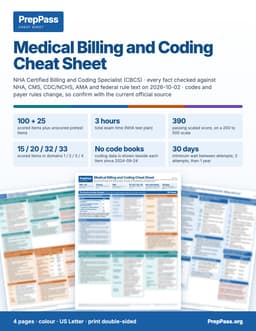
This guide is the teaching, read over weeks. If your exam is inside two weeks, the printable colour cheat sheet is the other product: the figures the exam turns on, laid out by section.
See the Medical Billing & Coding cheat sheet PDF — $9.99 →
4 pages · US Letter · printable PDF · yours to keep
What's included — and what isn't
Included
- All exam areas at real weight (coding, billing, compliance, reimbursement)
- ICD-10-CM conventions & sequencing + CPT/HCPCS modifiers & NCCI
Not included
- No printed copy is shipped — this is a file you download and can print yourself
- No video course, instructor or tutoring comes with the book — the free videos on the site are separate
Everything included, and everything that isn't
Included
- The revenue cycle, CMS-1500/UB-04, and EDI transactions explained
- Reimbursement math recomputed (DRG, RVU, coinsurance, limiting charge)
- 35 practice questions printed in the book, with explanations (399 more free on the site)
- Modifier + CARC/RARC cheat-sheets + a 7-day study plan — PDF + EPUB
Not included
- Not your exam registration or the testing centre's fee, which you still pay to the official body
Contents
See 5 sections and the page each one starts on
- Chapter 1 — Medical Coding: ICD-10-CM, CPT, and HCPCS (32%)p. 7
- Chapter 2 — Billing and Claims Processing (30%)p. 25
- Chapter 3 — Compliance and Regulatory Standards (20%)p. 40
- Chapter 4 — Reimbursement Methodologies and Patient Financials (18%)p. 55
- Chapter 5 — Cumulative review and test-day strategyp. 67
Taken from the PDF you download, with the page each one starts on — not typed here.
Read a chapter free, in full
One complete chapter, exactly as it ships in the eBook. Scroll the window to read it right here; no download, no email.
Read chapter 4 here, without leaving the page
We didn't give you the easy intro — the free chapter opens on one of the hardest-working parts of the book, so you can judge the teaching where the exam gets difficult.
Reimbursement is how providers get paid and how patient responsibility is calculated. This is the most math-heavy domain — and, for that reason, one of the easiest to score on, because the questions are arithmetic that always follows the same order of operations. The single most important habit: patient responsibility is calculated from the allowed amount, never from the billed charge. Master that and most reimbursement questions fall.
(Every dollar, percentage, RVU, and conversion factor below is a teaching number, not a current published rate. Always recompute using the real figures on your date of service.)
4.1 The allowed amount and patient responsibility
The allowed amount (also allowable or maximum allowable) is the most a payer recognizes as payable for a covered service under its fee schedule or contract. It is frequently less than the provider's billed charge. Every downstream number — deductible, coinsurance, plan payment — is based on the allowed amount.
For a participating (in-network) provider, the difference between the billed charge and the allowed amount is a contractual adjustment (write-off) that cannot be balance-billed to the patient.
The out-of-pocket maximum caps a patient's cost-sharing in a benefit period. Once the patient's combined deductible + coinsurance + copays reaches that cap, the plan pays 100% of covered, in-network services for the rest of the period. (Premiums and non-covered services do not count toward the cap.)
Worked example — the full breakdown
A participating provider bills $300 for a service with a contracted allowed amount of $200. The patient's deductible is already met, and the plan pays 80% (patient coinsurance 20%).
- Plan pays: 80% of $200 = $160.
- Patient coinsurance: 20% of $200 = $40.
- Contractual write-off: $300 − $200 = $100 (not billable to the patient).
- Check: $160 (plan) + $40 (patient) = $200 (allowed). The $100 write-off sits outside the allowed amount.
The patient owes $40 — computed from the $200 allowed, not the $300 charge.
Key concept. Patient responsibility comes from the allowed amount, not the billed charge. For a participating provider, the charge − allowed gap is a write-off and cannot be balance-billed.
4.2 Cost-sharing definitions
Three forms of cost-sharing — memorize the distinctions:
- Copayment (copay) — a fixed dollar amount per covered service (e.g., $30 office visit, $15 generic drug). Flat, known in advance, usually collected at the time of service.
- Deductible — the fixed amount the patient must pay each benefit period before the plan begins to pay its share (e.g., a $1,500 annual deductible). Many preventive services are exempt and covered before the deductible is met.
- Coinsurance — the patient's share as a percentage of the allowed amount, owed after the deductible is satisfied (e.g., 80/20, plan 80% / patient 20%). Because it is a percentage, the dollar amount rises with the cost of the service.
Order of operations when a claim has several: apply the deductible first, then coinsurance to the remaining allowed amount; handle any fixed copay per plan design. All of these accumulate toward the out-of-pocket maximum.
Worked example — deductible then coinsurance
Allowed amount $1,000, remaining deductible $200, coinsurance 20%.
- Apply the deductible first: patient pays $200; remaining allowed = $1,000 − $200 = $800.
- Coinsurance: 20% of $800 = $160.
- Patient total: $200 + $160 = $360.
- Plan pays: $800 − $160 = $640.
- Check: $360 + $640 = $1,000 (the full allowed amount).
Key concept. Copay = fixed dollars per service; deductible = pay-first threshold each period; coinsurance = a percentage after the deductible. Deductible first, then coinsurance on what remains.
4.3 Physician and facility payment systems
Different settings use different methodologies — match the system to the setting.
RBRVS (physician services)
Medicare prices physician services with the Resource-Based Relative Value Scale (RBRVS). Each service gets three relative value units (RVUs):
- Work RVU (physician time, skill, effort),
- Practice expense RVU (overhead),
- Malpractice RVU (liability).
Each RVU is adjusted for local costs by a Geographic Practice Cost Index (GPCI), summed, and multiplied by a national dollar conversion factor (CF).
Formula: Payment = [(Work RVU × GPCI) + (PE RVU × GPCI) + (MP RVU × GPCI)] × CF.
Worked example (teaching numbers): a service totals 2.0 fully geographically-adjusted RVUs, and the conversion factor is $33.00. Payment = 2.0 × $33.00 = $66.00. If the CF instead were $36.00, the same service would pay 2.0 × $36.00 = $72.00 — which is exactly why a conversion-factor change moves every physician fee.
Facility prospective payment
- Inpatient hospital: DRGs (Diagnosis-Related Groups). Each admission is grouped by diagnoses, procedures, and other factors into a DRG with a fixed payment weight, so the hospital receives a predetermined amount per admission regardless of exact resources used — an incentive for efficiency.
- Hospital outpatient: APCs (Ambulatory Payment Classifications) — the outpatient counterpart, paying a set amount per group of similar services.
Fee-for-service vs. capitation
- Fee-for-service (FFS) pays separately for each service, so revenue rises with volume.
- Capitation pays a fixed amount per member per month (PMPM) to care for each enrolled patient regardless of how many services that patient uses — shifting utilization risk to the provider.
Worked example — capitation: a group is paid $25 PMPM for 2,000 enrolled members. Monthly capitation revenue = $25 × 2,000 = $50,000, whether the members use 0 visits or 1,000 visits that month. Under FFS, the same 1,000 visits at, say, $60 allowed each would pay $60 × 1,000 = $60,000 — more revenue, but only if the volume occurs. The two models reward opposite behaviors.
Key concept. RBRVS prices physician claims (RVUs × GPCI × CF). DRGs price inpatient stays; APCs price outpatient facility services. FFS rewards volume; capitation pays PMPM and shifts risk to the provider.
4.4 Reimbursement math drills
The order never changes: start with the allowed amount → subtract any unmet deductible → apply coinsurance to what remains → treat charge − allowed as a write-off for participating providers.
Drill 1 — deductible already met. Allowed $1,000, deductible met, coinsurance 20%.
- Patient: 20% of $1,000 = $200. Plan: $800. Nothing else due.
Drill 2 — deductible still owed. Allowed $1,000, remaining deductible $300, coinsurance 20%.
- Deductible first: patient $300; remaining $700.
- Coinsurance: 20% of $700 = $140.
- Patient total: $300 + $140 = $440. Plan: $560. Check: $440 + $560 = $1,000. ✓
Drill 3 — the write-off. Same service, provider billed $1,400, allowed $1,000.
- Because the provider participates, the $1,400 − $1,000 = $400 gap is a contractual write-off — not billable to the patient. The patient still owes only the cost-sharing computed from the $1,000 allowed.
Drill 4 — copay plus coinsurance. Allowed $500, a $30 copay applies, deductible met, coinsurance 20%.
- Copay: $30. Coinsurance: 20% of $500 = $100. (Plan designs vary on whether coinsurance is figured before or after the copay; here we treat the copay as a separate fixed fee.)
- Patient: $30 + $100 = $130. Plan: $500 − $100 = $400 (the copay is the patient's separate fixed share).
Balance billing — charging the patient the difference between the billed charge and the allowed amount — is generally prohibited for participating providers and, for many services, further restricted by federal surprise-billing protections.
Key concept. Write the numbers in order every time: allowed − deductible, × coinsurance; keep the charge-to-allowed gap out of the patient's column for participating providers.
4.5 The revenue cycle
Everything in this book lives inside the revenue cycle — the full financial life of a patient encounter, from scheduling to a zero balance. Know the stages and where errors originate:
- Pre-registration / scheduling — capture demographics and insurance before the visit.
- Registration & eligibility verification — confirm coverage, benefits, copay, deductible status, and prior authorization requirements. Front-end errors here cause most back-end denials.
- Charge capture & coding — the encounter is documented, coded (ICD-10-CM, CPT/HCPCS), and charges are entered.
- Claim scrubbing & submission — edits are run; clean claims go out via clearinghouse (837).
- Payer adjudication — the payer processes and returns a remittance (835).
- Payment posting — record payments, apply contractual adjustments, move the correct remaining balance to the patient or secondary payer.
- Denial management & appeals — read CARC/RARC, fix root causes, appeal when warranted.
- Patient collections — send statements after insurance processes, offer payment plans, escalate per policy and law.
- A/R management & reporting — track days in A/R and % of A/R over 90 days; work the aging report oldest and largest first.
Payment posting and A/R detail
- Payment posting records each payment against the correct claim/line, applies the write-off to the allowed amount, and moves the correct balance onward. Electronic remittance (835) can auto-post, but exceptions and denials need human review. A missed contractual adjustment makes the account balance wrong and sends staff chasing phantom dollars.
- A/R aging sorts unpaid balances into buckets — current, 31–60, 61–90, over 90 days. The older a balance, the less likely it collects, so work the oldest and largest first.
- Patient statements should itemize services and dates, charges, insurance payments and adjustments, and the balance due, and should go out only after insurance has processed, so the patient sees a correct net balance rather than the full charge.
Worked example — payment posting
A remittance for a $500 billed service shows allowed $400, plan paid $320, patient coinsurance $80 (20% of $400), and a $100 contractual adjustment. Correct posting: record $320 payment, post the $100 as a contractual write-off, and move $80 to patient responsibility. If the biller forgot the $100 write-off, the system would still show a $180 balance ($500 − $320) and staff might wrongly bill the patient $180 instead of $80 — over-billing the patient by $100 and creating a compliance and trust problem. Accurate posting is what makes every later report trustworthy.
4.6 Participating vs. nonparticipating providers, and secondary-payer math
Whether a provider participates (is in-network) with a payer changes the money materially.
- A participating (par) provider accepts assignment and agrees to the payer's allowed amount as payment in full; the charge-minus-allowed difference is a write-off and cannot be balance-billed.
- A nonparticipating (non-par) provider may not be bound by the same write-off; depending on the payer and law, the patient can owe more. For Medicare, non-par providers who do not accept assignment are subject to a limiting charge cap, so even out-of-network balance billing is restricted.
Secondary-payer math builds on the primary calculation. After the primary pays, the secondary plan considers the remaining patient balance under its rules — it does not simply pay whatever is left, and total payments across plans generally cannot exceed the total allowed.
Worked example — primary then secondary
A service has a primary allowed amount of $200. The patient's primary deductible is met; the primary pays 80%:
- Primary pays: 80% of $200 = $160. Remaining patient balance from primary: 20% of $200 = $40.
Now the secondary plan processes the $40 balance. Suppose the secondary's allowed amount for this service is also $200 and it covers the patient's coinsurance in full:
- Secondary pays the $40 coinsurance. Patient owes $0.
But if the secondary's allowed amount were lower — say $180 — the secondary might pay only up to its allowable after accounting for what the primary already paid. Because the primary already paid $160, and the secondary's allowed is $180, the secondary would pay at most the difference up to its allowable (here $180 − $160 = $20), potentially leaving the patient a small balance depending on plan rules. The exam-level takeaway: the secondary considers the balance under its own allowable — it does not blindly pay the entire remaining amount.
4.7 More reimbursement drills
Drill 5 — deductible not yet met, small service. Allowed $150, remaining deductible $500 (nowhere near met), coinsurance 20%.
- The allowed amount ($150) is entirely applied to the deductible because the deductible ($500) is larger than the service. Patient owes $150; plan pays $0. Coinsurance never comes into play because the deductible is not yet satisfied. (The patient's remaining deductible drops to $500 − $150 = $350.)
Drill 6 — out-of-pocket maximum reached. A patient has already paid $8,000 in cost-sharing this year, and the plan's out-of-pocket maximum is $8,000. A new covered, in-network service has an allowed amount of $400 with normal 20% coinsurance.
- Because the out-of-pocket maximum is met, the plan pays 100% of covered, in-network services for the rest of the period. Patient owes $0; plan pays $400. The coinsurance is waived not by generosity but by the cap.
Drill 7 — copay only. A plan charges a flat $40 copay for an office visit, with the visit's allowed amount at $130 and the deductible not applicable to office visits.
- Patient owes the $40 copay. The plan pays $130 − $40 = $90. A copay is a fixed patient share; the percentage-based coinsurance logic does not apply.
Drill 8 — RVU with a different conversion factor. A service is 3.0 fully adjusted RVUs. Compute payment at two conversion factors: at $32.00, payment = 3.0 × $32.00 = $96.00; at $34.50, payment = 3.0 × $34.50 = $103.50. The $2.50 CF change raises this one service by $7.50 — and every physician service scales the same way, which is why the annual conversion-factor announcement matters to a whole practice's revenue.
Questions buyers ask
How do I get it?
Pay, and the download appears on this page straight away. The links are also emailed to you. No account is required.
What if it isn't for me?
Email us within 14 days for a full refund, no questions asked.
Is the free practice going away?
No. Every practice question, the timed mock and the free chapters on this site stay free. This book is the studying half, not a gate around the free half.
More questions (15)
Can I read it on my phone?
Yes — the EPUB is for phones and e-readers, the PDF is for printing and tabbing. You get both.
Is a study guide enough for the Medical Billing & Coding (CBCS) exam, or do I need a course?
A book is exam review: it does not replace any education, training or experience National Healthcareer Association (NHA) requires before you may sit the exam, so check those requirements first. For the exam content itself, this 89-page guide teaches the material chapter by chapter with 35 practice questions and explanations inside, and 399 more practice questions are free on PrepPass. A prep course adds live instruction and a set schedule; whether you need one beyond any required education is your call.
What is the cheapest way to prepare for the Medical Billing & Coding (CBCS) exam?
Start with what costs nothing: 399 practice questions on PrepPass, with explanations and no signup. If you want it taught in one file you keep, the full study guide is $14.99 once; the printable cheat sheet for the last days is $9.99. No subscription on any of them.
Who administers the NHA Certified Billing and Coding Specialist (CBCS) Exam?
National Healthcareer Association (NHA) — exam delivered by a PSI testing center, a live remote proctoring provider, or the candidate's own school or employer. NHA states that where live remote proctoring is used, the proctoring provider is selected for the candidate at registration.
How many questions are on the NHA Certified Billing and Coding Specialist (CBCS) Exam?
125 questions (100 scored, 25 unscored pretest). 100 scored items plus 25 unscored pretest items, per NHA's test plan. The test plan says coding manuals (CPT, ICD-10-CM and HCPCS) are required for the exam.
How long is the NHA Certified Billing and Coding Specialist (CBCS) Exam?
180 minutes
What is the passing score for the NHA Certified Billing and Coding Specialist (CBCS) Exam?
Scaled score of 390 on a 200–500 scale. This is a scaled score, not a percentage. NHA weights items by difficulty and does not publish the raw-to-scaled conversion, so it cannot be restated as a percentage or as a number of correct answers. Score reports additionally rate each content area as above, near or below the passing standard.
How much does the NHA Certified Billing and Coding Specialist (CBCS) Exam cost?
Not checked. NHA sells the exam through its store, which renders prices only in the browser; the page's HTML read on the retrieval date carries no amount, so PrepPass states none.
What languages is the NHA Certified Billing and Coding Specialist (CBCS) Exam offered in?
English. English only, stated affirmatively in the handbook rather than merely absent from it: NHA does not provide translated forms, translation aids or interpreters.
Does the Medical Billing & Coding (CBCS) study guide come as a PDF?
Yes — Medical Billing & Coding (CBCS) — Complete Study Guide (2026) downloads as PDF and EPUB, 89 pages. The download link is emailed the moment payment clears and does not expire.
How much does the Medical Billing & Coding (CBCS) study guide cost?
$14.99, once. There is no subscription and no account to create; the PDF and EPUB files are yours to keep.
Are there free Medical Billing & Coding (CBCS) practice questions?
Yes — 399 of them, free to use with no signup and an explanation on every one. They are separate from this study guide, which is what you are buying here. The same free, no-account system also has practice modes (adaptive, new questions, spaced review of misses, weak-topic focus, saved, my mistakes); a timed mock exam (100 questions, 120 minutes) with a score report by topic; a 10-question readiness check (about 5 minutes); 4 study chapters. None of it needs this study guide.
Can I read part of the Medical Billing & Coding (CBCS) study guide before buying?
Yes. A full chapter is free to read on this page — not a summary of one, the chapter itself.
What is the difference between the Medical Billing & Coding (CBCS) study guide and the cheat sheet?
The study guide ($14.99) teaches the material chapter by chapter and is meant to be read over weeks. The cheat sheet ($9.99, 4 pages) drops the teaching and keeps the figures: every number on the exam grouped by value so the confusable ones sit together, each reference page paired with a recall page that blanks the answers, and four routes by days left — 14, 7, 3, or tonight. They are separate purchases; neither replaces the other.
Is this the official Medical Billing & Coding (CBCS) study guide?
No. This is an independent study guide and is not affiliated with or endorsed by the exam's awarding body. It is written from ICD-10-CM/CPT/HCPCS official guidelines + HIPAA/CMS rules. Always confirm current requirements with the body that issues your licence.
Why buy the book when the practice is free?
Our practice questions and timed mock stay free — nothing on the site moves behind this book. The $14.99 book is the studying half: the material itself, taught in order, in a file you own.
- Systematic teaching — every exam section explained chapter by chapter, start to finish, not just questions
- Print it & tab it — a paper-ready PDF you can highlight, mark up, and bring to your study table
- Study anywhere, offline — EPUB on your phone or e-reader; no wifi, no browser tabs
- Everything in one place — the chapters and the practice questions in one file
- Yours for life — one-time $14.99, instant download, no subscription
The details
- Verified from the official source(ICD-10-CM/CPT/HCPCS official guidelines + HIPAA/CMS rules)
- 399 free practice questions
A medical billing & coding course runs $200–$2,000. This book teaches the same exam — same rules, verified to current standards — for a one-time $14.99 you keep for life.
Also free on PrepPass for Medical Billing & Coding (CBCS)
Beside this guide, PrepPass has a free study system for the same exam. It needs no account, and buying the guide does not unlock or change it: 399 practice questions with explanations; practice modes (adaptive, new questions, spaced review of misses, weak-topic focus, saved, my mistakes); a timed mock exam (100 questions, 120 minutes) with a score report by topic; a 10-question readiness check (about 5 minutes); 4 study chapters.
Progress is saved in your browser; a free account keeps it across devices. The readiness gauge reflects your own practice, not a prediction of the real exam result. How the practice works
One-time purchase, lifetime access to the download. The eBook is the full Medical Billing & Coding (CBCS) study guide in PDF and EPUB. Educational summary, not professional or legal advice — always confirm the current rules with the official source. Last updated: October 2026.