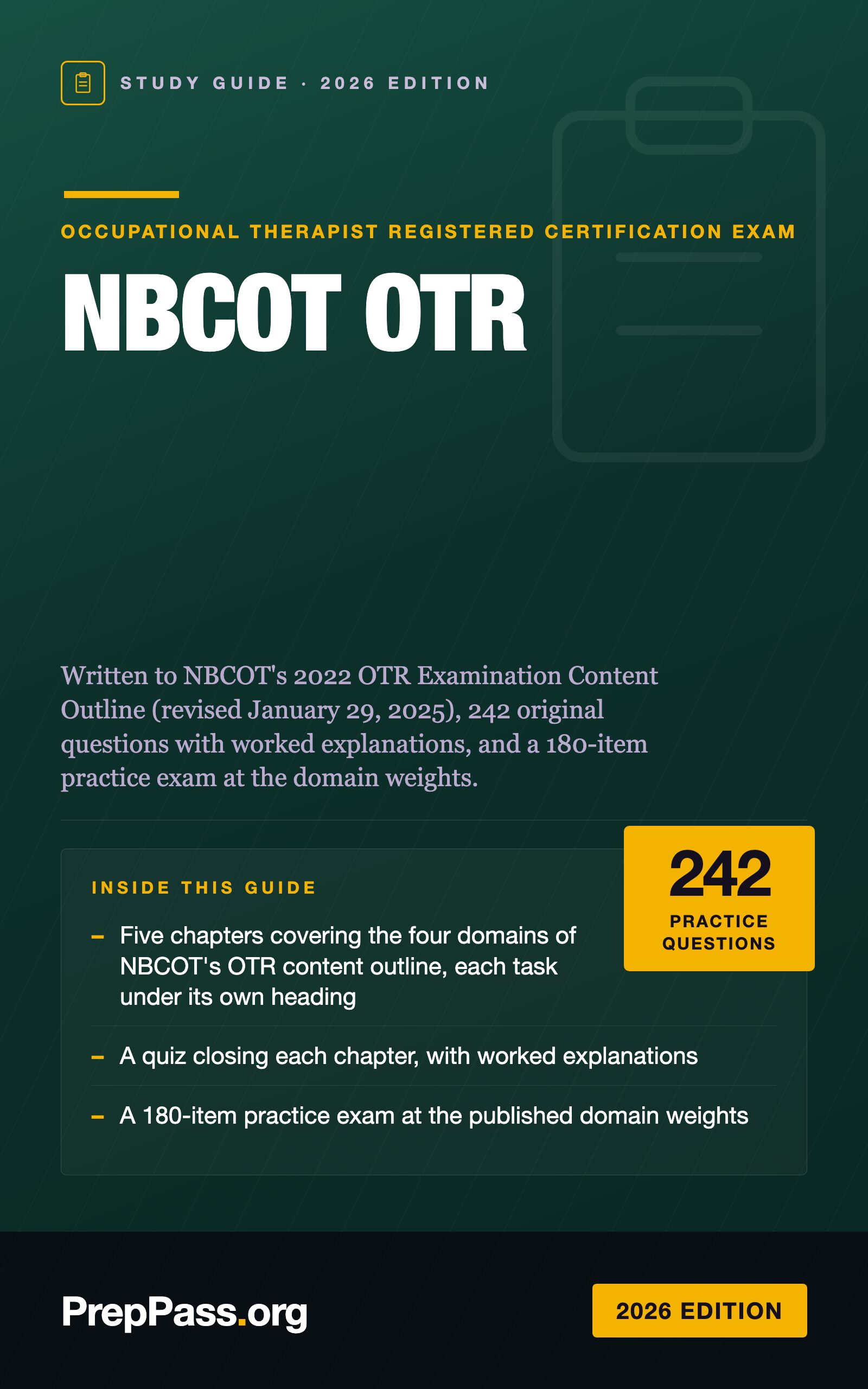
NBCOT OTR — Occupational Therapist Registered Certification Exam · 2026 Edition
NBCOT OTR Study Guide — 2026 Edition
Written to NBCOT's 2022 OTR Examination Content Outline (revised January 29, 2025), 242 original questions with worked explanations, and a 180-item practice exam at the domain weights.
- 242 original OTR practice questions, each with a worked explanation, in one PDF + EPUB you keep
PDF + EPUB · English · 124 pages · $24.99 one-time
This book is written in English.
Instant download after payment — no account needed, no subscription.
14-day money-back guarantee: not satisfied for any reason? Email support@preppass.org within 14 days of purchase for a full refund. Refund policy
Look inside the book
Three real pages, rendered straight from the PDF you download — a reference page, a teaching page, and a worked question, always in that order. Nothing here was redrawn to look better.
- Quick referenceAppendix A — Key terms glossary · PDF page 116
A page you can turn back to: the numbers, deadlines or terms gathered in one place.
- How it's taughtChapter 2 — Analysis, Interpretation, and Planning · PDF page 23
An explanation page: the material taught in prose, in the order the exam tests it.
- How it's taughtPractice exam — Section 2: Analysis, Interpretation, and Planning (41 items) · PDF page 103
An explanation page: the material taught in prose, in the order the exam tests it.
About the OTR exam
OTR candidates preparing for NBCOT certification, typically new occupational therapy graduates. This independent study guide offers practice questions mapped to the 2022 content outline with sourced explanations. It is not NBCOT-approved and includes no online practice. State licensure requirements vary.
| Awarding body | National Board for Certification in Occupational Therapy (NBCOT) |
|---|---|
| Questions | 180 items |
| Time limit | Four hours |
| Passing rule | A total scaled score of at least 450 on the 300-to-600 scale is required to pass; pass/fail is based only on total correct answers with no domain-level passing standards |
| Delivery | Computer-based, in person at a test center, via Pearson VUE |
| Eligibility | OTR candidates must graduate with an entry-level occupational therapy degree from an ACOTE-accredited OT program |
| Retakes | 30 days from last administration for 2nd-3rd attempt; 60 days for 4th-6th attempt; six months for 7th attempt or higher |
| Content outline | 2022 OTR Examination Content Outline, ID 82, rev. January 29, 2025 — effective January 29, 2025 |
| Domains and weights |
|
Questions buyers ask
- How many questions are on the OTR exam, and how long is it?
- The exam has 180 items with a four-hour time limit.
- What is the passing rule for the OTR exam?
- A total scaled score of at least 450 on the 300-to-600 scale is required to pass. Pass/fail is based only on total correct answers, with no domain-level passing standards.
- What are the exam domains and their weights?
- Evaluation and Assessment is 23%, Analysis, Interpretation, and Planning is 23%, Select and Manage Interventions is 38%, and Competency and Practice Management is 16%.
- Which outline edition is current, when did it take effect, and what changed?
- The current outline is the 2022 OTR Examination Content Outline (ID 82, rev. January 29, 2025). No cited source for the previous edition's contents was available, so changes from the prior edition are not stated.
- Who is eligible to sit for the OTR exam?
- OTR candidates must graduate with an entry-level occupational therapy degree from an ACOTE-accredited OT program and meet NBCOT character review requirements.
- What are the exam fees, and what happens if I fail?
- The current exam application fee is not published in the sources consulted; check NBCOT's fee schedule before registering. For retakes, wait 30 days (2nd-3rd attempt), 60 days (4th-6th), or six months (7th or higher).
- How is this book organized?
- Five chapters follow the four exam domains (Select and Manage Interventions takes two), each with a quiz, plus a full 180-question practice exam weighted like the real test, for 242 questions total. The book is priced at $24.99.
- What is the difference between the OTR and COTA exams?
- OTR and COTA are separate credentials with separate exams. OTR candidates need an entry-level OT degree from an ACOTE-accredited OT program; COTA candidates need an OTA degree. This book covers the OTR exam only.
- Is a study guide enough for the NBCOT OTR — Occupational Therapist Registered Certification Exam, or do I need a course?
- Check eligibility first — per National Board for Certification in Occupational Therapy (NBCOT): OTR candidates must graduate with an entry-level occupational therapy degree from an ACOTE-accredited OT program. A book does not replace those requirements. For the exam content itself, this 124-page guide teaches the material chapter by chapter with 242 practice questions and explanations inside. A prep course adds live instruction and a set schedule; whether you need one beyond any required education is your call.
- Does the NBCOT OTR — Occupational Therapist Registered Certification Exam study guide come as a PDF?
- Yes — NBCOT OTR Study Guide — 2026 Edition downloads as PDF and EPUB, 124 pages. The download link is emailed the moment payment clears and does not expire.
- How much does the NBCOT OTR — Occupational Therapist Registered Certification Exam study guide cost?
- $24.99, once. There is no subscription and no account to create; the PDF and EPUB files are yours to keep.
- Can I read part of the NBCOT OTR — Occupational Therapist Registered Certification Exam study guide before buying?
- Yes. A full chapter is free to read on this page — not a summary of one, the chapter itself.
- Is this the official NBCOT OTR — Occupational Therapist Registered Certification Exam study guide?
- No. This is an independent study guide and is not affiliated with or endorsed by the exam's awarding body. It is written from NBCOT's 2022 OTR Examination Content Outline and Certification Examination Handbook. Always confirm current requirements with the body that issues your licence.
What's included — and what isn't
Included
- Five chapters covering the four domains of NBCOT's OTR content outline, each task under its own heading
- A quiz closing each chapter, with worked explanations
- A 180-item practice exam at the published domain weights
- 242 original questions, each explained and cited to its source
- Glossary and a quick-reference clinical decision table
- PDF + EPUB you keep
Not included
- No printed copy is shipped — this is a file you download and can print yourself
- No video course, instructor, tutoring or online question bank comes with the book — everything is in the file
- Not your exam registration or the testing centre's fee, which you still pay to the official body
Contents
See 8 sections and the page each one starts on
- Chapter 1 — Evaluation and Assessmentp. 7
- Chapter 2 — Analysis, Interpretation, and Planningp. 16
- Chapter 3 — Preparatory Techniques, Physical Agent Modalities, and Wound Carep. 25
- Chapter 4 — Occupation-Based Interventions, Sensorimotor Approaches, Assistive Technology, and the Environmentp. 33
- Chapter 5 — Competency and Practice Managementp. 42
- Practice exam — Section 2: Analysis, Interpretation, and Planning (41 items)p. 65
- Appendix A — Key terms glossaryp. 116
- Appendix B — Quick-reference clinical decision tablep. 119
Taken from the PDF you download, with the page each one starts on — not typed here.
Read a chapter free, in full
One complete chapter, exactly as it ships in the eBook. Scroll the window to read it right here; no download, no email.
Read chapter 3 here, without leaving the page
We didn't give you the easy intro — the free chapter opens on one of the hardest-working parts of the book, so you can judge the teaching where the exam gets difficult.
Task 1 — Preparatory techniques and physical agent modalities
In the Occupational Therapy Practice Framework, these are "interventions to support occupations": methods and tasks that prepare the client for occupational performance, used as part of a treatment session in preparation for or concurrently with occupations and activities[1]. Physical agent modalities (PAMs) — such as superficial heat, cryotherapy, and electrotherapy — fall in this category. The defining principle is that they prepare the client for occupation-based intervention; they are not standalone treatments.
- Match the modality to the goal. A PAM is selected because it addresses a barrier (pain, edema, limited tissue extensibility) that is blocking participation in a valued occupation.
- Reassess the barrier. If the modality is not changing the targeted client factor, continuing it does not serve the plan.
- Document the link to occupation. The record should show why the preparatory intervention was needed and what occupation it enabled.
- Never the whole plan. The OTPF describes PAMs as modalities to prepare the client for occupational performance that should be part of a broader plan and not used exclusively[2]; examples include decreasing pain, assisting wound healing or edema control, or preparing muscles for movement[2].
- Check safety first. Before any PAM, the OTR checks precautions and contraindications for this client (sensation, circulation, implants, healing tissue); the practitioner is responsible for client safety throughout the process[3].
Wound care and pressure injury prevention
OTRs address wounds and pressure injuries within their scope, emphasizing prevention, positioning, and referral.
- Pressure injuries are areas of damaged skin caused by staying in one position for too long[4]. Prevention includes keeping skin clean and dry, changing position every two hours, and using pillows and products that relieve pressure[4].
- Know the burn degrees. First-degree burns damage only the outer layer of skin[5]. Second-degree burns damage the outer layer and the layer underneath[5]. Third-degree burns damage or destroy the deepest layer of skin and tissues underneath[6].
- Know where they form. Pressure sores commonly form where bones are close to the skin, such as the ankles, back, elbows, heels, and hips[7]; wheelchair users and people who cannot change position are at risk.
- Refer appropriately. Wounds showing signs of infection, stalled healing, or beyond the OTR's scope go to the wound care team or physician promptly.
Task 4 — Orthotics and prosthetics
The OTR designs, fabricates, fits, and trains clients in orthoses (splints/braces) and prostheses, and prepares the residual limb for prosthetic use.
- Orthoses support, align, protect, or improve function of a body part. The OTR selects the design based on the client's goals and monitors fit, skin integrity, and wear schedule.
- Prosthetic preparation. Shrinkers and liners provide continuous force compression to the residual limb[8], shaping it for prosthetic fitting.
- Desensitization. Areas of hypersensitivity on the residual limb should be addressed through desensitization techniques which include massage, use of desensitization media, and progressive loading of the residual limb[8].
- Shrinker schedule. The guideline instructs the client to keep wearing the shrinker when not wearing the liner and during sleep[9].
- Wear schedule for a new prosthesis. Initially the prosthesis should be worn no more than 15 to 30 minutes, two to three times daily[9]; if limb inspection shows no problems, wearing time increases in 30-minute increments, two to three times daily[9]. Training covers daily residual-limb inspection, care of the prosthesis, and the progressive wear schedule[9].
- Control before function. For safety, the patient should master basic operation of the prosthesis before functional training begins[9]. Myoelectric prostheses cannot be immersed in water because they are not water resistant[9].
- Phantom experiences. Phantom limb sensations are non-painful perceptions of the missing limb[9]; phantom limb pain is pain perceived in the amputated limb[9]. Candidates who mix the two up miss the management question.
- Training matters as much as the device. An orthosis or prosthesis only works if the client can don/doff it, care for the skin, and integrate the device into daily occupations.
Key numbers to remember
- Domain 3 is 38% of the exam — about 69 of 180 items, the largest domain[10].
- Change position every two hours to prevent pressure sores[4].
- New prosthesis: 15 to 30 minutes, two to three times daily at first[9], increasing in 30-minute steps[9].
Key takeaways
- Preparatory methods and PAMs prepare the client for occupational performance; they support, not replace, occupation-based intervention[1].
- Prevent pressure injuries with position changes every two hours, skin care, and pressure-relieving surfaces[4].
- For prosthetic readiness: compression shaping plus desensitization of hypersensitive areas[8].
Chapter 3 quiz
1. An OTR applies a physical agent modality before having a client practice dressing. The primary justification for the modality is that it:
- A. It counts as a billable unit whatever the client's response.
- B. It is the only intervention needed for the dressing goal.
- C. It is part of the facility's standard daily protocol.
- D. It prepares the client for the occupation that follows.
2. A client in a wheelchair is at risk for pressure injuries. The OTR's prevention teaching should emphasize:
- A. Sitting as still as possible to limit friction on the skin.
- B. Changing position often and keeping skin clean and dry.
- C. Applying heat to the seat to improve local circulation.
- D. Using a thin cushion so the skin builds tolerance to pressure.
3. A client has a burn that damaged only the outer layer of skin. This is classified as:
- A. A first-degree burn.
- B. A second-degree burn.
- C. A third-degree burn.
- D. A partial-thickness burn with blisters.
4. A burn that damages the outer layer and the layer underneath is classified as:
- A. A first-degree burn.
- B. A superficial burn.
- C. A second-degree burn.
- D. A third-degree burn.
5. After a transradial amputation, the OTR issues a shrinker for the residual limb. The purpose of the shrinker is to:
- A. Reduce sensation in the limb before prosthetic training.
- B. Apply continuous compression that shapes the limb for fitting.
- C. Protect the incision until the sutures are removed.
- D. Hold the elbow still to prevent a flexion contracture.
6. A client with a new upper-limb prosthesis reports hypersensitivity where the liner contacts the residual limb. The OTR should first:
- A. Stop wearing the prosthesis until the sensitivity resolves.
- B. Apply a cold pack to numb the area before each use.
- C. Refer to the physician for a change in pain medication.
- D. Begin desensitization: massage, media, and graded loading.
7. Which documentation best supports the use of a preparatory modality in a session?
- A. The barrier addressed, the response, and the occupation it enabled.
- B. The device settings, duration, and treatment area used.
- C. A statement that the modality followed the facility routine.
- D. The total minutes of the session spent on the modality.
8. An OTR notices a wound with increasing redness, warmth, and drainage during a session. The most appropriate action is to:
- A. Continue the plan and recheck the wound next week.
- B. Apply a thermal modality to increase blood flow to the area.
- C. Stop the session and refer promptly for medical assessment.
- D. Document the findings and proceed with the session.
9. A client asks why the OTR is spending session time on edema control before cooking practice. The best explanation is that:
- A. Edema control is unrelated to cooking and can be dropped.
- B. Less swelling prepares the hand for the cooking task.
- C. Payers require edema treatment before functional work.
- D. Cooking is unsafe until all swelling has resolved.
10. For a client being fitted with an upper-limb prosthesis, the OTR's training should prioritize:
- A. A full-day wearing schedule from the first day of delivery.
- B. Donning and doffing, limb inspection, and a graded wear schedule.
- C. Functional task training before basic control is mastered.
- D. Wearing the prosthesis only during therapy sessions.
11. Which statement about pressure injuries is correct?
- A. They result from staying in one position for too long.
- B. They occur only in clients who already have an infection.
- C. They cannot be prevented once a client uses a wheelchair.
- D. They form mainly on the feet and seldom on the hips.
12. An OTR is deciding whether to continue a PAM that has shown no change in the targeted client factor after several sessions. The OTR should:
- A. Continue it, since it was written into the original plan.
- B. Increase the intensity until a change is seen.
- C. Discontinue or replace it and document the clinical reasoning.
- D. Keep it but apply it to a different goal area.
Chapter 3 answer key
1. D. The OTPF defines PAMs as modalities that prepare the client for occupational performance and says they should be part of a broader plan and not used exclusively. A facility protocol is the tempting justification, but a routine does not justify a PAM; its link to the client's occupation does.[1, 2]
2. B. MedlinePlus lists the prevention measures: keeping skin clean and dry, changing position every two hours, and using pillows and products that relieve pressure. Sitting still is the tempting error because it reduces friction, but staying in one position too long is exactly what causes pressure sores.[4]
3. A. First-degree burns damage only the outer layer of skin. Second-degree burns also damage the layer underneath, which is why blistering partial-thickness burns are the tempting wrong answer; third-degree burns destroy the deepest layer and tissue beneath it.[5, 6]
4. C. MedlinePlus defines second-degree burns as damaging the outer layer and the layer underneath. Third-degree is the tempting overcall: it damages or destroys the deepest layer of skin and the tissue underneath, not just the second layer.[5, 6]
5. B. The VA/DoD guideline states that shrinkers and liners provide continuous force compression to the residual limb, which controls volume and shapes it for socket fitting; it is worn when the liner is off and during sleep. Protecting the incision is tempting, but that is the role of the surgical dressing, over which the shrinker is later applied.[8, 9]
6. D. The VA/DoD guideline directs that hypersensitive areas on the residual limb be addressed through desensitization: massage, desensitization media and progressive loading. Stopping wear is the tempting choice, but it removes the graded input that builds tolerance and delays prosthetic use.[8]
7. A. The Standards require documentation of the services provided, and the OTPF says PAMs must be part of a broader plan: the note shows why the modality was skilled by linking it to a barrier, the client's response and the occupation it enabled. Settings and duration are tempting because they are required details, but alone they do not show purpose or effect.[2, 3]
8. C. The practitioner is responsible for client safety and refers when the client's needs are best served by another professional; redness, warmth and drainage suggest infection. Documenting and proceeding is tempting because documentation is required, but recording a warning sign is not acting on it.[3]
9. B. Edema control is an intervention to support occupations: the OTPF lists PAMs to assist edema control or prepare for movement to enhance occupational performance. Waiting until all swelling resolves is tempting as the safe option, but graded use of the hand in cooking is part of the plan, not something to postpone.[1, 2]
10. B. The VA/DoD guideline has training cover donning and doffing, daily residual-limb inspection, care of the prosthesis and a progressive wear schedule, starting at 15 to 30 minutes two to three times a day. Functional training is tempting because it is the goal, but the guideline says basic operation should be mastered first, for safety.[9]
11. A. MedlinePlus defines pressure sores as areas of damaged skin caused by staying in one position for too long, and lists position changes and pressure-relieving products as prevention. The claim that wheelchair users cannot prevent them is the tempting fatalism; regular pressure relief and cushions are exactly how they are prevented.[4]
12. C. The Standards require the therapist to modify the plan throughout intervention and document changes; a PAM that is not changing its target is not serving the plan, and the OTPF says PAMs belong in a broader plan rather than standing alone. Raising the intensity is tempting, but it adds risk without evidence that the modality works for this client.[2, 3]
Sources cited in this excerpt
- Occupational Therapy Practice Framework: Domain and Process, 4th Edition. American Occupational Therapy Association. https://www.aota.org/practice/otpf
- Occupational Therapy Practice Framework: Domain and Process, 4th ed. (2020). American Occupational Therapy Association. https://www.aota.org/practice/otpf
- Standards of Practice for Occupational Therapy (2021). American Occupational Therapy Association. https://www.aota.org/practice/standards
- Pressure Ulcers. MedlinePlus (U.S. National Library of Medicine). https://medlineplus.gov/pressureulcers.html
- Burns. MedlinePlus (U.S. National Library of Medicine). https://medlineplus.gov/burns.html
- Burns. MedlinePlus, U.S. National Library of Medicine. https://medlineplus.gov/burns.html
- Pressure Sores. MedlinePlus, U.S. National Library of Medicine. https://medlineplus.gov/pressureulcers.html
- VA/DoD Clinical Practice Guideline for Upper Limb Amputation Rehabilitation. https://www.aaaceus.com/Courses/Articles/NL0215A_article1.pdf
- VA/DoD Clinical Practice Guideline for the Management of Upper Extremity Amputation Rehabilitation (2014). U.S. Department of Veterans Affairs / Department of Defense. https://www.aaaceus.com/Courses/Articles/NL0215A_article1.pdf
- NBCOT Certification Examination Handbook (archived August 2024). National Board for Certification in Occupational Therapy. https://www.nbcot.org/exam-handbook
Before you buy
- How do I get it?
- Pay, and the download appears on this page straight away. The links are also emailed to you. No account is required.
- What if it isn't for me?
- Email us within 14 days for a full refund, no questions asked.
- Is there online practice for this exam too?
- No. PrepPass has no online question bank for this exam; the book is self-contained. Its chapter quizzes and full-length practice exam, each question with a worked explanation, are all in the PDF and EPUB.
- Can I read it on my phone?
- Yes — the EPUB is for phones and e-readers, the PDF is for printing and tabbing. You get both.
The details
Written to NBCOT's 2022 OTR Examination Content Outline (revised January 29, 2025), 242 original questions with worked explanations, and a 180-item practice exam at the domain weights.
- Format: PDF + EPUB download · 124 pages
- 242 practice questions in the book, with a full answer key
- $24.99 one-time — no subscription
- 14-day money-back guarantee · refund policy
- Cross-referenced against: NBCOT's 2022 OTR Examination Content Outline and Certification Examination Handbook
- Last updated: September 2026
- Verified from the official source(NBCOT's 2022 OTR Examination Content Outline and Certification Examination Handbook)
- Instant download, yours for life
What the book gives you
PrepPass has no online question bank for this exam, so the $24.99 book is complete in itself: the material taught in order, a quiz closing each chapter and a full-length practice exam, in a file you own.
- Systematic teaching — every exam section explained chapter by chapter, start to finish, not just questions
- Print it & tab it — a paper-ready PDF you can highlight, mark up, and bring to your study table
- Study anywhere, offline — EPUB on your phone or e-reader; no wifi, no browser tabs
- Everything in one place — the chapters and the practice questions in one file
- Yours for life — one-time $24.99, instant download, no subscription
And it's risk-free: 14-day money-back guarantee — not satisfied? Email us for a full refund, no questions asked. See the refund policy.
14-day money-back guarantee · full refund, no questions asked.
One-time purchase, lifetime access to the download. The eBook is the full NBCOT OTR — Occupational Therapist Registered Certification Exam study guide in PDF and EPUB. Educational summary, not professional or legal advice — always confirm the current rules with the official source. Last updated: September 2026.