NCE — National Counselor Examination · 2026 Edition
NCE Study Guide — 2026 Edition
Edition noteFollows the current NCE outline. NBCC's new outline for summer 2027 is not covered; check which applies to your date.
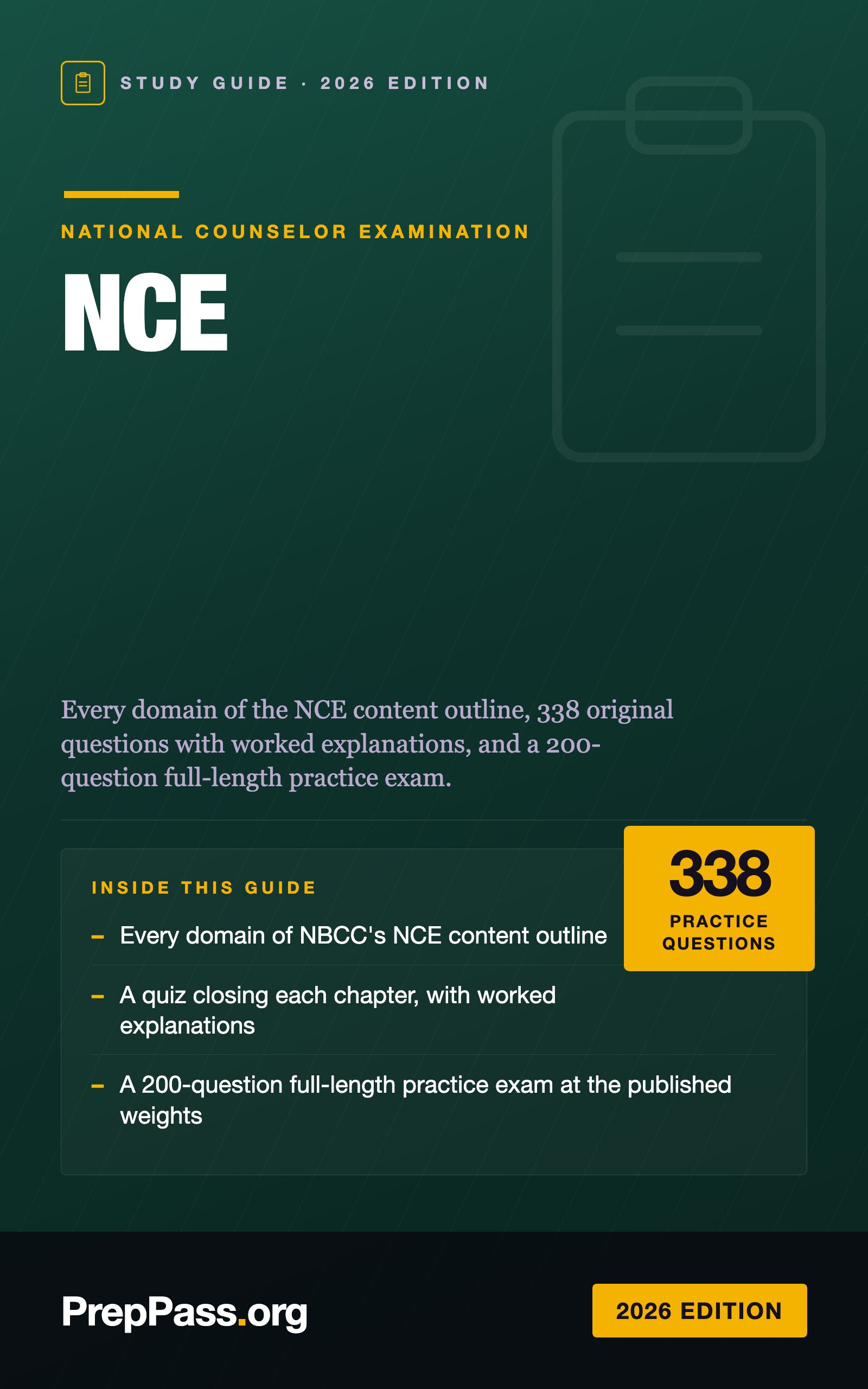
Every domain of the NCE content outline, 338 original questions with worked explanations, and a 200-question full-length practice exam.
- 338 original practice questions, each with a worked explanation, in one PDF + EPUB you keep
PDF + EPUB · English · 224 pages · $19.99 one-time
This book is written in English.
Instant download after payment — no account needed, no subscription.
14-day money-back guarantee: not satisfied for any reason? Email support@preppass.org within 14 days of purchase for a full refund. Refund policy
Try 10 questions first — free
Answer all 10, then see every answer explained — with the section of this guide that teaches it. About 5 minutes, no sign-up.
Start 10 free questionsLook inside the book
Three real pages, rendered straight from the PDF you download — a reference page, a teaching page, and a worked question, always in that order. Nothing here was redrawn to look better.
- Quick referenceChapter 2: Intake, Assessment, and Diagnosis · PDF page 29
A page you can turn back to: the numbers, deadlines or terms gathered in one place.
- How it's taughtChapter 8: Core Counseling Attributes · PDF page 128
An explanation page: the material taught in prose, in the order the exam tests it.
- A question, workedChapter 1: Professional Practice and Ethics · PDF page 20
A practice question with its answer and the reasoning behind it — not just a key.
About the exam itself
| Administering body | National Board for Certified Counselors, Inc. (NBCC) — exam delivered by Pearson VUE |
|---|---|
| Questions | 200 questions (160 scored, 40 unscored pretest) |
| Time limit | 225 minutes |
| Passing score | Not published by NBCC What we read and found nothing in: NBCC — Candidate Handbook for State Licensure, National Counselor Examination (NCE) (Revised September 24, 2024, PDF) |
| Fees |
Source: NBCC — National Certified Counselor (Application Fees for Certification) |
| Languages offered | Not published by NBCC What we read and found nothing in: NBCC — Candidate Handbook for State Licensure, National Counselor Examination (NCE) (Revised September 24, 2024, PDF) |
Questions buyers ask
- What has changed on the NCE — National Counselor Examination exam?
- Follows the current NCE outline. NBCC's new outline for summer 2027 is not covered; check which applies to your date. NCE Content Outline (© 2023), based on NBCC's job analysis finalized in June 2019: The current outline stays in force until NBCC's new NCE specifications take effect on July 1, 2027 (170 questions with three answer choices, a 100–500 score scale with a passing point of 360, six new content domains and a Spanish translation), per NBCC's Examination Specifications — Effective July 1, 2027.
- Is a study guide enough for the NCE — National Counselor Examination exam, or do I need a course?
- Check eligibility first — per National Board for Certified Counselors, Inc. (NBCC): each state counselor licensure board sets the requirements to sit for the NCE for licensure, and NBCC enforces them when registering candidates. NBCC's minimally qualified candidate has a graduate-level counseling degree from a CACREP-accredited program or one administered by an institutionally accredited college or university. A book does not replace those requirements. For the exam content itself, this 224-page guide teaches the material chapter by chapter with 338 practice questions and explanations inside, and 115 more practice questions are free on PrepPass. A prep course adds live instruction and a set schedule; whether you need one beyond any required education is your call.
- What is the cheapest way to prepare for the NCE — National Counselor Examination exam?
- Start with what costs nothing: 115 practice questions on PrepPass, with explanations and no signup. If you want it taught in one file you keep, the full study guide is $19.99 once. No subscription on any of them.
- What happens if I fail the NCE — National Counselor Examination exam?
- You can retake it under National Board for Certified Counselors, Inc. (NBCC)'s rule: if you do not pass, you may retake the NCE after a 30-day waiting period, once per authorized test window, paying the examination fee again each time you reregister. Your state licensure board decides how many attempts you are allowed. Confirm the current policy with National Board for Certified Counselors, Inc. (NBCC) before you book.
- Who administers the National Counselor Examination (NCE)?
- National Board for Certified Counselors, Inc. (NBCC) — exam delivered by Pearson VUE. NBCC administers the exam through the Center for Credentialing & Education (CCE). Candidates test in person at a Pearson VUE test center or online through Pearson VUE's OnVUE. Current content outline (Table 1, share of the 160 scored items): Professional Practice and Ethics 12%, Intake, Assessment, and Diagnosis 12%, Areas of Clinical Focus 29%, Treatment Planning 9%, Counseling Skills and Interventions 30%, Core Counseling Attributes 8%. NBCC has published new NCE specifications effective July 1, 2027: 170 questions with three answer choices, a 100–500 score scale with a passing point of 360, new domains, and a Spanish translation.
- How many questions are on the National Counselor Examination (NCE)?
- 200 questions (160 scored, 40 unscored pretest). All questions are multiple choice. The 40 unscored field-test items gather statistics for future forms and cannot be told apart from scored ones.
- How long is the National Counselor Examination (NCE)?
- 225 minutes. 225 minutes to answer the questions, within a 255-minute session that also includes a 5-minute agreement, a 10-minute tutorial and one scheduled 15-minute break after question 100.
- What is the passing score for the National Counselor Examination (NCE)?
- Not published by NBCC. NBCC sets the passing point with a modified Angoff method and uses statistical equating, so the passing score may vary slightly between versions of the exam. Each candidate's score report shows the passing score for the version taken; NBCC publishes no fixed number. The maximum possible score is 160.
- How much does the National Counselor Examination (NCE) cost?
- $375 — NCC certification application with exam registration included (NBCC, one-time). This is NBCC's price for taking the NCE as part of the National Certified Counselor application. The fee for registering for the NCE for state licensure is not printed in NBCC's state licensure handbook; the handbook says the examination fee is due at every reregistration and charges $50 to reschedule an appointment.
- What languages is the National Counselor Examination (NCE) offered in?
- Not published by NBCC. Neither the state licensure handbook, the current content outline nor NBCC's NCE page states which languages the current NCE is offered in. NBCC's specifications for the version effective July 1, 2027 say that version has been translated into Spanish.
- Does the NCE — National Counselor Examination study guide come as a PDF?
- Yes — NCE Study Guide — 2026 Edition downloads as PDF and EPUB, 224 pages. The download link is emailed the moment payment clears and does not expire.
- How much does the NCE — National Counselor Examination study guide cost?
- $19.99, once. There is no subscription and no account to create; the PDF and EPUB files are yours to keep.
- Are there free NCE — National Counselor Examination practice questions?
- Yes — 115 of them, free to use with no signup and an explanation on every one. They are separate from this study guide, which is what you are buying here.
- Can I read part of the NCE — National Counselor Examination study guide before buying?
- Yes. A full chapter is free to read on this page — not a summary of one, the chapter itself.
- Is this the official NCE — National Counselor Examination study guide?
- No. This is an independent study guide and is not affiliated with or endorsed by the exam's awarding body. It is written from NBCC's published NCE content outline and candidate handbook. Always confirm current requirements with the body that issues your licence.
Free NCE — National Counselor Examination practice questions and study chapters →
What's included — and what isn't
Included
- Every domain of NBCC's NCE content outline
- A quiz closing each chapter, with worked explanations
- A 200-question full-length practice exam at the published weights
- 338 original questions, each explained and cited to its source
- Ethics taught from the published codes, cited by section
- PDF + EPUB you keep
Not included
- No printed copy is shipped — this is a file you download and can print yourself
- No video course, instructor or tutoring comes with the book — the free videos on the site are separate
- Not your exam registration or the testing centre's fee, which you still pay to the official body
Contents
See 9 sections and the page each one starts on
- Chapter 1: Professional Practice and Ethicsp. 6
- Chapter 2: Intake, Assessment, and Diagnosisp. 23
- Chapter 3: Areas of Clinical Focus I — Disordersp. 39
- Answer Keyp. 54
- Chapter 4: Areas of Clinical Focus II — Life Issues and Careerp. 57
- Chapter 5: Treatment Planningp. 78
- Chapter 6: Counseling Skills and Interventions I — Theoriesp. 89
- Chapter 7: Counseling Skills and Interventions II — Techniquesp. 109
- Chapter 8: Core Counseling Attributesp. 127
Taken from the PDF you download, with the page each one starts on — not typed here.
Read a chapter free, in full
One complete chapter, exactly as it ships in the eBook. Scroll the window to read it right here; no download, no email.
Read chapter 4 here, without leaving the page
We didn't give you the easy intro — the free chapter opens on one of the hardest-working parts of the book, so you can judge the teaching where the exam gets difficult.
Areas of Clinical Focus is the exam's largest domain by scored items — about 29% of the scored questions, 47 of 160[1]. This chapter covers the life-issue and career-development half of that territory: loss and adjustment, aging, culture and oppression, identity, developmental tasks across the lifespan, career theory, and suicide knowledge (warning signs, risk factors, and the 988 Lifeline). Crisis-intervention skills and safety planning belong to Chapter 7; this chapter covers what counselors must know before they act.
4.1 Loss, grief, and adjustment to medical events
Exam items in this territory describe clients confronting a death, a serious diagnosis, an injury, or another medical event — and test whether the counselor frames the reaction as a life adjustment rather than assuming pathology. A useful anchor is SAMHSA's definition of individual trauma: an event, series of events, or set of circumstances experienced as physically or emotionally harmful or life threatening, with lasting adverse effects on functioning and on mental, physical, social, emotional, or spiritual well-being[2]. Medical events fit this frame directly. Trauma is common in American communities and especially common among people with mental and substance use disorders[2] — the exam expects counselors to consider the life-event context before reaching for a disorder label (see Chapter 3). The testable response posture is trauma-informed care: emphasizing safety, trust, collaboration, and empowerment[2].
The exam trap here is the disorder-first reflex: a client who withdraws after a diagnosis or a death is showing an adjustment response, and the first tested move is to normalize the adjustment context, not to diagnose. Specific grief models and stage sequences are not covered in this chapter (see Gaps) — items are answered from the adjustment framing above.
4.2 Aging and caregiving
Erikson's psychosocial theory extends personality development across the whole lifespan[3], and the exam's aging items run on his late-life stages. The social task of middle adulthood is generativity versus stagnation: finding one's life's work and contributing to others' development through volunteering, mentoring, and raising children[4] — so a 45-year-old who takes up mentoring or elder caregiving is an exam-style portrait of generativity, not of a career crisis. From age 65 to the end of life, the task is integrity versus despair[4]: a client reflecting on whether life choices were worthwhile is doing integrity work. The trap is mislabeling these life-review or generativity behaviors as depression or identity confusion; the exam wants the developmental label first. Caregiving concerns and end-of-life counseling now have their own sections below (§4.21 and §4.22).
4.3 Cultural adjustment, discrimination, and oppression
Exam items on cultural adjustment, racism, discrimination, and oppression test whether the counselor recognizes how these forces shape a client's presenting concerns — and whether the counselor's own response stays culturally responsive. The testable anchor is trauma-informed care, whose six principles include culturally, historically, and gender-responsive services that move beyond stereotypes and biases[5]. The other principles — safety, peer support, trustworthiness and transparency, collaboration and mutuality, and empowerment, voice and choice — give counselors a checklist for working with clients whose distress is partly rooted in discrimination rather than in individual pathology[5].
Discrimination also shows up in risk-factor knowledge: suicide rates are highest among non-Hispanic American Indian/Alaska Native people, followed by non-Hispanic White people[6]. An item that asks which population carries the highest rate is testing cultural context, not stereotyping — the answer is the cited data. The exam trap is treating culture as an afterthought; items reward the option that centers cultural, historical, and gender factors in the case formulation.
4.4 Gender identity, attachment, and loneliness
The same trauma-informed principles anchor gender-related items: services should be gender-responsive and move beyond stereotypes and biases[5]. Items here test that counselors affirm rather than pathologize a client's gender identity development and examine their own biases before forming a formulation. Specific stage models of gender identity development remain unsourced for this chapter (see Gaps). The separation/attachment facet is covered in §4.10; loneliness in adults is tested in this book's practice items.
4.5 Developmental tasks across the lifespan
Several theories give the exam its developmental vocabulary. Erikson contributes the psychosocial sequence: development is social and lifelong[3], with adolescence (ages 12–18) facing identity versus role confusion[4], middle adulthood facing generativity versus stagnation[4], and late adulthood (65+) facing integrity versus despair[4]. The exam's classic trap is the age–task mismatch: a 16-year-old testing identities is identity work, not generativity; a 70-year-old reviewing her life is integrity work, not identity confusion.
Piaget contributes the cognitive sequence. He studied children's cognitive growth[4] and proposed four stages: sensorimotor, preoperational, concrete operational, and formal operational[4]. The most-tested detail is conservation: a child who has not developed the understanding that changing something's appearance changes nothing about its amount (nothing removed or added) cannot yet perform mental operations — that is the preoperational child[4]. The exam trap is the tall-glass vignette: the child who insists the tall thin glass holds more is failing conservation, not arithmetic.
Kohlberg contributes moral development. Like cognitive development, it unfolds in stages[4], and the tested point is methodological: Kohlberg cared about the reasoning behind an answer to a moral dilemma, not the yes-or-no verdict[4]. The progression runs from pre-conventional morality (before age 9) to conventional morality (early adolescence) toward post-conventional morality (after formal operational thought), which only a few fully attain[4]. The trap: two clients give the same answer for different reasons — the Kohlberg item asks about the reasoning, and "obeying rules to avoid punishment" is pre-conventional.
James Fowler contributes faith development. His framework describes stages of faith across the lifespan[7]. Stage 3, synthetic-conventional faith, generally starts around age 13 and continues to around 18 — though some people remain there for life[8]. In a later stage, people begin questioning their own assumptions about their faith tradition and the authority structures of that tradition[9]. The final stage, universalizing faith, is rare — Fowler describes such people as seeming more lucid, more simple, and yet more fully human[8]. The exam trap is age matching: a 15-year-old conforming to a youth group's beliefs is synthetic-conventional, not a later stage.
4.6 Career development
Career items are heavily theory-driven, and the exam rewards keeping the theories straight. Frank Parsons' trait-factor approach is the matching theory: match personal traits to occupations[10]. The trap is confusing it with Super or Holland; the matching-options stem ("compare the person's traits with the job's requirements, then recommend") is Parsons.
Holland's theory runs on the RIASEC interest structure[11]. The six types are: Realistic (designing, building, or repairing equipment and materials; physical activity; working outdoors)[12]; Investigative (studying and researching living organisms, disease, impairment, or human behavior)[12]; Artistic (creating original visual art, performances, written works, food, or music)[12]; Social (helping, teaching, advising, assisting, or serving others)[12]; Enterprising (managing, negotiating, marketing, or selling in business settings, or leading people in political and legal situations)[12]; and Conventional (following procedures and regulations to organize information or data)[12]. Two classic traps: the counseling-friendly client is Social, not Enterprising (Enterprising manages and sells); and the core premise — occupation choice is an expression of personality and not random[10] — with occupational achievement, stability, and satisfaction depending on the congruence between personality and job environment[10].
Super's theory runs on the self-concept. Vocational development is the process of developing and implementing a self-concept[10]; people choose occupations that let them express their self-concepts[10]; and as the self-concept becomes more realistic and stable, vocational choices and behavior stabilize too[10]. Work satisfaction relates to how well a person has implemented the self-concept[10]. The trap is confusing Super with Parsons: Super explains instability through the self-concept ("this job just isn't me"), not through trait mismatch. Super also gives the exam its definition of career maturity: the similarity between a person's actual vocational behavior and what is expected at that developmental stage[10].
The theory of work adjustment (Dawis, Lofquist, and Weis) runs on needs and correspondence. The individual has biological and psychological needs expected to be fulfilled by occupational work[13]. Work adjustment shows as a correspondence between job satisfaction and satisfactory work and performance behavior[13]; satisfactory performance comes from the correspondence between individual abilities and workplace requirements[13]; and job satisfaction comes from the reinforcement of the employee's values by the work environment[13]. The trap: "same duties, same pay, one loves it and one hates it" is a values-correspondence item (theory of work adjustment), not a trait-match item (Parsons).
The instrument anchor is the Strong Interest Inventory: it measures career and leisure interests, based on the work of E. K. Strong Jr., who published the original interest inventory in 1927[14]. The exam trap is category confusion: interests are not abilities, so a client drawn to art but unskilled at it still gets an interest measure, not an ability test.
4.7 Suicide knowledge: warning signs, risk factors, and 988
This is the knowledge side; crisis-intervention skills and safety planning are Chapter 7. Suicide is death caused by injuring oneself with the intent to die[6]. It is a leading cause of death for people ages 10 and older and was responsible for 48,824 deaths in 2024[6]; that year an estimated 14.3 million adults seriously thought about suicide, 4.6 million planned an attempt, and 2.2 million attempted[6]. The annual cost exceeds $500 billion in medical costs, lost work, lives cut short, and quality-of-life costs[6].
Warning signs cluster into talk, feelings, and behavior. Talk: saying one wants to die[15]. Feelings: great guilt or shame[15]; being a burden to others[15]; feeling empty, hopeless, trapped, or having no reason to live[15]; being extremely sad, more anxious, agitated, or full of rage[15]; unbearable emotional or physical pain[15]. Behavior: making a plan or researching ways to die[15]; withdrawing from friends, saying goodbye, giving away important items, or making a will[15]; and taking dangerous risks such as driving extremely fast[15]. These signs demand help as soon as possible, particularly when the behavior is new or has increased recently[15].
Two tested facts correct common myths. First, asking directly about suicidal thoughts does not increase suicidal behavior or thoughts — studies show it does not cause or increase them[16]. Second, all talk of suicide should be taken seriously: suicidal thoughts or actions signal extreme distress and are not a typical response to stress[17].
The tested resource is the 988 Suicide & Crisis Lifeline. It offers 24/7 judgment-free support for mental health, substance use, and more[18]; the support is free and confidential[18]. In 2020, Congress designated the 988 dialing code, operated through the existing National Suicide Prevention Lifeline, with SAMHSA viewing it as a first step toward a transformed crisis-care system[18]. Connecting a person with the Lifeline (call or text 988) gives them a safety net when they need it[16]. The exam trap is the phone-only assumption: 988 is reachable by call or text.
Key numbers
- The NCE has 200 multiple-choice questions, 160 of them scored[19], with 3 hours and 45 minutes to complete[19]; Areas of Clinical Focus accounts for 29% of items, 47 scored[1].
- The 988 dialing code was designated in 2020[18].
- Suicide was responsible for 48,824 deaths in 2024 and is a leading cause of death for ages 10 and older[6]; in 2024, 14.3 million adults seriously thought about suicide, 4.6 million planned an attempt, and 2.2 million attempted[6]; annual cost exceeds $500 billion[6].
- Erikson: identity versus role confusion spans adolescence, ages 12–18[4]; integrity versus despair spans age 65 to end of life[4].
- Fowler: Stage 3 (synthetic-conventional) generally runs from about 13 to about 18[8].
- The Strong Interest Inventory descends from E. K. Strong Jr.'s 1927 inventory[14].
Key takeaways
- Areas of Clinical Focus is the largest scored domain — career theory and life-issue knowledge carry real weight on the exam[1].
- Holland: match the person to the RIASEC type — Social means helping and teaching, not managing and selling[12] — and remember that satisfaction follows personality–environment congruence[10].
- Keep the career theories apart: Parsons matches personal traits to occupations[10]; Super builds and implements the self-concept[10]; the theory of work adjustment matches needs and values to the environment[13].
- Erikson's age–task pairs are the exam's favorite mismatch traps: identity at 12–18[4], generativity in middle adulthood[4], integrity from 65[4].
- Piaget's most-tested detail is conservation[4]; Kohlberg's is that the reasoning, not the verdict, is scored[4].
- Suicide knowledge: warning signs cluster in talk, feelings, and behavior — and new or increased behavior is most urgent[15]; asking directly does not increase risk[16]; 988 is 24/7 judgment-free support for mental health, substance use, and more[18].
- Trauma-informed care anchors life-issue items: safety, trustworthiness, collaboration, empowerment, peer support, and services responsive to cultural, historical, and gender issues[5].
- Crisis-intervention skills and safety planning are Chapter 7's territory — this chapter covers the knowledge that precedes them.
Sources cited in this excerpt
- NBCC NCE Content Outline (©2023), Table 1.
- *Understanding Trauma and Its Impacts* — Substance Abuse and Mental Health Services Administration (SAMHSA). https://www.samhsa.gov/mental-health/trauma-violence
- OpenStax Psychology 2e, Ch. 9 "Lifespan Theories". https://openstax.org/books/psychology-2e/pages/9-1-what-is-lifespan-development
- OpenStax Psychology 2e, Ch. 9. https://openstax.org/books/psychology-2e/pages/9-1-what-is-lifespan-development
- SAMHSA FY 2022 Notice of Funding Opportunity — trauma-informed care definition (six key principles).
- *Suicide Facts* — Centers for Disease Control and Prevention (CDC). Page reviewed/updated May 7, 2026; mortality figures cite WISQARS 2024; ideation/planning/attempt figures cite the 2024 National Survey on Drug Use and Health (NSDUH). https://www.cdc.gov/suicide/facts/index.html
- Utah State University, Counseling and Prevention Services (Aggie Wellness), "Faith Challenges,". https://www.usu.edu/aggiewellness/caps/self-guided-resources/faith-challenges
- Utah State University CAPS. https://www.usu.edu/aggiewellness/caps/self-guided-resources/faith-challenges
- Utah State University CAPS, on Stage 4: Individuative-Reflective Faith. https://www.usu.edu/aggiewellness/caps/self-guided-resources/faith-challenges
- *Career Development Theories Overview* — First Year Experience @ MCC (Mesa Community College Pressbooks, CC BY-NC 4.0). https://open.maricopa.edu/fye101mcc/chapter/career-development-theories-overview/
- *Interest Profiler (IP)* — O*NET Resource Center. https://www.onetcenter.org/IP.html
- *Browse by Career Interest Types* — O*NET (U.S. Department of Labor). https://www.onetonline.org/find/descriptor/browse/1.B.1/
- *Theory of Work Adjustment* — EU-funded DIGIGEN module (CC BY-NC-SA 4.0).
- The Myers-Briggs Company, "Validity of the Strong Interest Inventory® Instrument,". https://www.themyersbriggs.com/en-us/support/validity-of-the-strong-interest-inventory
- *Warning Signs of Suicide* — National Institute of Mental Health (NIMH). https://www.nimh.nih.gov/health/publications/warning-signs-of-suicide
- *5 Action Steps to Help Someone Having Thoughts of Suicide* — NIMH. https://www.nimh.nih.gov/health/publications/5-action-steps-to-help-someone-having-thoughts-of-suicide
- *Frequently Asked Questions About Suicide* — NIMH. https://www.nimh.nih.gov/health/publications/suicide-faq
- *988 Suicide & Crisis Lifeline* — Substance Abuse and Mental Health Services Administration (SAMHSA). https://www.samhsa.gov/mental-health/988
- NBCC NCE Content Outline (©2023).
Before you buy
- How do I get it?
- Pay, and the download appears on this page straight away. The links are also emailed to you. No account is required.
- What if it isn't for me?
- Email us within 14 days for a full refund, no questions asked.
- Is the free practice going away?
- No. Every practice question, the timed mock and the free chapters on this site stay free. This book is the studying half, not a gate around the free half.
- Can I read it on my phone?
- Yes — the EPUB is for phones and e-readers, the PDF is for printing and tabbing. You get both.
The details
Every domain of the NCE content outline, 338 original questions with worked explanations, and a 200-question full-length practice exam.
- Format: PDF + EPUB download · 224 pages
- 338 practice questions in the book, with a full answer key
- 115 free practice questions for this exam on PrepPass, included at no cost
- $19.99 one-time — no subscription
- 14-day money-back guarantee · refund policy
- Cross-referenced against: NBCC's published NCE content outline and candidate handbook
- Last updated: September 2026
- Verified from the official source(NBCC's published NCE content outline and candidate handbook)
- 115 free practice questions
- Instant download, yours for life
Why buy the book when the practice is free?
Our practice questions and timed mock stay free — nothing on the site moves behind this book. The $19.99 book is the studying half: the material itself, taught in order, in a file you own.
- Systematic teaching — every exam section explained chapter by chapter, start to finish, not just questions
- Print it & tab it — a paper-ready PDF you can highlight, mark up, and bring to your study table
- Study anywhere, offline — EPUB on your phone or e-reader; no wifi, no browser tabs
- Everything in one place — the chapters and the practice questions in one file
- Yours for life — one-time $19.99, instant download, no subscription
And it's risk-free: 14-day money-back guarantee — not satisfied? Email us for a full refund, no questions asked. See the refund policy.
14-day money-back guarantee · full refund, no questions asked.
One-time purchase, lifetime access to the download. The eBook is the full NCE — National Counselor Examination study guide in PDF and EPUB. Educational summary, not professional or legal advice — always confirm the current rules with the official source. Last updated: September 2026.