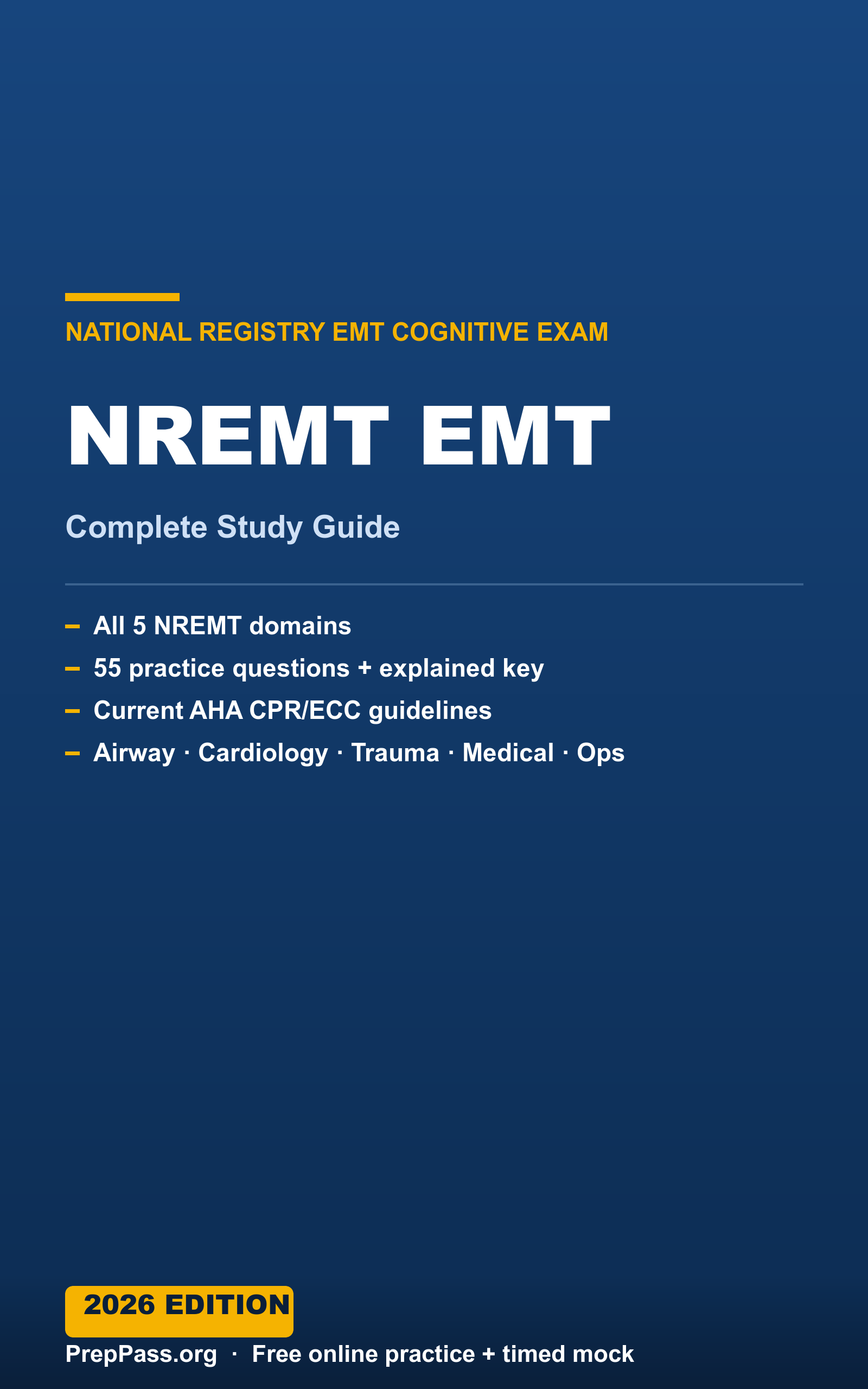
NREMT EMT — Complete Study Guide (2026)
The National Registry EMT cognitive exam across all five domains, with CPR taught to the current AHA guidelines and every drug dose flagged protocol-set.
Own the complete book — PDF + EPUB
The practice questions and timed mock stay free. The book is the studying half:
- Taught chapter by chapter — every exam section explained in order, not just questions
- Print it & tab it — a paper reference you can highlight and mark up
- Works offline — PDF for print, EPUB for your phone or e-reader
- Everything in one file — chapters, cram sheets, and practice questions together
14-day money-back guarantee — not satisfied? Email us for a full refund, no questions asked. Refund policy
Chapter 1 is free to read on this page — try before you buy. One payment unlocks the complete book (PDF + EPUB, practice questions with explanations, per-chapter cram sheets).
Instant PDF + EPUB download · one-time, yours forever · no subscription · 14-day money-back guarantee · not sure yet? read Chapter 1 free below.
The full opening chapter — the same text as the eBook. Scroll the window to read it right here; no download, no email.
From the PrepPass NREMT EMT Study Guide — 2026 Edition. This free sample chapter is an independent study guide and is not affiliated with or endorsed by the NREMT, NHTSA, or the AHA. It teaches exam content and is not medical advice; the CPR numbers and airway rules here are guideline- and protocol-dependent — verify every clinical fact against the current AHA guideline and your local protocol before you rely on it.
Nothing else you do matters if the patient cannot move air. A patent airway and adequate breathing are the foundation of all EMT care, which is why this domain comes first and why airway questions thread through every other section of the exam. The unifying skill is telling adequate breathing from inadequate breathing — because that single judgment decides whether you hand the patient oxygen and watch, or take over their breathing for them. Learn to make that call fast, and most of this domain falls into place.
1.1 Airway Assessment: Is Air Actually Moving?
The first question at every patient's side is whether the airway is open and whether breathing is adequate. "Adequate" means an acceptable rate, an acceptable depth (tidal volume), and a regular pattern that together move enough air to keep the patient oxygenated. A patient can be breathing fast and still be failing if each breath is too shallow to reach the lungs.
Look, listen, and feel. Watch the chest for equal rise and fall, listen for air movement and for abnormal sounds, and feel for air at the mouth and nose. You are judging whether the effort is actually producing ventilation, not just whether the patient is making breathing motions.
Know the normal adult rate. A healthy adult at rest breathes 12 to 20 times per minute. A rate persistently below or above that range is a warning sign. Very slow (bradypnea) or very fast (tachypnea) breathing, or breathing that is too shallow to move air, signals distress and possible respiratory failure.
Recognize abnormal airway sounds — each points to a location. Snoring means the tongue is partially obstructing the upper airway and the airway needs repositioning or an adjunct. Stridor, a high-pitched sound on inspiration, means the upper airway is narrowed — by swelling, a foreign body, or infection — and is an ominous sign. Wheezing is a whistling sound, usually on exhalation, from narrowed lower airways as in asthma. Crackles (rales) are a wet, popping sound from fluid in the alveoli, classically pulmonary edema. Gurgling means fluid — blood, vomit, secretions — in the airway that must be suctioned now.
Watch the work of breathing. Accessory-muscle use (neck and shoulder muscles pulling with each breath), nasal flaring, retractions between the ribs, and the tripod position (leaning forward on the arms) all mean the patient is working hard to breathe. In children, grunting and head-bobbing are late, dangerous signs. Increased work of breathing is respiratory distress; when a tiring patient's effort decreases and they become sleepy, that is respiratory failure — a far worse sign, not an improvement.
Cyanosis is a late sign. Bluish skin, lips, or nail beds mean the blood is poorly oxygenated. It appears late and demands immediate airway management and oxygen — do not wait for it before treating hypoxia.
1.2 Opening and Clearing the Airway
Manual maneuvers, positioning, and suction keep the airway open. The technique you choose depends on one question: do you suspect a spinal injury?
Head-tilt/chin-lift — the no-trauma opener. For an unresponsive medical patient with no suspected spinal injury, tilt the head back and lift the chin. This lifts the tongue off the back of the throat, the most common airway obstruction in an unresponsive person.
Jaw-thrust — the trauma opener. When you suspect a cervical-spine injury, open the airway with a jaw-thrust, which lifts the jaw forward while keeping the head neutral and in-line, minimizing spinal movement. If a jaw-thrust fails to open the airway, airway control still takes priority — an open airway always outranks perfect spinal precautions, because the patient dies of the blocked airway first.
Suction — but briefly. Gurgling means secretions, blood, or vomit in the airway; suction it. Because suctioning also removes oxygen, limit each attempt to no more than about 15 seconds in an adult (shorter in children and infants), and reoxygenate between attempts. Suction only what you can see, on the way out.
Recovery position — for the breathing, unresponsive, non-trauma patient. An unresponsive patient who is breathing adequately and has no suspected spinal injury is placed on their side (lateral recovery position) so the tongue falls forward and secretions or vomit drain out of the mouth instead of into the lungs.
1.3 Airway Adjuncts: OPA and NPA
Airway adjuncts hold the tongue off the back of the throat so it cannot obstruct the airway. The two an EMT uses are the oropharyngeal airway (OPA) and the nasopharyngeal airway (NPA). Choosing between them comes down to the gag reflex.
Oropharyngeal airway (OPA) — no gag reflex only. The OPA is inserted into the mouth and holds the tongue forward. Because it sits on the back of the tongue, it will trigger gagging, vomiting, or laryngospasm in anyone with an intact gag reflex, so it is used only in an unresponsive patient with no gag reflex. Size it by measuring from the corner of the mouth to the earlobe or the angle of the jaw. An OPA that is too long or too short can push the tongue back and worsen the obstruction. If the patient gags during insertion, remove it.
Nasopharyngeal airway (NPA) — tolerated with a gag reflex. The NPA is a soft tube passed through the nostril; because it does not touch the back of the tongue the same way, it is tolerated by semiconscious patients who still have a gag reflex. Lubricate it, size it from the nostril to the earlobe, and insert it with the bevel toward the septum. Avoid the NPA when you suspect a basilar skull fracture — signs include clear fluid from the nose or ears, raccoon eyes, or Battle's sign — because the tube could pass into the cranial vault.
Neither adjunct is a substitute for manual positioning: you still open the airway first, then place the adjunct to help keep it open.
1.4 Oxygen Delivery Devices
Oxygen is chosen by how much the patient needs and how well they tolerate the device, and each device has a flow rate that makes it work. Get the pairing wrong and the device fails.
Nasal cannula — low flow, low concentration. Two prongs into the nostrils at 1 to 6 liters per minute deliver roughly 24 to 44 percent oxygen. It is for patients who need modest oxygen and cannot tolerate a mask. Running it above 6 L/min dries the nose without adding useful oxygen.
Nonrebreather mask (NRB) — high concentration for the spontaneously breathing patient. A mask with a reservoir bag run at 10 to 15 liters per minute delivers a high oxygen concentration (commonly cited as roughly 80 to 90 percent, and higher with a good seal). The flow must be high enough to keep the reservoir bag from collapsing when the patient inhales. The NRB is for a patient who is breathing adequately but is hypoxic or seriously ill.
Bag-valve mask (BVM) — for the patient who is not breathing adequately. The BVM is not a passive oxygen device; it is how you breathe for a patient. With a reservoir and 15 L/min of oxygen it delivers nearly 100 percent. Use it whenever breathing is absent or inadequate.
Never withhold oxygen from a hypoxic patient. The old worry that oxygen will "knock out the respiratory drive" in a COPD patient must never stop you from treating hypoxia. A hypoxic COPD patient gets the oxygen they need; if their breathing is inadequate, you assist ventilations. Hypoxia kills far faster than the theoretical concern.
1.5 Ventilation: Breathing for the Patient
When breathing is inadequate or absent, the EMT delivers positive-pressure ventilation — most often with a BVM. This is the highest-skill judgment in the domain, because it means recognizing that oxygen alone is not enough and taking over.
When to ventilate. Assist or take over breathing when the rate is too slow (for example, an adult breathing 6 times a minute), too fast to move real volume, too shallow, or absent. Agonal respirations — slow, gasping, ineffective breaths often seen around cardiac arrest — are not adequate breathing; treat them as an arresting patient who needs ventilation and, if pulseless, CPR.
Confirm it is working. The single best sign of effective ventilation is visible, gentle chest rise with each breath. No chest rise means no ventilation — reposition the head, reseat the mask, check for an obstruction, and try again.
Rescue-breathing rate for a patient with a pulse. For an apneic adult who still has a pulse, deliver about one breath every 6 seconds (about 10 breaths per minute). For an apneic infant or child with a pulse, the current AHA guidance is faster — about one breath every 2 to 3 seconds (roughly 20 to 30 per minute). Each breath is given over about one second, just until the chest rises. (These rates are guideline-dependent — verify against the current AHA guideline and your protocol.)
Do not over-ventilate. Squeezing too fast, too hard, or too much volume forces air into the stomach (gastric distention), which causes vomiting and aspiration and raises pressure that reduces blood return to the heart. Slow, measured breaths to visible chest rise are the goal — more is not better.
1.6 Common Respiratory Emergencies
Breathing complaints are among the most frequent EMS calls, and the exam expects you to tell the common conditions apart by their story and their lung sounds. In every case the two decisions that matter most are the same: is the breathing adequate or inadequate, and does the patient have their own prescribed inhaler you can help them use.
Asthma. Spasm and swelling of the lower airways trap air on exhalation, producing wheezing and a prolonged expiratory phase, most often in a younger patient with a known history and a rescue inhaler. Position them upright, give oxygen for hypoxia, and assist with their prescribed bronchodilator (such as albuterol) per protocol. The ominous sign is a "silent chest" — a tiring asthmatic whose wheezing disappears because too little air is moving to make sound. That is not improvement; it is impending respiratory failure that needs assisted ventilation.
COPD (emphysema and chronic bronchitis). A long history of smoking, a barrel chest, chronic cough, and pursed-lip breathing mark the COPD patient, who lives with a chronically low oxygen level. Treat hypoxia with oxygen — do not withhold it — and assist ventilations if breathing becomes inadequate. Many of these patients use home oxygen and inhalers.
Congestive heart failure and pulmonary edema. When the heart fails as a pump, fluid backs up into the lungs, producing crackles (rales), severe shortness of breath that is worse lying flat, and sometimes pink frothy sputum and swollen ankles. These patients often want to sit upright; give oxygen, support ventilation as needed, and transport.
Pneumonia. Infection fills part of the lung with fluid, giving fever, a productive cough, localized crackles, and shortness of breath. Field care is supportive — oxygen and transport.
Hyperventilation. Rapid, deep breathing driven by anxiety can cause dizziness and tingling around the mouth and in the fingers. It is a diagnosis of exclusion: never assume "it's just anxiety," because a pulmonary embolism, a diabetic emergency, or an overdose can look identical. Reassure, coach slower breathing, and rule out dangerous causes.
Croup and epiglottitis (pediatric upper-airway). Croup is a viral illness with a barking, seal-like cough and inspiratory stridor, usually improving with humidified air. Epiglottitis is a rarer, life-threatening bacterial swelling of the epiglottis: high fever, drooling, a muffled voice, and a child sitting in the tripod position. Do not put anything in the mouth or agitate a suspected epiglottitis patient — keep them calm, give blow-by oxygen, and transport gently, because agitation can trigger complete airway obstruction.
What's in the eBook
Why buy the book when the practice is free?
Our practice questions and timed mock stay free — nothing on the site moves behind this book. The $9.99 book is the studying half: the material itself, taught in order, in a file you own.
- Systematic teaching — every exam section explained chapter by chapter, start to finish, not just questions
- Print it & tab it — a paper-ready PDF you can highlight, mark up, and bring to your study table
- Study anywhere, offline — EPUB on your phone or e-reader; no wifi, no browser tabs
- Everything in one place — chapters, per-chapter cram sheets, and practice questions in one file
- Yours for life — one-time $9.99, instant download, no subscription
And it's risk-free: 14-day money-back guarantee — not satisfied? Email us for a full refund, no questions asked. See the refund policy.
14-day money-back guarantee · full refund, no questions asked.
One-time purchase, lifetime access to the download. The eBook is the full NREMT (EMT) study guide in PDF and EPUB. Educational summary, not professional or legal advice — always confirm the current rules with the official source. Last updated: August 2026.