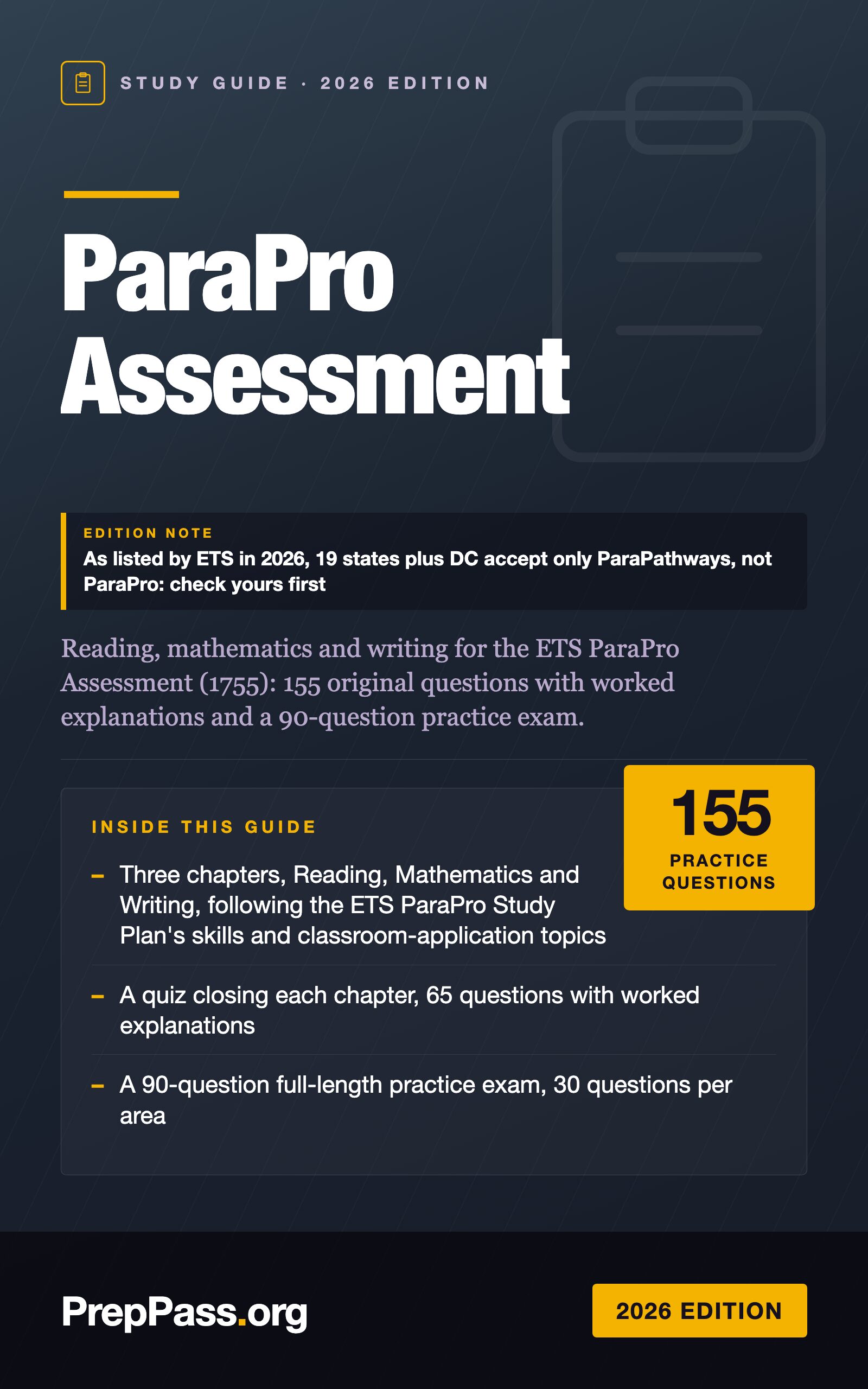
ParaPro Assessment (ETS test 1755) · 2026 Edition
ParaPro Assessment Study Guide — 2026 Edition
Edition noteAs listed by ETS in 2026, 19 states plus DC accept only ParaPathways, not ParaPro: check yours first
Reading, mathematics and writing for the ETS ParaPro Assessment (1755): 155 original questions with worked explanations and a 90-question practice exam.
- 155 original ParaPro practice questions, each with a worked explanation, in one PDF + EPUB you keep
PDF + EPUB · English · 129 pages · $24.99 one-time
This book is written in English.
Instant download after payment — no account needed, no subscription.
14-day money-back guarantee: not satisfied for any reason? Email support@preppass.org within 14 days of purchase for a full refund. Refund policy
Look inside the book
Three real pages, rendered straight from the PDF you download — a reference page, a teaching page, and a worked question, always in that order. Nothing here was redrawn to look better.
- Quick referenceChapter 2 — Mathematics · PDF page 56
A page you can turn back to: the numbers, deadlines or terms gathered in one place.
- How it's taughtChapter 3 — Writing · PDF page 68
An explanation page: the material taught in prose, in the order the exam tests it.
- A question, workedChapter 2 — Mathematics · PDF page 61
A practice question with its answer and the reasoning behind it — not just a key.
About the ParaPro exam
For paraprofessionals preparing for the ETS ParaPro Assessment (1755) — if your state or district accepts it. 19 states plus the District of Columbia list only the separate ParaPathways assessments (5758/5759); Wisconsin lists ParaPathways statewide except two districts. Confirm with your state or district before registering. Study chapters, quizzes, and a full 90-question practice exam. Independent of ETS.
Outline changes: No outline revision is announced on the current ETS ParaPro page; the 2019 Study Plan remains the document ETS links from the exam page.
| Awarding body | ETS |
|---|---|
| Questions | 90 selected-response questions |
| Time limit | 150 minutes |
| Passing rule | Set by each state or school district; ETS publishes a qualifying score for each accepting state or district (examples on 2026-09-27: Colorado 460, Kansas 455, Massachusetts 464). No universal cutoff. |
| Fees | $85.00 test registration fee, as listed on the ETS ParaPro page on 2026-09-27 |
| Delivery | Computer-delivered at Prometric test centers, other participating test centers, at home, or at a school or district |
| Content outline | ETS ParaPro Study Plan (Copyright © 2019), 2019 (current linked study plan, read 2026-09-27) |
| Domains and weights |
|
Questions buyers ask
- How many questions are on the ParaPro Assessment, and how much time do I get?
- The ParaPro Assessment has 90 selected-response questions and you get 150 minutes.
- What does the ParaPro Assessment cover?
- Reading, Mathematics, and Writing — each one is about 33 1/3% of the scored questions.
- Can I use a calculator on the ParaPro Assessment?
- No. ETS does not allow calculators on this examination, so this book trains you to do every step by hand.
- Where can I take the ParaPro Assessment?
- At a Prometric test center, at other participating test centers, at home, or at a school or district.
- What does the exam mean by application of skills in the classroom?
- In each area, about two-thirds of the questions measure basic skills and knowledge and about one-third measure applying those skills in the classroom.
- Which content outline does this book follow?
- The current ETS ParaPro page links the 2019 Study Plan as its study plan; ETS publishes no newer outline on that page.
- What score do I need to pass the ParaPro Assessment?
- There is no universal passing score. Each state or school district sets its own qualifying score — ETS publishes the list, with examples as of 2026-09-27 such as Colorado 460, Kansas 455, and Massachusetts 464.
- Who is eligible to take the ParaPro Assessment?
- ETS publishes no eligibility requirements for ParaPro on its exam page or Study Plan; check with your state or district for any local requirements.
- How much does the ParaPro Assessment cost, and what if I need to retake it?
- The test registration fee is $85.00 as listed by ETS on 2026-09-27. ETS publishes no retake policy on the exam page.
- Is ParaPro the same as ParaPathways? Which one does my state accept?
- They are different assessments. ParaPro (1755) is one 90-question test of reading, mathematics, and writing; ParaPathways is two separate assessments — Reading and Writing (5758) and Mathematics (5759). 19 states plus the District of Columbia list only ParaPathways; Wisconsin lists ParaPathways statewide but accepts ParaPro in two districts. Confirm with your state or local education agency before you register.
- What has changed on the ParaPro Assessment (ETS test 1755) exam?
- As listed by ETS in 2026, 19 states plus DC accept only ParaPathways, not ParaPro: check yours first. ETS ParaPro Study Plan (Copyright © 2019), 2019 (current linked study plan, read 2026-09-27): No outline revision is announced on the current ETS ParaPro page; the 2019 Study Plan remains the document ETS links from the exam page.
- Is a study guide enough for the ParaPro Assessment (ETS test 1755) exam, or do I need a course?
- A book is exam review: it does not replace any education, training or experience ETS requires before you may sit the exam, so check those requirements first. For the exam content itself, this 129-page guide teaches the material chapter by chapter with 155 practice questions and explanations inside. A prep course adds live instruction and a set schedule; whether you need one beyond any required education is your call.
- Does the ParaPro Assessment (ETS test 1755) study guide come as a PDF?
- Yes — ParaPro Assessment Study Guide — 2026 Edition downloads as PDF and EPUB, 129 pages. The download link is emailed the moment payment clears and does not expire.
- How much does the ParaPro Assessment (ETS test 1755) study guide cost?
- $24.99, once. There is no subscription and no account to create; the PDF and EPUB files are yours to keep.
- Can I read part of the ParaPro Assessment (ETS test 1755) study guide before buying?
- Yes. A full chapter is free to read on this page — not a summary of one, the chapter itself.
- Is this the official ParaPro Assessment (ETS test 1755) study guide?
- No. This is an independent study guide and is not affiliated with or endorsed by the exam's awarding body. It is written from ETS ParaPro Study Plan (test 1755), the ETS ParaPro page and State Requirements page read 2026-09-27, the Common Core State Standards for Mathematics, the GPO Style Manual and IES practice guides. Always confirm current requirements with the body that issues your licence.
What's included — and what isn't
Included
- Three chapters, Reading, Mathematics and Writing, following the ETS ParaPro Study Plan's skills and classroom-application topics
- A quiz closing each chapter, 65 questions with worked explanations
- A 90-question full-length practice exam, 30 questions per area
- 155 original questions, each explained and cited to its source
- Which states accept ParaPro and which list only ParaPathways, as ETS listed them in September 2026
- Key terms plus quick-reference sheets for math, punctuation and easily confused words
- PDF + EPUB you keep
Not included
- No printed copy is shipped — this is a file you download and can print yourself
- No video course, instructor, tutoring or online question bank comes with the book — everything is in the file
- Not your exam registration or the testing centre's fee, which you still pay to the official body
Contents
See 11 sections and the page each one starts on
- Chapter 1 — Readingp. 8
- Chapter 2 — Mathematicsp. 37
- Chapter 3 — Writingp. 65
- Section 1 — Readingp. 88
- Section 1 — Reading — answer key & explanationsp. 96
- Section 2 — Mathematicsp. 100
- Section 2 — Mathematics — answer key & explanationsp. 106
- Section 3 — Writingp. 109
- Section 3 — Writing — answer key & explanationsp. 115
- Appendix A — Key termsp. 120
- Appendix B — Quick-reference sheetsp. 122
Taken from the PDF you download, with the page each one starts on — not typed here.
Read a chapter free, in full
One complete chapter, exactly as it ships in the eBook. Scroll the window to read it right here; no download, no email.
Read chapter 2 here, without leaving the page
We didn't give you the easy intro — the free chapter opens on one of the hardest-working parts of the book, so you can judge the teaching where the exam gets difficult.
Exam weight: approximately 33⅓% of scored questions.[1]
Mathematics on the ParaPro Assessment is a test of the working math a paraeducator actually uses: adding up scores, measuring materials, converting units, reading a chart of student progress, and explaining all of it in plain language. The subject carries about one-third of the scored questions[1]. Like the other two subjects, it comes in two flavors: roughly two-thirds of the math questions check your own skills and knowledge, and roughly one-third check how you apply those skills in a classroom setting[2].
One logistical fact shapes everything about how you prepare: you may not use a calculator[1]. A useful habit is to get fluent with the fundamentals — every problem is hand-solvable, and quick mental math makes every other item on the section easier.
This chapter follows the official outline's three content categories — Number Sense and Basic Algebra, Geometry and Measurement, and Data Analysis — and closes with a section on the classroom-application questions, which test a different skill from pure computation[1].
II.A — Mathematics Skills and Knowledge
Number Sense and Basic Algebra
II.A.1.a. Perform basic addition, subtraction, multiplication, and division of whole numbers, fractions, and decimals
The outline lists basic addition, subtraction, multiplication, and division of whole numbers, fractions, and decimals as the foundation skill[1]. On this test those operations almost never appear as naked computations. They arrive inside short word problems, and choosing the right operation is half the battle[1]. Before you compute, ask what the story is doing: combining quantities (add), finding a difference or remainder (subtract), repeating a quantity (multiply), or splitting into equal parts (divide).
Decimals are where the easy points leak. The single most reliable technique is to line up the decimal points before you add or subtract, and to count decimal places when you multiply. A fast estimate — rounding each number to something friendly — tells you whether your exact answer is in the right neighborhood, and estimation is itself a tested skill[1]. If your careful multiplication says 4.8 × 3 = 144 while your estimate says "about 5 × 3 = 15," the estimate is telling you a decimal point went missing.
The most heavily tested fraction mistake is adding straight across: 1/2 + 1/3 is not 2/5. Fractions can only be added or subtracted after they are rewritten with a common denominator — that is what equivalent fractions are for[3]. So 1/2 becomes 3/6 and 1/3 becomes 2/6, and the sum is 5/6. Multiplication is the one operation that does not need a common denominator: multiply numerators, multiply denominators, then simplify — in general, (a/b) × (c/d) = ac/bd[3].
Worked example. A pitcher holds 3/4 liter of juice. A student pours in 1/2 liter more. How much juice is in the pitcher?
Step 1 — name the operation: the story combines two quantities → add.
Step 2 — find a common denominator: 3/4 and 1/2. Half of the quarters: 1/2 = 2/4.
Step 3 — add: 3/4 + 2/4 = 5/4 liters (or 1¼ liters).
The tempting wrong answer is 4/6 — adding numerators and denominators straight across, (3+1)/(4+2). Equivalent fractions are the only legal path to a fraction sum[3].
II.A.1.b. Recognize multiplication as repeated addition and division as repeated subtraction
The outline tests this as its own idea[1]: multiplication is repeated addition, and division is repeated subtraction. It matters because it is the safety net under every fact you half-remember — when the times table slips, you can rebuild the answer from the definition.
Take 4 × 3. The 4 tells how many groups; the 3 tells the size of each group. Draw or picture 4 groups of 3 counters: 3 + 3 + 3 + 3 = 12. So 4 × 3 = 12, by addition alone. Now reverse it: 12 ÷ 3 asks how many times you can take 3 away from 12. Subtract repeatedly: 12 − 3 = 9 (once), 9 − 3 = 6 (twice), 6 − 3 = 3 (three times), 3 − 3 = 0 (four times). Four subtractions reach zero, so 12 ÷ 3 = 4.
In a classroom this definition does real work. A student who answers "5 × 4 = 9" has added instead of multiplying; a student who answers "12 ÷ 4 = 8" has subtracted once instead of dividing. Both errors disappear the moment the student writes the repeated form: 5 × 4 = 4 + 4 + 4 + 4 + 4 = 20, and 12 ÷ 4 = 12 − 4 − 4 − 4 = 0 (three subtractions), so 12 ÷ 4 = 3. When a product or quotient looks suspicious, expand it — repeated addition or subtraction never lies.
Worked example. A student claims that 3 × 5 = 8. The paraprofessional asks the student to show it with counters.
Step 1 — set up the meaning: 3 × 5 means three groups of five: 5 + 5 + 5.
Step 2 — add: 5 + 5 = 10, 10 + 5 = 15. So 3 × 5 = 15, not 8.
Step 3 — name the misconception: the student added the two factors (3 + 5 = 8) instead of repeating the second factor three times. The fix is the definition itself — multiplication is repeated addition, so a multiplication answer must come from adding, and the number of addends must equal the first factor.
II.A.1.c. Recognize and interpret mathematical symbols such as +, <, and >
The outline expects you to recognize and interpret symbols such as +, <, and >[1]. These are rarely tested with a bare vocabulary question. Instead they show up inside comparisons — often of decimals, where the symbol that belongs between two numbers is the whole question. The open end of < and > always faces the larger number: 5 > 3, and 3 < 5.
The decimal comparison routine: line up the decimal points, pad with zeros, then compare place by place from the left. Compare 0.4 and 0.32: pad to 0.40 vs 0.32; tenths 4 vs 3, so 0.40 > 0.32. The common misconception is that a longer decimal is bigger (0.32 "looks" bigger than 0.4); the padding step kills it.
Worked example. Which symbol belongs in 0.7 __ 0.65?
Step 1 — pad: 0.70 vs 0.65.
Step 2 — compare tenths: 7 > 6, so 0.7 > 0.65.
A tempting wrong choice is <: it comes from comparing digit counts (0.65 has more digits) instead of values. Remember: the open end of the symbol faces the larger value, and value is decided place by place, not by length.
II.A.1.d. Understand the definitions of basic terms such as sum, difference, product, quotient, numerator, and denominator
The outline expects you to know the definitions of these terms[1], because they appear inside wordings — a classroom-application question may hinge on knowing that "the product of" signals multiplication while "the quotient of" signals division. Keep the pairs straight: sum goes with addition, difference with subtraction, product with multiplication, quotient with division; in a fraction, the numerator is the top number being counted and the denominator is the bottom number naming the size of the pieces.
Worked example. "Find the quotient of 36 and 4, then subtract the result from the sum of 5 and 7."
Step 1 — translate: quotient of 36 and 4 → 36 ÷ 4 = 9. Sum of 5 and 7 → 5 + 7 = 12.
Step 2 — "subtract the result from the sum": 12 − 9 = 3.
The tempting wrong answer is 9 − 12 = −3 — it comes from reading left to right instead of parsing "subtract X from Y." Also watch for "difference" traps: a student who computes 36 − 4 = 32 has confused quotient with difference. The term names the operation; translate first, compute second.
II.A.1.e. Recognize the position of numbers in relation to each other (e.g., 1/3 is between 1/4 and 1/2)
True number sense means feeling where a number lives relative to others. The outline's own example is that 1/3 sits between 1/4 and 1/2[1]. Build the habit of converting to a common scale — decimals work well: 1/4 = 0.25, 1/3 ≈ 0.33, 1/2 = 0.50 — and comparisons become mechanical.
Worked example. Which of these lies strictly between 2/5 and 3/5: 1/2, 3/10, 4/5, 1/4?
Step 1 — convert everything to one scale: 2/5 = 0.40, 3/5 = 0.60; candidates 1/2 = 0.50, 3/10 = 0.30, 4/5 = 0.80, 1/4 = 0.25.
Step 2 — check the interval (0.40, 0.60): only 0.50 fits. Answer: 1/2.
A tempting wrong choice is 3/10 — it sits near 2/5 and "looks close," but 0.30 is below the interval, not inside it. A useful habit for "which is largest" or "which lies between" questions: put every option into one comparable form first.
II.A.1.f. Recognize equivalent forms of a number (e.g., 2² = 4)
Equivalent forms are the same quantity wearing different clothes: 1/2 = 2/4 = 3/6 = 0.5 = 50%. The Study Plan lists recognizing them as its own skill, with the example that 2² = 4[4] — a power can be an equivalent form of an ordinary number, too. This skill is the engine behind fraction addition (item a) and number comparison (item e): you can only combine or compare numbers once they wear the same clothes.
The practical move is always the same: rewrite until the forms match. To test whether 0.75 and 3/4 are equivalent, convert: 3/4 = 3 ÷ 4 = 0.75. They are. To test 2² = 4, expand the power: 2 × 2 = 4. They are.
Worked example. Which of these equals 0.75? Options: 3/5, 7/8, 3/4, 5/6.
Step 1 — convert each fraction to a decimal: 3/5 = 0.60, 7/8 = 0.875, 3/4 = 0.75, 5/6 ≈ 0.833.
Step 2 — match: only 3/4 equals 0.75 exactly.
A tempting wrong choice is 7/8 — it is "close to three-quarters" in feeling, but 0.875 ≠ 0.75. Equivalent means equal, not close.
II.A.1.g. Demonstrate knowledge of place value for whole numbers and decimal numbers
Place value underpins all of it. The rule is simple and absolute: in a multi-digit number, a digit in one place represents ten times as much as it represents in the place to its right — and, equivalently, one-tenth of what it represents in the place to its left[3]. So in 5,286.34, the 8 is in the tens place and means 80, while the 3 just right of the decimal point is in the tenths place and means 0.3. When a question asks for the value of a digit, name the place first, then multiply.
Worked example. In the number 4,073.56, what is the value of the digit 7?
Step 1 — name the place: the 7 sits two positions left of the ones place → the tens place.
Step 2 — multiply: tens means ×10, so the digit 7 is worth 70.
A tempting wrong answer is 700 — that confuses the tens place with the hundreds place. Name the place first; the value follows.
II.A.1.h. Compute percentages
A percent is nothing more exotic than a rate per 100[3], and computing percentages is an explicitly listed skill[1]. Two mental routes cover nearly every percent question. The first is the 10% building block: 10% of any number is that number with one decimal place shifted, and 20% is twice that, 5% is half of that, and so on. The second is fraction equivalents you should know cold: 25% = 1/4, 50% = 1/2, 75% = 3/4, 20% = 1/5, 10% = 1/10. When a question asks for a percent off a price, compute the discount and subtract it from the original — the common mistake is to stop at the discount and offer it as the final price.
Worked example. A $40 workbook is 25% off. What is the sale price?
Step 1 — find the discount: 25% = 1/4, and 1/4 of $40 = $10. (Or: 10% of 40 is 4, so 20% is 8 and 5% is 2; 8 + 2 = 10.)
Step 2 — subtract from the original: $40 − $10 = $30. The sale price is $30.
The tempting wrong answer is $10 — that is the discount, not the price after the discount is taken off. Always ask which number the stem wants: the part, or what remains.
II.A.1.i. Demonstrate knowledge of basic concepts of exponents (e.g., 2² = 4, 2⁴ = 2×2×2×2 = 16)
Exponents are tested only at the basic-concept level[1]. An exponent tells you how many times to multiply the base by itself. The outline's own examples are 2² = 4 and 2⁴ = 2 × 2 × 2 × 2 = 16[1]. Note what an exponent is not: 2³ means 2 × 2 × 2 = 8, never 2 × 3 = 6. Candidates who multiply the base by the exponent instead of repeating the base get these wrong, so when you see a small exponent, expand it on paper — 3² = 3 × 3, 5² = 5 × 5 — before doing anything else with it.
Worked example. What is the value of 2³ + 3²?
Step 1 — expand each power: 2³ = 2 × 2 × 2 = 8; 3² = 3 × 3 = 9.
Step 2 — add: 8 + 9 = 17.
A tempting wrong answer is 12 — it comes from multiplying base by exponent (2 × 3 = 6 and 3 × 2 = 6, then adding). Expansion on paper defeats the most common exponent error there is.
II.A.1.j. Demonstrate knowledge of "order of operations" (parentheses, exponents, multiplication, division, addition, and subtraction)
The outline lists the order of operations by name — parentheses, exponents, multiplication, division, addition, and subtraction[1] — and the mathematical convention behind it is that arithmetic is performed in that conventional order whenever no parentheses specify a particular order[3]. A useful habit: before computing, look for multiplication or exponents hiding behind an addition sign, because the left-to-right impulse is the standard way to lose these points. Given 2 + 3 × 4, the student who works left to right gets 20; the correct answer is 14, because the multiplication happens first.
A reliable routine: first clear anything inside parentheses (working from the innermost pair outward), then evaluate exponents, then multiply and divide as they appear from left to right, and finally add and subtract as they appear from left to right. Parentheses override everything, which is exactly why a question may insert them to test whether you notice: (2 + 3) × 4 really is 20. Read the expression you are given, not the one you expect.
Worked example. What is the value of 3 + (5 − 2)² − 4?
Step 1 — parentheses: (5 − 2) = 3. The expression becomes 3 + 3² − 4.
Step 2 — exponents: 3² = 3 × 3 = 9. Now 3 + 9 − 4.
Step 3 — add and subtract left to right: 3 + 9 = 12; 12 − 4 = 8.
A tempting wrong answer is 32 — it comes from clearing the parentheses (3), then working strictly left to right: 3 + 3 = 6, 6² = 36, 36 − 4 = 32. The 6 was squared before the expression's own order was respected. A useful habit: compute the correct order and, on scratch paper, the left-to-right version too — the difference between them is exactly the trap the item is built to catch.
II.A.1.k. Use mental math to solve problems by estimation
Because calculators are banned, estimation is not a fallback strategy on this exam — it is a listed skill in its own right[1]. Some questions can be answered by estimation alone when the options are far apart: 196 + 28 must be near 200 + 30 = 230, so any option near 130 is instantly dead. More valuable, an estimate is a permanent error-check on your exact work. Do the precise computation, then ask whether the estimate agrees within reason. If it does not, the estimate is usually right and your arithmetic slipped.
Worked example. A paraeducator wants a quick check on 48 × 21 before grading. Which estimate is closest?
Step 1 — round each factor to something friendly: 48 → 50, 21 → 20.
Step 2 — multiply: 50 × 20 = 1,000.
Step 3 — sanity-check the direction: 48 was rounded up slightly and 21 rounded down slightly, so the true answer (1,008) sits near 1,000 — good.
A tempting wrong estimate is 48 × 21 ≈ 40 × 10 = 400 — it rounds both factors down hard, landing far below the neighborhood. Round to the nearest friendly number, not down to the easiest one.
II.A.1.l. Solve word problems
Word problems deserve their own deliberate process because the outline lists solving them as a separate skill[1]. The failure mode is rushing: reading the first number, grabbing an operation, and computing. Instead, read the whole problem first, name the quantity the question is actually asking for, and let the units guide you — dollars with dollars, hours with hours. Then compute, then sanity-check with an estimate. Multi-step problems (buy two items, pay with a bill, get change) reward writing each intermediate result down rather than chaining it all in your head.
Worked example. A paraeducator buys art supplies for $4.75 and $3.20, then pays with a $10 bill. How much change should she receive?
Step 1 — name the target: change = amount paid − total cost.
Step 2 — total the purchases, decimal points aligned: 4.75 + 3.20 = 7.95.
Step 3 — subtract from the payment: 10.00 − 7.95 = 2.05. Change: $2.05.
Sources cited in this excerpt
- ParaPro Assessment (1755) Study Plan. Educational Testing Service (ETS). https://parapro.ets.org/1755.html
- ParaPro Assessment 1755 product page (parapro.ets.org). Educational Testing Service. https://parapro.ets.org/1755.html
- Common Core State Standards for Mathematics. Common Core State Standards Initiative (National Governors Association and Council of Chief State School Officers). https://www.corestandards.org/wp-content/uploads/2021/01/Math_Standards1.pdf
- ParaPro Assessment (1755) Study Plan. Educational Testing Service. https://parapro.ets.org/1755.html
Before you buy
- How do I get it?
- Pay, and the download appears on this page straight away. The links are also emailed to you. No account is required.
- What if it isn't for me?
- Email us within 14 days for a full refund, no questions asked.
- Is there online practice for this exam too?
- No. PrepPass has no online question bank for this exam; the book is self-contained. Its chapter quizzes and full-length practice exam, each question with a worked explanation, are all in the PDF and EPUB.
- Can I read it on my phone?
- Yes — the EPUB is for phones and e-readers, the PDF is for printing and tabbing. You get both.
The details
Reading, mathematics and writing for the ETS ParaPro Assessment (1755): 155 original questions with worked explanations and a 90-question practice exam.
- Format: PDF + EPUB download · 129 pages
- 155 practice questions in the book, with a full answer key
- $24.99 one-time — no subscription
- 14-day money-back guarantee · refund policy
- Cross-referenced against: ETS ParaPro Study Plan (test 1755), the ETS ParaPro page and State Requirements page read 2026-09-27, the Common Core State Standards for Mathematics, the GPO Style Manual and IES practice guides
- Verified from the official source(ETS ParaPro Study Plan (test 1755), the ETS ParaPro page and State Requirements page read 2026-09-27, the Common Core State Standards for Mathematics, the GPO Style Manual and IES practice guides)
- Instant download, yours for life
What the book gives you
PrepPass has no online question bank for this exam, so the $24.99 book is complete in itself: the material taught in order, a quiz closing each chapter and a full-length practice exam, in a file you own.
- Systematic teaching — every exam section explained chapter by chapter, start to finish, not just questions
- Print it & tab it — a paper-ready PDF you can highlight, mark up, and bring to your study table
- Study anywhere, offline — EPUB on your phone or e-reader; no wifi, no browser tabs
- Everything in one place — the chapters and the practice questions in one file
- Yours for life — one-time $24.99, instant download, no subscription
And it's risk-free: 14-day money-back guarantee — not satisfied? Email us for a full refund, no questions asked. See the refund policy.
14-day money-back guarantee · full refund, no questions asked.
One-time purchase, lifetime access to the download. The eBook is the full ParaPro Assessment (ETS test 1755) study guide in PDF and EPUB. Educational summary, not professional or legal advice — always confirm the current rules with the official source.