Study guide · 2026 Edition
Patient Care Technician (CPCT/A) — Complete Study Guide (2026)
PrepPass's independent 2026 study guide for the Patient Care Technician exam is 59 pages including 55 practice questions with a full answer key, PDF + EPUB, $14.99 one-time; it is not affiliated with the exam provider. The book does not include PrepPass's separate online timed mock for this exam (100 questions, 170 minutes).
- Length
- 59 pages
- Practice questions in the book
- 55
- PrepPass online timed mock
- 100 questions · 170 min
- Exam facts last checked
- September 2026
- File last updated
- October 2026
- Delivery
- PDF + EPUB · English · instant download
What is in the Patient Care Technician (CPCT/A) study guide?
The real exam: NHA Certified Patient Care Technician/Assistant (CPCT/A) Exam — 120 questions (100 scored, 20 unscored pretest) · 120 minutes · Passing score: Scaled score of 390 on a 200–500 scale.
Patient care, safety and infection control, phlebotomy, and EKG monitoring for the CPCT/A-style certification — the CNA + phlebotomy + EKG skills in one guide.
Exam facts, who it suits and what changed
About the exam itself
| Administering body | National Healthcareer Association (NHA) — exam delivered by a PSI testing center, a live remote proctoring provider, or the candidate's own school or employer |
|---|---|
| Questions | 120 questions (100 scored, 20 unscored pretest) Source: NHA — Certified Patient Care Technician/Assistant (CPCT/A) Test Plan (job analysis 2018, PDF) |
| Time limit | 120 minutes Source: NHA — Certified Patient Care Technician/Assistant (CPCT/A) Test Plan (job analysis 2018, PDF) |
| Passing score | Scaled score of 390 on a 200–500 scale |
| Fees | Not checked |
| Languages offered | English |
Look inside the book
Three real pages, rendered straight from the PDF you download — a reference page, a teaching page, and a worked question, always in that order. Nothing here was redrawn to look better.
- Quick referenceChapter 2 — Safety and Infection Control · PDF page 20
A page you can turn back to: the numbers, deadlines or terms gathered in one place.
- How it's taughtChapter 1 — Patient Care: Vital Signs, Mobility, Hygiene, and Daily Care · PDF page 8
An explanation page: the material taught in prose, in the order the exam tests it.
- How it's taughtChapter 1 — Patient Care: Vital Signs, Mobility, Hygiene, and Daily Care · PDF page 11
An explanation page: the material taught in prose, in the order the exam tests it.
Exam inside two weeks?
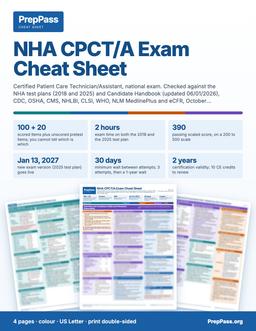
This guide is the teaching, read over weeks. If your exam is inside two weeks, the printable colour cheat sheet is the other product: the figures the exam turns on, laid out by section.
See the Patient Care Technician cheat sheet PDF — $9.99 →
4 pages · US Letter · printable PDF · yours to keep
What's included — and what isn't
Included
- Vitals, positioning/transfers, hygiene, pressure-injury staging, I&O
- Infection control: precautions, PPE don/doff, sharps & exposure response
Not included
- No printed copy is shipped — this is a file you download and can print yourself
- No video course, instructor or tutoring comes with the book — the free videos on the site are separate
Everything included, and everything that isn't
Included
- Phlebotomy: order of draw, tube additives, venipuncture technique
- EKG monitoring: V1–V6 placement, calibration, basic rhythms
- 55 original practice questions with answer explanations
- PDF (print & tab it) + EPUB (phone / e-reader)
Not included
- Not your exam registration or the testing centre's fee, which you still pay to the official body
Contents
See 7 sections and the page each one starts on
- Chapter 1 — Patient Care: Vital Signs, Mobility, Hygiene, and Daily Carep. 7
- Chapter 2 — Safety and Infection Controlp. 16
- Chapter 3 — Professional and Administrative Responsibilitiesp. 22
- Chapter 4 — Phlebotomyp. 28
- Chapter 5 — EKG Monitoringp. 33
- Practice Exam — 55 Questionsp. 38
- Answer Key with Explanationsp. 53
Taken from the PDF you download, with the page each one starts on — not typed here.
Read a chapter free, in full
One complete chapter, exactly as it ships in the eBook. Scroll the window to read it right here; no download, no email.
Read chapter 4 here, without leaving the page
We didn't give you the easy intro — the free chapter opens on one of the hardest-working parts of the book, so you can judge the teaching where the exam gets difficult.
Phlebotomy is memorization-heavy and unforgiving: the order of draw, the tube additives, the angle, and the specimen handling are either right or wrong, and a small error invalidates a result. Build a mental table for the tubes and drill it until recall is instant. Two rules frame the whole chapter: follow the order of draw to prevent additive carryover, and label every tube at the bedside before you leave the room. (Reminder: whether a patient care technician draws blood at all is set by your state, certification, and employer — see the disclaimer.)
4.1 Order of Draw and Tube Additives
The order of draw exists to prevent additive from one tube contaminating the next, which would skew results. The standard venous order (CLSI GP41) is:
- Blood culture bottles / sterile tubes — first, always, to maintain sterility and prevent contamination.
- Light blue — sodium citrate (coagulation, e.g., PT/INR); drawn immediately after cultures.
- Red or gold/SST — serum. A plain red tube has no additive and yields serum after the blood clots; an SST (gold/tiger) adds a clot activator and gel separator.
- Green — heparin (plasma chemistry).
- Lavender (purple) — EDTA (hematology, e.g., CBC).
- Gray — sodium fluoride (preserves glucose and lactate).
Memorize what each additive is for: lavender/EDTA = CBC and hematology; green/heparin = plasma chemistry; gray/sodium fluoride = glucose/lactate; light blue/citrate = coagulation.
4.2 Venipuncture Technique
Angle. Insert the needle at a 15 to 30 degree angle, bevel up. Too steep (90°) passes through the vein; too shallow (parallel) never enters it.
Vein selection. The median cubital vein in the antecubital area is the first choice — large, well-anchored, and away from the artery and major nerves. The cephalic is a second choice; the basilic is used with caution because it lies near the brachial artery and nerves.
Tourniquet time. Leave the tourniquet on no longer than 1 minute to prevent hemoconcentration, which falsely elevates results such as potassium and protein. Release it once blood flow is established.
Identify the patient with two identifiers before collecting any specimen — full name and date of birth are typical. A room or bed location is never an identifier.
Choose the arm and site with care. Avoid drawing from an arm on the side of a mastectomy with lymph-node removal, an arm with an active IV above the intended site (which dilutes the sample), and any area of hematoma, scarring, edema, or a fistula/graft. When only an IV arm is available, the draw is done below the IV after it has been paused per protocol, or the other arm or a different site is used — decisions that belong to the nurse when in doubt.
Fill coagulation tubes completely. A light-blue citrate tube must be filled to the line to keep the 9-parts-blood-to-1-part-additive ratio; a short-draw blue tube is rejected because it falsely prolongs clotting times.
Manage a fainting patient. If a patient becomes pale, sweaty, and light-headed (presyncope) during a draw, stop immediately, remove the needle and apply pressure, and lower the patient's head or lay them flat while you stay with them. You never continue the draw "to finish quickly" or walk a woozy patient to a chair.
4.3 Capillary Collection
Infant heel sticks are performed on the medial or lateral (side) plantar surface of the heel, avoiding the center of the heel and the bone (calcaneus) beneath it.
The capillary order of draw differs from venous: collect blood gases first, then EDTA (hematology), then other additive tubes, then serum. EDTA is collected early in a capillary draw to get a well-mixed hematology sample before clotting begins. Wipe away the first drop when indicated, as it may be diluted with tissue fluid.
4.4 Specimen Handling and Quality
Mix, do not shake. Gently invert additive tubes the recommended number of times immediately after collection to mix the additive. Shaking causes hemolysis — ruptured red cells that falsely elevate results such as potassium — as do too-small needles and excessive tourniquet time.
Label at the bedside. Label every tube immediately after collection, in the patient's presence, with the patient's name, identifiers, date, time, and your initials. Labeling later at the desk, or pre-labeling before the patient arrives, invites a wrong-patient error.
Confirm fasting status. For fasting tests (typically 8–12 hours), confirm and document whether the patient actually fasted; if a patient scheduled for a fasting glucose reports eating, notify the nurse or provider and document the non-fasting status before proceeding.
Key Numbers & Facts — Chapter 4 (memorize cold)
| Item | Value / rule |
|---|---|
| Order of draw | Cultures → light blue → red/gold → green → lavender → gray |
| Blood cultures | First (sterility) |
| Lavender (EDTA) | CBC / hematology |
| Green | Heparin — plasma chemistry |
| Gray (sodium fluoride) | Glucose / lactate |
| Light blue | Sodium citrate — coagulation (PT/INR) |
| Red (plain) | No additive → serum after clotting |
| Venipuncture angle | 15–30°, bevel up |
| First-choice vein | Median cubital |
| Tourniquet time | ≤ 1 minute (hemoconcentration) |
| Avoid drawing from | Mastectomy side, IV-above side, hematoma/edema/fistula |
| Light-blue citrate fill | Fill completely (9:1 ratio) |
| Presyncope during draw | Stop, withdraw, pressure, lay flat, stay |
| Infant heel stick | Medial/lateral plantar heel |
| Capillary order | Blood gases → EDTA → other additive → serum |
| Mix additive tubes | Gentle inversions — never shake (hemolysis) |
| Hemolysis falsely raises | Potassium |
| Labeling | Bedside, immediately, in the patient's presence |
| Fasting | Typically 8–12 h; report non-fasting |
Clinical Walkthrough — A Multi-Tube Draw
Orders come in for a coagulation panel, a chemistry panel, and a CBC. You confirm the patient with two identifiers, apply the tourniquet, and select the median cubital vein. You cannot find it for almost two minutes of palpating — stop: the tourniquet has been on too long (over one minute), so you release it, rest the arm, and reapply just before puncture, or the potassium will read falsely high. You enter at about 20°, bevel up, and draw in order: light blue citrate for the coagulation panel, then red/gold for chemistry, then lavender EDTA for the CBC. You gently invert each additive tube — no shaking, which would hemolyze the CBC and raise the potassium — and label every tube at the bedside before leaving. Every decision traces back to a number in the cram box.
Exam Traps — Chapter 4
- The order-of-draw carryover trap. Cultures first; light blue before lavender and gray. EDTA carried into a chemistry tube skews potassium and calcium.
- The tube-to-test mismatch trap. CBC = lavender/EDTA; glucose = gray/sodium fluoride; coagulation = light blue/citrate. Test-writers pair the right tube with the wrong test.
- The angle trap. Venipuncture is 15–30°, bevel up — not 90°, not parallel.
- The shake trap. Additive tubes are gently inverted; shaking causes hemolysis and a redraw.
- The label-later trap. Label at the bedside immediately, never at the desk afterward and never before the patient arrives.
- The tourniquet trap. Over 1 minute causes hemoconcentration — release and reapply, don't push through.
Questions buyers ask
How do I get it?
Pay, and the download appears on this page straight away. The links are also emailed to you. No account is required.
What if it isn't for me?
Email us within 14 days for a full refund, no questions asked.
Is the free practice going away?
No. Every practice question, the timed mock and the free chapters on this site stay free. This book is the studying half, not a gate around the free half.
More questions (15)
Can I read it on my phone?
Yes — the EPUB is for phones and e-readers, the PDF is for printing and tabbing. You get both.
Is a study guide enough for the Patient Care Technician (CPCT/A) exam, or do I need a course?
A book is exam review: it does not replace any education, training or experience National Healthcareer Association (NHA) requires before you may sit the exam, so check those requirements first. For the exam content itself, this 59-page guide teaches the material chapter by chapter with 55 practice questions and explanations inside, and 300 more practice questions are free on PrepPass. A prep course adds live instruction and a set schedule; whether you need one beyond any required education is your call.
What is the cheapest way to prepare for the Patient Care Technician (CPCT/A) exam?
Start with what costs nothing: 300 practice questions on PrepPass, with explanations and no signup. If you want it taught in one file you keep, the full study guide is $14.99 once; the printable cheat sheet for the last days is $9.99. No subscription on any of them.
Who administers the NHA Certified Patient Care Technician/Assistant (CPCT/A) Exam?
National Healthcareer Association (NHA) — exam delivered by a PSI testing center, a live remote proctoring provider, or the candidate's own school or employer. NHA states that where live remote proctoring is used, the proctoring provider is selected for the candidate at registration.
How many questions are on the NHA Certified Patient Care Technician/Assistant (CPCT/A) Exam?
120 questions (100 scored, 20 unscored pretest). 100 scored items plus 20 unscored pretest items, per NHA's test plan.
How long is the NHA Certified Patient Care Technician/Assistant (CPCT/A) Exam?
120 minutes
What is the passing score for the NHA Certified Patient Care Technician/Assistant (CPCT/A) Exam?
Scaled score of 390 on a 200–500 scale. This is a scaled score, not a percentage. NHA weights items by difficulty and does not publish the raw-to-scaled conversion, so it cannot be restated as a percentage or as a number of correct answers. Score reports additionally rate each content area as above, near or below the passing standard.
How much does the NHA Certified Patient Care Technician/Assistant (CPCT/A) Exam cost?
Not checked. NHA sells the exam through its store, which renders prices only in the browser; the page's HTML read on the retrieval date carries no amount, so PrepPass states none.
What languages is the NHA Certified Patient Care Technician/Assistant (CPCT/A) Exam offered in?
English. English only, stated affirmatively in the handbook rather than merely absent from it: NHA does not provide translated forms, translation aids or interpreters.
Does the Patient Care Technician (CPCT/A) study guide come as a PDF?
Yes — Patient Care Technician (CPCT/A) — Complete Study Guide (2026) downloads as PDF and EPUB, 59 pages. The download link is emailed the moment payment clears and does not expire.
How much does the Patient Care Technician (CPCT/A) study guide cost?
$14.99, once. There is no subscription and no account to create; the PDF and EPUB files are yours to keep.
Are there free Patient Care Technician (CPCT/A) practice questions?
Yes — 300 of them, free to use with no signup and an explanation on every one. They are separate from this study guide, which is what you are buying here. The same free, no-account system also has practice modes (adaptive, new questions, spaced review of misses, weak-topic focus, saved, my mistakes); a timed mock exam (100 questions, 170 minutes) with a score report by topic; a 10-question readiness check (about 5 minutes); 5 study chapters. None of it needs this study guide.
Can I read part of the Patient Care Technician (CPCT/A) study guide before buying?
Yes. A full chapter is free to read on this page — not a summary of one, the chapter itself.
What is the difference between the Patient Care Technician (CPCT/A) study guide and the cheat sheet?
The study guide ($14.99) teaches the material chapter by chapter and is meant to be read over weeks. The cheat sheet ($9.99, 4 pages) drops the teaching and keeps the figures: every number on the exam grouped by value so the confusable ones sit together, each reference page paired with a recall page that blanks the answers, and four routes by days left — 14, 7, 3, or tonight. They are separate purchases; neither replaces the other.
Is this the official Patient Care Technician (CPCT/A) study guide?
No. This is an independent study guide and is not affiliated with or endorsed by the exam's awarding body. It is written from CLSI order-of-draw / CDC precautions & PPE / ACC-AHA vitals / NPIAP staging / standard EKG references. Always confirm current requirements with the body that issues your licence.
Why buy the book when the practice is free?
Our practice questions and timed mock stay free — nothing on the site moves behind this book. The $14.99 book is the studying half: the material itself, taught in order, in a file you own.
- Systematic teaching — every exam section explained chapter by chapter, start to finish, not just questions
- Print it & tab it — a paper-ready PDF you can highlight, mark up, and bring to your study table
- Study anywhere, offline — EPUB on your phone or e-reader; no wifi, no browser tabs
- Everything in one place — the chapters and the practice questions in one file
- Yours for life — one-time $14.99, instant download, no subscription
The details
- Verified from the official source(CLSI order-of-draw / CDC precautions & PPE / ACC-AHA vitals / NPIAP staging / standard EKG references)
- 300 free practice questions
A patient care technician program runs $800–$3,000. This book teaches the same exam — same rules, verified to current standards — for a one-time $14.99 you keep for life.
Also free on PrepPass for Patient Care Technician (CPCT/A)
Beside this guide, PrepPass has a free study system for the same exam. It needs no account, and buying the guide does not unlock or change it: 300 practice questions with explanations; practice modes (adaptive, new questions, spaced review of misses, weak-topic focus, saved, my mistakes); a timed mock exam (100 questions, 170 minutes) with a score report by topic; a 10-question readiness check (about 5 minutes); 5 study chapters.
Progress is saved in your browser; a free account keeps it across devices. The readiness gauge reflects your own practice, not a prediction of the real exam result. How the practice works
One-time purchase, lifetime access to the download. The eBook is the full Patient Care Technician (CPCT/A) study guide in PDF and EPUB. Educational summary, not professional or legal advice — always confirm the current rules with the official source. Last updated: October 2026.