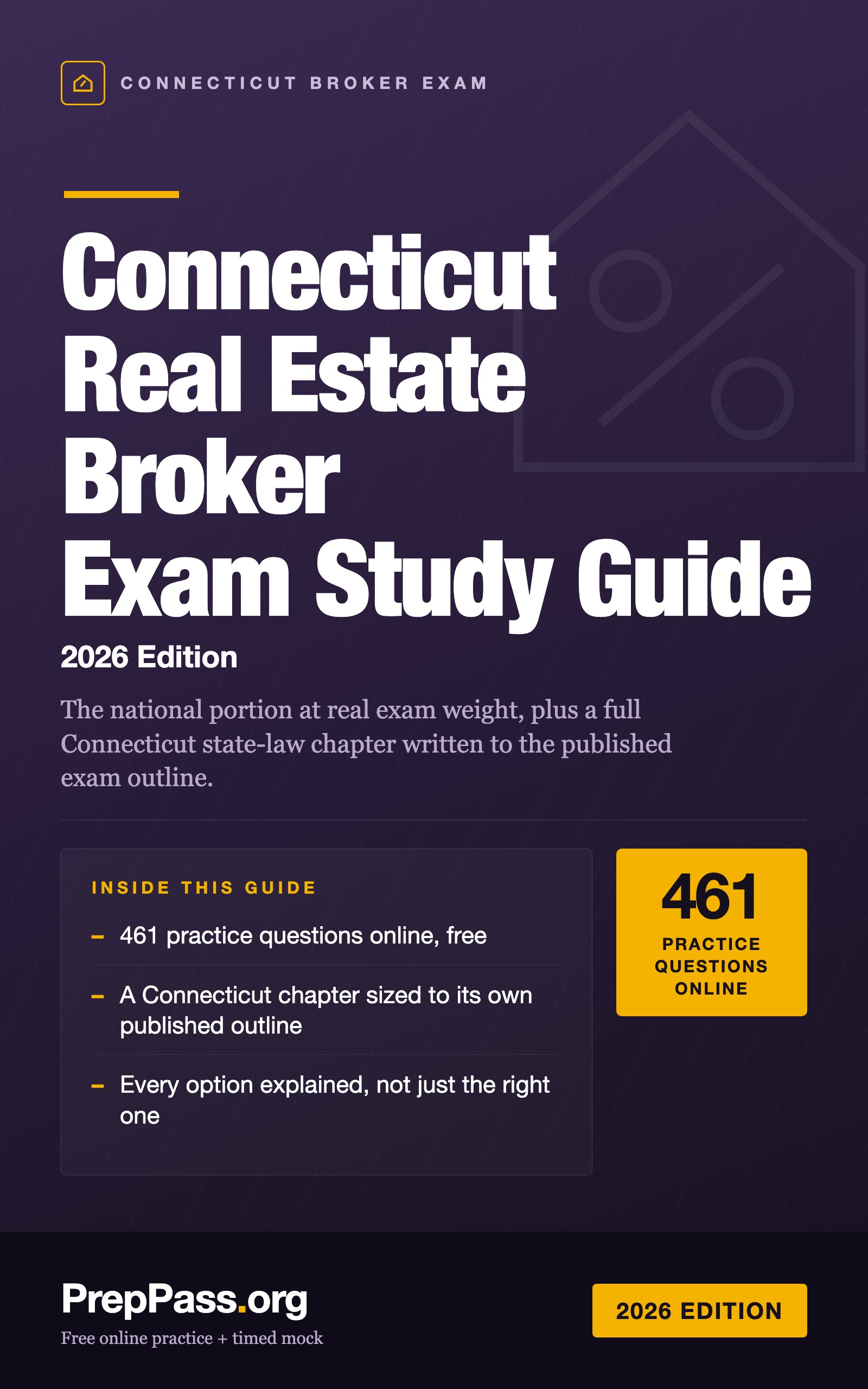
Connecticut Real Estate Broker · 2026 Edition
Connecticut Real Estate Broker Exam Study Guide (2026)
The national portion at real exam weight, plus a Connecticut chapter. The Connecticut chapter is sized to the published outline — 5 areas, 45 scored items — area by area, not flattened.
- All 8 chapters of the national portion plus a full Connecticut real-estate-law chapter — PDF + EPUB you keep
- A 60-question national practice exam, with a key that explains all four options and not just the right one
- 20 Connecticut law questions of its own, with a worked answer key
PDF + EPUB · English · 307 pages · $14.99 one-time
This book is written in English.
Instant download after payment — no account needed, no subscription. Refund policy
Try 10 questions first — free
Answer all 10, then see every answer explained — with the section of this guide that teaches it. About 5 minutes, no sign-up.
Start 10 free questionsLook inside the book
Three real pages, rendered straight from the PDF you download — a teaching page, a worked question, and a reference page. Nothing here was redrawn to look better.
- Quick referencePart C — Encumbrances a broker must read off a title report · PDF page 102
A page you can turn back to: the numbers, deadlines or terms gathered in one place.
- A question, workedAnswer Key and Explanations · PDF page 174
A practice question with its answer and the reasoning behind it — not just a key.
- How it's taughtPart II — Connecticut State Law & Practice · PDF page 302
An explanation page: the material taught in prose, in the order the exam tests it.
What's included — and what isn't
Included
- A Connecticut chapter written to the published exam outline, area by area
- Where Connecticut law departs from the national rule — both stated, so neither is guessed
- Supervision, trust accounts, brokerage operation and broker math
- A Connecticut practice set with every option explained, not just the right one
- 461 practice questions online, free, from the same bank
- PDF (print & tab it) + EPUB (phone / e-reader)
Not included
- No printed copy is shipped — this is a file you download and can print yourself
- No video course, instructor or tutoring comes with the book — the free videos on the site are separate
- Not your exam registration or the testing centre's fee, which you still pay to the official body
Contents
See 29 chapters and the page each one starts on
- Part C — Advertising and recordkeeping compliancep. 14
- Part D — Consumer contact and transaction integrityp. 16
- 2. Trust Funds, Escrow, and the Client’s Moneyp. 30
- Part C — Records that survive an auditp. 33
- Part D — Disputed moneyp. 34
- 3. Agency at the Broker Levelp. 40
- Part C — Fiduciary duties, at the level a broker is examined onp. 44
- Part D — Dual agency, designated agency, and the alternativesp. 46
- 4. Contracts and Brokerage Agreementsp. 55
- Part C — Options, rights of first refusal, and installment contractsp. 60
- Part D — Between contract and closingp. 61
- 5. Fair Housing, Accessibility, and Antitrust: The Exposure You Carry Personallyp. 72
- Part C — The exemptions, and why they rarely save anyonep. 78
- Part D — Disability: the distinction the exam always testsp. 79
- 6. Ownership, Land Use Controls, and Transfer of Titlep. 95
- Part C — Encumbrances a broker must read off a title reportp. 101
- Part D — Legal descriptionsp. 103
- 7. Valuation, Financing, and the Federal Lending Lawsp. 113
- Part C — The instrumentsp. 121
- Part D — Loan programs, structures, and qualifyingp. 123
- 8. Disclosures, Environmental Risk, and Property Managementp. 136
- Part C — The management agreement and the manager’s authorityp. 142
- Part D — Leases and tenanciesp. 144
- Practice Exam — 60 Questionsp. 153
- Answer Key and Explanationsp. 170
- Appendix A — Broker Math Cheat Sheetp. 221
- Appendix B — Glossaryp. 243
- Appendix C — Exam-Day Strategyp. 262
- Part II — Connecticut State Law & Practicep. 267
Taken from the PDF you download, with the page each one starts on — not typed here.
Read a chapter free, in full
One complete chapter, exactly as it ships in the eBook. Scroll the window to read it right here; no download, no email.
Read chapter 9 here, without leaving the page
We didn't give you the easy intro — the free chapter opens on one of the hardest-working parts of the book, so you can judge the teaching where the exam gets difficult.
What the Connecticut portion actually is
The Connecticut broker examination is delivered by PSI. Everything below is read out of PSI candidate information bulletin 1007, updated 13 November 2025.
| Items | Points | Time | |
|---|---|---|---|
| General (national) | 75 | 80 | 120 minutes |
| Connecticut state | 45 | 40 | 60 minutes |
| Both | 120 | 125 (see below) | 180 minutes |
Two things about that table you need to be told
First, the pass mark for a broker is 75 percent, not 70. The bulletin's words are: "In order to pass the Broker examinations, you must receive a score of at least 75%." The 70 percent you will find quoted in a great deal of Connecticut prep material — including, until recently, our own — is the salesperson standard printed elsewhere in the very same bulletin. If a guide tells you 70 percent and does not say "salesperson" next to it, that guide has copied the wrong row.
Second, the bulletin's points column does not add up. Seventy-five general items are worth 80 points and 45 state items are worth 40 points; 80 plus 40 is 120, but the "Both" row prints 125 points. We are not going to pretend that away. It is an inconsistency in the vendor's own document. Drive your planning off the item counts, which are internally consistent, and not off the points. Forty-five state items in sixty minutes is 80 seconds an item, and that is the number that matters when you sit down.
The five areas, and their published broker item counts
| # | Area | Broker items | Share |
|---|---|---|---|
| I | Connecticut real estate licensing requirements | 7 | 15.6% |
| II | Connecticut laws governing the activities of licensees | 12 | 26.7% |
| III | Connecticut real estate agency | 10 | 22.2% |
| IV | Connecticut-specific real estate laws | 8 | 17.8% |
| V | Brokers exam only | 8 | 17.8% |
Area V has no salesperson column at all. It is eight items — nearly a fifth of the Connecticut portion — on record keeping, escrow accounts, the broker's lien, notice of commission rights in commercial transactions, referrals and cooperation with out-of-state brokers, supervision, mortgage brokerage fees charged by brokers, and the custodial broker. A candidate revising from a salesperson book has not merely skimmed this material; that candidate has never encountered it. This chapter gives Area V its full share, and the same is true for the rest: the sections below are sized to the published counts, so Area II gets roughly twice the space Area I does because it carries roughly twice the items.
Unlike several states, Connecticut's bulletin does print lettered subtopics under all five areas, and this chapter follows them as its internal structure.
What the bulletin does not publish
PSI bulletin 1007 publishes no statute or regulation reference list for the Connecticut state portion. Its "Examination Study Materials" section lists commercial textbooks plus a generic pointer to "State of Connecticut, Real Estate Statutes and Regulations Concerning the Conduct of Real Estate Brokers and Salespersons, www.ct.gov/dcp." That is the whole of it.
We record that absence rather than manufacture a vendor citation list. Every C.G.S. and Conn. Agencies Regs. citation in this chapter is ours, read out of the current General Statutes and regulations, and must not be taken as the vendor's.
The regulator. The Connecticut Real Estate Commission is created inside the Department of Consumer Protection — C.G.S. Sec. 20-311a(a): "There is created in the Department of Consumer Protection the Connecticut Real Estate Commission." Eight members appointed by the Governor: three brokers, two salespersons, three public members. Under Sec. 20-311b(b) the commission authorizes the department to issue licenses, and under subsection (c) it administers licensure, renewal, suspension and revocation. Most states have a freestanding real estate commission; Connecticut's sits inside a consumer-protection department, and the practical consequence is that DCP administers while the commission decides.
Area I — Connecticut real estate licensing requirements (7 items, 15.6%)
Eight lettered subtopics: Commission purpose, powers and duties; activities requiring a license; exemptions; license types and qualifications; renewal, continuing education and transfer; the Real Estate Guaranty Fund; suspension and revocation; and registrations.
A. Commission purpose, powers and duties
Covered above. The point worth carrying into the exam is the split: the commission authorizes; the department issues. A trade association — the Connecticut Association of Realtors — holds no state licensing power at all, the Secretary of the State handles business-entity filings, and the Department of Banking supervises lenders and mortgage brokers. Each of those is a plausible-sounding wrong answer, and each is doing a genuinely different job.
B. Activities requiring a license, and C. exemptions
Sec. 20-311(15) defines engaging in the real estate business as acting for another, for a fee or other valuable consideration, to negotiate for or offer to list, sell, exchange, buy or rent an interest in real estate. The operative words are for another and for consideration.
Sec. 20-329 excepts, among others: an owner or lessor performing those acts with reference to property the owner owns, leases or seeks to acquire or lease (subdivision (1)); attorneys-at-law and attorneys-in-fact; fiduciaries; government employees; leasing agents; and — subdivision (11) — an unlicensed clerical employee of a broker.
The clerical exception is narrow, and it is drawn as a list of prohibitions. That person shall not: negotiate the terms of an agreement; list a property except on behalf of a licensee; open or be listed as a signatory on a broker's escrow or trust account; or sell, buy or lease real property for another for compensation.
Where this bites. An "assistant" who shows listings is soliciting and negotiating, not filing. The exception does not reach that conduct however the person is paid. And the trust-account signatory bar matters because Sec. 20-324k makes the broker accountable for that account — putting an unlicensed person on the signature card is a licensure problem before it is ever a money problem.
The trap. A friend who negotiates a purchase "for a share of the savings" is acting for another for valuable consideration. Calling the payment a share of savings rather than a commission changes nothing.
D. License types and qualifications
Public Act 23-84 gave Connecticut three tiers: the salesperson (Sec. 20-311(27)); the associate broker (Sec. 20-311(3)) — a real estate broker who is affiliated with or employed by a supervising licensee and who has authority to engage in the real estate business on that supervising licensee's behalf; and the supervising licensee (Sec. 20-311(31)).
Broker eligibility, Sec. 20-314(d)(1)(A). Three years actively engaged as a licensed salesperson under a supervising licensee immediately preceding the application; at least 1,500 hours in the real estate business in that period, certified by the supervising licensee; at least four closed transactions in those same three years (subparagraph (A)(vi)); and 120 classroom hours — 60 in principles and practices, 15 in legal compliance, 15 in brokerage principles and practices, and two 15-hour electives. Subdivision (2) waives the two elective courses only for an applicant with at least twenty transactions in the preceding five years.
The trap. Two years is the figure many neighboring states use and many study guides repeat. Connecticut's statute says three. No other hour total than 1,500 appears in Sec. 20-314.
E. Renewal, continuing education and transfer
Licenses expire biennially (Sec. 20-314(f)); DCP renews broker licenses on 30 November of every even-numbered year. Sec. 20-319(b) sets continuing education at not less than twelve hours of approved classroom study in each two-year period, plus an eight-dollar processing fee. The same subsection permits the requirement to be met instead by passing a written examination on current practice and law.
Note the shape as well as the number: a single two-year total, not an annual quota. A salesperson or associate broker changing affiliation registers the transfer and pays $25 under Sec. 20-319a.
F. The Real Estate Guaranty Fund
Sec. 20-324a lets a person aggrieved by a licensee's embezzlement, false pretenses, forgery, fraud, misrepresentation or deceit recover, on commission approval of an application under Sec. 20-324e, compensation "in an amount not exceeding in the aggregate the sum of twenty-five thousand dollars in connection with any one real estate transaction or claim, regardless of the number of persons aggrieved or parcels of real estate involved."
That aggregate wording is the item. The cap is not raised by adding claimants. Ten people harmed in one transaction share $25,000; they do not draw $25,000 each.
The route to the fund. Sec. 20-324e(b) requires a valid Superior Court judgment first and exhaustion of collection; Sec. 20-324d requires application within two years; and Sec. 20-324e(f) bars the licensee from a new license until the fund is repaid with interest.
G. Suspension and revocation
Sec. 20-320 lets the commission suspend or revoke and, in addition to or in lieu of that, impose a fine of not more than $5,000 per violation, on thirteen listed grounds. And the sentence candidates miss: every fine collected under the section is deposited in the Real Estate Guaranty Fund. A fine is not restitution — the consumer's route is the Sec. 20-324e application after judgment — and it is not commission operating revenue.
H. Registrations: teams and associate brokers
Since Public Act 21-167, effective 1 January 2022, each team registers with the department under Sec. 20-312(e). The initial registration is valid one year and costs $565; renewal is $375 for additional one-year periods.
Three figures live close together here and are routinely swapped. $565 is the initial team registration. $375 is the team renewal. $25 is Sec. 20-319a — a change to or transfer of a team registration, and a salesperson's or associate broker's transfer of affiliation. And note that team registrations run one year while licenses renew biennially: they are on different clocks.
See "What changed recently" on why the team provision is so often misattributed to the wrong public act.
Area II — Connecticut laws governing the activities of licensees (12 items, 26.7%)
The largest block on the Connecticut portion. Eight subtopics.
A. The broker/salesperson relationship
Sec. 20-312a is the sentence to memorize: "in any action brought by a third party against a real estate salesperson affiliated with a real estate broker as an independent contractor, such broker shall be liable to the same extent as if such affiliate had been employed as a real estate salesperson by such broker."
What it means. The independent-contractor label changes the tax and employment relationship. It changes nothing about the broker's exposure to third parties. Sec. 20-320(b) reinforces it: compliance with the chapter relieves nobody of responsibility for the conduct of their agents, employees or officers.
The trap. Candidates reach for the independent-contractor agreement as a shield, or try to scale the broker's liability to the commission split the broker actually retained. Neither appears in the statute, and the split is a private accounting between broker and affiliate.
Sec. 20-320(a)(4) adds the other half of the relationship: it is a disciplinary ground for a licensee to represent, or attempt to represent, a broker other than that licensee's own affiliated or supervising licensee, without the express knowledge and consent of that supervising licensee. A listing is a contract between the client and the brokerage, not property of the individual salesperson, and who pays a referral fee has no bearing on the consent requirement.
B. Duties to parties
Conn. Agencies Regs. Sec. 20-328-2a(a): a licensee shall not undertake to provide professional services concerning a property or its value where the licensee has a present or contemplated interest unless that interest is specifically disclosed to all affected parties.
The duty is satisfied by disclosure, not by withdrawal. A rule requiring the licensee to step out of the deal states a stricter obligation than Connecticut imposes. And the disclosure is affirmative — making it contingent on a party thinking to ask reverses the burden the regulation places on the licensee. The commission licenses and disciplines under Sec. 20-311b; it does not pre-approve individual transactions.
Subsection (g) of the same regulation bars placing any sign on a property without the owner's or lessor's written consent.
Sec. 20-320(a)(7) requires immediate delivery of a copy of any instrument to each party who executes it, where the instrument was prepared by the licensee or under the licensee's supervision. Connecticut uses no grace period here. Three days, ten days, and "at closing" all read a deadline into a statute whose text contains none, and each would leave a signing party without the document that binds them.
C. Handling of deposits and other monies
The account, Sec. 20-324k(a). Each broker who receives, accepts and holds any moneys on behalf of any principal, client or other person shall at all times maintain a separate escrow or trust account, distinct from his own account, in a bank of his choice doing business in this state.
Running client money through the brokerage operating account is commingling however carefully it is ledgered — and Sec. 20-320(a)(10) makes commingling a disciplinary ground. An account in the broker's own name fails the "distinct from his own account" requirement whether or not it earns interest.
The deadline, Sec. 20-324k(c): three banking days. And read the trigger carefully — the money goes in "within three banking days of the date the agreement evidencing such transaction is signed by all necessary parties," pending final legal disposition. The clock runs from full execution of the agreement, not from the moment the broker takes the check. An option that starts the count at receipt misstates the trigger before its number is even considered.
Sec. 20-324k(b) lets the commission examine and audit the trust account whenever it deems necessary. Subsection (e) makes a willful violation punishable by a fine of up to $1,000, six months' imprisonment, or both.
Disputed money. Where buyer and seller make conflicting demands, the broker is a stakeholder and holds "pending final legal disposition ... in accordance with the instructions of the person legally entitled to such moneys." Connecticut then gives the broker a way out of the middle: under Sec. 20-324k(d) the court may, on motion, order the broker to deposit the funds with the court, and on receipt it shall also dismiss any claim against the broker that rests solely on the broker's stakeholder role. Releasing to whoever demands first makes the broker the judge of a contract dispute; splitting it evenly decides the dispute just as surely, only in halves; and applying it to the commission is conversion of client money.
D. Misrepresentation — and the four money figures
Connecticut's chapter carries several different dollar figures, and the exam tests whether you can keep them apart. Learn them as a set:
| Provision | Figure | Nature |
|---|---|---|
| Sec. 20-324 — willful misrepresentation on a license application | $500, or 6 months, or both | criminal |
| Sec. 20-325 — engaging in the business without a license | $1,000 per violation, or 6 months, or both | criminal |
| Sec. 20-324k(e) — willful escrow violation | $1,000, or 6 months, or both | criminal |
| Sec. 20-312(d) / Sec. 20-320(a) — commission discipline | $5,000 per violation | administrative |
No provision of the chapter sets a $10,000 penalty. And note that the administrative $5,000 and the criminal $1,000 sit in different sections doing different jobs — see "What changed recently," because the $5,000 figure is new.
E. Disclosure of material and nonmaterial facts
Sec. 20-311(21) defines a nonmaterial fact concerning real property to include, but not be limited to, the facts that (A) an occupant is or has been infected with a disease on the Commissioner of Public Health's reportable list, or (B) the property was at any time suspected to have been the site of a death or felony.
The category is narrow and stigma-related. Water in the basement, a roof replaced after storm damage, a disputed boundary encroachment — those are physical conditions of the property, and the residential condition report prescribed by Sec. 20-327b asks the seller about each of them by name. That is the clearest signal that Connecticut treats them as facts to be disclosed, not as nonmaterial ones.
Two safe harbors sit beside the definition, and they have an unusual shape worth understanding:
- Sec. 20-327f — written notice of the availability of hazardous waste facility lists;
- Sec. 20-327g — written notice that a list of local properties used for hunting or shooting sports may be available at the town clerk's office.
Under Sec. 20-327g(a), on giving that written notice before or upon entering the contract, the seller and any licensee "shall be deemed to have fully satisfied any duty to disclose ... even if (1) the list is not available at the office of the town clerk, or (2) there is an error, omission or inaccuracy in the list." Subsection (c) says expressly that no seller or licensee shall be required to compile the list or contribute to compiling it, and subsection (b) says nothing in the section imposes liability for failing to disclose those properties.
The notice is the whole of the obligation. Requiring the seller to obtain the list and attach it adds a step the statute does not, and reading the safe harbor as a source of liability inverts it.
F. Advertising
Sec. 20-312c(d): each associate broker shall comply with all advertising requirements applying to brokers, and shall include the name of the supervising licensee who controls and supervises that associate broker, at a prominent location in all of the associate broker's advertisements. The point is that a consumer can see which brokerage stands behind the ad. The subsection asks for no license number, no issue date and no office address.
Sec. 20-312(e)(1) sets parallel naming rules for team advertising.
G. Commissions and compensation
Sec. 20-325b requires every written agreement fixing a broker's compensation to carry, in not less than ten-point boldface type or otherwise standing out from the surrounding text: "NOTICE: THE AMOUNT OR RATE OF REAL ESTATE BROKER COMPENSATION IS NOT FIXED BY LAW. IT IS SET BY EACH BROKER INDIVIDUALLY AND MAY BE NEGOTIABLE BETWEEN YOU AND THE BROKER."
The notice exists precisely to contradict the belief that some authority sets the rate. An answer naming the commission as the rate-setter states what the statute is written to deny; a ceiling tied to what is "customary in the local market" is the same error in softer form, and agreeing rates by reference to a market custom carries antitrust exposure of its own.
Before you buy
- How do I get it?
- Pay, and the download appears on this page straight away. The links are also emailed to you. No account is required.
- What if it isn't for me?
- Email us within 14 days for a full refund, no questions asked.
- Is the free practice going away?
- No. Every practice question, the timed mock and the free chapters on this site stay free. This book is the studying half, not a gate around the free half.
- Can I read it on my phone?
- Yes — the EPUB is for phones and e-readers, the PDF is for printing and tabbing. You get both.
The details
The national portion at real exam weight, plus a Connecticut chapter. The Connecticut chapter is sized to the published outline — 5 areas, 45 scored items — area by area, not flattened.
- Format: PDF + EPUB download · 307 pages
- 80 practice questions in the book, with a full answer key
- 461 free practice questions for this exam on PrepPass, included at no cost
- $14.99 one-time — no subscription
- 14-day money-back guarantee · refund policy
- Cross-referenced against: C.G.S. ch. 392, Secs. 20-311 to 20-329hh · C.G.S. Sec. 20-311(3) · C.G.S. Sec. 20-312(d) · C.G.S. Sec. 20-312(e) · PSI bulletin 1007 (rev 2025-11-13)
- Last updated: September 2026
- Verified from the official source(C.G.S. ch. 392, Secs. 20-311 to 20-329hh · C.G.S. Sec. 20-311(3) · C.G.S. Sec. 20-312(d) · C.G.S. Sec. 20-312(e) · PSI bulletin 1007 (rev 2025-11-13))
- 461 free practice questions
- Instant download, yours for life
a real estate broker pre-license course runs $200–$1,000. This book teaches the same exam — same rules, verified to current standards — for a one-time $14.99 you keep for life.
Why buy the book when the practice is free?
Our practice questions and timed mock stay free — nothing on the site moves behind this book. The $14.99 book is the studying half: the material itself, taught in order, in a file you own.
- Systematic teaching — every exam section explained chapter by chapter, start to finish, not just questions
- Print it & tab it — a paper-ready PDF you can highlight, mark up, and bring to your study table
- Study anywhere, offline — EPUB on your phone or e-reader; no wifi, no browser tabs
- Everything in one place — chapters, per-chapter cram sheets, and practice questions in one file
- Yours for life — one-time $14.99, instant download, no subscription
And it's risk-free: 14-day money-back guarantee — not satisfied? Email us for a full refund, no questions asked. See the refund policy.
14-day money-back guarantee · full refund, no questions asked.
One-time purchase, lifetime access to the download. The eBook is the full Connecticut Real Estate Broker study guide in PDF and EPUB. Educational summary, not professional or legal advice — always confirm the current rules with the official source. Last updated: September 2026.