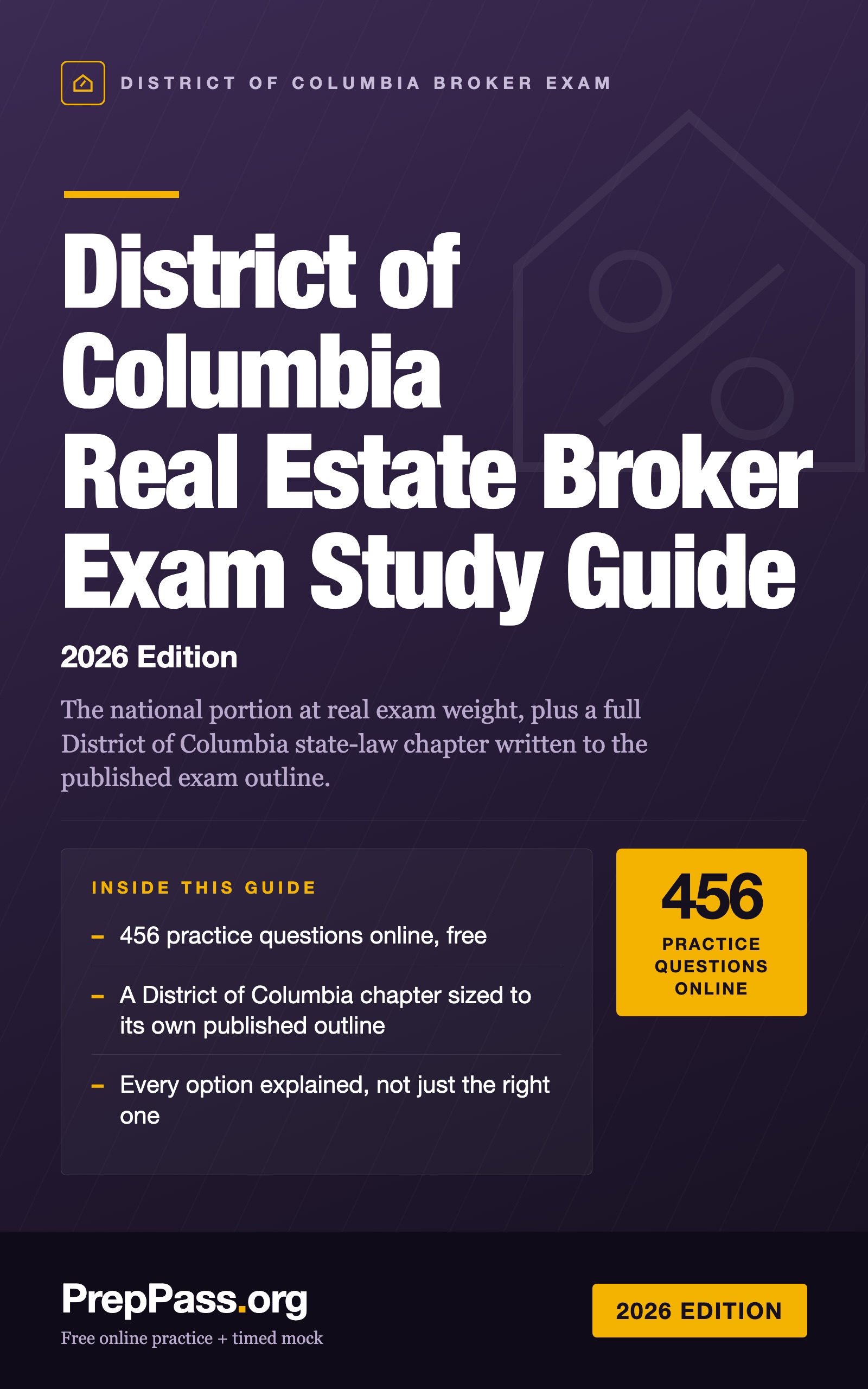
District of Columbia Real Estate Broker · 2026 Edition
District of Columbia Real Estate Broker Exam Study Guide (2026)
The national portion at real exam weight, plus a District of Columbia chapter. The District of Columbia chapter is sized to the published outline — 4 areas, 40 scored items — area by area, not flattened.
- All 8 chapters of the national portion plus a full District of Columbia real-estate-law chapter — PDF + EPUB you keep
- A 60-question national practice exam, with a key that explains all four options and not just the right one
- 20 District of Columbia law questions of its own, with a worked answer key
PDF + EPUB · English · 310 pages · $14.99 one-time
This book is written in English.
Instant download after payment — no account needed, no subscription. Refund policy
Try 10 questions first — free
Answer all 10, then see every answer explained — with the section of this guide that teaches it. About 5 minutes, no sign-up.
Start 10 free questionsLook inside the book
Three real pages, rendered straight from the PDF you download — a teaching page, a worked question, and a reference page. Nothing here was redrawn to look better.
- How it's taughtPart D — Disability: the distinction the exam always tests · PDF page 86
An explanation page: the material taught in prose, in the order the exam tests it.
- Quick referencePart C — Encumbrances a broker must read off a title report · PDF page 102
A page you can turn back to: the numbers, deadlines or terms gathered in one place.
- A question, workedAnswer Key and Explanations · PDF page 174
A practice question with its answer and the reasoning behind it — not just a key.
What's included — and what isn't
Included
- A District of Columbia chapter written to the published exam outline, area by area
- Where District of Columbia law departs from the national rule — both stated, so neither is guessed
- Supervision, trust accounts, brokerage operation and broker math
- A District of Columbia practice set with every option explained, not just the right one
- 456 practice questions online, free, from the same bank
- PDF (print & tab it) + EPUB (phone / e-reader)
Not included
- No printed copy is shipped — this is a file you download and can print yourself
- No video course, instructor or tutoring comes with the book — the free videos on the site are separate
- Not your exam registration or the testing centre's fee, which you still pay to the official body
Contents
See 29 chapters and the page each one starts on
- Part C — Advertising and recordkeeping compliancep. 14
- Part D — Consumer contact and transaction integrityp. 16
- 2. Trust Funds, Escrow, and the Client’s Moneyp. 30
- Part C — Records that survive an auditp. 33
- Part D — Disputed moneyp. 34
- 3. Agency at the Broker Levelp. 40
- Part C — Fiduciary duties, at the level a broker is examined onp. 44
- Part D — Dual agency, designated agency, and the alternativesp. 46
- 4. Contracts and Brokerage Agreementsp. 55
- Part C — Options, rights of first refusal, and installment contractsp. 60
- Part D — Between contract and closingp. 61
- 5. Fair Housing, Accessibility, and Antitrust: The Exposure You Carry Personallyp. 72
- Part C — The exemptions, and why they rarely save anyonep. 78
- Part D — Disability: the distinction the exam always testsp. 79
- 6. Ownership, Land Use Controls, and Transfer of Titlep. 95
- Part C — Encumbrances a broker must read off a title reportp. 101
- Part D — Legal descriptionsp. 103
- 7. Valuation, Financing, and the Federal Lending Lawsp. 113
- Part C — The instrumentsp. 121
- Part D — Loan programs, structures, and qualifyingp. 123
- 8. Disclosures, Environmental Risk, and Property Managementp. 136
- Part C — The management agreement and the manager’s authorityp. 142
- Part D — Leases and tenanciesp. 144
- Practice Exam — 60 Questionsp. 153
- Answer Key and Explanationsp. 170
- Appendix A — Broker Math Cheat Sheetp. 221
- Appendix B — Glossaryp. 243
- Appendix C — Exam-Day Strategyp. 262
- Part II — District of Columbia State Law & Practicep. 267
Taken from the PDF you download, with the page each one starts on — not typed here.
Read a chapter free, in full
One complete chapter, exactly as it ships in the eBook. Scroll the window to read it right here; no download, no email.
Read chapter 9 here, without leaving the page
We didn't give you the easy intro — the free chapter opens on one of the hardest-working parts of the book, so you can judge the teaching where the exam gets difficult.
What the District of Columbia portion actually is
The District of Columbia broker examination is delivered by PSI. Everything in this section is read out of PSI candidate information bulletin 5587, updated 6/3/2026 (copyright line: "Copyright (c) 2026 by PSI Services LLC").
| Items | Points | Time | |
|---|---|---|---|
| General (national) | 75 | 80 | 120 minutes |
| District of Columbia state | 40 | 40 | 90 minutes |
| Both portions in one sitting | 115 | 120 | 210 minutes |
Passing standard: 75%.
The number everybody gets wrong, and why
Look at the row for both portions. The broker examination is 115 items. The 120 is a POINTS total, not an item count. Seventy-five general items and forty state items make 115 questions; the same table values those 75 general items at 80 points, and 80 plus 40 makes 120.
The bulletin explains its own arithmetic in a footnote: "National broker exams include questions that are scored up to two points." Some general items are worth more than one point; that is the whole of the mystery. A guide calling the broker examination "120 questions" has read the points column as an item column. The number that matters when you sit down is 2.25 minutes an item on the state portion, where forty items get ninety minutes.
Now the second error, which is more common still. You will be told everywhere that the national broker portion is 80 items. It is 75. The 80 is real, but it is the salesperson general portion, which the same table in the same bulletin gives as 80 items — two adjacent rows, two different examinations. If a source says "80-item national portion" without printing the word salesperson next to it, it has taken the salesperson's row.
Four separate outlines live in that document
Bulletin 5587 carries four content outlines: a general portion for salespersons and brokers; a state portion for salespersons and brokers, the one taught in this chapter; and a general and a state portion for property managers, 40 items each.
The property manager state outline is a single area running on rent control, DOPA, TOPA and evictions. It looks like a District of Columbia real estate law outline because it is one — for a different credential. Do not revise from the property manager blocks, or you will prepare rent control and eviction procedure at a grain the broker portion does not test and skip the licensure, escrow, supervision and brokerage-entity material it does.
The four broker areas and their published counts
| # | Area | Broker items | Share |
|---|---|---|---|
| I | Duties and powers of the Real Estate Commission | 5 | 12.5% |
| II | Licensing requirements | 6 | 15% |
| III | Statutory requirements governing the activities of licensees | 24 | 60% |
| IV | Responsibilities specific to brokerage practice | 5 | 12.5% |
Area III is 60 percent of the District of Columbia portion, in one block — twenty-four of the forty state items under a single heading. That should reorganize your revision, because two things candidates expect to be areas in their own right are buried inside it:
- Agency is sub-item III.I, with III.I.1 (disclosure of relationships) and III.I.2 (fiduciary duties) beneath it. In several neighboring states agency is a top-level block worth a fifth of the state examination; a candidate carrying that expectation into the District will look for an agency section, fail to find one, and wrongly conclude the District tests agency lightly.
- The tenant's right to purchase — TOPA — is ONE lettered sub-item, III.H. One letter, for the most distinctive body of real property law the District has, with no national counterpart at all and two cutbacks in the last eight years; see "What changed recently."
This chapter is sized to those counts: Area III gets roughly sixty percent of the teaching text and twelve of the twenty printed questions, structured on its eighteen lettered and numbered subtopics — A advertising and technology through K.2 District of Columbia regulations.
The bulletin publishes no reference list — so the citations here are ours
This is unusual and has to be said plainly. PSI bulletin 5587 has no statute or regulation reference list for the District of Columbia state portion. Its entire "STUDY MATERIALS" section reads:
"Obtain DC regulations document to study for the examination. You can access the 'Real Estate Legislation and Regulations' at this link https://govservices.dcra.dc.gov/newoplalicenses. This is the ONLY Commission supplied material for use in preparing for the law portion of the DC real estate examination."
That URL is a DCOPLA licensing landing page, not a document: no linked PDF of statutes, no chapter list, no citation. There is nothing to check for currency and nothing to reproduce.
We will not manufacture a vendor list to fill the gap. Every D.C. Official Code and DCMR citation in this chapter is ours, derived from the published subtopics and read out of the current Code and DCMR. They are not the vendor's and should not be represented as the vendor's.
Deriving them turned up three traps that circulating material walks into.
Trap one: the licensure statute is Subchapter I-B, not Subchapter IV. Real estate licensure sits in D.C. Official Code Title 47, Chapter 28, Subchapter I-B, §§ 47-2853.01 to 47-2853.30. Material in circulation points candidates at "Title 47, chapter 28, subchapter IV" — but Subchapter IV is captioned "Other Licenses," and its Part D is "Professional Engineers. [Repealed]." There is no real estate there.
Trap two: half of Title 42, Chapter 17 is a graveyard. The Real Estate Licensure Act of 1982 lives at Title 42, Chapter 17, and its Subchapter I, §§ 42-1701 to 42-1709, is in force and does real work — licensee duties, escrow, the written listing requirement, the Guaranty and Education Fund. But Subchapter II is captioned "Repealed Provisions," and the surviving sections still cross-refer to § 42-1755(f) and §§ 42-1753 to 42-1763 — all repealed. Those are dead ends: follow one and you land on a repeal note, not on law.
Trap three: the DCMR is stale on the agency's name. 17 DCMR Chapter 26 (Real Estate Licenses), §§ 2600 to 2699, is the operative rulebook and is in force. But § 2600.2 still names the "Department of Consumer and Regulatory Affairs." DCRA's licensing functions moved in 2022 to the Department of Licensing and Consumer Protection, and the rule text was never conformed. The two names refer to the same function; the current one is the Department of Licensing and Consumer Protection, whose licensing arm DCOPLA is the office you deal with. Do not key anything to the agency name as the DCMR prints it — and do not read "DCRA" in a rule as evidence the rule is obsolete. Only the name is.
Two further repeals: § 47-2853.19 (cease and desist orders) is repealed — see now § 47-2844.01 — and § 47-2853.17(c)(8) still cross-refers to it. And three provisions of the TOPA subchapter are marked [Not Funded] and are not in effect: § 42-3404.02c, § 42-3404.02d and § 42-3404.15 (the TOPA transparency portal). Nothing here is authored from them.
One regulator, two names
§ 47-2853.06(h) establishes a Board of Real Estate of nine members — three brokers, two salespersons, two property managers, a District bar member engaged in real estate law, one consumer member — which "shall regulate the practices of real estate brokers, real estate salespersons, and property managers." Mayor's Order 2009-11 (2 February 2009) re-designated it the Real Estate Commission. Both names appear in current law and both are correct.
Area I — Duties and powers of the Real Estate Commission (5 items, 12.5%)
Five of forty items, across four subtopics: general powers; investigations, hearings and appeals; disciplinary actions (sanctions, suspension and revocation, and fines are called out separately); and administration of the Guaranty and Education Fund.
A. General powers
§ 47-2853.08 lists what the Commission does: sets the scope of practice; sets the requirements for licensure and renewal, including continuing education; decides reciprocity and endorsement; hears protests from applicants denied a license; and receives and decides complaints against licensees.
Note what is not on that list. The Council of the District of Columbia drafts the statute, and the Commission does not issue the license paper in its own name: under 17 DCMR § 2600.2 it sits under the administrative control of the Mayor through the District's licensing department, and the formula throughout Subchapter I-B is that the board directs the Mayor to act.
B. Investigations, hearings and appeals
§ 47-2853.22(a) entitles the licensee to a hearing before a license is denied, suspended or revoked, before a reprimand or civil fine, and before remediation or probation. Notice goes by certified mail to the last known address at least 15 days before the hearing (§ 47-2853.22(d)). Counsel is permitted, the Commission may administer oaths and subpoena documents (enforced through the Superior Court, § 47-2853.22(f)(3)), and it must decide in writing within 90 days.
Summary suspension is the exception, and it is fast. Under § 47-2853.18 the Mayor may suspend or restrict a license without a hearing where the conduct presents an imminent danger to the health and safety of the District's residents; § 47-2853.18(c) then gives the licensee the right to request a hearing within 72 hours after service of the notice, held within 72 hours of a timely request and decided within 72 hours after.
The trap. Fifteen days is the notice the Commission owes you before an ordinary hearing. Seventy-two hours is the window in which you must demand a hearing after a summary suspension. Both are real, they sit within four sections of each other, and the exam swaps them.
Appeal. § 47-2853.23: "Any person aggrieved by a final decision of a board may appeal the decision to the District of Columbia Court of Appeals pursuant to § 2-510" — review of the agency record by the District's highest court, not a fresh trial. The Superior Court is the trial court and appears here only for subpoena enforcement, and the Mayor acts at the board's direction with no reconsideration role.
C. Disciplinary actions — sanctions, suspension and revocation, fines
On a majority vote of the members present and voting, the Commission may direct denial, suspension or revocation, a reprimand, remediation or probation — and under § 47-2853.17(c)(5) may "[i]mpose a civil fine not to exceed $5,000 for each violation." "For each violation" is the operative phrase: the cap is per violation, not per matter, so four violations in one transaction can be fined four times.
Keep the criminal figures separate. § 47-2853.27(a) sets a criminal fine of up to $10,000 and one year's imprisonment, § 47-2853.27(b) raises it to $25,000 on a later conviction, and § 42-1708(a) sets up to $3,000 and a year for knowingly filing a false document. All three require a conviction in court, which a disciplinary hearing does not produce.
The trap. $25,000 is the most memorable number in the cluster, and it is the repeat criminal fine. The Commission's ceiling is $5,000 per violation; the licensure statute sets no $1,000 or $2,500 figure at all.
D. Administration of the Guaranty and Education Fund
§ 42-1706 establishes the Real Estate Guaranty and Education Fund, funded by a sum every licensee pays on licensure and at each renewal, to pay a consumer's actual and direct loss on an unpaid final judgment against a licensee for fraud, misrepresentation, conversion of trust funds and like grounds.
The figure, and the way it is written, is the item. § 42-1707(d) caps "[t]he aggregate of claims by judgment creditors against the Fund based upon an unpaid final judgment arising out of the acts of the licensee in connection with a single transaction" at $50,000, "regardless of the number of claimants," and directs that where the claims exceed that sum the money is paid "in proportion to the amounts of their final judgments."
The cap sits on the transaction, not on the claimant. Five people harmed in one deal share $50,000 pro rata; they do not draw $50,000 each. The per-claimant reading is the most attractive wrong answer in Area I.
And the licensee does not walk away. § 42-1707(g) automatically suspends a licensee whose account is paid out of the Fund until the money is repaid with interest. The $10,000 and $25,000 figures sometimes attached to this Fund are early rungs on the phase-in schedule in § 42-1707(c), which reached $50,000 in the fifth year after 10 March 1983.
Where the District of Columbia departs from the national rule. Two particulars the national treatment of recovery funds will not give you: the cap is per transaction and expressly indifferent to the number of claimants, and this is a Guaranty and Education Fund — a licensing-education revenue source as well as a consumer remedy.
Before you buy
- How do I get it?
- Pay, and the download appears on this page straight away. The links are also emailed to you. No account is required.
- What if it isn't for me?
- Email us within 14 days for a full refund, no questions asked.
- Is the free practice going away?
- No. Every practice question, the timed mock and the free chapters on this site stay free. This book is the studying half, not a gate around the free half.
- Can I read it on my phone?
- Yes — the EPUB is for phones and e-readers, the PDF is for printing and tabbing. You get both.
The details
The national portion at real exam weight, plus a District of Columbia chapter. The District of Columbia chapter is sized to the published outline — 4 areas, 40 scored items — area by area, not flattened.
- Format: PDF + EPUB download · 310 pages
- 80 practice questions in the book, with a full answer key
- 456 free practice questions for this exam on PrepPass, included at no cost
- $14.99 one-time — no subscription
- 14-day money-back guarantee · refund policy
- Cross-referenced against: 17 DCMR Chapter 26 (Real Estate Licenses), §§ 2600 to 2699 · PSI bulletin 5587 (rev 2026-06-03)
- Last updated: September 2026
- Verified from the official source(17 DCMR Chapter 26 (Real Estate Licenses), §§ 2600 to 2699 · PSI bulletin 5587 (rev 2026-06-03))
- 456 free practice questions
- Instant download, yours for life
a real estate broker pre-license course runs $200–$1,000. This book teaches the same exam — same rules, verified to current standards — for a one-time $14.99 you keep for life.
Why buy the book when the practice is free?
Our practice questions and timed mock stay free — nothing on the site moves behind this book. The $14.99 book is the studying half: the material itself, taught in order, in a file you own.
- Systematic teaching — every exam section explained chapter by chapter, start to finish, not just questions
- Print it & tab it — a paper-ready PDF you can highlight, mark up, and bring to your study table
- Study anywhere, offline — EPUB on your phone or e-reader; no wifi, no browser tabs
- Everything in one place — chapters, per-chapter cram sheets, and practice questions in one file
- Yours for life — one-time $14.99, instant download, no subscription
And it's risk-free: 14-day money-back guarantee — not satisfied? Email us for a full refund, no questions asked. See the refund policy.
14-day money-back guarantee · full refund, no questions asked.
One-time purchase, lifetime access to the download. The eBook is the full District of Columbia Real Estate Broker study guide in PDF and EPUB. Educational summary, not professional or legal advice — always confirm the current rules with the official source. Last updated: September 2026.