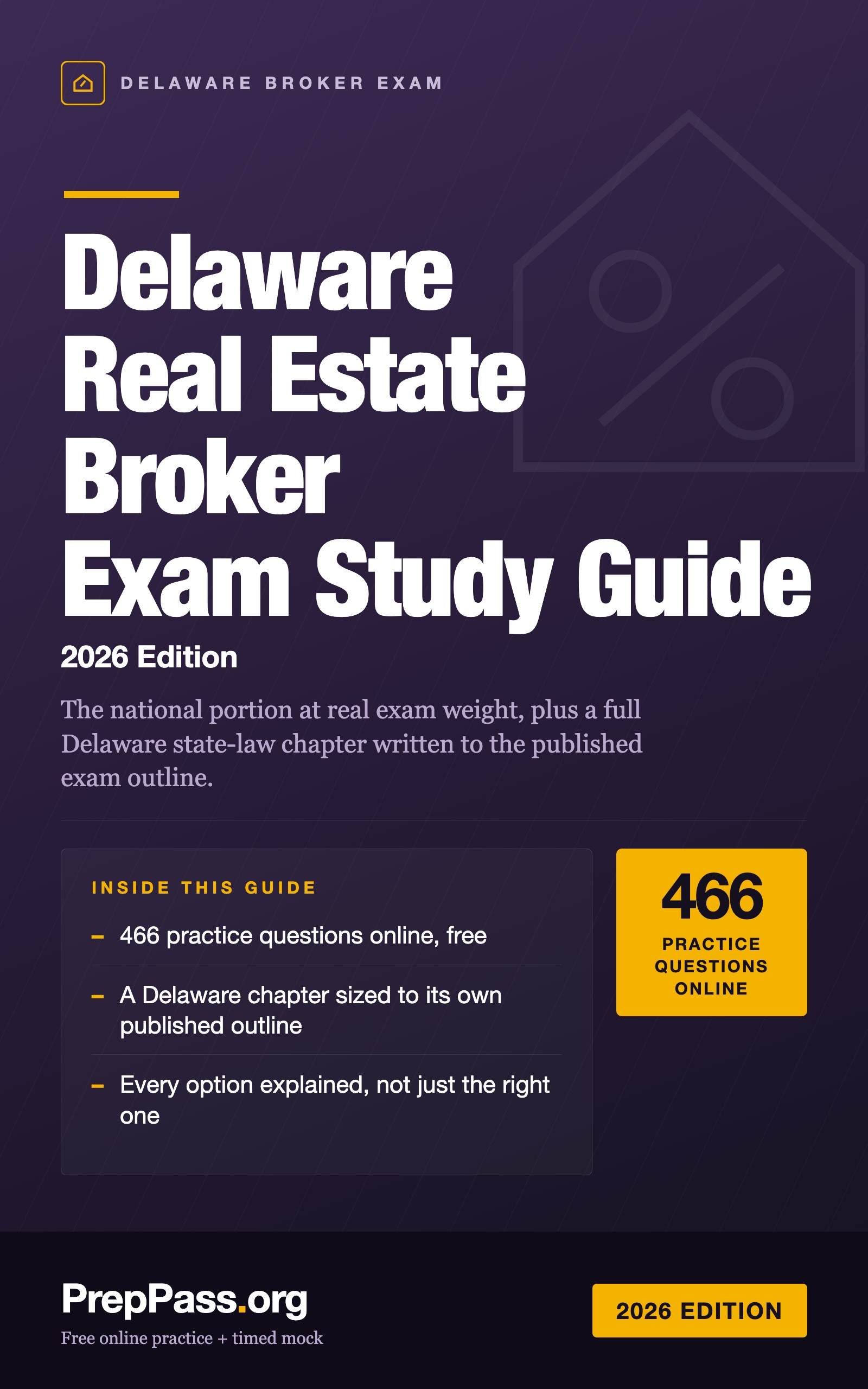
Delaware Real Estate Broker · 2026 Edition
Delaware Real Estate Broker Exam Study Guide (2026)
The national portion at real exam weight, plus a Delaware chapter. The Delaware chapter is sized to the published outline — 5 areas, 50 scored items — area by area, not flattened.
- All 8 chapters of the national portion plus a full Delaware real-estate-law chapter — PDF + EPUB you keep
- A 60-question national practice exam, with a key that explains all four options and not just the right one
- 20 Delaware law questions of its own, with a worked answer key
PDF + EPUB · English · 304 pages · $14.99 one-time
This book is written in English.
Instant download after payment — no account needed, no subscription. Refund policy
Try 10 questions first — free
Answer all 10, then see every answer explained — with the section of this guide that teaches it. About 5 minutes, no sign-up.
Start 10 free questionsLook inside the book
Three real pages, rendered straight from the PDF you download — a teaching page, a worked question, and a reference page. Nothing here was redrawn to look better.
- Quick referencePart C — Encumbrances a broker must read off a title report · PDF page 102
A page you can turn back to: the numbers, deadlines or terms gathered in one place.
- A question, workedAnswer Key and Explanations · PDF page 174
A practice question with its answer and the reasoning behind it — not just a key.
- How it's taughtPart II — Delaware State Law & Practice · PDF page 286
An explanation page: the material taught in prose, in the order the exam tests it.
What's included — and what isn't
Included
- A Delaware chapter written to the published exam outline, area by area
- Where Delaware law departs from the national rule — both stated, so neither is guessed
- Supervision, trust accounts, brokerage operation and broker math
- A Delaware practice set with every option explained, not just the right one
- 466 practice questions online, free, from the same bank
- PDF (print & tab it) + EPUB (phone / e-reader)
Not included
- No printed copy is shipped — this is a file you download and can print yourself
- No video course, instructor or tutoring comes with the book — the free videos on the site are separate
- Not your exam registration or the testing centre's fee, which you still pay to the official body
Contents
See 29 chapters and the page each one starts on
- Part C — Advertising and recordkeeping compliancep. 14
- Part D — Consumer contact and transaction integrityp. 16
- 2. Trust Funds, Escrow, and the Client’s Moneyp. 30
- Part C — Records that survive an auditp. 33
- Part D — Disputed moneyp. 34
- 3. Agency at the Broker Levelp. 40
- Part C — Fiduciary duties, at the level a broker is examined onp. 44
- Part D — Dual agency, designated agency, and the alternativesp. 46
- 4. Contracts and Brokerage Agreementsp. 55
- Part C — Options, rights of first refusal, and installment contractsp. 60
- Part D — Between contract and closingp. 61
- 5. Fair Housing, Accessibility, and Antitrust: The Exposure You Carry Personallyp. 72
- Part C — The exemptions, and why they rarely save anyonep. 78
- Part D — Disability: the distinction the exam always testsp. 79
- 6. Ownership, Land Use Controls, and Transfer of Titlep. 95
- Part C — Encumbrances a broker must read off a title reportp. 101
- Part D — Legal descriptionsp. 103
- 7. Valuation, Financing, and the Federal Lending Lawsp. 113
- Part C — The instrumentsp. 121
- Part D — Loan programs, structures, and qualifyingp. 123
- 8. Disclosures, Environmental Risk, and Property Managementp. 136
- Part C — The management agreement and the manager’s authorityp. 142
- Part D — Leases and tenanciesp. 144
- Practice Exam — 60 Questionsp. 153
- Answer Key and Explanationsp. 170
- Appendix A — Broker Math Cheat Sheetp. 221
- Appendix B — Glossaryp. 243
- Appendix C — Exam-Day Strategyp. 262
- Part II — Delaware State Law & Practicep. 267
Taken from the PDF you download, with the page each one starts on — not typed here.
Read a chapter free, in full
One complete chapter, exactly as it ships in the eBook. Scroll the window to read it right here; no download, no email.
Read chapter 9 here, without leaving the page
We didn't give you the easy intro — the free chapter opens on one of the hardest-working parts of the book, so you can judge the teaching where the exam gets difficult.
Everything before this page is the national manuscript, and it is the same for a broker candidate in Boise as for one in Wilmington. This chapter is Delaware only. Where Delaware's rule is simply the national rule with a local name on it, you will not find it repeated here. Where Delaware departs — and on agency it departs about as far as any state in the country — the departure is spelled out, with the national rule named alongside it, so you know which answer the state portion wants.
1. What the Delaware state portion actually is
Delaware's real estate examinations are delivered by Pearson VUE, not PSI. The governing document is Pearson VUE candidate handbook #090800, dated January 2026, and the state content outline printed inside it carries its own effective date of 1 June 2020. Note the gap: the handbook is refreshed far more often than the outline it contains, so the structure of your state portion has been stable for six years even though the booklet on the website looks new.
The broker examination is 80 scored general items plus 50 scored state items — 130 scored items, and both the salesperson and broker examinations also carry 10 unscored pretest items that are not identified as such. You get a four-hour (240-minute) appointment for the whole thing. The passing score is a scaled 70, and the examination fee is $88. (Fees drift; confirm the current figure on the live handbook before you register.)
The 50 state items are allocated as follows.
| Area | Items | Share of the state portion |
|---|---|---|
| I. Duties and powers of the Real Estate Commission | 4 | 8% |
| II. Licensing requirements | 3 | 6% |
| III. Statutory requirements governing the activities of licensees | 17 | 34% |
| IV. Additional state topics | 16 | 32% |
| V. Broker only | 10 | 20% |
| Total | 50 | 100% |
Two structural facts decide how you should spend your study time.
First: Areas I through IV are identical on the salesperson and broker examinations. The salesperson sits those 40 items and stops. The broker sits the same 40 and then adds Area V, "Broker only," on top — ten items on escrow accounts, examination of records, broker eligibility, place of business and supervision, foreclosure consultants, manufactured homes and the DMV, the New Home Buyer Protection Act, the commercial broker's lien, conditional and installment sales agreements, and mortgage loan modification services. A fifth of your state portion is not in any Delaware salesperson study product, because the salesperson never sees it. That is the single most concrete reason this edition exists rather than the cheaper one.
Second: Area IV is sixteen items covering seventeen lettered subtopics — A through Q. There are fewer items than subjects. Nothing in Area IV rewards deep study of any one statute, and everything in it can appear. Read all seventeen, learn the one operative number in each, and move on. Area III is the opposite: eight lettered subtopics carrying seventeen items, so agency, disclosures and money handling there are worth real depth.
The regulator is the Delaware Real Estate Commission, which sits inside the Division of Professional Regulation (dpr.delaware.gov). Delaware also offers a Client Waiver: a candidate already licensed in another state may skip the general portion and sit only the state portion. If that is you, this chapter is your whole examination.
One honesty note you will not get from a competitor. Pearson VUE handbook #090800 publishes no statute reference list for Delaware at all. The only statutory citation anywhere in the handbook is a single sentence in its licensing narrative: qualifications, application and examination "are set forth in 24 Delaware Code, Subsection 2907 and Commission Regulations 2.0 and 3.0." Both are in force; the regulations are 24 DE Admin. Code 2900 §§ 2.0 and 3.0. Every other citation in this chapter is our own reading of the Delaware Code and the Commission's rules, derived from the printed subtopic names. We say so because a study guide that dresses its own research as the vendor's is telling you something it cannot know, and you deserve to be able to check us.
2. Area I — Duties and powers of the Real Estate Commission (4 of 50 items, 8%)
24 Del. C. § 2900(a) puts the Commission's purpose in a specific order: its primary objective is to protect the public, specifically the direct recipients of regulated services; setting standards of competency is expressly secondary. That ranking decides close questions — where public protection and licensee convenience pull apart, the statute has already chosen.
Composition. § 2903(b) seats nine members appointed by the Governor: five professional and four public. The professional five are three licensed brokers (one from each county), one associate broker and one salesperson — deliberately mixed, so the associate broker and salesperson tiers each keep a voice. The public four are one from each county plus one from the City of Wilmington. Every member must have been a Delaware resident for at least five years before appointment, and an act or vote by a member appointed in violation of that subsection is invalid.
Powers. § 2906 gives the Commission rulemaking, approval of forms, qualifications for licensure, prelicensing and continuing education standards, random CE audits, hearings, sanctions, Guaranty Fund orders, and cease-and-desist orders with fines against unlicensed practice.
Investigation is separated from adjudication, and the separation is tested. Under § 2911 and 29 Del. C. § 8735 complaints are received and investigated by the Division of Professional Regulation, which issues the final written investigative report; the Commission then adjudicates. The chairperson does not investigate — § 2906(a)(9) has the Commission refer complaints to the Division and assign a member only to advise on technical aspects. The Attorney General enters at a different point: § 2907(e) requires a referral where an applicant supplied intentionally false information.
Hearing safeguards. A majority is a quorum under § 2904(c), but no licensee may be disciplined without the affirmative vote of at least five members. § 2912(d) forbids restricting, suspending or revoking a license before notice and an opportunity to be heard under the Administrative Procedures Act. § 2915 allows a temporary suspension pending hearing only on the written order of the Secretary of State with the Chairperson's concurrence, only after at least 24 hours' notice, and for no longer than 60 days. Appeals go to the Superior Court.
Sanctions. § 2912 lists the grounds — substantial misrepresentation, false promises, failing to account for others' money, illegal or negligent practice, paying unlicensed persons, undisclosed compensation for related products or services, misrepresenting a statutorily required form, discipline in another jurisdiction. § 2914 supplies the remedies, singly or in combination: a letter of reprimand, probation with reporting or practice limits, a monetary penalty not to exceed $5,000 for each violation, suspension, revocation or permanent revocation, and additional continuing education. Where the rule bites the broker: § 2912(b) provides that an employee's or associate's violation is not cause to revoke the broker's license unless the Commission is satisfied the broker knew of it. Knowledge, not employment, is the trigger. Do not confuse the $5,000 administrative ceiling with the $10,000 criminal fine in § 2924 for a second or subsequent conviction for unlicensed practice, which is imposed by the Justices of the Peace, not the Commission.
The Guaranty Fund — and the two dollar figures that get mixed up. § 2922 lets a person holding a final judgment against a licensee or brokerage organization for theft, forgery, fraud, misrepresentation or deceit recover from the Fund what the judgment debtor will not pay. The claim must be verified and filed within 60 days of the final judgment, and the claimant must show diligent exhaustion of collection remedies. The cap is $50,000 in the aggregate for any one transaction or claim, regardless of how many people were hurt or parcels involved. Each licensee pays a one-time $25 Guaranty Fund fee. § 2922(i) directs the Commission to keep the Fund above $350,000, and § 2922(j) triggers a pro rata assessment on licensees if the balance falls below $250,000. $50,000 and $250,000 are both current and they do different jobs — one is the ceiling on what a claimant can take out, the other is the floor below which every licensee gets a bill. A question that offers you $250,000 as a recovery cap is offering you the assessment trigger. Finally, § 2922(d) lets the Commission suspend or revoke the license of the licensee whose conduct drew a payment until the Fund is repaid in full with interest, and a discharge in bankruptcy does not lift that.
3. Area II — Licensing requirements (3 of 50 items, 6%)
Three items cover six printed subtopics, so this area is broad and shallow. Learn the exemptions and the entity rule, and know the CE structure.
Activities requiring a license. § 2901(a) bars unlicensed practice and holding oneself out as qualified. § 2901(e) is the exemption list: owners and lessors dealing with their own property, attorneys in fact acting under a power of attorney, attorneys-at-law, receivers, bankruptcy trustees, administrators, executors, any person selling real estate under order of any court, trustees, auctioneers as defined in 30 Del. C. § 2301(a)(3), and providers of property management services. Two of those are narrower than they look. Rule 1.4.1.1 confines the auctioneer exemption to the day of the auction (advertising the auction beforehand is still allowed). And Rule 9.0 draws a hard line through property management: an unlicensed person may do maintenance, clerical work, collect rent, show units, and hand out and receive applications, but may not negotiate or draft leases, vary the owner's terms, approve applications, or hold out as having managerial authority. The on-site rental agent who "approves tenants" is doing licensed work.
Delaware licenses people, not firms. § 2901(c) states flatly that no brokerage organization, corporation, partnership or other business entity is licensed under the chapter; the firm provides real estate services only because it has a broker who is responsible for them. § 2902(a)(3) confirms it by defining a brokerage organization as the entity "which is not licensed but is acting as a broker under § 2901(c)." There is no corporate-broker class to qualify for. If your national reading taught you that a corporation obtains an entity license and designates a qualifying broker, that is the majority rule and it is not Delaware's.
Eligibility. § 2907 sets the conditions: no disqualifying administrative penalties elsewhere, no substantially related criminal conviction absent a waiver, prelicensing education, and the uniform national and state examination. Salespersons must be 18; associate brokers must be 23, meet the experience and financial prerequisites in the rules, and complete the broker prelicensing course. § 2909 provides for reciprocal licensure of licensees in good standing elsewhere.
Renewal and continuing education. Rule 12.1 makes licenses biennial, expiring 30 April of each even-numbered year, with a 30-day late-renewal window that does not extend the CE deadline. Rule 14.1.2 requires 21 hours in seven prescribed three-hour modules: agency and fair housing, professional standards, real estate documents, office management, legislative issues, practices of real estate, and electives. The count and the module structure travel together — Delaware prescribes what the hours must be about, which is why "any 21 approved hours" is wrong, and Rule 14.12.3 excludes Module 5 (legislative issues) even from advanced-course substitutions. Hours prorate by length of licensure under Rule 14.2, and new licensees owe an extra 12 hours in four named subjects within 90 days of issuance under Rule 14.13. Licensees attest to completion; the Commission audits at random, and unjustified non-compliance carries a minimum $250 penalty for a first finding and $1,000 for a second. § 2921 governs termination and transfer between brokers — inactive status under § 2921(b) is something a licensee elects, not something imposed — and Rule 1.5 requires an address change to be reported to the Division within thirty days.
Before you buy
- How do I get it?
- Pay, and the download appears on this page straight away. The links are also emailed to you. No account is required.
- What if it isn't for me?
- Email us within 14 days for a full refund, no questions asked.
- Is the free practice going away?
- No. Every practice question, the timed mock and the free chapters on this site stay free. This book is the studying half, not a gate around the free half.
- Can I read it on my phone?
- Yes — the EPUB is for phones and e-readers, the PDF is for printing and tabbing. You get both.
The details
The national portion at real exam weight, plus a Delaware chapter. The Delaware chapter is sized to the published outline — 5 areas, 50 scored items — area by area, not flattened.
- Format: PDF + EPUB download · 304 pages
- 80 practice questions in the book, with a full answer key
- 466 free practice questions for this exam on PrepPass, included at no cost
- $14.99 one-time — no subscription
- 14-day money-back guarantee · refund policy
- Cross-referenced against: 24 Del. C. § 2923 · 24 Del. C. § 2936 · 24 Del. C. § 2901 · Pearson VUE #090800 (rev 2026-01 (handbook dated January 2026; state content outline effective 2020-06-01))
- Last updated: September 2026
- Verified from the official source(24 Del. C. § 2923 · 24 Del. C. § 2936 · 24 Del. C. § 2901 · Pearson VUE #090800 (rev 2026-01 (handbook dated January 2026; state content outline effective 2020-06-01)))
- 466 free practice questions
- Instant download, yours for life
a real estate broker pre-license course runs $200–$1,000. This book teaches the same exam — same rules, verified to current standards — for a one-time $14.99 you keep for life.
Why buy the book when the practice is free?
Our practice questions and timed mock stay free — nothing on the site moves behind this book. The $14.99 book is the studying half: the material itself, taught in order, in a file you own.
- Systematic teaching — every exam section explained chapter by chapter, start to finish, not just questions
- Print it & tab it — a paper-ready PDF you can highlight, mark up, and bring to your study table
- Study anywhere, offline — EPUB on your phone or e-reader; no wifi, no browser tabs
- Everything in one place — chapters, per-chapter cram sheets, and practice questions in one file
- Yours for life — one-time $14.99, instant download, no subscription
And it's risk-free: 14-day money-back guarantee — not satisfied? Email us for a full refund, no questions asked. See the refund policy.
14-day money-back guarantee · full refund, no questions asked.
One-time purchase, lifetime access to the download. The eBook is the full Delaware Real Estate Broker study guide in PDF and EPUB. Educational summary, not professional or legal advice — always confirm the current rules with the official source. Last updated: September 2026.