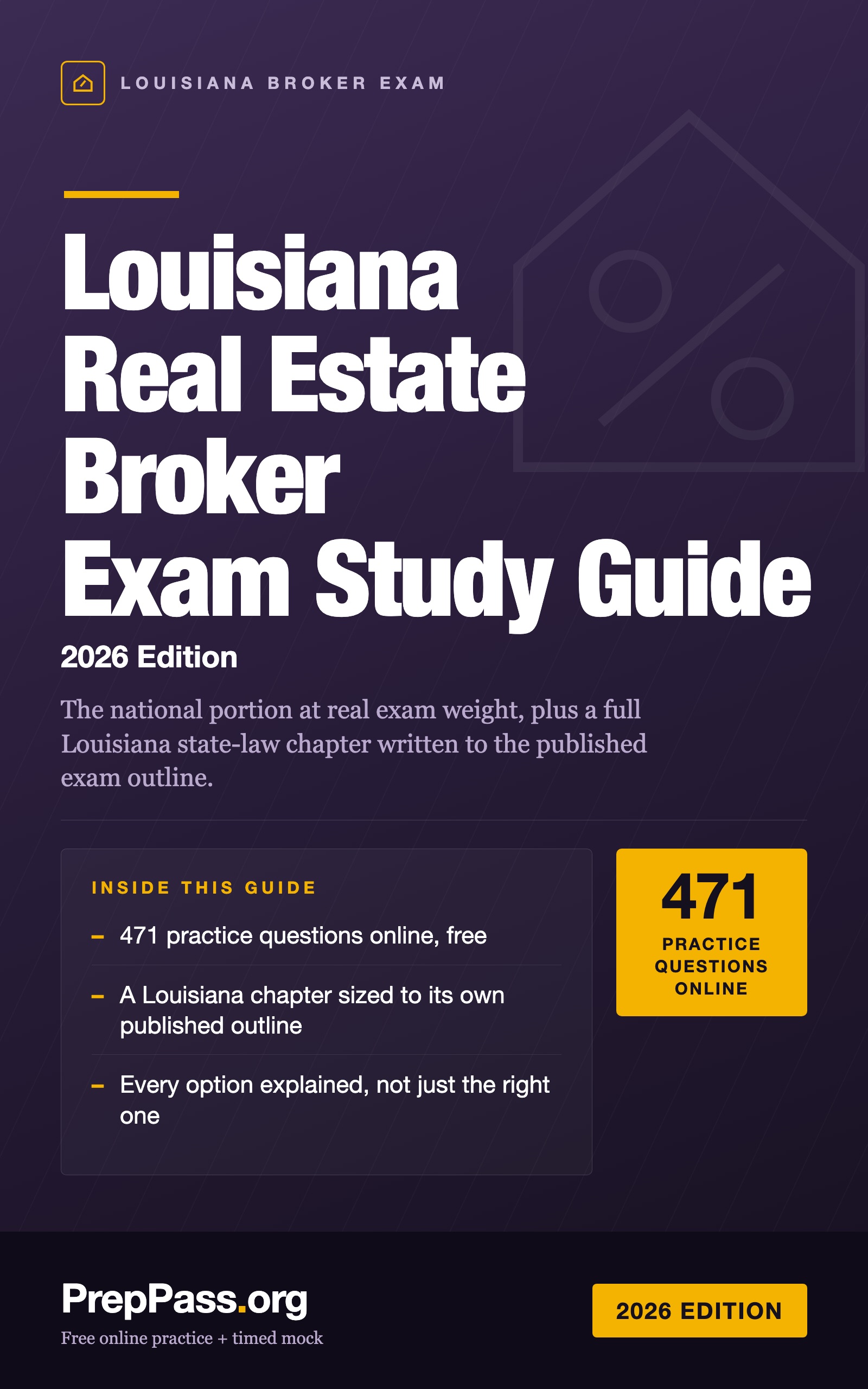
Louisiana Real Estate Broker · 2026 Edition
Louisiana Real Estate Broker Exam Study Guide (2026)
The national portion at real exam weight, plus a Louisiana chapter. The Louisiana chapter is sized to the published outline — 5 areas, 55 scored items — area by area, not flattened.
- All 8 chapters of the national portion plus a full Louisiana real-estate-law chapter — PDF + EPUB you keep
- A 60-question national practice exam, with a key that explains all four options and not just the right one
- A Louisiana law practice set of its own, with a worked answer key
PDF + EPUB · English · 316 pages · $14.99 one-time
This book is written in English.
Instant download after payment — no account needed, no subscription. Refund policy
Try 10 questions first — free
Answer all 10, then see every answer explained — with the section of this guide that teaches it. About 5 minutes, no sign-up.
Start 10 free questionsLook inside the book
Three real pages, rendered straight from the PDF you download — a teaching page, a worked question, and a reference page. Nothing here was redrawn to look better.
- Quick referencePart C — Encumbrances a broker must read off a title report · PDF page 102
A page you can turn back to: the numbers, deadlines or terms gathered in one place.
- A question, workedAnswer Key and Explanations · PDF page 174
A practice question with its answer and the reasoning behind it — not just a key.
- How it's taughtAnswer key · PDF page 313
An explanation page: the material taught in prose, in the order the exam tests it.
What's included — and what isn't
Included
- A Louisiana chapter written to the published exam outline, area by area
- Where Louisiana law departs from the national rule — both stated, so neither is guessed
- Supervision, trust accounts, brokerage operation and broker math
- A Louisiana practice set with every option explained, not just the right one
- 471 practice questions online, free, from the same bank
- PDF (print & tab it) + EPUB (phone / e-reader)
Not included
- No printed copy is shipped — this is a file you download and can print yourself
- No video course, instructor or tutoring comes with the book — the free videos on the site are separate
- Not your exam registration or the testing centre's fee, which you still pay to the official body
Contents
See 30 chapters and the page each one starts on
- Part C — Advertising and recordkeeping compliancep. 14
- Part D — Consumer contact and transaction integrityp. 16
- 2. Trust Funds, Escrow, and the Client’s Moneyp. 30
- Part C — Records that survive an auditp. 33
- Part D — Disputed moneyp. 34
- 3. Agency at the Broker Levelp. 40
- Part C — Fiduciary duties, at the level a broker is examined onp. 44
- Part D — Dual agency, designated agency, and the alternativesp. 46
- 4. Contracts and Brokerage Agreementsp. 55
- Part C — Options, rights of first refusal, and installment contractsp. 60
- Part D — Between contract and closingp. 61
- 5. Fair Housing, Accessibility, and Antitrust: The Exposure You Carry Personallyp. 72
- Part C — The exemptions, and why they rarely save anyonep. 78
- Part D — Disability: the distinction the exam always testsp. 79
- 6. Ownership, Land Use Controls, and Transfer of Titlep. 95
- Part C — Encumbrances a broker must read off a title reportp. 101
- Part D — Legal descriptionsp. 103
- 7. Valuation, Financing, and the Federal Lending Lawsp. 113
- Part C — The instrumentsp. 121
- Part D — Loan programs, structures, and qualifyingp. 123
- 8. Disclosures, Environmental Risk, and Property Managementp. 136
- Part C — The management agreement and the manager’s authorityp. 142
- Part D — Leases and tenanciesp. 144
- Practice Exam — 60 Questionsp. 153
- Answer Key and Explanationsp. 170
- Appendix A — Broker Math Cheat Sheetp. 221
- Appendix B — Glossaryp. 243
- Appendix C — Exam-Day Strategyp. 262
- Part II — Louisiana State Law & Practicep. 267
- Answer keyp. 308
Taken from the PDF you download, with the page each one starts on — not typed here.
Read a chapter free, in full
One complete chapter, exactly as it ships in the eBook. Scroll the window to read it right here; no download, no email.
Read chapter 9 here, without leaving the page
We didn't give you the easy intro — the free chapter opens on one of the hardest-working parts of the book, so you can judge the teaching where the exam gets difficult.
What the Louisiana state portion actually is
Start with a warning that saves some candidates their fee. Louisiana migrated from PSI to Pearson VUE. The PSI bulletin that still circulates in study groups and on résumé-padding blog posts is obsolete, and its content outline is not the one your exam is built from. The current document is Pearson VUE content outline #091901, revision 04/2025, whose state outline is effective September 1, 2021, with candidate handbook #091900 alongside it.
The structure, from the handbook:
| Items | Minutes | Handbook code | |
|---|---|---|---|
| National portion | 80 scored | 150 | LAREBNA2 |
| Louisiana state portion | 55 scored (+ 5–10 unscored pretest) | 90 | LAREBST3 |
| Combined broker exam | 135 scored | 240 | LAREBCO1 |
Two things about this exam that are unusual, and that you should know before you study
First: there is no separate broker outline. Broker and salesperson candidates in Louisiana sit the identical 55-item state examination. #091901 prints one state outline, not two. The two licenses differ on this paper in exactly one respect — the cut score. That is unlike Virginia, Ohio, Texas and South Carolina, all of which publish different item counts for the broker form. It also means that any Louisiana state-portion study material aimed at salespersons is aimed at your exam too; what makes a broker edition worth buying is the depth, the supervision material in area III, and the four-year/150-hour licensure path — not a different set of topics.
Second: the passing standard is a scaled score, and it is not a percentage. For brokers the cut score is a scaled score of 75 out of 100 on each portion (70 for salespersons). Handbook #091900 says in terms that the scaled score "is neither the number of questions you answered correctly nor the percentage of questions you answered correctly."
That sentence matters and almost every competitor gets it wrong. A scaled score is a transformation of your raw score onto a common 0–100 reporting scale, so that forms of differing difficulty can be compared fairly: a candidate who sits a slightly harder form needs fewer raw points for the same scaled 75 than a candidate who sits an easier one. You cannot work backwards from "75" to "I need 41 of 55 right." Anyone who prints "75%" for Louisiana has either not read the handbook or has decided a clean-looking number is worth more than an accurate one. Study to be comfortably above the line, not to a raw target that does not exist.
The published areas — and why they are ranges
Louisiana publishes item counts as ranges, not as fixed numbers. Here is what #091901 actually prints, with the numbers this chapter uses for weighting:
| Area (published order) | Published range | Midpoint used here | Weight |
|---|---|---|---|
| I. Duties, Overview, and Powers of the Real Estate Commission | 4–6 items | 5 | 10% |
| II. Licensing Requirements | 7–9 items | 8 | 15% |
| III. Statutory Requirements Governing the Activities of Licensees | 13–15 items | 14 | 25% |
| IV. Louisiana Civil Law System | 13–15 items | 14 | 25% |
| V. Louisiana Law of Agency | 13–15 items | 14 | 25% |
The single numbers in the third column are midpoints of the published bands. They are an editorial choice, not a published figure, and you should not repeat them to anyone as though Pearson VUE printed them. They are honest ones: the midpoints 5 / 8 / 14 / 14 / 14 sum to exactly 55, which is the published total. As percentages of 55 they are 9.09 / 14.55 / 25.45 / 25.45 / 25.45, and those cannot be written as integers summing to 100 without breaking the tie between the three identical 13–15 bands. The declared weights of 10 / 15 / 25 / 25 / 25 therefore absorb the whole +0.9-point rounding error into the smallest area, so that areas III, IV and V stay equal — which is how the published outline has them.
Read the bottom three rows again. Areas III, IV and V are each a quarter of the state exam. Nothing else on it comes close.
What no chapter can promise you about area IV
Area IV lists 49 numbered sub-items across eight lettered headings — property classification, immovables, movables, legal descriptions, ownership, servitudes, usufruct, habitation, right of use, building restrictions, co-ownership, community property, separate property, partnerships and corporations, condominiums, donations, successions, the surviving spouse's usufruct, expropriation, possession, acquisitive prescription, fifteen separate obligations-and-contracts topics, five on sales, four on privileges and mortgages, and four on leases. The exam gives that heading 13 to 15 items.
No bank and no chapter can cover it exhaustively, and any that claims to is padding. What this chapter does instead is teach the sub-items the exam actually reaches at that item count: component parts; usufruct; habitation against the right of use; predial servitudes; building restrictions; the community property presumption and the concurrence rule for community immovables; the surviving spouse's usufruct with intestacy; acquisitive prescription; lesion beyond moiety; the authentic act; redhibition; bond for deed; and reconduction. Privileges and mortgages (heading G) are not covered here, and neither are legal descriptions or movables within heading A. That is a deliberate allocation, stated so you can see it, rather than a gap you discover in the exam room.
The same discipline applies elsewhere. At 4–6 items, area I's investigations, hearings and appeals subtopic (heading C) is not separately covered. At 13–15 items, area III's broker/salesperson relationship (B) and property management (L) are not.
Governing law. #091901 carries no reference or statute list of its own — unlike South Carolina's PSI bulletin, it simply ends at the content outline. The authorities this chapter is built on are therefore named here rather than borrowed from a vendor list: the Louisiana Real Estate License Law, R.S. 37:1430–1469; the Louisiana law of agency in real estate transactions, R.S. 9:3891–3899; the Louisiana Civil Code, Books II and III; the Louisiana Residential Property Disclosure Act, R.S. 9:3196–3200; the bond-for-deed statute at R.S. 9:2941–2948; the lessee's-deposit statute at R.S. 9:3251–3254; and the commission's rules at LAC 46:LXVII.
The headline: half of this exam is civil law, and the national chapters are common law
Louisiana is the only civil-law jurisdiction in the United States. Its private law descends from the Napoleonic tradition, and the exam uses that tradition's vocabulary throughout: immovables rather than real property, usufruct rather than life estate, predial servitudes rather than easements, ownership in indivision rather than tenancy in common.
Areas IV and V together are half the state exam. That means a study guide written from common-law sources is not merely mis-weighted for Louisiana — it is substantively wrong for half the paper. Everything in the national portion of this book about estates, easements, concurrent ownership, contract formation, marketable title and the transfer of ownership is correct for the national exam and must be set aside for area IV.
The most dangerous move here is the one that feels most helpful: telling yourself "usufruct is just Louisiana's word for a life estate." It is not, and the exam is built out of exactly those non-equivalences. Learn the translation and the place where the translation fails.
| The national chapters say | Louisiana says | Where the two are not the same |
|---|---|---|
| Real property | Immovable (Art. 462) | The Code, not the parties, fixes what is part of the tract: Art. 463 lists buildings, permanent constructions, standing timber and ungathered crops when they belong to the owner of the ground. If they belong to someone else, Art. 464 makes the building and the timber separate immovables — a category common law has no clean word for. |
| Fixtures | Component parts (Art. 466) | Art. 466 makes things attached to a building that "serve to complete a building of its general type" component parts — doors, shutters, gutters, cabinetry, and the plumbing, heating, cooling and electrical systems. It is a definitional test, not the common law's intention-and-annexation test. |
| Personal property | Movable (Art. 475) | Defined residually: everything the law does not consider immovable. |
| Fee simple absolute | Ownership (Art. 477) | "The right that confers on a person direct, immediate and exclusive authority over a thing." When burdened by a usufruct, what the owner keeps is naked ownership (Art. 478) — the Louisiana word for what you may be calling a remainder. |
| Life estate | Usufruct (Arts. 535, 539) | A real right of limited duration on the property of another, held under the obligation of preserving its substance and acting as a prudent administrator. It ends at the usufructuary's death (Art. 607) — but Art. 608 allows a usufruct in favor of a juridical person for up to thirty years, and a corporation cannot hold a life estate measured by its own life. |
| Easement appurtenant | Predial servitude (Art. 646) | A charge on a servient estate for the benefit of a dominant estate, and the two estates must belong to different owners. It passes with the dominant estate (Art. 650) — and it is extinguished by ten years' nonuse (Art. 753), which no common-law easement appurtenant is. Where both estates are in one hand, Art. 741 calls the arrangement destination of the owner, and it ripens into a servitude only when the estates cease to belong to the same owner. |
| Easement in gross | Right of use (Art. 639) | Art. 641 allows it in favor of a natural person or a legal entity; Art. 643 makes it transferable; Art. 644 makes it survive the holder's death. |
| Life estate for a person's use of a dwelling | Habitation (Art. 630) | The deliberate opposite of the right of use: a natural person only, nontransferable and nonheritable (Art. 637), ending at the holder's death (Art. 638). Art. 634 lets the holder occupy the house and receive friends, guests and boarders — a right to dwell, never a right to collect rents. |
| Tenancy in common | Ownership in indivision (Art. 797) | Shares are presumed equal. Art. 805: a co-owner may freely lease, alienate or encumber his own undivided share, but disposing of the entire thing requires the consent of all. Art. 807 gives any co-owner the right to demand partition. |
| Joint tenancy with right of survivorship | (no equivalent) | Louisiana does not use it. |
| Tenancy by the entirety | Community of acquets and gains (Art. 2327) | Not the same mechanism. Each spouse owns a present undivided one-half interest (Art. 2336); Art. 2340 presumes things possessed during the regime to be community, rebuttably; and Art. 2347 requires the concurrence of both spouses to alienate, encumber or lease community immovables — a specific list of transactions, not a unity of person. |
| CC&Rs / deed restrictions | Building restrictions (Art. 775) | Charges imposed by the owner under a feasible general plan — and Art. 781 bars any action for injunction or damages after two years from the commencement of a noticeable violation, after which the immovable is freed of the restriction that was violated. Common-law covenants do not evaporate on a two-year clock. |
| Adverse possession | Acquisitive prescription (Arts. 3473, 3475, 3486) | Ten years with good faith and just title; thirty years without either. |
| Will / intestacy | Testate (Art. 874) and intestate (Art. 875) succession | Art. 890: where descendants survive, the surviving spouse takes a usufruct over the decedent's share of the community, terminating on the survivor's death or remarriage, whichever comes first. |
| Notarized, witnessed deed | Authentic act (Art. 1833) | Executed before a notary in the presence of two witnesses, and signed by each party, each witness and the notary. Art. 1835 makes it full proof of the agreement against the parties and their heirs; Art. 1834 saves a defective one as an act under private signature. Note Art. 2440: a sale of an immovable may be made by authentic act or by act under private signature. |
| Delivery of the deed passes title | Art. 2456 | Ownership transfers between the parties as soon as they agree on the thing and the price is fixed — before delivery, before payment. Art. 2442 makes the act effective against third persons only once filed for registry. |
| Earnest money as a deposit toward price | Art. 2624 | A sum given in connection with a contract to sell is a deposit on account of the price unless the parties expressly stipulate earnest money — in which case either party may recede: the buyer by forfeiting it, the seller by returning it plus an equal amount. |
| Gross inadequacy of price (rarely a remedy) | Lesion beyond moiety (Art. 2589) | A seller of a corporeal immovable may rescind where the price is less than one half of fair market value. Art. 2591 lets the buyer keep the property by paying the difference; Art. 2595 gives a one-year peremptive period from the sale. |
| Latent defects / implied warranty | Redhibition (Art. 2520) | Two grades in one article: rescission where the defect renders the thing useless or so inconvenient the buyer would not have bought it; reduction of the price for a lesser defect. Art. 2521 withholds the warranty for defects known or reasonably discoverable; Art. 2534 sets the prescriptive periods. |
| Land contract / contract for deed | Bond for deed (R.S. 9:2941) | A contract to sell in which the price is paid in installments and the seller delivers title after a stipulated sum is paid. Despite the name, no surety is involved. |
| Holdover tenancy | Reconduction (Arts. 2721, 2723) | A fixed-term lease is reconducted if the lessee stays on without opposition — one week for a term longer than a week, thirty days for an agricultural lease. Art. 2723 makes the reconducted term month to month for a nonagricultural lease of a month or longer, and Art. 2724 continues the lease's other provisions. It shortens the term rather than repeating it. |
Before you buy
- How do I get it?
- Pay, and the download appears on this page straight away. The links are also emailed to you. No account is required.
- What if it isn't for me?
- Email us within 14 days for a full refund, no questions asked.
- Is the free practice going away?
- No. Every practice question, the timed mock and the free chapters on this site stay free. This book is the studying half, not a gate around the free half.
- Can I read it on my phone?
- Yes — the EPUB is for phones and e-readers, the PDF is for printing and tabbing. You get both.
The details
The national portion at real exam weight, plus a Louisiana chapter. The Louisiana chapter is sized to the published outline — 5 areas, 55 scored items — area by area, not flattened.
- Format: PDF + EPUB download · 316 pages
- 80 practice questions in the book, with a full answer key
- 471 free practice questions for this exam on PrepPass, included at no cost
- $14.99 one-time — no subscription
- 14-day money-back guarantee · refund policy
- Cross-referenced against: Pearson VUE #091901 (rev #091901 rev 04/2025 (state outline eff. 2021-09-01); pulled and pdftotext'd 2026-08-31)
- Last updated: September 2026
- Verified from the official source(Pearson VUE #091901 (rev #091901 rev 04/2025 (state outline eff. 2021-09-01); pulled and pdftotext'd 2026-08-31))
- 471 free practice questions
- Instant download, yours for life
a real estate broker pre-license course runs $200–$1,000. This book teaches the same exam — same rules, verified to current standards — for a one-time $14.99 you keep for life.
Why buy the book when the practice is free?
Our practice questions and timed mock stay free — nothing on the site moves behind this book. The $14.99 book is the studying half: the material itself, taught in order, in a file you own.
- Systematic teaching — every exam section explained chapter by chapter, start to finish, not just questions
- Print it & tab it — a paper-ready PDF you can highlight, mark up, and bring to your study table
- Study anywhere, offline — EPUB on your phone or e-reader; no wifi, no browser tabs
- Everything in one place — chapters, per-chapter cram sheets, and practice questions in one file
- Yours for life — one-time $14.99, instant download, no subscription
And it's risk-free: 14-day money-back guarantee — not satisfied? Email us for a full refund, no questions asked. See the refund policy.
14-day money-back guarantee · full refund, no questions asked.
One-time purchase, lifetime access to the download. The eBook is the full Louisiana Real Estate Broker study guide in PDF and EPUB. Educational summary, not professional or legal advice — always confirm the current rules with the official source. Last updated: September 2026.