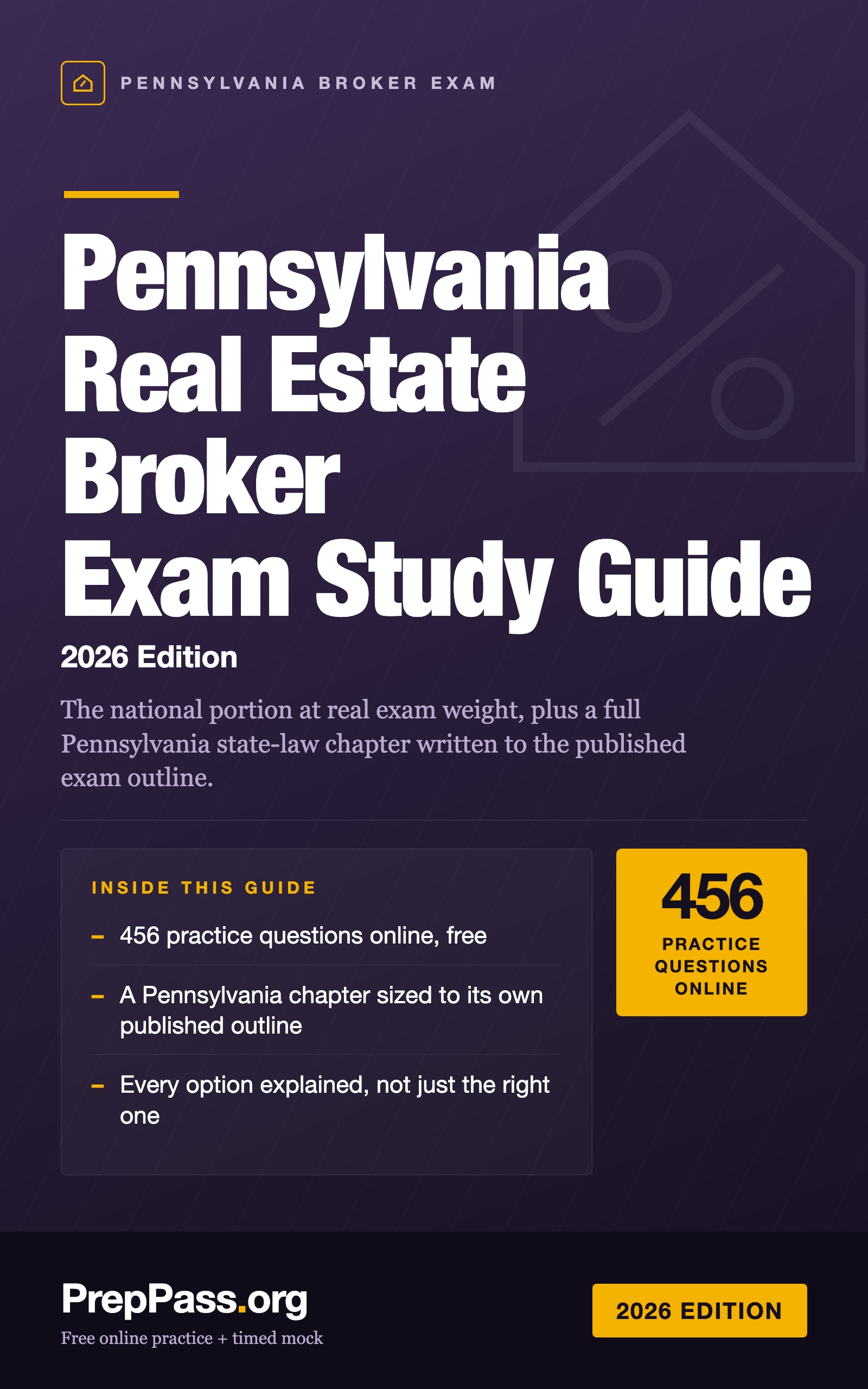
Pennsylvania Real Estate Broker · 2026 Edition
Pennsylvania Real Estate Broker Exam Study Guide (2026)
The national portion at real exam weight, plus a Pennsylvania chapter. The Pennsylvania chapter is sized to the published outline — 6 areas, 40 scored items — area by area, not flattened.
- All 8 chapters of the national portion plus a full Pennsylvania real-estate-law chapter — PDF + EPUB you keep
- A 60-question national practice exam, with a key that explains all four options and not just the right one
- 20 Pennsylvania law questions of its own, with a worked answer key
PDF + EPUB · English · 294 pages · $14.99 one-time
This book is written in English.
Instant download after payment — no account needed, no subscription. Refund policy
Try 10 questions first — free
Answer all 10, then see every answer explained — with the section of this guide that teaches it. About 5 minutes, no sign-up.
Start 10 free questionsLook inside the book
Three real pages, rendered straight from the PDF you download — a teaching page, a worked question, and a reference page. Nothing here was redrawn to look better.
- Quick referencePart C — Encumbrances a broker must read off a title report · PDF page 102
A page you can turn back to: the numbers, deadlines or terms gathered in one place.
- A question, workedAnswer Key and Explanations · PDF page 174
A practice question with its answer and the reasoning behind it — not just a key.
- How it's taughtPart II — Pennsylvania State Law & Practice · PDF page 289
An explanation page: the material taught in prose, in the order the exam tests it.
What's included — and what isn't
Included
- A Pennsylvania chapter written to the published exam outline, area by area
- Where Pennsylvania law departs from the national rule — both stated, so neither is guessed
- Supervision, trust accounts, brokerage operation and broker math
- A Pennsylvania practice set with every option explained, not just the right one
- 456 practice questions online, free, from the same bank
- PDF (print & tab it) + EPUB (phone / e-reader)
Not included
- No printed copy is shipped — this is a file you download and can print yourself
- No video course, instructor or tutoring comes with the book — the free videos on the site are separate
- Not your exam registration or the testing centre's fee, which you still pay to the official body
Contents
See 29 chapters and the page each one starts on
- Part C — Advertising and recordkeeping compliancep. 14
- Part D — Consumer contact and transaction integrityp. 16
- 2. Trust Funds, Escrow, and the Client’s Moneyp. 30
- Part C — Records that survive an auditp. 33
- Part D — Disputed moneyp. 34
- 3. Agency at the Broker Levelp. 40
- Part C — Fiduciary duties, at the level a broker is examined onp. 44
- Part D — Dual agency, designated agency, and the alternativesp. 46
- 4. Contracts and Brokerage Agreementsp. 55
- Part C — Options, rights of first refusal, and installment contractsp. 60
- Part D — Between contract and closingp. 61
- 5. Fair Housing, Accessibility, and Antitrust: The Exposure You Carry Personallyp. 72
- Part C — The exemptions, and why they rarely save anyonep. 78
- Part D — Disability: the distinction the exam always testsp. 79
- 6. Ownership, Land Use Controls, and Transfer of Titlep. 95
- Part C — Encumbrances a broker must read off a title reportp. 101
- Part D — Legal descriptionsp. 103
- 7. Valuation, Financing, and the Federal Lending Lawsp. 113
- Part C — The instrumentsp. 121
- Part D — Loan programs, structures, and qualifyingp. 123
- 8. Disclosures, Environmental Risk, and Property Managementp. 136
- Part C — The management agreement and the manager’s authorityp. 142
- Part D — Leases and tenanciesp. 144
- Practice Exam — 60 Questionsp. 153
- Answer Key and Explanationsp. 170
- Appendix A — Broker Math Cheat Sheetp. 221
- Appendix B — Glossaryp. 243
- Appendix C — Exam-Day Strategyp. 262
- Part II — Pennsylvania State Law & Practicep. 267
Taken from the PDF you download, with the page each one starts on — not typed here.
Read a chapter free, in full
One complete chapter, exactly as it ships in the eBook. Scroll the window to read it right here; no download, no email.
Read chapter 9 here, without leaving the page
We didn't give you the easy intro — the free chapter opens on one of the hardest-working parts of the book, so you can judge the teaching where the exam gets difficult.
Pennsylvania is one of the few states that publishes a genuinely separate broker examination outline rather than a shared salesperson/broker document. That matters more than it sounds: material scraped from the Pennsylvania salesperson outline will miss an entire area that exists only on the broker paper. Everything below is Pennsylvania law — the Real Estate Licensing and Registration Act (RELRA, 63 P.S. §§ 455.101 et seq., cited here by section number as the act itself does) and the State Real Estate Commission's regulations at 49 Pa. Code Chapter 35, plus the satellite statutes the outline reaches. Nothing here repeats the national portion; where Pennsylvania's rule and the national rule diverge, both are named.
What the Pennsylvania portion actually is
| Regulator | Pennsylvania State Real Estate Commission, Bureau of Professional and Occupational Affairs, Department of State |
| Test vendor / document | Pearson VUE candidate handbook #093901, revision 2026-03; outline effective 16 March 2026 |
| National portion | 80 items |
| Pennsylvania portion | 40 scored items |
| Time for the Pennsylvania portion | 60 minutes |
| Governing law | RELRA, 63 P.S. §§ 455.101 et seq.; 49 Pa. Code Ch. 35; 68 Pa.C.S. Ch. 73; Landlord and Tenant Act of 1951 |
Two facts about that table should change how you prepare. First, the outline is the freshest in this series — effective 16 March 2026 — so it already reflects Act 52 of 2024, which older Pennsylvania study guides do not. Second, sixty minutes is the tightest state-portion allowance of any state measured: ninety seconds per item. Ninety seconds is enough to read a scenario and recognize the governing section. It is not enough to derive an answer from principle. Section numbers, deadlines and dollar caps have to be automatic.
Pennsylvania also licenses well beyond broker and salesperson, and the exam knows it: cemetery broker, cemetery salesperson, builder-owner salesperson, rental listing referral agent, campground membership salesperson and time-share salesperson, plus registration of cemetery companies (RELRA Ch. 5). An associate broker is not a separate class of license — under the § 201 definition it is a broker employed by another broker.
The published broker weighting
| # | Area (as published) | Items | Share |
|---|---|---|---|
| I | Real Estate Commission | 4 | 10.0% |
| II | Licensure | 6 | 15.0% |
| III | Agency and Disclosure | 10 | 25.0% |
| IV | Regulations Governing the Activities of Licensees | 10 | 25.0% |
| V | Miscellaneous | 5 | 12.5% |
| VI | Brokerage Management | 5 | 12.5% |
| Total | 40 | 100% |
Areas III and IV together are half the paper. Agency and Disclosure alone is a quarter of it. Area VI, Brokerage Management, exists only on the broker examination — it is the offices-inspections-escrow block that a salesperson never sits, and its first subtopic is expressly flagged "Broker only" in the published outline.
A note on the source document: the lettered sub-lists printed under each area heading are not reproduced in this book, because we will not present a subtopic list we cannot point to in the published outline. Each section below tells you instead what the exam actually asks about in that area, derived from the area's weight and from the tested content itself.
1. I. Real Estate Commission — 4 of 40 scored items (10%)
Composition and powers. RELRA § 202 creates the Commission inside the Bureau of Professional and Occupational Affairs of the Department of State. Eleven seats: the Commissioner of Professional and Occupational Affairs; the Director of the Bureau of Consumer Protection or a designee; three public members; five licensed Pennsylvania brokers each engaged in the real estate business in this Commonwealth for not less than ten years immediately prior to appointment; and one member licensed as a broker or cemetery broker for at least five years who has sold cemetery lots for at least ten. The Governor appoints; the term is five years (§ 202(b)). § 404 is the rulemaking power — the source of 49 Pa. Code Ch. 35 — and § 403 lets the Commission prescribe the subjects tested while the Department arranges the professional testing service that writes and administers the examinations.
Complaints and hearings. § 604(a) lets the Commission act on its own motion and requires it to act promptly on a verified written complaint. Adjudications follow 2 Pa.C.S. and 1 Pa. Code Pt. II under § 701(c).
Where Pennsylvania departs from the national rule: § 702 and the actual-knowledge shield
The national manuscript teaches broad vicarious liability — the broker answers for the salesperson. § 702(a) says the opposite about the license: an employee's violation is not grounds to suspend or revoke the employing broker's license "unless it appears at the hearing that such employer had actual knowledge of such violation." § 702(c) supplies the Commission's shortcut: a course of dealing shown to have been followed by the employee is prima facie evidence of the employer's knowledge. Note the boundary carefully — § 702 protects the broker's license; it does not immunize the broker from § 604(a)(16), failure to exercise adequate supervision, which is the broker's own violation.
The Recovery Fund. Chapter 8. Unlike Maryland's administrative fund, Pennsylvania's is judgment-based: a consumer needs a final judgment against a licensee for fraud, misrepresentation or deceit in a licensed transaction, must have exhausted collection remedies, and must apply within one year of the end of the proceedings. § 803(d) caps liability at $20,000 for any one claim and $100,000 per licensee, prorating among claimants above the ceiling. § 803(f) automatically suspends the license on payment, with reinstatement only on full repayment plus 10% annual interest. § 801(b) puts campground membership sales and the preparation of broker price opinions outside the fund entirely.
2. II. Licensure — 6 of 40 scored items (15%)
What requires a license. § 201 defines "broker" by a list of acts done for another for consideration — including performing a comparative market analysis. Act 52 of 2024 added a second paragraph reaching "any person who, whether for the person or for another, engages or attempts to engage in a wholesale transaction," defined as promoting the sale, exchange or purchase of an equitable interest in residential property with intent to assign it for consideration without having taken title as the owner of record. Contract assignment without taking title is now licensed activity, and the words whether for the person or for another are what close the gap wholesalers used to exploit.
Exclusions. § 304 and § 35.202 cover attorneys at law; attorneys-in-fact acting under an executed and recorded power; fiduciaries acting under court order; and the resident manager of multifamily housing, who may show units and provide information on rental amounts, building rules and leasing determinations, but may not negotiate terms or conditions of occupancy, execute leases for the owner, or hold tenants' money other than on the owner's behalf (§ 304(10)). The owner exclusion in § 304(1) still covers an owner dealing in property owned or leased and no more than five partners or officers of an entity — but Act 52 added the sentence "This exclusion shall not apply to a wholesale transaction."
Broker eligibility (broker-only content). § 511 requires a broker candidate to be 21, a high school graduate, to have completed 240 hours of instruction, and to have been a licensed salesperson for three years or hold equivalents the Commission accepts. § 35.271 converts the 240 hours into 16 credits — two in office management and two in law — and requires "experience qualifications that the Commission considers adequate for practice as a broker," supported by a detailed resume and the employing broker's sworn confirmation (§ 35.271(a)(5)(ii)). Commonwealth Court held in Bhala v. State Real Estate Commission that three years of merely holding a license is not by itself enough. Expect that distinction on the paper.
Renewal, reactivation, transfer, discipline. § 35.382 conditions renewal on 14 hours of Commission-approved continuing education by the May 31 deadline, and imposes the same 14 hours to reactivate a noncurrent license. § 501(b) requires a licensee inactive for five years to sit the examination again. § 603(a) gives a salesperson or associate broker changing brokers ten days after the intended date of change to notify the Commission in writing, pay the fee and return the current license — a copy of that notice serves as a temporary license in the interim. § 501(c) and § 35.251 bar relicensure for five years after a revocation, and § 35.291 requires a suspended broker to return the license and post the Commission's notice at every office.
3. III. Agency and Disclosure — 10 of 40 scored items (25%)
A quarter of the paper. Pennsylvania's agency vocabulary is statutory and it is not the national vocabulary — do not borrow terms from states that simplified theirs.
Duties owed to every consumer. § 606.1(a) lists fourteen duties owed to every consumer whether or not an agency relationship exists, and each is introduced by words making it non-waivable. There is exactly one carve-out, in § 606.1(a)(3): a seller whose property is already subject to an existing contract for sale may waive, in writing and in the manner the Commission prescribes, the licensee's duty to present further written offers. § 35.292(a)(3) carries it into the rules. Honesty and good faith, accounting for money, and timely conflict disclosure cannot be waived at all.
Confidentiality, and its hard limit. § 606.1(g) and § 35.311(d) forbid revealing or using a principal's confidential information during or following the relationship, subject to five closed exceptions: the principal's consent; disclosure to someone acting solely on the principal's behalf; subpoena or court order; prevention of a crime the principal intends; and the licensee's own defense. Confidentiality never covers a known material defect — § 35.312(a)(2) states the seller's agent's confidentiality duty and immediately qualifies it, "except that a licensee has a duty to reveal known material defects about the property," and § 35.284a(c) requires written disclosure to the buyer.
Where Pennsylvania departs from the national rule: subagency and the transaction licensee both survive
Many states repealed subagency and renamed the non-agent role. Pennsylvania did neither. A subagent under § 201 is "a broker, not in the employ of the listing broker, who is engaged to act for or cooperate with the listing broker in selling property as an agent of the seller," and is deemed to have an agency relationship with the seller; § 35.312(c) lets the seller's agent compensate subagents with the seller's written agreement. A transaction licensee is a licensed broker or salesperson who provides services without being anyone's agent or advocate, and owes limited confidentiality protecting exactly three facts (§§ 606.6, 35.316): that the seller will take less than the asking price, that the buyer will pay more than offered, and that either will accept different financing terms. A known material defect is expressly outside that shield. Note that a transaction licensee is still a licensee — Act 52's wholesaler cannot claim the status as a way around licensure.
Dual and designated agency. § 606 permits a broker to act as a seller/landlord agent, a buyer/tenant agent, a dual agent, or a transaction licensee, and to designate individual licensees. Dual agency requires written consent from both parties following the initial-interview disclosures, and § 606.4(a) adds a Pennsylvania-specific ingredient: "The consent must include a statement of the terms of compensation." Where the broker designates agents for both sides, § 606.5(a) makes the broker a dual agent who "has the responsibility to direct and supervise the business activities of designated agents," while § 35.315(d) leaves non-designated licensees in the firm with no agency relationship at all. Designation narrows the individual's agency, never the broker's.
Disclosure timing. The initial interview is the first contact at which a substantive discussion about real estate needs occurs (§ 608(a); § 35.201). If it is in person, the Consumer Notice (§ 35.336) is given then. If it is not — a phone call counts — the licensee gives the oral disclosure in § 35.339 and delivers the written notice by the earlier of the first in-person meeting or the first showing (§ 608(d); § 35.284(a)(2)). "Earlier," not "later": the rule exists to stop a licensee showing property before the notice arrives.
Working and being paid. § 606.1(b)(1) permits a licensee to perform services before a written agreement is signed but bars recovery of any fee without one — a statutory foreclosure of quantum meruit, stated in one sentence: the licensee "is not entitled to recover a fee, commission or other valuable consideration in the absence of such a signed agreement." Open listings and nonexclusive buyer agency agreements may be oral only if the consumer receives a written memorandum of the terms (§ 606.1(b)(2); § 35.281(b)(1)). § 604(a)(12) lets a salesperson accept compensation only from the affiliated broker; § 604(a)(12.1) lets a broker pay only its own licensed employees or another broker, subject to the qualified association exception in § 604(c) — an entity § 201 requires to be owned solely by licensees all affiliated with the same broker.
What the paperwork must say. § 608.1 sets the mandatory contents of every written broker agreement, including a description of the Recovery Fund with the Commission's telephone number, and § 35.331 carries the list into the rules. The Consumer Notice acknowledgment has its own retention rule: where no transaction follows, the signed — or refused — acknowledgment is kept six months (§ 35.286(a)(1)), against the three years that transaction records get.
Where it bites. A firm lists a house; a buyer walks into the open house and, over the next three weeks, is shown four more properties by a second licensee in the same office, with no written buyer agreement. The broker designates both licensees and the deal closes. Three Pennsylvania rules land at once. The written Consumer Notice had to reach the buyer by the earlier of the first in-person meeting or the first showing, not at the offer. The broker is a dual agent under § 606.5(a) and had to supervise both designated agents and protect each side's confidences. And the buyer-side licensee, having worked without a signed agreement, cannot recover a fee from the buyer at all — the work was lawful, the fee is gone.
Before you buy
- How do I get it?
- Pay, and the download appears on this page straight away. The links are also emailed to you. No account is required.
- What if it isn't for me?
- Email us within 14 days for a full refund, no questions asked.
- Is the free practice going away?
- No. Every practice question, the timed mock and the free chapters on this site stay free. This book is the studying half, not a gate around the free half.
- Can I read it on my phone?
- Yes — the EPUB is for phones and e-readers, the PDF is for printing and tabbing. You get both.
The details
The national portion at real exam weight, plus a Pennsylvania chapter. The Pennsylvania chapter is sized to the published outline — 6 areas, 40 scored items — area by area, not flattened.
- Format: PDF + EPUB download · 294 pages
- 80 practice questions in the book, with a full answer key
- 456 free practice questions for this exam on PrepPass, included at no cost
- $14.99 one-time — no subscription
- 14-day money-back guarantee · refund policy
- Cross-referenced against: Pearson VUE #093901 (rev 2026-03 (outline eff. 2026-03-16))
- Last updated: September 2026
- Verified from the official source(Pearson VUE #093901 (rev 2026-03 (outline eff. 2026-03-16)))
- 456 free practice questions
- Instant download, yours for life
a real estate broker pre-license course runs $200–$1,000. This book teaches the same exam — same rules, verified to current standards — for a one-time $14.99 you keep for life.
Why buy the book when the practice is free?
Our practice questions and timed mock stay free — nothing on the site moves behind this book. The $14.99 book is the studying half: the material itself, taught in order, in a file you own.
- Systematic teaching — every exam section explained chapter by chapter, start to finish, not just questions
- Print it & tab it — a paper-ready PDF you can highlight, mark up, and bring to your study table
- Study anywhere, offline — EPUB on your phone or e-reader; no wifi, no browser tabs
- Everything in one place — chapters, per-chapter cram sheets, and practice questions in one file
- Yours for life — one-time $14.99, instant download, no subscription
And it's risk-free: 14-day money-back guarantee — not satisfied? Email us for a full refund, no questions asked. See the refund policy.
14-day money-back guarantee · full refund, no questions asked.
One-time purchase, lifetime access to the download. The eBook is the full Pennsylvania Real Estate Broker study guide in PDF and EPUB. Educational summary, not professional or legal advice — always confirm the current rules with the official source. Last updated: September 2026.