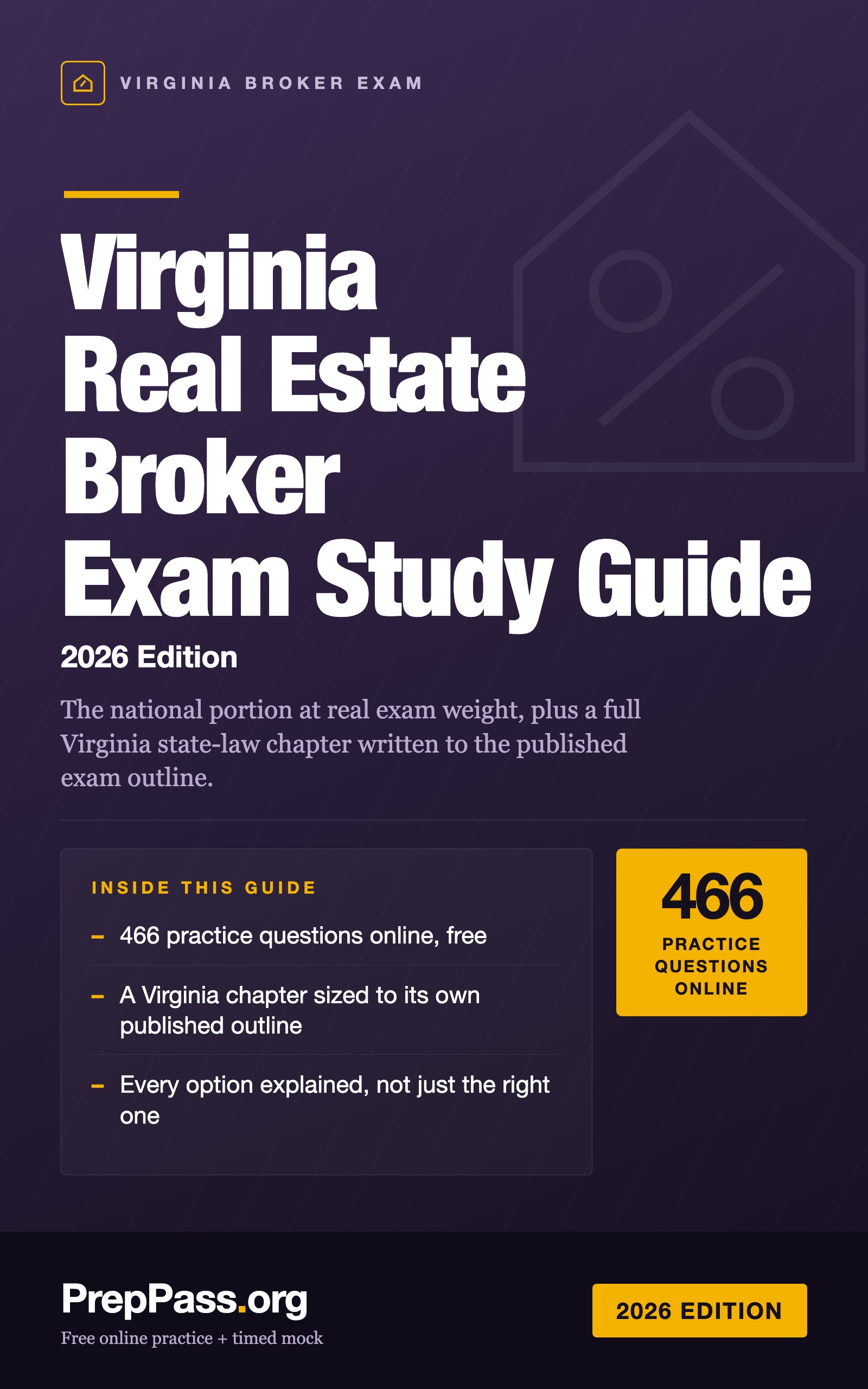
Virginia Real Estate Broker · 2026 Edition
Virginia Real Estate Broker Exam Study Guide (2026)
The national portion at real exam weight, plus a Virginia chapter. The Virginia chapter is sized to the published outline — 6 areas, 50 scored items — area by area, not flattened.
- All 8 chapters of the national portion plus a full Virginia real-estate-law chapter — PDF + EPUB you keep
- A 60-question national practice exam, with a key that explains all four options and not just the right one
- 20 Virginia law questions of its own, with a worked answer key
PDF + EPUB · English · 304 pages · $14.99 one-time
This book is written in English.
Instant download after payment — no account needed, no subscription. Refund policy
Try 10 questions first — free
Answer all 10, then see every answer explained — with the section of this guide that teaches it. About 5 minutes, no sign-up.
Start 10 free questionsLook inside the book
Three real pages, rendered straight from the PDF you download — a teaching page, a worked question, and a reference page. Nothing here was redrawn to look better.
- Quick referencePart C — Encumbrances a broker must read off a title report · PDF page 102
A page you can turn back to: the numbers, deadlines or terms gathered in one place.
- A question, workedAnswer Key and Explanations · PDF page 174
A practice question with its answer and the reasoning behind it — not just a key.
- How it's taughtPart II — Virginia State Law & Practice · PDF page 298
An explanation page: the material taught in prose, in the order the exam tests it.
What's included — and what isn't
Included
- A Virginia chapter written to the published exam outline, area by area
- Where Virginia law departs from the national rule — both stated, so neither is guessed
- Supervision, trust accounts, brokerage operation and broker math
- A Virginia practice set with every option explained, not just the right one
- 466 practice questions online, free, from the same bank
- PDF (print & tab it) + EPUB (phone / e-reader)
Not included
- No printed copy is shipped — this is a file you download and can print yourself
- No video course, instructor or tutoring comes with the book — the free videos on the site are separate
- Not your exam registration or the testing centre's fee, which you still pay to the official body
Contents
See 29 chapters and the page each one starts on
- Part C — Advertising and recordkeeping compliancep. 14
- Part D — Consumer contact and transaction integrityp. 16
- 2. Trust Funds, Escrow, and the Client’s Moneyp. 30
- Part C — Records that survive an auditp. 33
- Part D — Disputed moneyp. 34
- 3. Agency at the Broker Levelp. 40
- Part C — Fiduciary duties, at the level a broker is examined onp. 44
- Part D — Dual agency, designated agency, and the alternativesp. 46
- 4. Contracts and Brokerage Agreementsp. 55
- Part C — Options, rights of first refusal, and installment contractsp. 60
- Part D — Between contract and closingp. 61
- 5. Fair Housing, Accessibility, and Antitrust: The Exposure You Carry Personallyp. 72
- Part C — The exemptions, and why they rarely save anyonep. 78
- Part D — Disability: the distinction the exam always testsp. 79
- 6. Ownership, Land Use Controls, and Transfer of Titlep. 95
- Part C — Encumbrances a broker must read off a title reportp. 101
- Part D — Legal descriptionsp. 103
- 7. Valuation, Financing, and the Federal Lending Lawsp. 113
- Part C — The instrumentsp. 121
- Part D — Loan programs, structures, and qualifyingp. 123
- 8. Disclosures, Environmental Risk, and Property Managementp. 136
- Part C — The management agreement and the manager’s authorityp. 142
- Part D — Leases and tenanciesp. 144
- Practice Exam — 60 Questionsp. 153
- Answer Key and Explanationsp. 170
- Appendix A — Broker Math Cheat Sheetp. 221
- Appendix B — Glossaryp. 243
- Appendix C — Exam-Day Strategyp. 262
- Part II — Virginia State Law & Practicep. 267
Taken from the PDF you download, with the page each one starts on — not typed here.
Read a chapter free, in full
One complete chapter, exactly as it ships in the eBook. Scroll the window to read it right here; no download, no email.
Read chapter 9 here, without leaving the page
We didn't give you the easy intro — the free chapter opens on one of the hardest-working parts of the book, so you can judge the teaching where the exam gets difficult.
What the Virginia state portion actually is
The Virginia real estate broker license examination is delivered by PSI. Everything in this chapter is keyed to PSI's candidate information bulletin 466, the revision recorded 2026-02-18. That exam has two halves, and only one of them is Virginia. The national portion carries 75 scored items scored to 80 points — the point total is larger than the item count because national broker items can be worth up to two points. The Virginia state portion carries 50 scored items worth 50 points, one point each. Together that is 125 scored items.
Passing is published as points correct, not as a percentage: 60 of the 80 national points and 38 of the 50 state points. Print that as a percentage and you will mislead yourself in two directions at once — the national fraction is not an item count, and the state fraction is. On the state half you may miss twelve questions and pass; you may not miss thirteen.
| Quick facts | Virginia broker |
|---|---|
| Vendor | PSI, candidate information bulletin 466 (revision 2026-02-18) |
| Regulator | Real Estate Board, within the Department of Professional and Occupational Regulation (DPOR) |
| Governing law | Code of Virginia Title 54.1, Chapter 21 (Sections 54.1-2100 through 54.1-2146) |
| Board regulations | 18VAC135-20 |
| State items | 50 scored items, 50 points |
| National items | 75 scored items scored to 80 points |
| Pass mark | 60 of 80 national points; 38 of 50 state points |
| Time | national 105 minutes + state 55 minutes = 160 minutes for 125 scored items |
One honest caveat about the clock. The 105 + 55 = 160 minute figure is what the bulletin's own Examination Summary Table publishes, and it is what this book's exam record carries. But the machine-readable outline block built from the bulletin's content outline records the state minutes as not captured — the outline section itself does not print them. The two are not in conflict; one simply says less than the other. We are telling you that rather than quietly presenting 55 minutes as though it had been read off the outline. Confirm the timing on the live bulletin before exam day; a vendor can re-cut a time allowance without touching a single content weight.
The six areas, and what the broker exam adds
| Area (published order) | Broker items of 50 | Share | Salesperson items |
|---|---|---|---|
| I. Licensing | 13 | 26% | 8 |
| II. Escrow Accounts | 7 | 14% | 2 |
| III. Disclosure Requirements | 7 | 14% | 10 |
| IV. Agency Definitions and Relationships | 12 | 24% | 12 |
| V. Virginia Fair Housing Law and Regulations | 6 | 12% | 4 |
| VI. Specific Acts Pertaining to Real Estate Practice | 5 | 10% | 4 |
Read the last two columns against each other, because the difference is the whole reason this edition exists. Licensing goes from 8 items to 13, and Escrow Accounts goes from 2 items to 7 — a three-and-a-half-fold jump — while Disclosure Requirements actually falls from 10 to 7. Agency holds at 12. In other words, the Virginia broker exam does not simply ask harder versions of the salesperson's questions; it re-aims at supervision, records, audits and the trust account, because those are what a broker, and only a broker, is answerable for. If you are studying from a salesperson course book you own, its escrow chapter was built for two questions. You are sitting seven.
A second caveat. Under Escrow Accounts and under Virginia Fair Housing Law and Regulations the bulletin prints a weight and nothing else — no lettered subtopic list at all. The outline record keeps those two lists empty rather than inventing one, and this chapter does the same: the escrow and fair housing coverage below is built directly from 18VAC135-20 and from Title 36, Chapter 5.1, not from a subtopic list that does not exist. Where the bulletin does print subtopics — Licensing, Disclosure Requirements, Agency, and Specific Acts — those lettered items drive what is covered.
Sections marked with an item count below are sized to that count. The chapter's teaching prose is allocated in proportion to the published weights, which is why Licensing runs long and Specific Acts runs short.
I. Licensing — 13 of 50 items
Section 54.1-2104 creates a nine-member Real Estate Board inside DPOR: seven members who have been actively engaged as licensed brokers or salespersons for at least seven consecutive years, and two citizen members, all serving four-year terms. Section 54.1-2105 A lets the Board do all things necessary to carry Chapter 21 into effect and promulgate regulations, and those regulations are 18VAC135-20. Section 54.1-2105.2 lets the Board order an unlicensed person to cease and desist, and subsection C allows a civil penalty of up to $1,000 for any real estate transaction, or the compensation received from it, whichever is greater. The practical consequence for you: two documents govern, and where the 2025 legislation changed something the regulation has not caught up on, the Code governs.
Qualifying. 18VAC135-20-30 requires an individual applicant to be at least 18, to hold a high school diploma or its equivalent, to report prior discipline in any jurisdiction, to submit to fingerprinting, and to sign a statement that the applicant has read Chapter 21 and the regulations. For brokers, subdivision B 2 of Section 54.1-2105 adds not less than 12 semester hours of real estate instruction, with subsection D naming the subjects: brokerage, finance, appraisal, law and related Board-approved topics. That is not the salesperson's 60-hour principles course, which lives in subdivision B 1 b, and it is not the 30-hour post-license curriculum either. Then subsection C of 18VAC135-20-35 supplies the experience test: actively engaged as a real estate salesperson for 36 of the 48 months immediately preceding application, verified by the principal or supervising broker. "Actively engaged" is not a soft phrase; 18VAC135-20-10 defines it as active licensure with a licensed firm or sole proprietorship performing licensed activity for an average of at least 40 hours per week. A salesperson who kept a license parked with a firm for four years and closed two deals has active licensure and no experience. Subsection E 4 applies the same 36-of-48 test to reciprocity applicants.
What requires a license, and who may do what. Section 54.1-2106.1 requires a firm license for any business entity other than a sole proprietorship, an individual broker license, an individual salesperson license, and a business entity salesperson license for a real estate team. Subsection E adds the one brokers forget: a branch office license for each additional place of business, with a copy kept on those premises. Open a staffed second office in Fredericksburg that the public is invited to walk into and the firm license does not stretch to cover it; the Board issues a separate branch license, and the same subsection exempts locations such as vehicles, post office boxes and coffee shops, and a residence unless it is held out to the public. Inside the office, subsection A of 18VAC135-20-335 reserves five activities to licensees — showing property; holding an open house; answering questions on listings, title, financing, closing, contracts, brokerage agreements and legal documents; discussing or negotiating a contract, lease or property management agreement with anyone outside the firm; and negotiating or agreeing to any commission, split, management fee or referral fee. Subsection B is the counterpart list of what unlicensed staff may do: clerical work, scheduling, courier work, placing signs on properties, and recording and depositing escrow funds. The trap is that an unlicensed assistant may place the sign in the yard but may not staff the open house behind it, and may not answer the caller who asks about financing. Subsection C of Section 54.1-2103 gives on-site rental staff a narrow further allowance: they may show units and accept payments, but may not negotiate. Subdivision 3 of 18VAC135-20-165 puts responsibility for supervising unlicensed personnel on the supervising broker.
Records and audits — a broker-only cluster. Subsection C of 18VAC135-20-185 retains brokerage agreements and dual or designated agency disclosures for three years from execution, transaction documents for three years from closing or, where the deal failed, from ratification, and receipt-and-disbursement records for three years from closing or termination. Subsection A requires the principal broker's financial records to show from whom money was received, the date of receipt, the place and date of deposit, and the final disposition. Section 54.1-2106.2 and subdivision A 1 of 18VAC135-20-225 require an audit of the firm's practices, policies and procedures within 90 days before the firm license expires, on a Board form kept on the premises, which the broker then certifies at renewal. Note the direction of travel: the audit runs before renewal, so that the certification means something. When the Board comes asking, subsection A of 18VAC135-20-240 gives the licensee 10 days to produce a requested record, and subsection B gives 21 days to answer any other Board inquiry. Two different clocks, and candidates swap them constantly. Section 54.1-2146 allows any required record to be an electronic record.
Maintenance. 18VAC135-20-90 sets a two-year term expiring on the last day of the anniversary month, so every licensee runs a personal cycle rather than a common statewide date, and 18VAC135-20-110 C warns that failing to receive the Board's renewal notice excuses nothing. Subdivision A 1 of Section 54.1-2105.03 requires brokers to complete 24 hours of continuing education each term: at least 11 required hours (three of ethics, two of fair housing, two of legal updates, two of agency, two of contracts), at least eight hours on supervision and brokerage management, two of those covering broker supervision, and five elective hours. Salespersons take 16 hours under subdivision A 2, and the eight-hour management block is precisely the difference — it is a broker-only obligation. New salespersons instead take the 30-hour post-license curriculum in Section 54.1-2105.01 and 18VAC135-20-95 within their first year. 18VAC135-20-70 governs activation and transfer between firms, effective when the new principal or supervising broker executes the transfer application. Subdivision A 1 of 18VAC135-20-170 gives the individual licensee 30 calendar days to report a change of name or address; subdivision B 1 gives the principal broker 10 calendar days to report that a licensee has terminated active status, and subdivision B 2 applies the same 10 days when a principal broker terminates. Subsection C of 18VAC135-20-140 allows reinstatement for one year after expiration and then never — after that the applicant meets all current education and examination requirements as a new applicant — while subsection B marks the 30-day point at which the reinstatement fee replaces the renewal fee, and subsection D warns that practicing on the expired license may itself be unlicensed activity. Verify fee amounts and any CE hour changes against the Board's current schedule; hours and fees are the figures most likely to drift.
Improper dealings and improper brokerage. 18VAC135-20-260 lists the prohibited acts: obtaining a license by fraud, signing an experience verification form without actual knowledge, failing to inform the Board in writing within 30 days of a disqualifying conviction or of discipline in another jurisdiction, and a long subdivision 11 on failing to safeguard the public — a broker who lacks signatory authority on all accounts, a licensee practicing on an inactive or expired license, a licensee giving access to a property without the owner's authorization. Subdivision 12 covers dishonest conduct: diverting commission away from the firm, submitting the same earnest money check with multiple offers, misrepresenting who holds a deposit. 18VAC135-20-280 covers improper financial transactions — paying an unlicensed person for licensed work, a salesperson accepting compensation from anyone but the principal or supervising broker without that broker's prior written consent, and net listings. And 18VAC135-20-330 is the provision every supervising broker should be able to recite: a principal or supervising broker is disciplined for a subordinate's violation only where the broker knew or should have known and failed to act. Supervision liability in Virginia is fault-based, not automatic.
What the supervisory cluster looks like from the broker's desk. Put the broker-only obligations side by side and they form one routine rather than six scattered rules. Every 24 months the firm's license comes up; within the 90 days before it does, the principal or supervising broker runs the 18VAC135-20-225 audit of practices, policies and procedures on the Board's form, keeps that form on the premises, and certifies at renewal under Section 54.1-2106.2 that it was done. In the same cycle the broker completes the eight supervision-and-management hours, two of them on broker supervision, that subdivision A 1 b of Section 54.1-2105.03 adds on top of everything a salesperson takes. Between cycles the broker holds signatory authority on every escrow account — its absence is itself a failure to safeguard the public under subdivision 11 of 18VAC135-20-260 — reports each licensee's termination within 10 calendar days, produces requested records within 10 days and answers other Board inquiries within 21, keeps three years of brokerage agreements and transaction files under subsection C of 18VAC135-20-185, and licenses each additional staffed office. The trap is treating any of this as the office administrator's job. 18VAC135-20-330 limits discipline for a subordinate's violation to a broker who knew or should have known; every obligation in this paragraph is the broker's own, and there is no subordinate to blame for an audit that was never run.
Before you buy
- How do I get it?
- Pay, and the download appears on this page straight away. The links are also emailed to you. No account is required.
- What if it isn't for me?
- Email us within 14 days for a full refund, no questions asked.
- Is the free practice going away?
- No. Every practice question, the timed mock and the free chapters on this site stay free. This book is the studying half, not a gate around the free half.
- Can I read it on my phone?
- Yes — the EPUB is for phones and e-readers, the PDF is for printing and tabbing. You get both.
The details
The national portion at real exam weight, plus a Virginia chapter. The Virginia chapter is sized to the published outline — 6 areas, 50 scored items — area by area, not flattened.
- Format: PDF + EPUB download · 304 pages
- 80 practice questions in the book, with a full answer key
- 466 free practice questions for this exam on PrepPass, included at no cost
- $14.99 one-time — no subscription
- 14-day money-back guarantee · refund policy
- Cross-referenced against: Title 55 Chapter 29 · PSI bulletin 466 (rev 2026-02-18)
- Last updated: September 2026
- Verified from the official source(Title 55 Chapter 29 · PSI bulletin 466 (rev 2026-02-18))
- 466 free practice questions
- Instant download, yours for life
a real estate broker pre-license course runs $200–$1,000. This book teaches the same exam — same rules, verified to current standards — for a one-time $14.99 you keep for life.
Why buy the book when the practice is free?
Our practice questions and timed mock stay free — nothing on the site moves behind this book. The $14.99 book is the studying half: the material itself, taught in order, in a file you own.
- Systematic teaching — every exam section explained chapter by chapter, start to finish, not just questions
- Print it & tab it — a paper-ready PDF you can highlight, mark up, and bring to your study table
- Study anywhere, offline — EPUB on your phone or e-reader; no wifi, no browser tabs
- Everything in one place — chapters, per-chapter cram sheets, and practice questions in one file
- Yours for life — one-time $14.99, instant download, no subscription
And it's risk-free: 14-day money-back guarantee — not satisfied? Email us for a full refund, no questions asked. See the refund policy.
14-day money-back guarantee · full refund, no questions asked.
One-time purchase, lifetime access to the download. The eBook is the full Virginia Real Estate Broker study guide in PDF and EPUB. Educational summary, not professional or legal advice — always confirm the current rules with the official source. Last updated: September 2026.