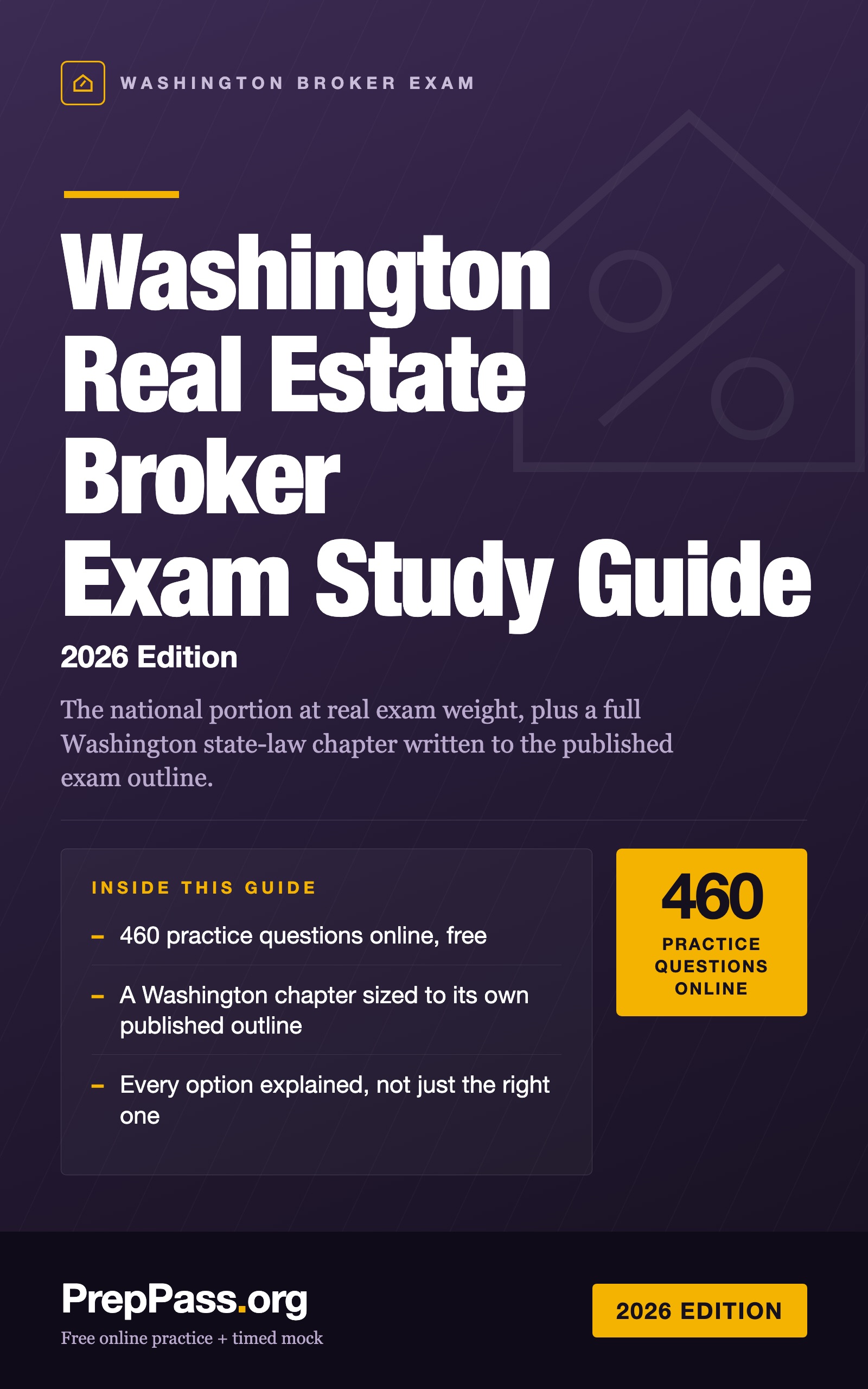
Washington Real Estate Broker · 2026 Edition
Washington Real Estate Broker Exam Study Guide (2026)
The national portion at real exam weight, plus a Washington chapter. The Washington chapter is sized to the published outline — 5 areas, 44 scored items — area by area, not flattened.
- All 8 chapters of the national portion plus a full Washington real-estate-law chapter — PDF + EPUB you keep
- A 60-question national practice exam, with a key that explains all four options and not just the right one
- 20 Washington law questions of its own, with a worked answer key
PDF + EPUB · English · 299 pages · $14.99 one-time
This book is written in English.
Instant download after payment — no account needed, no subscription. Refund policy
Try 10 questions first — free
Answer all 10, then see every answer explained — with the section of this guide that teaches it. About 5 minutes, no sign-up.
Start 10 free questionsLook inside the book
Three real pages, rendered straight from the PDF you download — a teaching page, a worked question, and a reference page. Nothing here was redrawn to look better.
- Quick referencePart C — Encumbrances a broker must read off a title report · PDF page 102
A page you can turn back to: the numbers, deadlines or terms gathered in one place.
- A question, workedPart II — Washington State Law & Practice · PDF page 292
A practice question with its answer and the reasoning behind it — not just a key.
- How it's taughtPart II — Washington State Law & Practice · PDF page 295
An explanation page: the material taught in prose, in the order the exam tests it.
What's included — and what isn't
Included
- A Washington chapter written to the published exam outline, area by area
- Where Washington law departs from the national rule — both stated, so neither is guessed
- Supervision, trust accounts, brokerage operation and broker math
- A Washington practice set with every option explained, not just the right one
- 460 practice questions online, free, from the same bank
- PDF (print & tab it) + EPUB (phone / e-reader)
Not included
- No printed copy is shipped — this is a file you download and can print yourself
- No video course, instructor or tutoring comes with the book — the free videos on the site are separate
- Not your exam registration or the testing centre's fee, which you still pay to the official body
Contents
See 29 chapters and the page each one starts on
- Part C — Advertising and recordkeeping compliancep. 14
- Part D — Consumer contact and transaction integrityp. 16
- 2. Trust Funds, Escrow, and the Client’s Moneyp. 30
- Part C — Records that survive an auditp. 33
- Part D — Disputed moneyp. 34
- 3. Agency at the Broker Levelp. 40
- Part C — Fiduciary duties, at the level a broker is examined onp. 44
- Part D — Dual agency, designated agency, and the alternativesp. 46
- 4. Contracts and Brokerage Agreementsp. 55
- Part C — Options, rights of first refusal, and installment contractsp. 60
- Part D — Between contract and closingp. 61
- 5. Fair Housing, Accessibility, and Antitrust: The Exposure You Carry Personallyp. 72
- Part C — The exemptions, and why they rarely save anyonep. 78
- Part D — Disability: the distinction the exam always testsp. 79
- 6. Ownership, Land Use Controls, and Transfer of Titlep. 95
- Part C — Encumbrances a broker must read off a title reportp. 101
- Part D — Legal descriptionsp. 103
- 7. Valuation, Financing, and the Federal Lending Lawsp. 113
- Part C — The instrumentsp. 121
- Part D — Loan programs, structures, and qualifyingp. 123
- 8. Disclosures, Environmental Risk, and Property Managementp. 136
- Part C — The management agreement and the manager’s authorityp. 142
- Part D — Leases and tenanciesp. 144
- Practice Exam — 60 Questionsp. 153
- Answer Key and Explanationsp. 170
- Appendix A — Broker Math Cheat Sheetp. 221
- Appendix B — Glossaryp. 243
- Appendix C — Exam-Day Strategyp. 262
- Part II — Washington State Law & Practicep. 267
Taken from the PDF you download, with the page each one starts on — not typed here.
Read a chapter free, in full
One complete chapter, exactly as it ships in the eBook. Scroll the window to read it right here; no download, no email.
Read chapter 9 here, without leaving the page
We didn't give you the easy intro — the free chapter opens on one of the hardest-working parts of the book, so you can judge the teaching where the exam gets difficult.
Before anything else, get the tier names right, because Washington uses them backwards from most of the country. In Washington the entry-level license is called "Broker." The upper tier — the one that supervises — is called "Managing Broker." If you came here from a state where "broker" is the senior license, you are looking for the Managing Broker examination, and this chapter is written for it.
Everything below is Washington law: chapter 18.85 RCW (license law), chapter 18.86 RCW (brokerage relationships), and the WAC 308-124 series. Nothing here repeats the national portion; where Washington departs from the national rule, both are named — and Washington departs further than almost any state, because it replaced common-law agency by statute.
What the Washington portion actually is
| Regulator | Washington State Department of Licensing (DOL); the real estate commission is advisory only |
| Test vendor / document | PSI candidate information bulletin 4658, revision 2024-03-28 |
| National portion | 90 items |
| Washington portion | 44 items — but 48 points |
| Time for the Washington portion | 90 minutes |
| Passing score | scaled 75 |
| Governing law | RCW 18.85, RCW 18.86, WAC 308-124A / B / C / D / E / H / I |
Items are not points here, and the arithmetic matters. Forty-four items carry forty-eight points because the last section — IV, Scenarios in Real Estate Practice — is 4 questions worth 8 points, two points each. Those four items are worth twice what any other item on the state portion is worth. Four questions carry one sixth of the available points. Budget time accordingly: roughly 90 seconds for an ordinary item, and do not rush the scenarios.
The published Managing Broker weighting
| # | Area (as published) | MB items | Share | Entry Broker |
|---|---|---|---|---|
| I | General Rules | 6 | 13.6% | 4–5 |
| II | Licensing Requirements | 9 | 20.5% | 8 |
| III | Washington Statutes and Rules Governing Licensee Activity | 18 | 40.9% | 13 |
| III(b) | Real Estate Brokerage Relationships (Agency) | 7 | 15.9% | 4–5 |
| IV | Scenarios in Real Estate Practice | 4 (8 points) | 9.1% | none |
| Total | 44 (48 points) | 100% |
Area III alone is 41% of the state portion — nearly half again what it is worth on the entry exam. Size your study to that.
Three defects in the published document you should expect to see
These are problems with the source, not with this book, and a candidate who does not know about them will assume the mistake is theirs.
- The bulletin's footnote is wrong on its own face. A footnote states that only the national examination carries 2-point items. The state content outline on the same document expressly records area IV as "4 questions / 8 points," and the examination summary table gives the state portion as 44 questions and 48 points. The state portion carries 2-point items. Trust the outline and the summary table, not the footnote.
- The document has a numbering defect: two consecutive sections are both labeled III. The published outline runs I, II, III (Washington Statutes and Rules Governing Licensee Activity), III again (Real Estate Brokerage Relationships (Agency)), IV. This book calls the second one III(b) to keep them apart. Expect to see two IIIs on the real document.
- Area IV exists only on the Managing Broker exam. There is no scenario section on the entry Broker exam and no counterpart to study from. If your practice material has no Washington scenario items, it was built for the wrong tier.
A note on the source: the lettered sub-lists under each area heading are not reproduced here, because this book will not present a subtopic list it cannot point to in the published outline. Each section below tells you what the exam actually asks about in that area.
1. I. General Rules — 6 of 44 scored items (13.6%)
Who regulates, and who only advises. Licensing sits with the Department of Licensing under chapter 18.85 RCW. RCW 18.85.041 gives the director the operative powers: to issue rules with the advice and approval of the commission, to enforce the licensing laws, to grant or deny licenses, to hold hearings, and to set standards for clear and conspicuous advertising. The real estate commission created by RCW 18.85.021 is the director as chair plus six members appointed by the governor for six-year terms — at least two from west of the Cascades and at least two from east of them — and the statute says in terms that they "act in an advisory capacity to the director." The commission conducts examinations of applicants under RCW 18.85.031; it does not issue or revoke licenses.
Definitions worth memorizing. RCW 18.85.011 controls the vocabulary. "Commercial real estate" is any parcel other than real estate containing one to four residential units, excluding single-family lots and units sold or leased unit by unit unless the purpose is commercial. That definition carries real weight downstream: RCW 18.86.020(3) excuses a services agreement for a buyer's agent acting solely for commercial real estate, and RCW 18.86.080(8) substitutes a written Compensation Disclosure. A "designated broker" owns a sole proprietorship firm or holds a controlling interest and carries a designated broker endorsement on a managing broker's license. An "inactive license" is one that is not expired and not affiliated with a firm.
Investigations, appeals, penalties. Chapter 18.235 RCW — the uniform regulation of business and professions act — governs unlicensed practice, license denial and discipline (RCW 18.85.440). Chapter 308-124I WAC sets audit and investigation procedure and states that licensees have no privacy interest in the records they are required to keep. After an adjudicative hearing the director may act on a preponderance of the evidence (RCW 18.85.380). An appeal goes to superior court, and RCW 18.85.390 requires a $1,000 cash bond with the notice filed within thirty days of the director's decision; RCW 18.85.401 then makes the appellant pay for the certified transcript within fifteen days or the appeal is dismissed. Sanctions come from RCW 18.235.110, which caps a fine at $5,000 per violation and requires aggravating and mitigating circumstances to be weighed. Acting without a license is separately a gross misdemeanor (RCW 18.85.411).
Follow the money — three different accounts. RCW 18.85.451 assesses a $20 fee on every original and renewal broker and managing broker license, including renewals of inactive licenses; RCW 18.85.461 deposits it in the Washington real estate research account, spendable only for the research center of RCW 18.85.471. All three sections expire September 30, 2035, a sunset extended by 2025 c 362. Fines go to the real estate education program account (RCW 18.85.321). Pooled trust account interest is split 75/25 between the housing trust fund and that education account (RCW 18.85.311).
2. II. Licensing Requirements — 9 of 44 scored items (20.5%)
What needs a license. RCW 18.85.331 makes it unlawful to act as a broker, managing broker or real estate firm without a license, and bars any suit for compensation unless the plaintiff pleads and proves he was licensed "before the time of offering to perform any real estate transaction or procuring any promise or contract for the payment of compensation." The moment of licensure is fixed at the front of the deal — licensing up later cures nothing.
Exemptions. RCW 18.85.151 lists them: owners dealing for their own account; an attorney-in-fact acting without compensation; attorneys practicing law; court-appointed fiduciaries; office personnel who perform no licensable act; government right-of-way staff; self-storage operators; pure referrers whose pay is not contingent on the licensee's; and — the one most often tested — unlicensed property management assistants, whose work is limited by RCW 18.85.151(13) to a closed list: delivering or receiving a lease application, lease, amendment, security deposit or rental payment made payable to the firm or owner; showing a rental unit, or executing leases or rental agreements, while acting under the direct instruction of the owner or designated or managing broker; providing information about a unit, lease, application, deposit or rent amount; and administrative, clerical, financial or maintenance tasks. Negotiating terms is not on that list.
Three names on one ladder. A Broker holds the entry license and is supervised. A Managing Broker has met additional experience and education and may supervise — but under RCW 18.85.111(3) may be licensed to only one firm at a time. A Designated Broker is the managing broker a firm designates as legally responsible for it; RCW 18.85.121 requires a managing broker license and expressly allows one person to serve as designated broker for more than one firm, with an endorsement naming every firm. There is no separate designated broker examination — the credential is an endorsement. RCW 18.85.091(1)(a) makes designating one a condition of the firm license, and RCW 18.85.011(10) requires the designated broker to own or hold a controlling interest in the firm. Note the pairing that trips candidates: one-firm exclusivity attaches to the managing broker license; multi-firm service attaches to the designated broker role. A branch office needs a branch manager who is a managing broker (RCW 18.85.241).
Eligibility and education. For the entry Broker license, RCW 18.85.101 requires 90 hours — a 60-hour Fundamentals course including three hours of fair housing and consumer protection, plus a 30-hour Practices course — completed within two years before the examination. For the Managing Broker license, RCW 18.85.111 requires three years of licensed experience as a full-time real estate broker within the previous five years, plus 90 further clock hours that must include brokerage management, business management, and advanced real estate law; WAC 308-124A-750 requires each of those to be at least thirty hours with a comprehensive examination, completed within three years of applying. Experience alone never suffices, however long, and no academic degree waives the licensed-brokerage requirement. WAC 308-124A-713 supplies the only alternative routes — a real estate major plus one year as a licensed broker; one year as a real estate attorney; five years as a licensed mortgage broker or loan originator, limited practice officer or escrow agent, licensed or certified appraiser, or corporate property manager.
Renewal, fees, status. An individual license expires two years from issuance (RCW 18.85.191); a late application draws a penalty fee, and a license whose renewal fee is not received within one year of expiration is canceled, after which a new license must be obtained. Expiry and cancellation are different events a year apart. Renewal requires 30 clock hours every two years (RCW 18.85.211), including the three-hour prescribed core curriculum and the prescribed Washington fair housing curriculum, with at least fifteen of the thirty taken within twenty-four months of the renewal date and up to fifteen surplus hours carried forward (WAC 308-124A-790). RCW 18.85.211(1) says expressly that examinations shall not be required to fulfill any part of the education requirement. A broker's first active renewal is heavier: 90 hours including real estate law and advanced practices (WAC 308-124A-785). An inactive license is one delivered to the director; it renews without the education, but no brokerage services may be performed, and after three years inactive the holder must complete a 30-hour course within the year before applying for active status (RCW 18.85.265(3)).
3. III. WA Statutes and Rules Governing Licensee Activity — 18 of 44 scored items (40.9%)
The largest block on the managing broker exam, and the block that most distinguishes it from the entry exam.
Cite the right WAC chapter
This is a real trap and it costs points. Chapter 308-124 WAC is titled "Real estate—Definitions and brief adjudicative proceedings" and has four sections. It contains none of the operating rules. The rules that matter live in 308-124A (licensing and examination), 308-124B (firms, branch offices, advertising), 308-124C (records and responsibilities), 308-124D (operational procedures), 308-124E (trust account procedures), 308-124H (course, school and instructor approval) and 308-124I (audit and investigation procedures). A study aid that cites bare "WAC 308-124" for a trust-account or supervision rule is citing the wrong chapter.
The firm owns the file
RCW 18.85.275(2) makes listings, transactions, management agreements and other brokerage service contracts the property of the real estate firm — they do not go with a departing broker. The same subsection sets the chain of custody: the broker delivers funds and records to the appointed managing broker, who delivers to the designated broker, each becoming responsible only on receipt. Subsection (3) lets the designated broker delegate safe handling of client funds, trust accounts, records and supervision to a managing broker licensed to the firm by signed written agreement, with a record of every delegation. RCW 18.85.291 keeps the licenses with the firm and ends their force when the broker stops representing it. And WAC 308-124A-730(1)(c) closes the obvious abuse: the designated broker may not condition surrender of the license on the broker performing any act — not an open transaction, not an unpaid advance. Termination must be in writing, with notice to the real estate program without delay.
Prohibited conduct
RCW 18.85.361 lists twenty-five grounds on top of the unprofessional conduct in RCW 18.235.130. The frequently tested ones:
- (8) advertising without the firm's licensed name clearly and conspicuously;
- (9) accepting other than cash or its equivalent as earnest money unless the fact is communicated to the owner before the owner's acceptance and shown in the purchase and sale agreement — two requirements, both before acceptance;
- (10) taking compensation from more than one party without prior full written disclosure to all parties;
- (16) and (17) failing to keep trust or transaction records three years;
- (19) a broker accepting compensation from anyone but her own firm;
- (21) buying or leasing property directly or through a third party without disclosing in writing that the person is a licensee — the words "or through a third party" catch an entity the licensee controls;
- (22) failing to exercise adequate supervision — an independent ground against the firm and its managing and designated brokers, requiring no discipline of the supervised broker first;
- (23) bad faith, dishonesty, untrustworthiness or incompetence.
Compensation
RCW 18.85.301 makes it unlawful to pay an unlicensed person for brokerage services, unlawful for a firm to pay a broker not licensed to it, and unlawful for a broker to be paid other than through her own firm's designated broker. The only carve-out is sharing with a manufactured housing retailer licensed under chapter 46.70 RCW. On the agency side, RCW 18.86.080 allows compensation from the seller, the buyer, a third party or shared between firms; states that paying compensation does not by itself create an agency relationship; and requires a services agreement containing the terms of compensation before a firm may be paid — with one substitute, a written "Compensation Disclosure" delivered to a buyer of commercial real estate before that buyer signs an offer, plus a narrow exception for a broker's price opinion or a bare referral.
Trust accounts — and the two clocks that get confused
RCW 18.85.285(5) requires client funds to be kept separate and apart and physically segregated from the licensee's own money, deposited into the firm's trust account in a recognized Washington depository, and (for client funds other than property management) held in a pooled interest-bearing account.
Two rule deadlines run alongside, and they are different rules measuring different things:
- WAC 308-124E-100 — the broker physically delivers funds to the managing broker, branch manager or designated broker within two business days of the client's signature, or sooner if the client contract requires. Business days exclude Saturdays, Sundays and RCW 1.16.050 holidays.
- WAC 308-124E-105(6) — the firm deposits into the trust account not later than the next banking day following receipt. The single exception, in (6)(b), is a check the earnest money agreement itself says is to be held for a specified time or until a specified event — written into the agreement, not decided by the broker.
Trust money may not be disbursed before closing without a written release from both parties (WAC 308-124E-110(3)); the firm's own commission check may be drawn on the account only after final closing (110(2)); and commissions to the firm's own licensees and firm business expenses must come from the business account (105(16)(c)). Commissions owed to another firm may be paid from trust (105(14)). Security and damage deposits get their own rule: WAC 308-124E-115(5) forbids disbursement to the owner or anyone else without the tenant's written agreement, until the end of the tenancy.
Records, offices, property management
WAC 308-124C-105 puts the required records on the designated broker: duplicate receipts, sequentially numbered non-duplicative checks with registers, validated deposit slips, a client ledger for every transaction and management account, separate ledger sheets for each tenant and vendee, reconciled statements with canceled checks, a log of brokerage service contracts, and a transaction folder for each deal — all kept at one licensed location. WAC 308-124C-110 requires three years' retention and inspection availability, and permits electronic storage where retrieval is immediate at the licensed office. WAC 308-124C-115 requires notice to the real estate program within twenty days after service or knowledge of any criminal complaint, information, indictment or conviction naming the licensee; of a civil order, verdict or judgment involving real estate or business activity, regardless of any pending appeal; and of discipline against another professional license. Only the civil branch is limited to real estate or business subject matter — the criminal branch is not, and it runs from service or knowledge of the charge, not from conviction.
RCW 18.85.241 lets the designated broker establish branch offices under the same name as the firm, requires a duplicate license prominently displayed at each branch, and requires each branch to have a branch manager who is a managing broker. There is one narrow exemption: no branch license is needed for sales activity confined to a single subdivision or tract lying within thirty-five miles of a licensed office. Every managed property needs a written management agreement signed by the owner and the designated broker (WAC 308-124D-215), stating compensation, unit type and count, authority to collect and disburse, authority over security deposits, and how often owner summary statements are furnished; amendments must be written and signed by the same two people.
Before you buy
- How do I get it?
- Pay, and the download appears on this page straight away. The links are also emailed to you. No account is required.
- What if it isn't for me?
- Email us within 14 days for a full refund, no questions asked.
- Is the free practice going away?
- No. Every practice question, the timed mock and the free chapters on this site stay free. This book is the studying half, not a gate around the free half.
- Can I read it on my phone?
- Yes — the EPUB is for phones and e-readers, the PDF is for printing and tabbing. You get both.
The details
The national portion at real exam weight, plus a Washington chapter. The Washington chapter is sized to the published outline — 5 areas, 44 scored items — area by area, not flattened.
- Format: PDF + EPUB download · 299 pages
- 80 practice questions in the book, with a full answer key
- 460 free practice questions for this exam on PrepPass, included at no cost
- $14.99 one-time — no subscription
- 14-day money-back guarantee · refund policy
- Cross-referenced against: RCW 18.85.361 · RCW 18.86.030 · RCW 18.85.275 · PSI bulletin 4658 (rev 2024-03-28)
- Last updated: September 2026
- Verified from the official source(RCW 18.85.361 · RCW 18.86.030 · RCW 18.85.275 · PSI bulletin 4658 (rev 2024-03-28))
- 460 free practice questions
- Instant download, yours for life
a real estate broker pre-license course runs $200–$1,000. This book teaches the same exam — same rules, verified to current standards — for a one-time $14.99 you keep for life.
Why buy the book when the practice is free?
Our practice questions and timed mock stay free — nothing on the site moves behind this book. The $14.99 book is the studying half: the material itself, taught in order, in a file you own.
- Systematic teaching — every exam section explained chapter by chapter, start to finish, not just questions
- Print it & tab it — a paper-ready PDF you can highlight, mark up, and bring to your study table
- Study anywhere, offline — EPUB on your phone or e-reader; no wifi, no browser tabs
- Everything in one place — chapters, per-chapter cram sheets, and practice questions in one file
- Yours for life — one-time $14.99, instant download, no subscription
And it's risk-free: 14-day money-back guarantee — not satisfied? Email us for a full refund, no questions asked. See the refund policy.
14-day money-back guarantee · full refund, no questions asked.
One-time purchase, lifetime access to the download. The eBook is the full Washington Real Estate Broker study guide in PDF and EPUB. Educational summary, not professional or legal advice — always confirm the current rules with the official source. Last updated: September 2026.