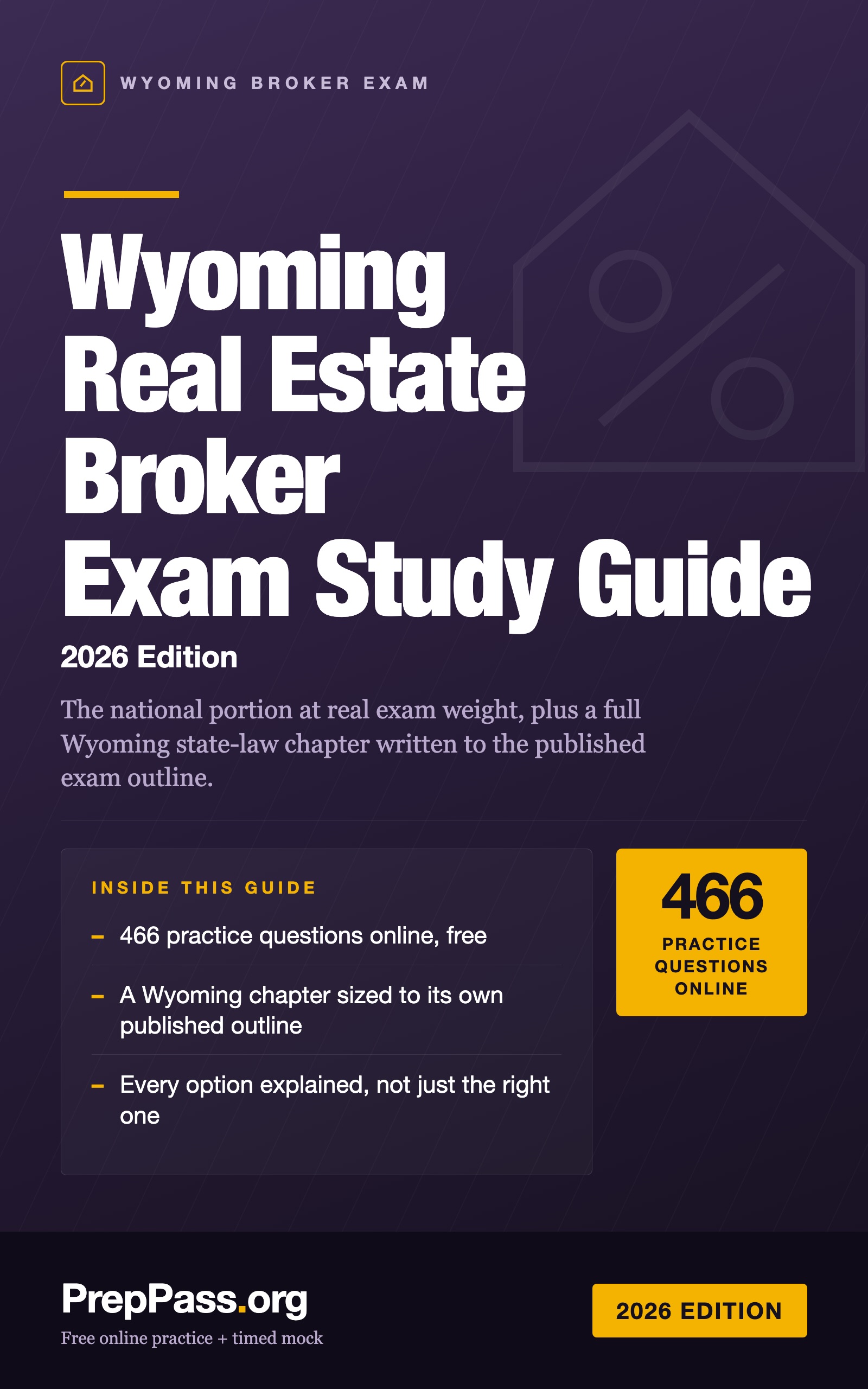
Wyoming Real Estate Broker · 2026 Edition
Wyoming Real Estate Broker Exam Study Guide (2026)
The national portion at real exam weight, plus a Wyoming chapter. Wyoming publishes no exam content outline, so coverage follows the curriculum the regulator names as the exam's basis — stated plainly in the book rather than dressed up as a published weighting.
- All 8 chapters of the national portion plus a full Wyoming real-estate-law chapter — PDF + EPUB you keep
- A 60-question national practice exam, with a key that explains all four options and not just the right one
- 20 Wyoming law questions of its own, with a worked answer key
PDF + EPUB · English · 335 pages · $14.99 one-time
This book is written in English.
Instant download after payment — no account needed, no subscription. Refund policy
Try 10 questions first — free
Answer all 10, then see every answer explained — with the section of this guide that teaches it. About 5 minutes, no sign-up.
Start 10 free questionsLook inside the book
Three real pages, rendered straight from the PDF you download — a teaching page, a worked question, and a reference page. Nothing here was redrawn to look better.
- Quick referencePart C — Encumbrances a broker must read off a title report · PDF page 102
A page you can turn back to: the numbers, deadlines or terms gathered in one place.
- A question, workedAnswer Key and Explanations · PDF page 174
A practice question with its answer and the reasoning behind it — not just a key.
- How it's taughtPart II — Wyoming State Law & Practice · PDF page 331
An explanation page: the material taught in prose, in the order the exam tests it.
What's included — and what isn't
Included
- A Wyoming chapter written to the published exam outline, area by area
- Where Wyoming law departs from the national rule — both stated, so neither is guessed
- Supervision, trust accounts, brokerage operation and broker math
- A Wyoming practice set with every option explained, not just the right one
- 466 practice questions online, free, from the same bank
- PDF (print & tab it) + EPUB (phone / e-reader)
Not included
- No printed copy is shipped — this is a file you download and can print yourself
- No video course, instructor or tutoring comes with the book — the free videos on the site are separate
- Not your exam registration or the testing centre's fee, which you still pay to the official body
Contents
See 29 chapters and the page each one starts on
- Part C — Advertising and recordkeeping compliancep. 14
- Part D — Consumer contact and transaction integrityp. 16
- 2. Trust Funds, Escrow, and the Client’s Moneyp. 30
- Part C — Records that survive an auditp. 33
- Part D — Disputed moneyp. 34
- 3. Agency at the Broker Levelp. 40
- Part C — Fiduciary duties, at the level a broker is examined onp. 44
- Part D — Dual agency, designated agency, and the alternativesp. 46
- 4. Contracts and Brokerage Agreementsp. 55
- Part C — Options, rights of first refusal, and installment contractsp. 60
- Part D — Between contract and closingp. 61
- 5. Fair Housing, Accessibility, and Antitrust: The Exposure You Carry Personallyp. 72
- Part C — The exemptions, and why they rarely save anyonep. 78
- Part D — Disability: the distinction the exam always testsp. 79
- 6. Ownership, Land Use Controls, and Transfer of Titlep. 95
- Part C — Encumbrances a broker must read off a title reportp. 101
- Part D — Legal descriptionsp. 103
- 7. Valuation, Financing, and the Federal Lending Lawsp. 113
- Part C — The instrumentsp. 121
- Part D — Loan programs, structures, and qualifyingp. 123
- 8. Disclosures, Environmental Risk, and Property Managementp. 136
- Part C — The management agreement and the manager’s authorityp. 142
- Part D — Leases and tenanciesp. 144
- Practice Exam — 60 Questionsp. 153
- Answer Key and Explanationsp. 170
- Appendix A — Broker Math Cheat Sheetp. 221
- Appendix B — Glossaryp. 243
- Appendix C — Exam-Day Strategyp. 262
- Part II — Wyoming State Law & Practicep. 267
Taken from the PDF you download, with the page each one starts on — not typed here.
Read a chapter free, in full
One complete chapter, exactly as it ships in the eBook. Scroll the window to read it right here; no download, no email.
Read chapter 9 here, without leaving the page
We didn't give you the easy intro — the free chapter opens on one of the hardest-working parts of the book, so you can judge the teaching where the exam gets difficult.
What the Wyoming portion actually is
The Wyoming broker examination is delivered by Pearson VUE. The figures below are read out of Wyoming Real Estate State Content Outlines, document #095101, revision 04/2025, in which the Wyoming state content outline carries an effective date of January 1, 2021.
| Scored items | Pretest items | Time | |
|---|---|---|---|
| National portion | 80 | 5 | 150 minutes |
| Wyoming state portion (broker) | 50 | 5–10 | 90 minutes |
| Wyoming state portion (salesperson) | 40 | 5–10 | — |
The vendor's own sentence is the authority for the counts: "The state-specific examinations are made up of forty (40) scored items for salesperson candidates and fifty (50) items for broker candidates. Both examinations also contain five to ten (5-10) pretest items."
Read that twice, because it has a practical consequence for your ninety minutes. You will sit between 55 and 60 Wyoming questions and be scored on 50, without being told which 50. Pretest items are unmarked. Budgeting your time as though there were fifty questions in front of you is how candidates run out of clock in the last fifteen items — the ones most likely to be Area V, which is worth the most.
The area weights are published as RANGES, not as counts
This is the most important structural fact about the Wyoming state portion, and almost every study aid on the market gets it wrong by printing a tidy per-area item count that no one publishes.
Pearson VUE publishes no per-area item counts for Wyoming. It publishes per-area ranges, printed inline inside each area heading and split by tier. The heading for Area II, verbatim, reads:
II. LICENSING (SALES 7-9 ITEMS, BROKER 4-6 ITEMS)
There is no separate broker column anywhere in the document. One outline serves both tiers, and the tier split lives inside the parenthetical. Where two numbers are given, the broker figure is the second one. Where the heading says "SALES & BROKER," the one range covers both. Area V is labeled BROKER ONLY, and a salesperson candidate never sees it.
| # | Area | Published range (verbatim heading) | Broker range | This book's derived allocation | Share |
|---|---|---|---|---|---|
| I | The Real Estate Licensing Agency's Powers | SALES & BROKER 2-5 ITEMS | 2–5 | 3 | 6% |
| II | Licensing | SALES 7-9 ITEMS, BROKER 4-6 ITEMS | 4–6 | 5 | 10% |
| III | Requirements Governing the Activities of Licensees | SALES 15-17 ITEMS, BROKER 14-16 ITEMS | 14–16 | 15 | 30% |
| IV | Additional Topics | SALES & BROKER 11-13 ITEMS | 11–13 | 12 | 24% |
| V | Broker Responsibility and Office Management | BROKER ONLY, 14-16 ITEMS | 14–16 | 15 | 30% |
| Total | 45–56 | 50 | 100% |
Notice the arithmetic in the bottom row. The five broker ranges span 45 to 56 against a declared total of 50. The published bands do not add up to the published total, and they are not meant to. A range is a statement about where an area's item count will fall on any given form, not a share of a fixed pie.
The 3 / 5 / 15 / 12 / 15 allocation in this book is ours
Say this to yourself before you use any weighting in this chapter: the integer item counts are derived, not printed. Pearson VUE does not publish them and neither does the Wyoming Real Estate Commission. Here is exactly how we got them, so you can check the reasoning rather than trust the number.
Four of the five broker bands have an integer midpoint: 4–6 gives 5, 14–16 gives 15, 11–13 gives 12, and 14–16 gives 15. Area I's band, 2–5, has a midpoint of 3.5. Take every integer midpoint as it stands and round Area I's 3.5 down to 3, and the five numbers come to exactly 50 while leaving every area inside its own published band. It is the unique allocation that minimizes squared deviation from the published midpoints — total deviation 0.5, against 1.5 for any allocation that rounds Area I up to 4 and then has to take a whole item off another area to get back to 50.
And here is the confirmation that midpoint-summing is not expected to land on the declared total at all: run the same operation on the salesperson ranges and you get 3.5 + 8 + 16 + 12 = 39.5 against a declared 40, which is not even an integer. The bands were never built to be summed. Ours is a defensible reading of them, nothing more.
So: every "items" figure and every percentage in the area headings below is ours. The verbatim published range is printed beside each one so you can always see what the vendor actually said. Nowhere in this chapter is a derived integer presented as a published figure.
What the vendor does not publish, which is itself the finding
The Wyoming state outline's entire reference apparatus is a two-line box. It reads:
State Exam Resources — Links are available at http://realestate.wyo.gov/.
That is all of it. No statute is cited. No rule chapter is named. No document is titled. The link is live and resolves to the Commission's resource portal, which is a page of links, not a citation list. There is therefore no vendor-published list of authorities to check against the statute books for repealed provisions — a check this chapter had to run itself, and did (see "What changed recently").
Every Wyo. Stat. Ann. and Wyoming Real Estate Commission rule citation in this chapter is ours. Each one was read out of the Wyoming Legislative Service Office title compilations and the Commission's own published rule chapters. None of them should be attributed to Pearson VUE, because Pearson VUE cited none of them. Wyoming statutes are cited here the way Wyoming practitioners cite them, as W.S. 33-28-111(a)(ix) and so on; "W.S." and "Wyo. Stat. Ann." are the same thing.
The regulator throughout is the Wyoming Real Estate Commission, whose office is in Cheyenne and whose files and records remain there by statute (W.S. 33-28-105(d)). The governing statute is the Real Estate License Act, W.S. 33-28-101 through 33-28-401, and there are eight chapters of Commission rules beneath it.
Area I — The Real Estate Licensing Agency's Powers (published range: SALES & BROKER 2-5 ITEMS; derived allocation 3 of 50, 6%)
Three items on our reading, the smallest block on the form. Do not overinvest here — but do not skip it, because the items that appear are almost always about who may decide and what the Commission may do to you.
Start with the source of the power. W.S. 33-28-105(a) creates a Commission of five commissioners, each a citizen of Wyoming, appointed by the governor with the advice and consent of the senate. Not less than three nor more than four must have been engaged in business as a licensee in Wyoming for at least five years immediately preceding appointment, and no more than one commissioner may be appointed from the same county to serve at the same time. Terms are three years, and no member may be appointed to succeed himself for more than one full term. The same subsection gives the Commission its powers: to regulate the issuance of licenses, to revoke or suspend them, to censure licensees, and to promulgate rules. W.S. 33-28-105(h) makes three members a quorum, and the action of a majority the action of the Commission.
A. Investigations, hearings and appeals
The operative rule. W.S. 33-28-111(a) gives the Commission two ways in: it shall investigate upon a written sworn complaint, and it may investigate upon its own motion. Both routes reach any licensee conducting real estate advertising, self-promotion as a licensee, or real estate activity regarding real estate located in Wyoming.
Who hears it. W.S. 33-28-113(a) lets the Commission contract with independent hearing officers, and names the only disqualification in the section: the hearing officer "shall not be an employee of the office of the attorney general, or an employee or member of the commission." Under subsection (b) hearings run under the Wyoming Administrative Procedure Act, the hearing officer has the powers in W.S. 16-3-112(b), and written findings of fact and conclusions of law are forwarded to the Commission — the officer recommends, the Commission decides. Under subsection (c), judicial review may be taken in the district court of the county where the violation allegedly occurred.
Where it bites. The disqualification is about independence from the two bodies that build and prosecute the case, not about experience or geography. A Wyoming attorney in private practice is the ordinary profile for the job. Having heard an earlier real estate case is not a conflict. Residence is irrelevant, because it is venue for review that the statute ties to the county of the violation, not the identity of the person presiding.
The administrative machinery around the hearing lives in Commission rules chapter 8. A complaint must be sworn and written (§ 2(a)), and may come from any person or entity, a Commission member, or a staff member. It goes to the Commission Investigator and one Liaison Commission Member (LCM) drawn from a rotating schedule (§ 3), and that LCM is then barred from taking part in the contested case that follows (§ 3(a)) — the same separation the hearing-officer rule enforces from the other direction. Before a formal hearing, § 5 requires notice by certified and first-class mail giving the licensee twenty days to show compliance. Section 6 allows a default order where the licensee has not responded in writing fourteen days before the hearing or does not appear. Section 1 routes a doubtful application to an Application Review Committee of one commissioner, the Commission Investigator and an attorney general's prosecuting attorney, with thirty days to request reconsideration of a preliminary denial.
B. Sanctions and penalties
The operative rule on administrative sanctions. W.S. 33-28-111(a) authorizes the Commission to impose an administrative fine not to exceed two thousand five hundred dollars ($2,500.00) for each separate offense, and to censure a licensee, place a licensee on probation and set its terms, or suspend or revoke any license. The cap is per offense, so a course of conduct with several violations can total well past $2,500 even though no single count may exceed it.
Where the money goes, and why it is asked. W.S. 33-28-111(c) sends all administrative fines to the state treasurer to be credited to the public school fund of the county in which the violation occurred. Not to the Commission. The Commission does not fund itself out of what it collects in discipline, and a candidate who assumes otherwise reaches for the wrong distractor.
A fourth censure is itself an offense. W.S. 33-28-111(a)(xxxiii) makes "receiving more than three (3) censures from the commission within a two (2) year period" a ground for discipline in its own right. The trigger is more than three, so exactly three inside two years does not meet it, and the window moves with the censures rather than resetting on a calendar year.
The criminal and civil tracks are separate. W.S. 33-28-114(a) makes performing real estate activity without a license a misdemeanor, punishable by a fine of not more than $2,500 or up to six months in county jail; on a subsequent conviction, not more than $5,000 or up to one year or both; and $5,000 where a corporation, partnership or association is convicted. Subsection (b) adds a civil penalty recoverable by any aggrieved person of not less than the sum received and not more than three times that sum. W.S. 33-28-112 lets the district court enjoin a violation on action by the attorney general or the district attorney, and punishes violation of the injunction as contempt by up to $2,500 or six months or both. And W.S. 33-28-115 closes the civil door: no person may sue in any Wyoming court for compensation for real estate activity unless licensed at the time.
The trap. The $2,500 and $5,000 figures live in different provisions and answer different questions. $2,500 is the administrative fine per offense; $5,000 is the criminal fine for a repeat unlicensed-practice conviction or a convicted entity. And $10,000, which candidates reach for, is not a penalty at all — it is the recovery-account payment ceiling in W.S. 33-28-202(a), covered in Area IV.
C. Examination of records
The operative rule. W.S. 33-28-122(a)(iii) requires every responsible broker to "permit the commission or its representative to examine the responsible broker's trust accounting records," and Commission rules chapter 5, section 2 confirms that the Commission may audit those records to assure compliance with the rules and the statutes.
And refusing is a separate offense. W.S. 33-28-111(a)(xii) makes "unreasonably failing to produce documents of record in his possession or under his control concerning any real estate transaction under investigation by the commission" a stand-alone ground for discipline; Commission rules chapter 6, section 1(a)(x) adds failing to provide information requested relative to a complaint, investigation or audit; and W.S. 33-28-111(a)(xxxii) makes refusing to appear or testify under oath at a Commission hearing a ground of its own.
Where it bites. No court order is needed. The duty runs to the licensing agency under the Act, not through civil discovery, so a broker who answers an audit demand by asking for a subpoena has already committed the second violation. Client identity is not a shield — the Act creates no privilege over transaction and trust records. And closing does not end the duty, because W.S. 33-28-123 requires the records to exist for at least two years after the company last participated in the transaction.
Before you buy
- How do I get it?
- Pay, and the download appears on this page straight away. The links are also emailed to you. No account is required.
- What if it isn't for me?
- Email us within 14 days for a full refund, no questions asked.
- Is the free practice going away?
- No. Every practice question, the timed mock and the free chapters on this site stay free. This book is the studying half, not a gate around the free half.
- Can I read it on my phone?
- Yes — the EPUB is for phones and e-readers, the PDF is for printing and tabbing. You get both.
The details
The national portion at real exam weight, plus a Wyoming chapter. Wyoming publishes no exam content outline, so coverage follows the curriculum the regulator names as the exam's basis — stated plainly in the book rather than dressed up as a published weighting.
- Format: PDF + EPUB download · 335 pages
- 80 practice questions in the book, with a full answer key
- 466 free practice questions for this exam on PrepPass, included at no cost
- $14.99 one-time — no subscription
- 14-day money-back guarantee · refund policy
- Cross-referenced against: Wyoming Real Estate Commission Rules, chapters 1-8 · Pearson VUE — Wyoming Real Estate State Content Outlines #095101 (rev #095101 | 04/2025; state outline Effective: January 1, 2021)
- Last updated: September 2026
- Verified from the official source(Wyoming Real Estate Commission Rules, chapters 1-8 · Pearson VUE — Wyoming Real Estate State Content Outlines #095101 (rev #095101 | 04/2025; state outline Effective: January 1, 2021))
- 466 free practice questions
- Instant download, yours for life
a real estate broker pre-license course runs $200–$1,000. This book teaches the same exam — same rules, verified to current standards — for a one-time $14.99 you keep for life.
Why buy the book when the practice is free?
Our practice questions and timed mock stay free — nothing on the site moves behind this book. The $14.99 book is the studying half: the material itself, taught in order, in a file you own.
- Systematic teaching — every exam section explained chapter by chapter, start to finish, not just questions
- Print it & tab it — a paper-ready PDF you can highlight, mark up, and bring to your study table
- Study anywhere, offline — EPUB on your phone or e-reader; no wifi, no browser tabs
- Everything in one place — chapters, per-chapter cram sheets, and practice questions in one file
- Yours for life — one-time $14.99, instant download, no subscription
And it's risk-free: 14-day money-back guarantee — not satisfied? Email us for a full refund, no questions asked. See the refund policy.
14-day money-back guarantee · full refund, no questions asked.
One-time purchase, lifetime access to the download. The eBook is the full Wyoming Real Estate Broker study guide in PDF and EPUB. Educational summary, not professional or legal advice — always confirm the current rules with the official source. Last updated: September 2026.