SHRM-SCP — SHRM Senior Certified Professional · 2026 Edition
SHRM-SCP Study Guide — 2026 Edition
Edition noteWritten to SHRM's 2026 BASK, which merged two competencies into Inclusive Mindset and expanded AI content.
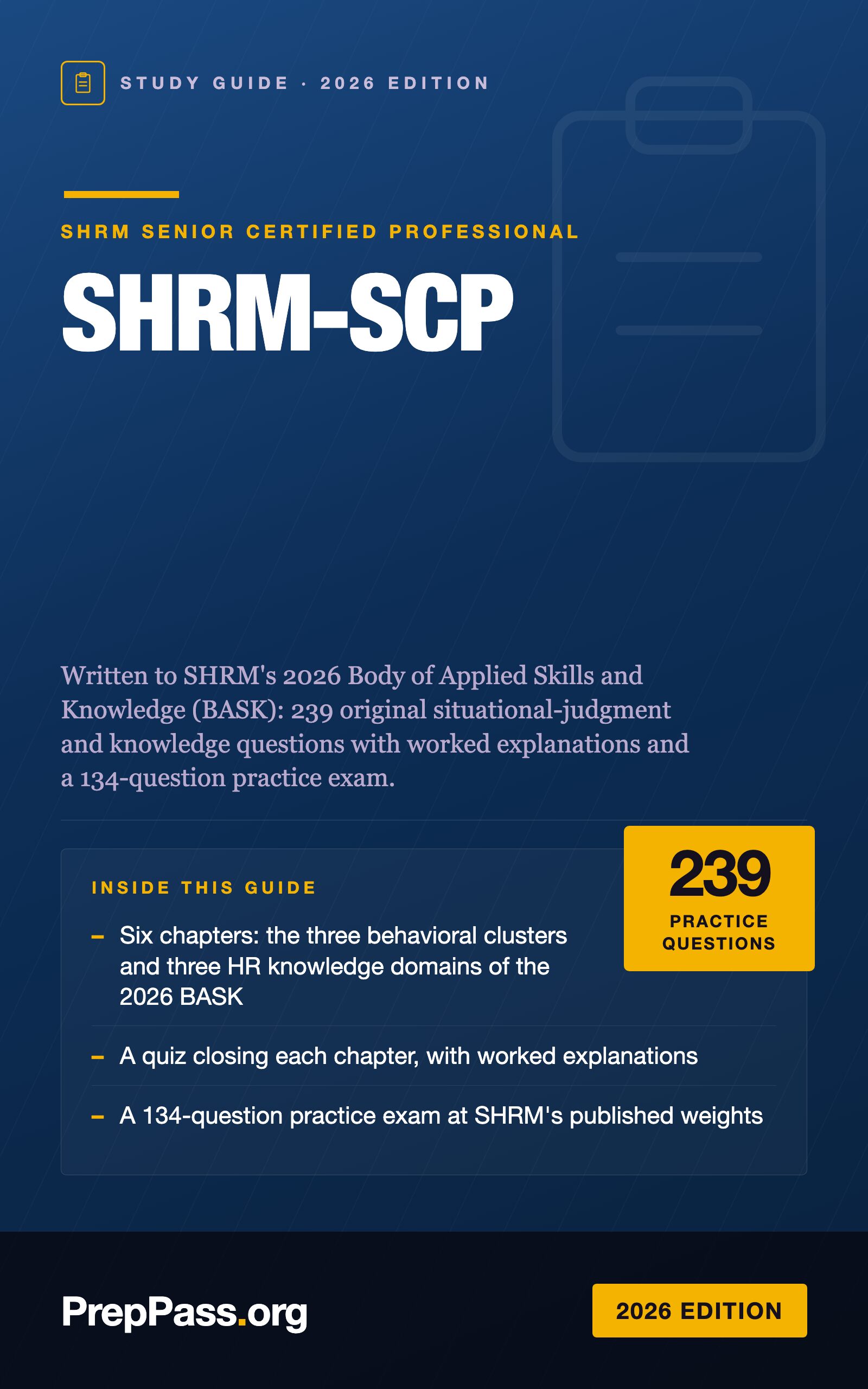
Written to SHRM's 2026 Body of Applied Skills and Knowledge (BASK): 239 original situational-judgment and knowledge questions with worked explanations and a 134-question practice exam.
- 239 original SHRM-SCP practice questions, each with a worked explanation, in one PDF + EPUB you keep
PDF + EPUB · English · 181 pages · $24.99 one-time
This book is written in English.
Instant download after payment — no account needed, no subscription.
14-day money-back guarantee: not satisfied for any reason? Email support@preppass.org within 14 days of purchase for a full refund. Refund policy
Look inside the book
Three real pages, rendered straight from the PDF you download — a reference page, a teaching page, and a worked question, always in that order. Nothing here was redrawn to look better.
- Quick referencePractice Exam · Section 5 — Organization (24 questions) · PDF page 160
A page you can turn back to: the numbers, deadlines or terms gathered in one place.
- How it's taughtChapter 3 — Business · PDF page 54
An explanation page: the material taught in prose, in the order the exam tests it.
- A question, workedChapter 2 — Interpersonal · PDF page 37
A practice question with its answer and the reasoning behind it — not just a key.
About the SHRM-SCP exam
For senior HR professionals preparing for the SHRM-SCP. The book teaches every BASK competency and HR functional area, with situational-judgment and knowledge questions, chapter quizzes and a full-length practice exam weighted to SHRM's outline. It is independent of SHRM and includes no online practice.
Outline changes: The 2026 BASK combined the Inclusion & Diversity and Global Mindset competencies into one competency, Inclusive Mindset, and expanded AI-related content in the behavioral competencies; SHRM gives the effective date only as 2026.
| Awarding body | Society for Human Resource Management (SHRM) |
|---|---|
| Questions | 134 multiple-choice questions (80 stand-alone knowledge items and 54 situational-judgment items); the exam also includes 24 unscored field-test items |
| Time limit | Two separately timed sections of up to 110 minutes each; unused time in Section 1 does not carry over |
| Passing rule | Scaled scores range from 120 to 200; all candidates who pass receive the maximum score of 200 |
| Fees | 2026: early bird $350 member / $450 nonmember; standard $399 / $499; all rates include a nonrefundable $50 application fee, and standard rates include a $49 deadline fee |
| Delivery | By computer at Prometric test centers |
| Eligibility | At least three years performing strategic-level HR/HR-related duties, or SHRM-CP held for at least three years while working in or moving into a strategic-level role; at least 1,000 hours of strategic-level work per calendar year; no HR title or degree required |
| Retakes | No retesting in the same window; reapply as a new candidate in a later window and pay the full fee; no limit on reapplications |
| Content outline | SHRM Body of Applied Skills and Knowledge (SHRM BASK), 2026 |
| Domains and weights |
|
Questions buyers ask
- How many questions are on the SHRM-SCP, and how long is it?
- The SHRM-SCP has 134 multiple-choice questions — 80 knowledge items and 54 situational-judgment items — plus 24 unscored field-test items, delivered in two separately timed sections of up to 110 minutes each.
- What score do I need to pass the SHRM-SCP?
- SHRM reports scaled scores from 120 to 200, and every candidate who passes receives the maximum score of 200. SHRM does not publish a required number or percentage of correct answers.
- What does the SHRM-SCP cover, and how is it weighted?
- Half the exam covers behavioral competencies — Leadership 19%, Business 17.5%, Interpersonal 13.5% — and half covers HR knowledge — People 19%, Organization 18%, Workplace 13%.
- Which version of the SHRM BASK applies, and what changed?
- The SHRM BASK was most recently updated in 2026. The 2026 edition merged Inclusion & Diversity and Global Mindset into one competency, Inclusive Mindset, and added AI-related content.
- Who is eligible for the SHRM-SCP?
- Candidates need at least three years of strategic-level HR work, or three years holding the SHRM-CP while working in or moving into a strategic role, with at least 1,000 strategic-level hours per calendar year. No HR title or degree is required.
- How much does the SHRM-SCP cost, and can I retake it?
- In 2026 the fee is $350 (member) or $450 (nonmember) at the early-bird rate, and $399 or $499 at the standard rate. You cannot retest in the same window; you reapply in a later window and pay the full fee.
- How is this book organized?
- Six chapters follow the BASK's three behavioral clusters and three HR knowledge domains, each closing with key concepts and a quiz; a 134-question practice exam follows the published weights. There are 239 questions in all, for $24.99.
- How is the SHRM-SCP different from the SHRM-CP?
- Both exams share the same format and content weights, but the SHRM-SCP is for professionals in strategic roles, while the SHRM-CP is for those in operational roles.
- Is a study guide enough for the SHRM-SCP — SHRM Senior Certified Professional exam, or do I need a course?
- Check eligibility first — per Society for Human Resource Management (SHRM): at least three years performing strategic-level HR/HR-related duties, or SHRM-CP held for at least three years while working in or moving into a strategic-level role; at least 1,000 hours of strategic-level work per calendar year; no HR title or degree required. A book does not replace those requirements. For the exam content itself, this 181-page guide teaches the material chapter by chapter with 239 practice questions and explanations inside. A prep course adds live instruction and a set schedule; whether you need one beyond any required education is your call.
- Does the SHRM-SCP — SHRM Senior Certified Professional study guide come as a PDF?
- Yes — SHRM-SCP Study Guide — 2026 Edition downloads as PDF and EPUB, 181 pages. The download link is emailed the moment payment clears and does not expire.
- How much does the SHRM-SCP — SHRM Senior Certified Professional study guide cost?
- $24.99, once. There is no subscription and no account to create; the PDF and EPUB files are yours to keep.
- Can I read part of the SHRM-SCP — SHRM Senior Certified Professional study guide before buying?
- Yes. A full chapter is free to read on this page — not a summary of one, the chapter itself.
- Is this the official SHRM-SCP — SHRM Senior Certified Professional study guide?
- No. This is an independent study guide and is not affiliated with or endorsed by the exam's awarding body. It is written from SHRM's 2026 Body of Applied Skills and Knowledge (BASK) and 2026 SHRM Certification Handbook, with U.S. statutes, the eCFR and EEOC, DOL and NLRB guidance. Always confirm current requirements with the body that issues your licence.
What's included — and what isn't
Included
- Six chapters: the three behavioral clusters and three HR knowledge domains of the 2026 BASK
- A quiz closing each chapter, with worked explanations
- A 134-question practice exam at SHRM's published weights
- 239 original situational-judgment and knowledge questions, each explained and cited
- U.S. employment law from the statutes and eCFR, with a thresholds-and-deadlines appendix
- PDF + EPUB you keep
Not included
- No printed copy is shipped — this is a file you download and can print yourself
- No video course, instructor, tutoring or online question bank comes with the book — everything is in the file
- Not your exam registration or the testing centre's fee, which you still pay to the official body
Contents
See 17 sections and the page each one starts on
- Chapter 1 Leadership — Leadership & 19% Navigation, Ethical Practice, Inclusive Mindsetp. 7
- Chapter 2 Interpersonal — 13.5% Relationship Management, Communicationp. 7
- Chapter 3 Business — Business 17.5% Acumen, Consultation, Analytical Aptitudep. 7
- Chapter 6 Workplace — Managing a 13% Global Workforce, Risk Management, CSR, U.S.p. 7
- Chapter 1 — Leadershipp. 8
- Chapter 2 — Interpersonalp. 28
- Chapter 3 — Businessp. 41
- Chapter 4 — Peoplep. 57
- Answer key & explanationsp. 72
- Chapter 5 — Organizationp. 77
- Chapter 6 — Workplacep. 94
- Practice Exam · Section 2 — Interpersonal (18 questions)p. 119
- Practice Exam · Section 4 — People (25 questions)p. 136
- Practice Exam · Section 5 — Organization (24 questions)p. 146
- Appendix A — The exam at a glance (quick reference)p. 163
- Appendix B — Key termsp. 164
- Appendix C — U.S. employment- law thresholds and deadlinesp. 166
Taken from the PDF you download, with the page each one starts on — not typed here.
Read a chapter free, in full
One complete chapter, exactly as it ships in the eBook. Scroll the window to read it right here; no download, no email.
Read chapter 4 here, without leaving the page
We didn't give you the easy intro — the free chapter opens on one of the hardest-working parts of the book, so you can judge the teaching where the exam gets difficult.
The People domain — HR Strategy, Talent Acquisition, Employee Engagement & Retention, Learning & Development, and Total Rewards — is the core HR expertise the SHRM-SCP applies at enterprise scale. On the exam, the three HR knowledge domains are tested through knowledge items: SHRM's handbook describes Knowledge Items as covering "key concept topics in the HR Knowledge Domains"[1]. That makes this chapter, and the two that follow, the most fact-dense part of the book. The SCP-level difference is scope and integration: you are not designing one program but architecting systems that work together — acquisition feeding development, development feeding succession, rewards reinforcing the behaviors the strategy needs. The HR process itself is sequential: "employees can't be trained and paid until selected and placed in jobs, which follows recruitment, which is preceded by human resource planning and job analysis and design"[2].
HR Strategy
HR strategy translates enterprise strategy into a people agenda: what workforce capabilities the strategy requires, what the current workforce provides, and what must be built, bought, borrowed or automated to close the gap. SHRM's workforce-planning guidance notes that "most workforce decisions involve a choice: buy talent externally, build it internally, borrow it through contingent labor, or automate the work"[3]. The senior deliverables are the workforce plan, the HR strategic plan with measurable objectives, and the governance that keeps HR investments aligned as strategy evolves.
How it is tested: you are given an enterprise direction — geographic expansion, digital transformation, a shift to services — and asked for the HR strategy. The best answer starts with capability gaps, then sequences choices with honest timelines. The strategy must define success in business terms — time-to-capability for critical roles, bench strength, regretted turnover — not activity counts. Not every role deserves the same investment: SHRM distinguishes "critical roles that drive disproportionate strategic value, core roles that form the operational backbone, and noncore roles"[3].
Key concepts: HR Strategy
Strategic planning. Planning runs through formulation, goal setting, implementation and evaluation. A vision statement expresses "what a business's founders want that business to accomplish"[4]; the mission statement "gives a broad description of how the firm will try to make its vision a reality"[4]. Analysis frameworks include PESTLE, SWOT, industry analysis (Porter), scenario planning, the growth-share matrix and blue-ocean thinking (Chapter 3). Management by objectives "is a philosophy of management, a planning and controlling technique, and an employee-involvement program"[5] in which goals cascade and are agreed jointly.
Systems thinking. Organizations are open systems — "a system that interacts with its environment"[6] — made of interdependent parts that need feedback. A change in one HR process (pay) ripples into others (retention, internal equity, recruiting).
Project management. Approaches include traditional (waterfall), Lean Six Sigma, agile, critical chain, design thinking and Kaizen; the process runs initiating, planning and designing, launching, monitoring and controlling, and closing. Tools include critical-path analysis, variance analysis and Gantt charts ("tools such as a Gantt chart can help you stage your communication"[7]); governance defines team roles and a work breakdown structure.
Talent Acquisition
Strategic talent acquisition means building the capability to attract, select and onboard the talent the strategy requires. Everything starts with job analysis, "a study of the tasks required to do a job well"[2]; its outputs are the job description, which lists "the tasks and responsibilities of a job"[2], and the job specification, which spells out "the skills, knowledge, and abilities a person must have to fill a job"[2].
Selection science is heavily tested. The most important property of any assessment is predictive validity — "the accuracy with which applicant assessment scores can be used to forecast performance on the job"[8]. Structured interviews "ensure candidates have equal opportunities to provide information and are assessed accurately and consistently"[9]: all candidates get "the same predetermined questions in the same order" and "the same rating scale"[9]. Every selection procedure should be monitored for adverse impact against the four-fifths standard[10], and where two procedures are "substantially equally valid," the Uniform Guidelines direct the employer to use the one with "the lesser adverse impact"[10].
Onboarding is where acquisition turns into retention. "Nearly one-third of all new hires quit their jobs within the first six months"[11], and orientation "is simply the first step in a journey that can take weeks and sometimes even months"[11]. The trap in acquisition scenarios is optimizing one step — faster sourcing, cheaper assessments — while the system leaks.
Key concepts: Talent Acquisition
Employee value proposition (EVP) and employment brand. Culture, growth, purpose and varied work, communicated honestly — including realistic job previews.
Sourcing. "The internal labor market consists of employees currently employed by the firm; the external labor market is the pool of potential applicants outside the firm"[12]. "Promotions and job transfers are the most common results of internal recruiting"[12]; externally, "referrals and professional networking are commonly used methods"[12], alongside career fairs, universities, social media, job boards and talent marketplaces.
Selection methods. Ability and job-knowledge tests, personality tests, work samples, assessment centers, individual and panel interviews, and increasingly AI-based skill matching — all selection procedures under the Uniform Guidelines[10].
Employment categories. Full-time, part-time, temporary, contract, intern and gig workers.
Job offer negotiations. Salary, relocation assistance, telecommuting and job sharing are the usual levers; negotiate within established ranges and apply the same rules to every candidate[13].
Offer contingencies and screening law. Background checks obtained from a consumer reporting agency trigger the Fair Credit Reporting Act: get "written permission from the applicant"[14], and before rejecting someone based on the report, give "a notice that includes a copy of the consumer report you relied on... and a copy of A Summary of Your Rights"[14]; after the decision, give an adverse-action notice[14]. For criminal records, the EEOC's guidance favors a targeted screen considering "the nature of the crime, the time elapsed, and the nature of the job"[15] with individualized assessment[15]; "an arrest record standing alone may not be used to deny an employment opportunity"[15]. Job ads cannot discourage protected groups — an ad seeking "recent college graduates" "may discourage... people over 40 from applying and may violate the law"[16].
Employment verification. The employee completes Form I-9 Section 1 "no later than the employee's first day of employment"[17]; the employer completes Section 2 "within three business days of the hire"[18] and retains the form "three years after the date of the hire or one year after the date the individual's employment is terminated, whichever is later"[18]. E-Verify "compares information entered by an employer from an employee's Form I-9... to records available to the U.S." government[19].
Onboarding approaches. Orientation, buddy systems, personalization, digital assistants and specialized training; the supervisor's job-specific orientation matters most[20].
TA metrics and technology. Cost per hire, time to fill, applicant-to-interview-to-offer ratios, yield from proactive sourcing, and quality of hire; applicant tracking systems, AI-supported screening, video interviewing and onboarding systems; and a positive candidate experience (streamlined applications, limited rounds, frequent communication).
Employee Engagement & Retention
Engagement is the emotional commitment employees bring to the organization's goals; retention is keeping the people the strategy needs. Senior HR connects the two with data: which drivers actually predict retention in this workforce, and which interventions move them cost-effectively. The job attitudes behind engagement are well defined: job satisfaction is "a pleasurable or positive emotional state resulting from the appraisal of one's job or job experience"[21], and job involvement "refers to the extent to which a person is interested in and committed to assigned tasks"[21].
How it is tested: turnover data and a request for a retention strategy. The strategic answer segments — regretted versus non-regretted, critical versus replaceable roles, new-hire versus tenured patterns. A first-year spike points to selection or onboarding; a mid-career exodus points to growth or pay progression; a single-department problem points to its manager. It also prices the problem, so retention becomes an investment case.
Key concepts: Employee Engagement & Retention
Culture and its effects. Culture shapes performance, learning, innovation, risk-taking and reputation; culture types range from authoritarian and mechanistic to participative, learning and high-performance.
Employee lifecycle. Recruitment, integration, development and departure — each phase a point at which to measure and improve the employee experience.
Job design. Job enlargement is "the horizontal expansion of a job, increasing the number and variety of tasks"[22]; job enrichment "attempts to increase job depth by providing the employee with more autonomy, responsibility, and decision-making authority"[22] and "has been found to increase job satisfaction and reduce absenteeism and turnover"[22]. Job rotation, "also called cross-training," shifts workers from one job to another[22].
Workplace flexibility. "Flextime, compressed workweek, four-day workweek, telecommuting, and job sharing"[22].
Measuring engagement. Surveys, pulse surveys, focus groups, stay interviews and engagement software — with action on the results[23].
Performance management. A performance appraisal compares "actual performance with expected performance" to inform training, pay and promotion decisions[24]; organizations increasingly favor "continuous real-time feedback" over annual reviews[24]. Common rater errors are "central tendency error, (2) strictness or leniency error, (3) halo effect, (4) recency error, and (5) personal biases"[25]. The halo effect "occurs when managers have an overly positive view of a particular employee"[25]; central tendency "is the failure to recognize either very good or very poor performers"[25]. Techniques include graphic rating scales, the critical-incident method (recording examples of unusually successful or unsuccessful behavior[26]), behaviorally anchored rating scales built on observable behaviors[26], MBO, and calibration sessions.
Recognition and wellness. Recognition programs "acknowledge or give special attention to employee actions... and support business strategy by reinforcing behaviors"[27] — service and spot awards, points systems, peer-to-peer recognition. Wellness covers mental-health, financial-wellness and stress-management programs, and caregiver support.
Retention and turnover metrics. Voluntary turnover rate, turnover by location or level, vacancy rate and quality of hire; realistic job previews, stay interviews and predictive attrition analysis are the retention tools.
Learning & Development
Strategic L&D builds the capabilities the workforce plan requires: leadership pipelines, critical-skill academies, reskilling for automation, and learning infrastructure. Evaluation discipline separates strategic L&D from training theater. The Kirkpatrick model has four levels; Level 3, Behavior — "the degree to which participants apply what they learned during training when they are back on the job" — is described by its authors as "the most important Kirkpatrick level"[28], and Level 4, Results, is "the degree to which targeted outcomes occur"[28]. Their advice for planning: "start with Level 4 Results and work your way down"[28].
Key concepts: Learning & Development
Needs analysis and program design. Needs analysis operates at the organization, task (training) and person levels, using surveys, observation and interviews. The ADDIE model's "five phases—Analysis, Design, Development, Implementation, and Evaluation—represent a dynamic, flexible guideline for building effective training"[29]; the analysis phase incorporates "the needs assessment, the course outline, and the analysis of delivery methods"[29]. Alternatives include the successive approximation model (SAM), action mapping and Bloom's taxonomy.
Adult learning and delivery. The 70-20-10 model (roughly 70% of development from experience, 20% from others, 10% from formal training); visual, auditory and kinesthetic preferences and the learning-everywhere model; e-learning, micro-learning, blended and just-in-time learning, gamification and rotational programs.
On-the-job methods and career development. Job rotation is "the reassignment of workers to several different jobs over time"[20]; an apprenticeship "combines specific on-the-job instruction with classroom training"[20]; mentoring involves "a senior manager or other experienced employee providing job- and career-related information to a mentee"[20]. Career pathing, individual development plans and SMART goals complete the toolkit.
Developmental assessments. 360-degree assessments, simulations, high-potential assessments, personality, skills and competency assessments, and adaptive testing.
Leadership development and succession. Succession planning reviews key roles and "the readiness levels of potential internal (and external!) candidates to fill these roles"[30]. Talent reviews "often employ the use of a 9-box template, which plots employee performance versus employee potential"[30]. Development follows through stretch assignments, coaching and high-potential programs.
Knowledge sharing and technology. Knowledge maps and knowledge cafés; learning management systems, adaptive platforms, VR/AR and generative-AI tools.
Sources cited in this excerpt
- 2026 SHRM Certification Handbook. Society for Human Resource Management, 2026. https://www.shrm.org/content/dam/en/shrm/credentials/shrm-certification/2026_shrm_certification-handbook.pdf
- 8.1 Achieving High Performance through Human Resources Management - Introduction to Business. OpenStax (Rice University), CC BY 4.0, n.d. https://openstax.org/books/introduction-business/pages/8-1-achieving-high-performance-through-human-resources-management
- Strong Companies Prioritize More Than Operational Workforce Planning. Society for Human Resource Management, n.d. https://www.shrm.org/in/topics-tools/news/strong-companies-prioritize-more-than-operational-workforce
- 9.2 Firm Vision and Mission - Principles of Management. OpenStax (Rice University), CC BY 4.0, n.d. https://openstax.org/books/principles-management/pages/9-2-firm-vision-and-mission
- 17.7 Management by Objectives: A Planning and Control Technique - Principles of Management. OpenStax (Rice University), CC BY 4.0, n.d. https://openstax.org/books/principles-management/pages/17-7-management-by-objectives-a-planning-and-control-technique
- 3.7 Contingency and System Management - Principles of Management. OpenStax (Rice University), CC BY 4.0, n.d. https://openstax.org/books/principles-management/pages/3-7-contingency-and-system-management
- How HR Leaders Can Embrace Their Role as Change Champions. Society for Human Resource Management, n.d. https://www.shrm.org/mena/enterprise-solutions/insights/how-hr-leaders-can-embrace-their-role-as-change-champions
- Assessment and Selection. U.S. Office of Personnel Management, n.d. https://www.opm.gov/policy-data-oversight/assessment-and-selection/
- Structured Interviews. U.S. Office of Personnel Management, n.d. https://www.opm.gov/policy-data-oversight/assessment-and-selection/structured-interviews/
- 29 CFR Part 1607 - Uniform Guidelines on Employee Selection Procedures (1978). Electronic Code of Federal Regulations, current text as retrieved 2026-09-23. https://www.ecfr.gov/current/title-29/subtitle-B/chapter-XIV/part-1607
- Don't Underestimate the Importance of Good Onboarding. Society for Human Resource Management, n.d. https://www.shrm.org/topics-tools/news/talent-acquisition/dont-underestimate-importance-good-onboarding?zd_source=hrt&zd_campaign=4254&zd_term=chiradeepbasumallick
- 8.2 Employee Recruitment - Introduction to Business. OpenStax (Rice University), CC BY 4.0, n.d. https://openstax.org/books/introduction-business/pages/8-2-employee-recruitment
- Pay Transparency Without Pay Equity Creates New Challenges. Society for Human Resource Management, n.d. https://www.shrm.org/in/topics-tools/news/blogs/pay-transparency-without-pay-equity-creates-new-challenges
- Using Consumer Reports: What Employers Need to Know. U.S. Federal Trade Commission, n.d. https://www.ftc.gov/business-guidance/resources/using-consumer-reports-what-employers-need-know
- Enforcement Guidance on the Consideration of Arrest and Conviction Records in Employment Decisions under Title VII. U.S. Equal Employment Opportunity Commission, n.d. https://www.eeoc.gov/laws/guidance/arrest_conviction.cfm
- Prohibited Employment Policies/Practices. U.S. EEOC, n.d. https://www.eeoc.gov/prohibited-employment-policiespractices
- Handbook for Employers M-274: Guidance for Completing Form I-9. U.S. Citizenship and Immigration Services, current text as retrieved 2026-09-23. https://www.uscis.gov/book/export/html/59502
- 8 CFR Part 274a — Control of Employment of Aliens. eCFR (National Archives / GPO), current text as retrieved 2026-09-23. https://www.ecfr.gov/current/title-8/chapter-I/subchapter-B/part-274a
- What is E-Verify? USCIS / E-Verify, current text as retrieved 2026-09-23. https://www.e-verify.gov/about-e-verify/what-is-e-verify
- 8.4 Employee Training and Development - Introduction to Business. OpenStax (Rice University), CC BY 4.0, n.d. https://openstax.org/books/introduction-business/pages/8-4-employee-training-and-development
- 3.5 Work-Related Attitudes - Organizational Behavior. OpenStax (Rice University), CC BY 4.0, n.d. https://openstax.org/books/organizational-behavior/pages/3-5-work-related-attitudes
- 9.7 From Motivation Theory to Application - Introduction to Business. OpenStax (Rice University), CC BY 4.0, n.d. https://openstax.org/books/introduction-business/pages/9-7-from-motivation-theory-to-application
- Employee Surveys Help Measure Engagement. SHRM, n.d. https://www.shrm.org/topics-tools/news/employee-relations/employee-surveys-help-measure-engagement
- 8.5 Performance Planning and Evaluation - Introduction to Business. OpenStax (Rice University), CC BY 4.0, n.d. https://openstax.org/books/introduction-business/pages/8-5-performance-planning-and-evaluation
- 8.1 Performance Appraisal Systems - Organizational Behavior. OpenStax (Rice University), CC BY 4.0, n.d. https://openstax.org/books/organizational-behavior/pages/8-1-performance-appraisal-systems
- 8.2 Techniques of Performance Appraisal - Organizational Behavior. OpenStax (Rice University), CC BY 4.0, n.d. https://openstax.org/books/organizational-behavior/pages/8-2-techniques-of-performance-appraisal
- 11.4 Influencing Employee Performance and Motivation - Principles of Management. OpenStax (Rice University), CC BY 4.0, n.d. https://openstax.org/books/principles-management/pages/11-4-influencing-employee-performance-and-motivation
- Integrating Technology with the Kirkpatrick Model for Enhanced Training Evaluation. Kirkpatrick Partners, n.d. https://www.kirkpatrickpartners.com/blog/integrating-technology-with-the-kirkpatrick-model-for-enhanced-training-evaluation/
- The ADDIE Model of Instructional Design Fact Sheet. U.S. Department of Justice, Office of Community Oriented Policing Services, n.d. https://cops.usdoj.gov/pdf/training/ADDIE_Fact_Sheet.pdf
- 11.6 Talent Development and Succession Planning - Principles of Management. OpenStax (Rice University), CC BY 4.0, n.d. https://openstax.org/books/principles-management/pages/11-6-talent-development-and-succession-planning
Before you buy
- How do I get it?
- Pay, and the download appears on this page straight away. The links are also emailed to you. No account is required.
- What if it isn't for me?
- Email us within 14 days for a full refund, no questions asked.
- Is there online practice for this exam too?
- No. PrepPass has no online question bank for this exam; the book is self-contained. Its chapter quizzes and full-length practice exam, each question with a worked explanation, are all in the PDF and EPUB.
- Can I read it on my phone?
- Yes — the EPUB is for phones and e-readers, the PDF is for printing and tabbing. You get both.
The details
Written to SHRM's 2026 Body of Applied Skills and Knowledge (BASK): 239 original situational-judgment and knowledge questions with worked explanations and a 134-question practice exam.
- Format: PDF + EPUB download · 181 pages
- 239 practice questions in the book, with a full answer key
- $24.99 one-time — no subscription
- 14-day money-back guarantee · refund policy
- Cross-referenced against: SHRM's 2026 Body of Applied Skills and Knowledge (BASK) and 2026 SHRM Certification Handbook, with U.S. statutes, the eCFR and EEOC, DOL and NLRB guidance
- Last updated: September 2026
- Verified from the official source(SHRM's 2026 Body of Applied Skills and Knowledge (BASK) and 2026 SHRM Certification Handbook, with U.S. statutes, the eCFR and EEOC, DOL and NLRB guidance)
- Instant download, yours for life
A prep course for the SHRM-SCP runs $820–$1,599. This book teaches the same exam — same rules, verified to current standards — for a one-time $24.99 you keep for life.
What the book gives you
PrepPass has no online question bank for this exam, so the $24.99 book is complete in itself: the material taught in order, a quiz closing each chapter and a full-length practice exam, in a file you own.
- Systematic teaching — every exam section explained chapter by chapter, start to finish, not just questions
- Print it & tab it — a paper-ready PDF you can highlight, mark up, and bring to your study table
- Study anywhere, offline — EPUB on your phone or e-reader; no wifi, no browser tabs
- Everything in one place — the chapters and the practice questions in one file
- Yours for life — one-time $24.99, instant download, no subscription
And it's risk-free: 14-day money-back guarantee — not satisfied? Email us for a full refund, no questions asked. See the refund policy.
14-day money-back guarantee · full refund, no questions asked.
One-time purchase, lifetime access to the download. The eBook is the full SHRM-SCP — SHRM Senior Certified Professional study guide in PDF and EPUB. Educational summary, not professional or legal advice — always confirm the current rules with the official source. Last updated: September 2026.