ATI TEAS 7 Academic Skills · 2026 Edition
ATI TEAS 7 Exam — Complete Study Guide (2026)
The PrepPass ATI TEAS 7 study guide book (2026 edition) is an independent guide: 854 pages of teaching plus 290 practice questions with a full answer key, PDF + EPUB, $29.99 one-time. Exam facts last checked September 2026 against the exam body's published sources. Inside: a named exam-traps list and a self-check closing each of the 4 content areas; a full-length practice test at the back, timed like the real exam, with the reasoning behind every answer.
- All 4 TEAS content areas as one PDF + EPUB you keep
- A named exam-traps list and a self-check closing each of the 4 content areas
- A full-length practice test at the back, timed like the real exam, with the reasoning behind every answer
$29.99one-time · lifetime download · no subscription
PDF + EPUB · English · 854 pages · $29.99 one-time
This book is written in English.
Instant download after payment — no account needed, no subscription.
14-day money-back guarantee: not satisfied for any reason? Email support@preppass.org within 14 days of purchase for a full refund. It's a download, so there is nothing to ship back. Refund policy
Exam facts last checked against official sources: September 2026.
To prepare for the ATI TEAS 7 Academic Skills exam, start with what the exam body publishes: ATI TEAS Study Guide 2026-2027 from ATI — the test maker's own study guide, $19.99 eBook; $24.99 printed book. The exam itself (ATI TEAS® (Test of Essential Academic Skills)): 170 questions (150 scored, 20 unscored pretest), 209 minutes. Choose this book if you want the four sections taught with worked maths and a timed full-length practice test, as one download.
Try 10 questions first — free
Answer all 10, then see every answer explained — with the section of this guide that teaches it. About 5 minutes, no sign-up.
You do not need the book to practise: 400 practice questions for this exam are free on PrepPass.
Start 10 free questionsLook inside the book
Three real pages, rendered straight from the PDF you download — a reference page, a teaching page, and a worked question, always in that order. Nothing here was redrawn to look better.
- Quick referencePart I — The rest of the punctuation · PDF page 624
A page you can turn back to: the numbers, deadlines or terms gathered in one place.
- How it's taughtPart X — States of matter and physical properties · PDF page 499
An explanation page: the material taught in prose, in the order the exam tests it.
- A question, workedPart X — States of matter and physical properties · PDF page 471
A practice question with its answer and the reasoning behind it — not just a key.
Exam inside two weeks?
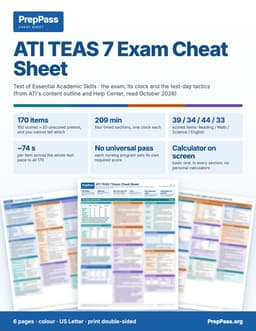
This guide is the teaching, read over weeks. If your exam is inside two weeks, the printable colour cheat sheet is the other product: the figures the exam turns on, laid out by section.
See the ATI TEAS 7 Academic Skills cheat sheet PDF — $9.99 →
6 pages · US Letter · printable PDF · yours to keep
About the exam itself
| Administering body | Assessment Technologies Institute, LLC (ATI) Source: ATI Help Center — What do I need to know before I register for the ATI TEAS exam? |
|---|---|
| Questions | 170 questions (150 scored, 20 unscored pretest) |
| Time limit | 209 minutes Source: ATI Help Center — What is the Time Limit for the ATI TEAS exam? |
| Passing score | The TEAS has no pass or fail. ATI: “Each school sets its own cut score for the ATI TEAS® Exam,” and “There is no universal passing score; each program sets its own.” ATI reports a Total score and Content Area scores from 0.0 to 100%, adjusted for differences in difficulty between forms, so they are not a simple percentage of questions answered correctly; ATI also reports Academic Preparedness Levels. Ask each program you apply to what score it requires. PrepPass states no passing score for the TEAS. What we read and found nothing in: ATI Help Center — What score do I need to get on the ATI TEAS exam? |
| Fees |
Source: ATI Help Center — What is the cost of the ATI TEAS exam? |
| Languages offered | Not published by ATI What we read and found nothing in: ATI Help Center — What is the ATI TEAS Exam? (Table 1, ATI TEAS Content Specifications) |
Questions buyers ask
- Which ATI TEAS 7 Academic Skills study guide should I use?
- It depends on what you already have. ATI: ATI TEAS Study Guide 2026-2027, $19.99 eBook; $24.99 printed book — choose ATI's guide if you want the review written by the company that makes the exam. Mometrix Test Preparation: ATI TEAS Secrets Study Guide, $29.99 ebook; $34.99 printed book — choose Mometrix if you mainly want many full-length practice tests. This PrepPass guide: 854 pages, 290 practice questions with explanations, PDF + EPUB, $29.99 one-time — choose this book if you want the four sections taught with worked maths and a timed full-length practice test, as one download. Prices were checked on 2026-09-24; confirm them with each seller.
- Is a study guide enough for the ATI TEAS 7 Academic Skills exam, or do I need a course?
- A book is exam review: it does not replace any education, training or experience Assessment Technologies Institute, LLC (ATI) requires before you may sit the exam, so check those requirements first. For the exam content itself, this 854-page guide teaches the material chapter by chapter with 290 practice questions and explanations inside, and 400 more practice questions are free on PrepPass. A prep course adds live instruction and a set schedule; whether you need one beyond any required education is your call.
- What is the cheapest way to prepare for the ATI TEAS 7 Academic Skills exam?
- Start with what costs nothing: 400 practice questions on PrepPass, with explanations and no signup. If you want it taught in one file you keep, the full study guide is $29.99 once; the printable cheat sheet for the last days is $9.99. No subscription on any of them.
- Who administers the ATI TEAS® (Test of Essential Academic Skills)?
- Assessment Technologies Institute, LLC (ATI). ATI writes and scores the exam. Your school decides where you take it, choosing among four formats ATI names: TEAS at ATI (remote, proctored by ATI), TEAS Online at Institution (remote, proctored by the school), TEAS at Institution (in person) and TEAS at PSI. Some schools accept only an exam taken on their own campus. ATI states that no ATI TEAS exam may be taken outside the United States, except by qualifying active-duty military testing on base.
- How many questions are on the ATI TEAS® (Test of Essential Academic Skills)?
- 170 questions (150 scored, 20 unscored pretest). ATI gives the same figures on three help-center pages. By section (total items, of which unscored): Reading 45 (6), Math 38 (4), Science 50 (6), English and Language Usage 37 (4). You will not know which items are unscored pretest items. Each item is marked right or wrong with no partial credit, and ATI states there is no penalty for guessing. Some items are not single-answer multiple choice: ATI lists multiple-select, fill-in-the-blank, ordered-response and hot-spot items.
- How long is the ATI TEAS® (Test of Essential Academic Skills)?
- 209 minutes. Each section has its own clock and unused time does not carry over: Reading 55 minutes, Math 57, Science 60, English and Language Usage 37. Sections always come in that order, and once a section is submitted you cannot return to it; when a section's time runs out, unanswered questions count as incorrect. A 10-minute break after Math does not use testing time. ATI suggests planning on about four hours from sign-in to finish. Approved extended-time accommodations change the section limits.
- What is the passing score for the ATI TEAS® (Test of Essential Academic Skills)?
- The TEAS has no pass or fail. ATI: “Each school sets its own cut score for the ATI TEAS® Exam,” and “There is no universal passing score; each program sets its own.” ATI reports a Total score and Content Area scores from 0.0 to 100%, adjusted for differences in difficulty between forms, so they are not a simple percentage of questions answered correctly; ATI also reports Academic Preparedness Levels. Ask each program you apply to what score it requires. PrepPass states no passing score for the TEAS.
- How much does the ATI TEAS® (Test of Essential Academic Skills) cost?
- $120 — TEAS at ATI (remote, proctored by ATI), plus applicable sales tax (ATI, per attempt); $120 — TEAS at PSI (at a PSI test center or remote through PSI; same price), plus applicable sales tax (ATI, per attempt). These are the only two prices ATI sets. For TEAS at Institution and TEAS Online at Institution the price is set by the school, and ATI notes it may be higher (proctoring or room costs) or appear lower or free when folded into another fee. TEAS at PSI is paid to ATI; you then schedule with PSI. Every attempt, including a retake, is a new registration at the full price, and TEAS registrations are not refundable. Other ATI charges: $15 per reschedule for exams scheduled on atitesting.com (at least 48 hours before the exam), and $29.99 for each additional transcript — one transcript credit is included with TEAS at ATI and TEAS at PSI. ATI offers a discounted registration to active-duty military members, spouses and dependents on request.
- What languages is the ATI TEAS® (Test of Essential Academic Skills) offered in?
- Not published by ATI. None of the ATI pages read states which languages the TEAS is offered in, and a search of ATI's help center for “spanish” returned no results. ATI's main TEAS page was down for scheduled maintenance when checked. PrepPass does not state a language for the exam; ask ATI or your school.
- Does the ATI TEAS 7 Academic Skills study guide come as a PDF?
- Yes — ATI TEAS 7 Exam — Complete Study Guide (2026) downloads as PDF and EPUB, 854 pages. The download link is emailed the moment payment clears and does not expire.
- How much does the ATI TEAS 7 Academic Skills study guide cost?
- $29.99, once. There is no subscription and no account to create; the PDF and EPUB files are yours to keep.
- Are there free ATI TEAS 7 Academic Skills practice questions?
- Yes — 400 of them, free to use with no signup and an explanation on every one. They are separate from this study guide, which is what you are buying here. The same free, no-account system also has practice modes (adaptive, new questions, spaced review of misses, weak-topic focus, saved, my mistakes); a timed mock exam (100 questions, 120 minutes) with a score report by topic; a 10-question readiness check (about 5 minutes); 4 study chapters; a day-by-day study plan. None of it needs this study guide.
- Can I read part of the ATI TEAS 7 Academic Skills study guide before buying?
- Yes. A full chapter is free to read on this page — not a summary of one, the chapter itself.
- What is the difference between the ATI TEAS 7 Academic Skills study guide and the cheat sheet?
- The study guide ($29.99) teaches the material chapter by chapter and is meant to be read over weeks. The cheat sheet ($9.99, 6 pages) drops the teaching and keeps the figures: every number on the exam grouped by value so the confusable ones sit together, each reference page paired with a recall page that blanks the answers, and four routes by days left — 14, 7, 3, or tonight. They are separate purchases; neither replaces the other.
- Is this the official ATI TEAS 7 Academic Skills study guide?
- No. This is an independent study guide and is not affiliated with or endorsed by the exam's awarding body. It is written from ATI TEAS 7 content outline · Independent study aid — not affiliated with, endorsed by or approved by ATI. Always confirm current requirements with the body that issues your licence.
Free ATI TEAS 7 Academic Skills practice questions and study chapters →
How this book compares
ATI, which makes the TEAS, sells its own study guide with a full-length practice test. This book teaches all four sections with a full-length practice test; Mometrix sells a guide built around several practice tests.
| Resource | Price | What you get | Choose it if |
|---|---|---|---|
| This bookATI TEAS 7 Exam — Complete Study Guide (2026)PrepPass | $29.99 | Independent downloadable study guide for all four sections
| Choose this book if you want the four sections taught with worked maths and a timed full-length practice test, as one download. |
| From the exam bodyATI TEAS Study Guide 2026-2027 (opens the publisher's page in a new tab)ATI | $19.99 eBook; $24.99 printed book | The test maker's own study guide
| Choose ATI's guide if you want the review written by the company that makes the exam. |
| AlternativeATI TEAS Secrets Study Guide (opens the publisher's page in a new tab)Mometrix Test Preparation | $29.99 ebook; $34.99 printed book | Study guide with practice tests
| Choose Mometrix if you mainly want many full-length practice tests. |
This book
ATI TEAS 7 Exam — Complete Study Guide (2026)
PrepPass
- Price
- $29.99
- What you get
Independent downloadable study guide for all four sections
- 290 practice questions with explanations
- 854 pages, PDF + EPUB
- Choose it if
- Choose this book if you want the four sections taught with worked maths and a timed full-length practice test, as one download.
From the exam body
ATI TEAS Study Guide 2026-2027 (opens the publisher's page in a new tab)
ATI
- Price
- $19.99 eBook; $24.99 printed book
- What you get
The test maker's own study guide
- Review of all four subject areas and a full-length practice test (Form C) with answer explanations
- Choose it if
- Choose ATI's guide if you want the review written by the company that makes the exam.
Alternative
ATI TEAS Secrets Study Guide (opens the publisher's page in a new tab)
Mometrix Test Preparation
- Price
- $29.99 ebook; $34.99 printed book
- What you get
Study guide with practice tests
- Six full-length practice tests (1,000+ questions) and video tutorials (per the product title)
- Choose it if
- Choose Mometrix if you mainly want many full-length practice tests.
Other resources' prices and contents are as listed on each publisher's or seller's own page, checked September 24, 2026. Prices change; confirm on the linked page before you buy. This book's price and contents come from our own catalog.
Sources (2)
- https://www.atitesting.com/teas/study-manual — read September 24, 2026
- https://www.mometrix.com/studyguides/teas/ — read September 24, 2026
What's included — and what isn't
Included
- All 4 ATI TEAS content areas — Reading, Math, Science and English
- Mathematics worked step by step with checked arithmetic
- Reading and English & Language Usage strategy with examples
- Anatomy, physiology, biology, and chemistry science review
- A full-length 170-question practice test in four timed sections (45/38/50/37 questions; 55/57/60/37 minutes), plus 120 questions by content area — every answer explained
- PDF (print & tab it) + EPUB (phone / e-reader)
Not included
- No printed copy is shipped — this is a file you download and can print yourself
- No video course, instructor or tutoring comes with the book — the free videos on the site are separate
- Not your exam registration or the testing centre's fee, which you still pay to the official body
Contents
See 17 sections and the page each one starts on
- Part I — Graphic informationp. 72
- Part I — Data, statistics, and graphsp. 177
- Part I — The integumentary systemp. 332
- Part V — Chemical reactionsp. 444
- Part X — States of matter and physical propertiesp. 459
- Part I — The rest of the punctuationp. 558
- Practice Questionsp. 657
- Answer Key & Explanationsp. 682
- Answer key — English and Language Usagep. 691
- Section 4 — English and Language Usagep. 723
- Answer Key & Explanations — Full-Length Practice Testp. 731
- Answer key — Science (Questions 84–133)p. 742
- Appendix A — Mathematics quick referencep. 753
- Appendix B — Science quick referencep. 774
- Appendix C — English quick referencep. 809
- Appendix D — Word partsp. 828
- Appendix E — Glossary of terms used in this bookp. 842
Taken from the PDF you download, with the page each one starts on — not typed here.
Read a chapter free, in full
One complete chapter, exactly as it ships in the eBook. Scroll the window to read it right here; no download, no email.
Read chapter 2 here, without leaving the page
We didn't give you the easy intro — the free chapter opens on one of the hardest-working parts of the book, so you can judge the teaching where the exam gets difficult.
Numbers and algebra, measurement and data — the section where method beats memory, because the exam changes the numbers and keeps the method.
Introduction
Of the four sections on this exam, Mathematics is the one that most rewards deliberate practice, and it is the one most people study wrong. They study it by reading. They read a worked solution, follow every line, nod, and conclude that they understand it. Then they sit a timed set and discover that following a solution and producing one are not the same skill at all. Reading a solution exercises recognition. Producing one exercises retrieval, and retrieval is what the exam measures.
So this chapter is built to be worked, not read. Every method carries a worked example set out line by line, and every major method also carries a wrong turn — the specific mistake that the method invites, spelled out with the wrong number it produces, so that when you produce that wrong number yourself you will recognize it as an old acquaintance instead of trusting it.
The second thing to understand about this section is that it is not a memory test. There is very little to memorize here. A short list of conversion factors, a short list of area and volume formulas, the order of operations, and the definition of the mean: that is close to the whole of it. Everything else is method. You are not asked whether you remember that 3/8 + 1/6 = 13/24; you are asked whether you can find a common denominator when the two numbers are ones you have never seen together before. The exam changes the numbers every time. It does not change the method. That is very good news, because methods are learnable in a way that long memorized lists are not.
The third thing is that this section is heavily weighted toward two clusters: numbers and algebra on one side, and measurement and data on the other. Numbers and algebra is the larger of the two. If your study time is limited, the parts of this chapter on fractions, decimals, percent, ratio and basic equation-solving will move your score further than anything else, because those four topics feed into almost every other question on the section. A measurement question often reduces to a proportion. A data question often reduces to a percent. A geometry question often reduces to substituting into a formula and doing decimal arithmetic without slipping a place value. Master the core arithmetic and you have partly mastered everything else.
Finally: a basic four-function on-screen calculator is available on the Mathematics items. Use it. But understand exactly what it protects you from and what it does not. It protects you from arithmetic slips. It does nothing whatever about a wrong setup. A calculator will divide 45 by 63 as cheerfully and as accurately as it will divide 63 by 45, and only one of those is the answer to the question you were asked. The whole of this chapter's discipline is aimed at the setup, because the setup is where the marks are lost.
What the Mathematics section asks you to do
Strip away the wording and the Mathematics items ask a small number of things over and over.
Compute cleanly with the four number forms. Whole numbers, fractions, decimals and percents are four ways of writing the same kind of quantity, and a great many items are simply asking whether you can move between them and operate on them without error. Items in this family look like bare arithmetic, or like a short word problem dressed around bare arithmetic.
Compare and order quantities. Given a mixed list — a fraction, a decimal, a percent, perhaps a negative number — put them in order. This looks trivial and is a reliable source of lost marks, because the comparison must happen in a single common form and people try to do it by eye.
Set up and solve a proportion. A very large number of items reduce to "these two things stay in the same relationship; one of the four numbers is missing." Recipes, dosages, map scales, unit prices, fuel economy, staffing ratios, and most unit conversions all live here.
Translate words into algebra and solve. One unknown, one equation, occasionally an inequality. The algebra itself is modest — linear equations, sometimes with fractions. The translation is the hard part, and it is a learnable skill with its own vocabulary.
Convert units, within a system and across systems. Metric to metric, customary to customary, and the handful of bridges between them. Rates and squared units make the same task harder, and both appear.
Measure figures. Perimeter, circumference, area, volume, surface area, and composite shapes built from those. The formulas you need are few, and the errors are almost never in the formula.
Read and interpret data. Mean, median, mode, range, and what a bar graph, a line graph, a circle graph or a scatterplot actually claims. Also — and this matters more than students expect — what a graph does not claim, and how a graph misleads.
Judge whether an answer is reasonable. This is not a named topic but it is present in every item. An estimate made before you compute is the single most efficient error-catcher available to you, and it costs a few seconds.
Learning objectives
By the end of this chapter you should be able to:
- Apply the order of operations correctly, including to expressions containing exponents, nested grouping symbols, and negative numbers.
- Add, subtract, multiply and divide fractions and mixed numbers, and explain why a common denominator is required for two of those operations and not the other two.
- Convert freely among fractions, decimals and percents, and order a mixed list of all three.
- Solve all three forms of percent question from a single setup, and handle percent increase, percent decrease, successive changes, and working backwards to an original amount.
- Build a proportion whose units line up, solve it by cross-multiplication, and check the result against the original relationship.
- Compute and compare unit rates and unit prices.
- Evaluate expressions, combine like terms, distribute, and solve one-step, two-step, two-sided, fractional and literal equations.
- Solve a linear inequality and state the one operation that reverses the inequality sign.
- Translate an English sentence into an equation, identifying what the variable stands for before writing anything.
- Convert within the metric system and within US customary units, and across the two systems using standard factors.
- Convert a rate and convert squared and cubed units, without treating them as ordinary units.
- Convert between Fahrenheit and Celsius in both directions.
- Compute perimeter, circumference, area, volume and surface area for the standard figures, and decompose a composite figure into figures you know.
- Compute mean, median, mode, range and a weighted mean, and choose the measure of center that a given data set deserves.
- Read a bar graph, line graph, circle graph and scatterplot, and identify the ways each can mislead.
- Estimate an answer before computing it and use that estimate to reject impossible answer choices.
Key concepts at a glance
| Idea | What it means in one line | Where it bites |
|---|---|---|
| Order of operations | Grouping, then exponents, then multiply/divide left to right, then add/subtract left to right | Left-to-right pairs; a minus sign in front of a square |
| Common denominator | Pieces must be the same size before you can count them together | Needed to add and subtract; never needed to multiply |
| Reciprocal | Flip the fraction; dividing by a number is multiplying by its reciprocal | Dividing by a fraction makes the result larger |
| Place value | Each column is ten times the one to its right | Decimal multiplication and division; rounding |
| Percent | A fraction whose denominator is one hundred | Every percent item; "of" means multiply |
| Base of a percent | The number the percent is taken of | Percent change; working backwards |
| Proportion | Two equal ratios; one of four numbers missing | Conversions, recipes, unit price, scale |
| Unit rate | How much per exactly one | Comparing two package sizes |
| Like terms | Same variable, same exponent | Combining terms; distributing |
| Inverse operation | Undo what was done, in reverse order | Solving every equation |
| Dimensional analysis | Write units as fractions and cancel them | Every conversion, especially rates |
| Measure of center | Mean, median or mode — they answer different questions | Skewed data; outliers |
| Estimate | A rough answer computed before the exact one | Filtering answer choices; catching a wrong setup |
How to read the worked examples in this chapter
Each worked example is set out in numbered steps, and each step does exactly one thing. That is deliberate. When you make an arithmetic error you almost never make it in the step you were thinking about; you make it in the step you performed automatically while thinking about the next one. Writing one action per line makes the automatic step visible.
After most worked examples you will find a paragraph headed The wrong turn. This is not padding, and it is not a joke at anyone's expense. It is the most useful part of the page. Every method in arithmetic has a characteristic failure — a plausible-looking move that produces a specific wrong number. Those wrong numbers are not random: they are the numbers that appear in the answer choices. A distractor is usually not a random near-miss; it is the result you get if you make the standard mistake. When you learn the standard mistake alongside the method, two things happen. You stop making it, and you start recognizing the choice that was placed there to catch it.
Read the wrong turn and ask yourself honestly whether it is the move you would have made. If it is, that subsection is one you should work rather than read.
You will also find callout boxes — blockquotes whose first line is a heading. They hold the things worth returning to: conversion factors, formula lists, and the short rules that are easier to look up than to reconstruct. If you are reviewing this chapter in a hurry, read the callouts and work the self-check problems at the end.
The four-step habit this chapter is built on
Every worked example in this chapter, whatever the topic, follows the same underlying shape. It is worth naming it, because the shape is transferable and the individual methods are not.
One: say what is being asked, in your own words, before you touch a number. "They want the percent, not the part." "They want how much is left, not how much was used." An astonishing share of lost marks are correct arithmetic answering the wrong question.
Two: estimate. One sentence, no pencil. "A bit less than half of forty, so call it eighteen." The estimate has no authority over the exact answer, but it has absolute authority over an exact answer that is wildly different from it.
Three: set up, then compute. Write the equation, the proportion or the expression completely before evaluating any part of it. Setting up and computing are different mental activities and interleaving them is where setups go wrong.
Four: check by a second route. Reverse the operation. Substitute the answer back in. Compare against the estimate. Convert to a different form and see whether it still looks right. A check that repeats the original method catches nothing, because it makes the same mistake again; a check that takes a different route catches almost everything.
### Remember this — the four-step habit | Step | Question you are answering | Time it costs | |---|---|---| | 1. Read | What exactly is being asked for? | A few seconds | | 2. Estimate | Roughly how big should the answer be? | A few seconds | | 3. Set up, then compute | What is the full expression before I evaluate anything? | Most of the item | | 4. Check a second way | Does it survive a route I have not already used? | A few seconds |
Part A — Number sense and whole numbers
Place value, and reading a number out loud
Place value is the reason our arithmetic works at all, and the reason a decimal point matters. Each column in a written number is worth ten times the column to its right. In 4,7 0 6, the 4 sits in the thousands column and is worth 4,000; the 7 sits in the hundreds column and is worth 700; the 0 holds the tens column open so that the 6 lands in the ones column and not the tens. That zero is doing real work. Remove it and you have 476, a different number entirely.
Reading a number out loud, properly, is a habit worth building, because the spoken form carries the place value with it. "Four thousand, seven hundred six" contains the information that the 7 is hundreds. "Four seven zero six" does not, and people who read numbers that way are the people who lose a place value when they write them down again.
Worked example. In the number 38,472, what is the value of the digit 8, and what is the value of the digit 4?
- Label the columns from the right: 2 is ones, 7 is tens, 4 is hundreds, 8 is thousands, 3 is ten-thousands.
- The 8 sits in the thousands column, so its value is 8 × 1,000 = 8,000.
- The 4 sits in the hundreds column, so its value is 4 × 100 = 400.
- Answer: the 8 is worth 8,000 and the 4 is worth 400.
- Check by rebuilding the number: 30,000 + 8,000 + 400 + 70 + 2 = 38,472. It reassembles, so the labeling was right.
The wrong turn. A student counts the columns from the left instead of the right and reports the 8 as being in the hundreds place, worth 800. Counting from the left cannot work, because the leftmost column's value depends on how long the number is, while the rightmost column is always ones. Always count from the ones column outward — and when a decimal point is present, count outward from the point in both directions.
The order of operations, and the two places people break it
An expression like 8 + 3 × 4 has two possible readings, and mathematics settles the dispute by convention: multiplication binds more tightly than addition. The conventional order is grouping symbols first, then exponents and roots, then multiplication and division, then addition and subtraction.
The two words that do the damage are "then". Multiplication and division are not two ranks; they are one rank, performed left to right in the order they appear. The same is true of addition and subtraction. Almost every order-of-operations error on this exam comes from treating them as two ranks — doing all the multiplying before any dividing, or all the adding before any subtracting.
### Remember this — order of operations | Rank | Operations | Direction | |---|---|---| | 1 | Grouping: parentheses, brackets, the bar of a fraction | Innermost first | | 2 | Exponents and roots | As written | | 3 | Multiplication and division together | Left to right | | 4 | Addition and subtraction together | Left to right |
Worked example. Evaluate 8 + 3 × (10 − 6)² ÷ 4 − 5.
- Grouping first: 10 − 6 = 4, so the expression is 8 + 3 × 4² ÷ 4 − 5.
- Exponent next: 4² = 16, giving 8 + 3 × 16 ÷ 4 − 5.
- Multiplication and division, left to right. The multiplication comes first as written: 3 × 16 = 48. Now 8 + 48 ÷ 4 − 5.
- Continue left to right at the same rank: 48 ÷ 4 = 12. Now 8 + 12 − 5.
- Addition and subtraction, left to right: 8 + 12 = 20, then 20 − 5 = 15.
- Answer: 15.
The wrong turn. A student who reaches step 3 and decides that multiplication outranks division computes 3 × 16 = 48 and then, seeing 8 + 48 ÷ 4 − 5, reaches the same place — this particular expression forgives that error. Change it to 3 ÷ 4 × 16 and it does not: left to right gives 0.75 × 16 = 12, while multiplying first gives 4 × 16 = 64, then 3 ÷ 64, which is about 0.047. The more common break is at the start: a student adds 8 + 3 = 11 first, then 11 × 16 = 176, ÷ 4 = 44, − 5 = 39. That 39 is a number you should learn to distrust on sight; it is the classic left-to-right-regardless answer.
Grouping symbols inside grouping symbols
When parentheses are nested, work from the innermost outward. A fraction bar is itself a grouping symbol: everything above the bar is grouped and everything below the bar is grouped, even though no parentheses are printed.
Worked example. Evaluate (24 − 4 × 3) ÷ (2 + 1)².
- Inside the first parentheses, multiplication before subtraction: 4 × 3 = 12, so 24 − 12 = 12.
- Inside the second parentheses: 2 + 1 = 3.
- Now the expression reads 12 ÷ 3². Exponent before division: 3² = 9.
- 12 ÷ 9 = 4/3, which is 1 1/3, or about 1.33.
- Answer: 4/3 (about 1.33).
- Check: 4/3 × 9 = 12, and 12 was the numerator. Reversing the division returns the numerator, so the division was performed correctly.
The wrong turn. A student squares before adding inside the parentheses, reading (2 + 1)² as 2 + 1², which is 2 + 1 = 3. The answer then comes out as 12 ÷ 3 = 4 instead of 4/3 — three times too large. The exponent applies to the whole grouped quantity, because the parentheses were closed before the exponent was written. Anything inside a grouping symbol is finished before the grouping symbol's own exponent is applied.
Adding and subtracting negative numbers
Think of a number line with zero in the middle, positives to the right and negatives to the left. Adding a positive moves you right; adding a negative moves you left. Subtracting is the same as adding the opposite, which is why subtracting a negative moves you right.
Before you buy
- How do I get it?
- Pay, and the download appears on this page straight away. The links are also emailed to you. No account is required.
- What if it isn't for me?
- Email us within 14 days for a full refund, no questions asked.
- Is the free practice going away?
- No. Every practice question, the timed mock and the free chapters on this site stay free. This book is the studying half, not a gate around the free half.
- Can I read it on my phone?
- Yes — the EPUB is for phones and e-readers, the PDF is for printing and tabbing. You get both.
The details
Reading, Mathematics, Science, and English — with a full-length 170-question practice test. Science is the biggest area; each nursing program sets its own required score.
- Format: PDF + EPUB download · 854 pages
- 290 practice questions in the book, with a full answer key
- 400 free practice questions for this exam on PrepPass, included at no cost
- $29.99 one-time — no subscription
- 14-day money-back guarantee · refund policy
- Cross-referenced against: ATI TEAS 7 content outline · Independent study aid — not affiliated with, endorsed by or approved by ATI
- Last updated: September 2026
- Verified from the official source(ATI TEAS 7 content outline · Independent study aid — not affiliated with, endorsed by or approved by ATI)
- 400 free practice questions
- Instant download, yours for life
A TEAS prep course runs $99–$199. This book teaches the same exam — same rules, verified to current standards — for a one-time $29.99 you keep for life.
Why buy the book when the practice is free?
Our practice questions and timed mock stay free — nothing on the site moves behind this book. The $29.99 book is the studying half: the material itself, taught in order, in a file you own.
- Systematic teaching — every exam section explained chapter by chapter, start to finish, not just questions
- Print it & tab it — a paper-ready PDF you can highlight, mark up, and bring to your study table
- Study anywhere, offline — EPUB on your phone or e-reader; no wifi, no browser tabs
- Everything in one place — the chapters and the practice questions in one file
- Yours for life — one-time $29.99, instant download, no subscription
And it's risk-free: 14-day money-back guarantee — not satisfied? Email us for a full refund, no questions asked. See the refund policy.
Also free on PrepPass for ATI TEAS 7 Academic Skills
Beside this guide, PrepPass has a free study system for the same exam. It needs no account, and buying the guide does not unlock or change it: 400 practice questions with explanations; practice modes (adaptive, new questions, spaced review of misses, weak-topic focus, saved, my mistakes); a timed mock exam (100 questions, 120 minutes) with a score report by topic; a 10-question readiness check (about 5 minutes); 4 study chapters; a day-by-day study plan.
Progress is saved in your browser; a free account keeps it across devices. The readiness gauge reflects your own practice, not a prediction of the real exam result. How the practice works
14-day money-back guarantee · full refund, no questions asked.
One-time purchase, lifetime access to the download. The eBook is the full ATI TEAS 7 Academic Skills study guide in PDF and EPUB. Educational summary, not professional or legal advice — always confirm the current rules with the official source. Last updated: September 2026.