CSLB C-12 Earthwork and Paving (Trade Exam) Practice Test
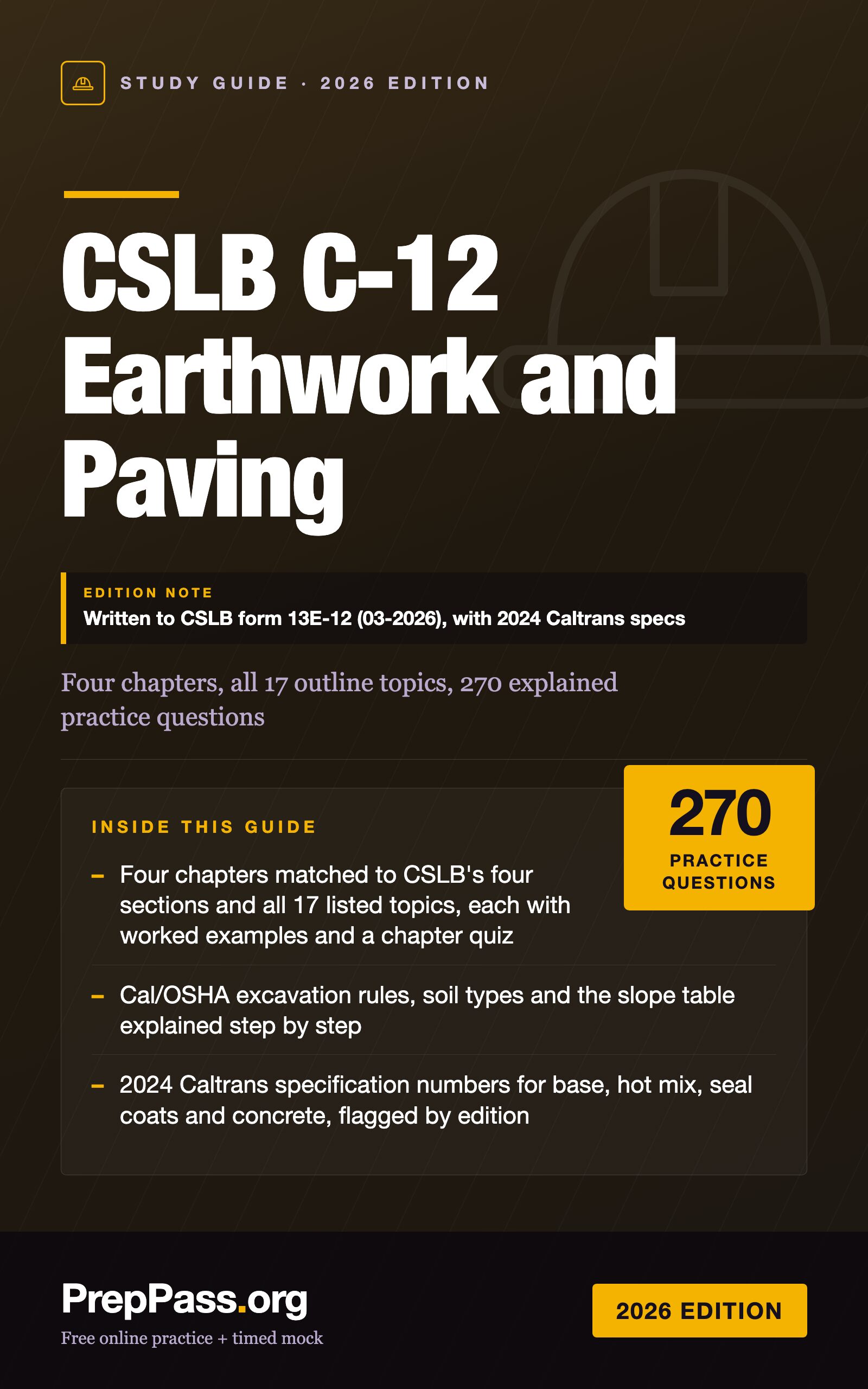
Practice stays free. The full CSLB C-12 Earthwork and Paving study guide is the material itself, taught start to finish — a downloadable PDF + EPUB you keep.
| Administering body | Contractors State License Board (CSLB), California Department of Consumer Affairs — exam delivered by PSI Services LLC |
|---|---|
| Questions | Not published by CSLB What we read and found nothing in: CSLB — Step 7: Studying for the Examination |
| Time limit | 210 minutes |
| Passing score | Not published by CSLB What we read and found nothing in: CSLB — Step 7: Studying for the Examination |
| Fees |
Source: CSLB — List of All CSLB Fees |
| Languages offered | English |
Frequently asked questions
How many CSLB Trade — Earthwork and Paving (C-12) practice questions are here?+
A full bank of original CSLB Trade — Earthwork and Paving (C-12) practice questions across the official content areas, weighted like the real exam, with explanations. Free, no signup.
What is the CSLB Trade — Earthwork and Paving (C-12) exam like?+
A multiple-choice exam, 210 minutes. Practice by topic here, then take the full timed mock exam to gauge readiness.
Are these the real exam questions?+
No. Every question is 100% original, written from public primary sources with explanations. We never copy real exam questions or paid prep material.
Can I study in Chinese or Spanish?+
PrepPass practice is in English, 中文 and Español. The official exam is in English — switch the question language to English any time to rehearse the exact terminology you'll see on test day.
Is there a study guide for the CSLB Trade — Earthwork and Paving (C-12)?+
Yes. PrepPass sells CSLB C-12 Earthwork and Paving Study Guide — 2026 Edition, a PDF + EPUB download, $24.99 one-time; the practice on this page stays free without it. See the study guide →
Sample practice questions
A few sample questions from this free bank, with full explanations. Use the practice tool above for the whole set.
- 1. Planning and Estimating
Which task is within the C-12 definition as the Board words it?
- a.Installing guard rails and wheel stops on a lot
- b.Fabricating and installing water pipelines
- c.Forming and finishing structural concrete walls
- d.Placing paving and other surfacing materials
Answer: d
Explanation: The definition includes "the mixing, fabricating and placing of paving and any other surfacing materials." Guard rails and vehicle stops appear in the C-32 definition, fabricating and installing pipelines is the C-34 definition (with its own incidental trenching and paving), and forming and finishing concrete is the C-8 definition.
Source: CSLB C-12 classification text (16 CCR Div. 8, Art. 3)
- 2. Earthwork and Grade Control
The completed surface of a cold-planed pavement is checked with a 12-foot straightedge parallel to the centerline. What is the maximum variation?
- a.0.03 foot of depth plus 0.03 foot of slope
- b.0.05 foot
- c.0.15 foot
- d.0.02 foot
Answer: d
Explanation: The planed surface may not vary more than 0.02 foot under a 12-foot straightedge parallel to the centerline. The 0.05 foot figure is the base tolerance, 0.15 foot is the drop-off limit between open lanes, and 0.03 foot is the allowed depth adjustment and the transverse slope variation, which are not added to the straightedge limit.
Source: Caltrans 2024 Standard Specifications §39-3.04C(2)
- 3. Paving
What is the minimum thickness of each lift when Type A hot mix is placed in multiple lifts?
- a.0.15 foot
- b.0.05 foot
- c.0.30 foot
- d.0.50 foot
Answer: a
Explanation: When the thickness shown is 0.30 foot or more, multiple lifts of not less than 0.15 foot each are allowed. Thinner lifts cool too quickly, 0.30 foot is the total thickness threshold, and 0.50 foot is the aggregate base layer limit.
Source: Caltrans 2024 Standard Specifications §39-2.02C
- 4. Paving
By when must soil tracked onto a public street from the job site be removed?
- a.Within 6 hours, and never allowed into a storm drain
- b.By the end of the work week, then swept
- c.Within 72 hours, and if the weather is dry
- d.After the project is finished, then swept
Answer: a
Explanation: Material tracked onto the surfacing must be removed within 6 hours and may not enter storm drains, open drainage facilities or watercourses. The longer periods let sediment wash into drains.
Source: Caltrans 2024 Standard Specifications §13-7.01C
- 5. Planning and Estimating
A State specification calls for 0.35 foot of aggregate base. What thickness is that in inches?
- a.4.2 inches
- b.3.5 inches
- c.0.42 inch
- d.35 inches
Answer: a
Explanation: Multiply feet by 12: 0.35 × 12 = 4.2 inches. Reading 0.35 foot as 3.5 inches moves the decimal point, 0.42 inch drops a factor of ten, and 35 inches treats the foot value as inches times 100.
Source: Caltrans 2024 Standard Specifications §26-1.03 (thickness stated in feet)
- 6. Planning and Estimating
Minor concrete for curbs and sidewalks must contain at least how much cementitious material?
- a.300 pounds per cubic yard
- b.463 pounds per cubic yard
- c.505 pounds per cubic yard for all curbs
- d.600 pounds per cubic yard
Answer: b
Explanation: Minor concrete contains at least 463 pounds of cementitious material per cubic yard; 505 applies to extruded or slip-form curb with 3/8-inch maximum aggregate. Three hundred pounds is below the minimum, 600 pounds is not a stated value, and 505 applies to only one kind of curb rather than all curbs.
Source: Caltrans 2024 Standard Specifications §73-1.02A
- 7. Earthwork and Grade Control
A Type B excavation was cut at 1:1, and tension cracks now show at the top edge. What must be done?
- a.The slope must be cut back to a minimum of 1-1/2:1
- b.It must be cut to a steeper 3/4:1 slope
- c.Keep the slope and seal the cracks with spoil
- d.It must be left alone until the cracks widen
Answer: a
Explanation: Signs of distress require the actual slope to be at least 1/2 horizontal to 1 vertical less steep than the maximum, so 1:1 becomes 1-1/2:1. Sealing the cracks with spoil leaves the unsafe slope in place, 3/4:1 is steeper, and waiting for the cracks to widen invites a cave-in.
Source: 8 CCR §1541.1 Appendix B(c)(3)(B)
- 8. Paving
The plans show 0.45 foot of Type A hot mix, placed in two equal lifts. What is the thickness of each lift and the gradation?
- a.0.225 foot, with the 1/2-inch gradation
- b.0.225 foot, with the 3/4-inch gradation
- c.0.15 foot, with the 3/4-inch gradation
- d.0.45 foot, with the 1-inch gradation
Answer: b
Explanation: Two equal lifts are 0.225 foot each, and lifts of 0.20 to less than 0.25 foot use the 3/4-inch gradation. The 1/2-inch gradation is for 0.15 to less than 0.20 foot, 0.15 foot would need three lifts, and a single 0.45-foot lift with the 1-inch gradation ignores the two equal lifts the question describes.
Source: Caltrans 2024 Standard Specifications §39-2.02C
- 9. Paving
How long should traffic stay off new porous asphalt according to the EPA fact sheet?
- a.24 to 48 hours
- b.12 to 18 hours
- c.60 to 90 days
- d.3 to 4 weeks
Answer: a
Explanation: The EPA fact sheet says contractors should avoid vehicular traffic for 24 to 48 hours after installing porous asphalt. Twelve to 18 hours is shorter than the fact sheet advises, and 3 to 4 weeks and 60 to 90 days are far longer.
Source: U.S. EPA, Stormwater BMP: Permeable Pavements
- 10. Safety
What does the noise order require when sound levels exceed the permissible exposure table?
- a.Feasible controls first; ear protection if they fail
- b.Hearing tests during the first month of exposure
- c.A warning sign at the machine
- d.Ear protection first, then engineering controls if needed
Answer: a
Explanation: When levels exceed the table, feasible administrative or engineering controls are used, and if they do not bring sound within the table, the employer provides ear protection and requires its use. Hearing tests do not reduce the exposure, a sign alone does not control the noise, and putting ear protection ahead of feasible controls reverses the order.
Source: 8 CCR §5096(b); §1521