Study guide · 2026 Edition
CSLB C-12 Earthwork and Paving Study Guide — 2026 Edition
PrepPass's independent 2026 study guide for the CSLB C-12 Earthwork and Paving exam is 222 pages including 270 practice questions with a full answer key, PDF + EPUB, $24.99 one-time; it is not affiliated with the exam provider. The book does not include PrepPass's separate online timed mock for this exam (100 questions, 210 minutes). The book also prints its own practice exam, which is separate.
Edition: Written to CSLB form 13E-12 (03-2026), with 2024 Caltrans specs
- Length
- 222 pages
- Practice questions in the book
- 270
- PrepPass online timed mock
- 100 questions · 210 min
- Exam facts checked, file updated
- November 2026
- Delivery
- PDF + EPUB · English · instant download
What is in the CSLB C-12 Earthwork and Paving study guide?
The real exam: CSLB Earthwork and Paving (C-12) Trade Examination — Questions: Not published by CSLB · 210 minutes · Passing score: Not published by CSLB.
Four chapters, all 17 outline topics, 270 explained practice questions
Examination registration (each registration, first attempt or retake): $51.43 per attempt, paid to PSI Services LLC. A retake pays it again. This guide: $24.99, one time.
Exam facts, who it suits and what changed
About the exam itself
| Administering body | Contractors State License Board (CSLB), California Department of Consumer Affairs — exam delivered by PSI Services LLC |
|---|---|
| Questions | Not published by CSLB What we read and found nothing in: CSLB — Step 7: Studying for the Examination |
| Time limit | 210 minutes |
| Passing score | Not published by CSLB What we read and found nothing in: CSLB — Step 7: Studying for the Examination |
| Fees |
Source: CSLB — List of All CSLB Fees |
| Languages offered | English |
Look inside the book
Three real pages, rendered straight from the PDF you download — a reference page, a teaching page, and a worked question, always in that order. Nothing here was redrawn to look better.
- Quick referenceChapter 1 — Planning and Estimating (20%) · PDF page 39
A page you can turn back to: the numbers, deadlines or terms gathered in one place.
- How it's taughtAppendix E — Extra practice sets · PDF page 206
An explanation page: the material taught in prose, in the order the exam tests it.
- A question, workedChapter 2 — Earthwork and Grade Control (29%) · PDF page 69
A practice question with its answer and the reasoning behind it — not just a key.
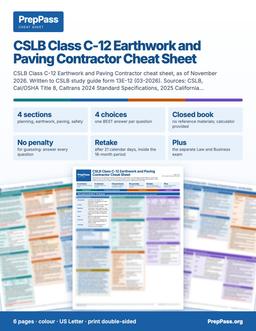
Exam inside two weeks?
This guide is the teaching, read over weeks. If your exam is inside two weeks, the printable colour cheat sheet is the other product: the figures the exam turns on, laid out by section.
See the CSLB C-12 Earthwork and Paving cheat sheet PDF — $9.99 →
6 pages · US Letter · printable PDF · yours to keep
What's included — and what isn't
Included
- Four chapters matched to CSLB's four sections and all 17 listed topics, each with worked examples and a chapter quiz.
- Cal/OSHA excavation rules, soil types and the slope table explained step by step.
Not included
- No printed copy is shipped — this is a file you download and can print yourself
- No video course, instructor or tutoring comes with the book — the free videos on the site are separate
Everything included, and everything that isn't
Included
- 2024 Caltrans specification numbers for base, hot mix, seal coats and concrete, flagged by edition.
- California Chapter 11B accessibility numbers for ramps, curb ramps and parking.
- 270 original questions: 40 chapter-quiz questions, an 80-question practice exam and 150 extra-practice questions, every option explained.
- Sixteen calculation drills, a formula sheet and a key-numbers table that names the source edition of each figure.
Not included
- Not your exam registration or the testing centre's fee, which you still pay to the official body
Contents
See 15 sections and the page each one starts on
- Chapter 3 — Paving (30%)p. 13
- Chapter 1 — Planning and Estimating (20%)p. 15
- Chapter 2 — Earthwork and Grade Control (29%)p. 44
- Chapter 4 — Safety (21%)p. 101
- Practice exam — 80 questionsp. 128
- Section 1 — Planning and Estimating (16 questions)p. 128
- Section 2 — Earthwork and Grade Control (23 questions)p. 131
- Section 3 — Paving (24 questions)p. 136
- Section 4 — Safety (17 questions)p. 141
- Practice exam answer key and explanationsp. 145
- Appendix A — Terms the exam expects you to use preciselyp. 155
- Appendix B — Formulas Percent grade = rise ÷ run × 100.p. 157
- Appendix C — Key numbers, with the edition of eachp. 163
- Appendix D — Pairs the exam likes to confuse Pair Differencep. 166
- Appendix E — Extra practice setsp. 167
Taken from the PDF you download, with the page each one starts on — not typed here.
Read a chapter free, in full
One complete chapter, exactly as it ships in the eBook. Scroll the window to read it right here; no download, no email.
Read chapter 1 here, without leaving the page
The Board gives Planning and Estimating about 20% of the C-12 examination and lists five knowledge statements under it: plans and specifications, job site conditions, estimating, project layout, and materials and equipment.[1] This is where the exam's arithmetic lives. The study guide says some questions require mathematical computation and that a calculator will be provided, and its printed samples include a material-tonnage problem.[1] Everything in this chapter is built so that you can set up that kind of problem in your head before you touch the calculator: know what the number measures, what unit it is in and what unit the answer must be in.
The chapter also does something quieter. It teaches you to read the documents and the ground before you price or dig. Most failures in earthwork and paving contracting begin as planning failures: a utility nobody located, a haul distance nobody measured, a swell factor nobody applied, a specification temperature nobody read.
1.1 Plans and specifications
What a C-12 contractor is licensed to do
Start with the license itself, because scope questions are planning questions. The Board's classification text reads: "An earthwork and paving contractor digs, moves, and places material forming the surface of the earth, other than water, in such a manner that a cut, fill, excavation, grade, trench, backfill, or tunnel (if incidental thereto) can be executed, including the use of explosives for these purposes. This classification includes the mixing, fabricating and placing of paving and any other surfacing materials."[2]
Read that as four separate permissions:
- Moving earth. Cut, fill, excavation, grade, trench and backfill. The phrase "other than water" matters: moving water is not the license.
- Tunnels, if incidental. A tunnel is inside the license only when it is incidental to the earthwork, not as a main business.
- Explosives for those purposes. Blasting is in the C-12 definition when it serves excavation.[2] The Board's list of retired C-61 subcategories shows what happened to the old specialty licenses: Land Clearing and Blasting are marked "Now under C-12 or A," Soil Grouting "Now under C-32, C-12 or A" and Tennis Court Surfacing "Now under C-12 or A."[3]
- Mixing, fabricating and placing paving and any other surfacing materials. The paving half of the license is not limited to asphalt. "Any other surfacing materials" is broad, which is why tennis court surfacing and specialty surfaces appear in Chapter 3.
Neighboring classifications explain the edges, and the exam likes edges:
- C-8 Concrete "forms, pours, places, finishes and installs specified mass, pavement, flat and other concrete work."[4] The word "pavement" appears in both definitions, so the two classifications overlap on concrete paving; the C-12 definition adds the earth moving, base and every other surfacing material around it.
- C-32 Parking and Highway Improvement applies protective coatings, vehicle stops, guard rails, directional lines, buttons, markers, signs and arrows on the horizontal surface of a parking facility or roadway, and "does not include the re-paving of these surfaces."[5] Striping and wheel stops are C-32 work; laying the pavement is C-12.
- C-34 Pipeline includes "the trenching, boring, shoring, backfilling, compacting, paving and surfacing necessary to complete the installation of such pipelines."[6] Trench-and-pave work that is incidental to a pipeline belongs to that license.
- C-27 Landscaping includes preparing and grading plots and areas of land for landscape installation.[7]
- A General Engineering is a contractor whose principal business is fixed works requiring specialized engineering knowledge, which the statute lists as including highways, streets and roads, airports, drainage, flood control and tunnels.[8]
The documents and what each one tells you
A set of documents for earthwork and paving has two halves: the plans, which show where things go, and the specifications, which say what the things are and how they are built. A third group, the reports, tells you what the ground and the existing facilities are like.
Plans, in the order you will usually find them:
- Title sheet, legend, abbreviations and general notes. The legend tells you what a line type or hatch means; the notes often carry requirements that appear nowhere else.
- Typical sections. A typical section shows the pavement structure as layers: surface course, base, subbase if any, and subgrade, each with a thickness, and the cross slope. It also shows widths of lanes, shoulders, curb and sidewalk. The State's specifications measure thicknesses in feet; a typical section may show "0.25 ft" where a city plan shows "3 inches". Convert before you compare.
- Plan view. A bird's-eye view of alignment, stationing, edges of pavement, curbs, drainage structures, utilities, right-of-way and construction limits. Stationing runs along the centerline: STA 12+50 is 1,250 feet from the starting station.
- Profile. A side view along the centerline showing existing ground and finished grade. Grades are given as a percent (rise over run times 100); a vertical curve joins two grades.
- Cross sections. Slices perpendicular to the centerline at stated stations, showing existing ground and the proposed section so that cut and fill areas can be measured. These are the raw material for the average-end-area volume method in Statement 1.3.
- Grading plan. Contour lines for the existing and proposed ground. Contours close together mean steep ground; contours far apart mean flat ground; a contour line never crosses another except at a vertical face.
- Drainage, utility, erosion-control and traffic-control sheets. Drainage structures with inverts and slopes, existing and relocated utilities, the stormwater measures Chapter 4 teaches, and the staging of lane closures and detours.
- Details. Curb, gutter, sidewalk, curb ramp and driveway details, pavement joints, trench backfill, and manholes adjusted to grade.
The specification is where materials, tests, tolerances, temperatures, methods and measurement are written. The State's own specifications are written in three recurring parts for each section: general, materials and construction, followed by payment. For example, the State's aggregate base section runs 26-1.01 General (with submittals and quality assurance), 26-1.02 Materials, 26-1.03 Construction and 26-1.04 Payment.[9] Each part answers a different estimating question:
- General tells you what you must submit and what testing you must perform and pay for.
- Materials tells you what to buy: gradations, quality tests, binder grade.
- Construction tells you how much labor, equipment and time: layer thickness, compaction, temperatures, tolerances.
- Payment tells you how the quantity is measured, and that decides what you must count. Aggregate base, for example, may be paid by volume from the dimensions shown or by weight, and when paid by weight the engineer deducts water in excess of optimum moisture content plus 1 percent.[9]
Tolerances you read off the plans and specs
Some numbers are tolerances rather than dimensions, and the exam asks for them. The State specification for earthwork requires the grading plane to be prepared so that it does not vary more than 0.05 foot above or below the grade established by the engineer where hot mix asphalt is to be placed, and not to extend above that grade where concrete base or pavement is to be placed.[10] The completed aggregate base surface must not vary more than 0.05 foot from the established grade.[9] Compare the two: both are 0.05 foot, about five-eighths of an inch, but one is plus-or-minus and one is a ceiling on the high side.
Worked example 1 — Convert a plan scale
A parking lot plan is drawn at 1 inch = 40 feet. A drive aisle measures 3-3/4 inches on the sheet. How long is the aisle?
- Convert 3-3/4 inches to 3.75 inches.
- Multiply by the scale: 3.75 × 40 = 150 feet.
Check: each inch is 40 feet, so 3 inches is 120 feet and the extra three-quarters of an inch is 30 feet, total 150 feet. The trap is dividing instead of multiplying, which gives 0.09 feet, or using an engineer's scale reading for the wrong scale.
Worked example 2 — Percent grade from a profile
A profile shows finish grade elevation 412.40 feet at STA 12+00 and 415.60 feet at STA 14+00. What is the grade?
- Rise = 415.60 − 412.40 = 3.20 feet.
- Run = 14+00 − 12+00 = 200 feet.
- Grade = 3.20 ÷ 200 = 0.016 = 1.6 percent, uphill in the direction of increasing stations.
The exam may give the same slope as a ratio. A 4:1 slope (4 horizontal to 1 vertical) is 1 ÷ 4 = 25 percent; a 1:12 ramp is 1 ÷ 12 = 8.33 percent; a 1:48 cross slope is 2.08 percent.
Worked example 3 — Interpolate between contours
Two contours at 100 and 102 feet are 40 feet apart measured on the ground between them. A point lies 15 feet from the 100-foot contour on the line between the contours. What is its elevation?
- The 2 feet of rise is spread over 40 feet, or 0.05 feet per foot.
- 15 feet × 0.05 = 0.75 foot above the 100-foot contour.
- Elevation = 100.75 feet.
Rules for reading documents
- Convert units before you compare. The State's specifications write layer thickness in feet (0.25 foot) and plans may write inches (3 inches). 0.25 foot = 3 inches; 0.5 foot = 6 inches; 0.15 foot = 1.8 inches.
- Stationing is distance. Subtract the numbers: STA 18+75 minus STA 12+50 is 625 feet.
- Cross sections measure area; profiles measure grade. Volume needs areas; layout needs grades.
- The payment clause decides what you count. Volume from the dimensions shown, weight in tons, or each, linear foot, square yard: price the unit the owner pays.
- A tolerance is a promise about the finished product. Know whether it is plus-or-minus, a ceiling or a floor.
- The license covers earth and surfacing as a system. Striping, wheel stops and guard rails are C-32; incidental trench paving for a pipeline is C-34.
Named traps
- Scale confusion. Multiplying when you should divide, or reading an architectural scale on an engineering drawing.
- Feet versus inches for thickness. A State specification's 0.5 foot of base is 6 inches, not 0.5 inch.
- Reading a ceiling as a plus-or-minus. Concrete base grading planes may not extend above grade; HMA base grading planes may vary 0.05 foot either way.
1.2 Job site conditions
Walk the site before you price it
A site walk answers questions the plans cannot. Take a checklist and a camera and look at:
- Access and staging. Where trucks enter, where they turn, where equipment is stored and fueled, where the stabilized entrance will go, how far haul trucks must travel to the dump or borrow site.
- Existing grade and drainage. Where water goes now, where it will go during construction and where it will go afterward. Water that enters an excavation is a safety problem and a cost problem.
- Existing pavement and structures. Pavement condition, curb and gutter, walls, buildings and sidewalks that excavation could undermine. The excavation safety order requires that where the stability of adjoining buildings, walls or other structures is endangered, shoring, bracing or underpinning be provided, and that sidewalks and pavements not be undermined unless a support system or other protection is provided.[11]
- Overhead lines. Look up before you look down.
- Surface encumbrances. Trees, poles, fences and rocks that create a hazard must be removed or supported.[11]
- Neighbors, traffic and pedestrians. The traffic-control plan, the pedestrian route, school and hospital hours, and the business entrances you must keep open.
- Weather and season. Earthwork cannot be compacted frozen or under a snow blanket, and paving has minimum air and surface temperatures.[10, 12] A schedule that puts a thin lift of asphalt in November in the mountains is a planning error.
Utilities: the question the license exam asks first
Before digging, the contractor must find out what is underground. The Cal/OSHA excavation order says the approximate location of subsurface installations such as sewer, telephone, fuel, electric and water lines, or any other installation reasonably expected to be encountered, "shall be determined by the excavator prior to opening an excavation." Excavation may not start until two things have happened: the excavator has marked the area as Government Code section 4216.2 requires, and the excavator has received a positive response from all known owner-operators within the boundaries of the proposed project.[11] The regional notification center and all known owners who are not members must be advised "at least 2 working days prior to the start of any digging or excavation work," except for emergency repair of subsurface facilities.[11]
Three further rules matter for planning:
- High priority installations. When excavation is proposed within 10 feet of one, the owner-operator must notify the excavator before the legal start time and an on-site meeting must be scheduled to decide how the installation's location will be verified. High priority installations are high-pressure natural gas pipelines above 60 psig, petroleum pipelines, pressurized sewage pipelines, conductors or cables that have a potential to ground of 60,000 volts or more, and hazardous materials pipelines.[11]
- Exact location. When digging approaches the approximate location, the exact location is determined by safe and acceptable means that prevent damage.[11]
- If you hit one. An excavator who discovers or causes damage must immediately notify the facility owner-operator or the regional notification center, must report every break, leak, nick, dent, gouge or groove to the operator, and if damage to a high priority installation releases flammable, toxic or corrosive gas or liquid, or endangers life, health or property, must immediately call 911.[11]
The State specification adds a planning-stage rule for work around traffic: if local authorities regulate traffic, the contractor notifies them at least 5 business days before job site activities begin.[13]
Overhead lines
The Cal/OSHA high-voltage order treats every overhead conductor as energized until the owner or operator verifies that the line is not energized and it is visibly grounded at the work site.[14] General clearances are 6 feet for lines from 600 up to 50,000 volts (phase to phase), 10 feet above 50,000 up to 345,000 volts, 16 feet above 345,000 up to 750,000 volts and 20 feet above 750,000 up to 1,000,000 volts.[14] Boom-type lifting equipment and material storage have larger clearances; for the same lowest voltage band, 600 to 50,000 volts, the required distance is 10 feet.[14] The contractor must designate someone to watch the clearance whenever the operator cannot keep it by sight.[14]
Soils, groundwater and the report
A soil investigation report is the planner's best friend. It tells you what the borings found, where groundwater stood, what the soils are and sometimes what compaction and grading recommendations the geotechnical engineer made. Read it for: depth to groundwater (dewatering cost and trench safety), presence of fill, organics or expansive clay (overexcavation cost), rock (ripping or blasting cost) and any contaminated soil (a hazardous material is hauled, not used as fill: the State specification directs that excavated material be used in embankments "unless the material resulting from the excavation is hazardous").[10] Chapter 2 teaches how soils are classified for safety and for compaction.
Permits and environmental conditions
- Excavation permit. Cal/OSHA requires an annual or project permit for construction of trenches or excavations 5 feet or deeper into which any person is required to descend. The permit is not required for emergency repair of underground facilities, for work where no person has to descend, or for certain exempt entities.[15]
- Stormwater coverage. The State's construction stormwater permit applies to sites that disturb one or more acres of land surface, or are part of a larger common plan of development that disturbs more than one acre.[16] Chapter 4 teaches the plan, the people and the inspections.
- Local permits and encroachment permits. Work in a public street needs the agency's approval and a traffic-control plan; read the permit conditions for working hours, noise and dust.
Worked example 4 — Which clearance applies?
A telescoping boom crane will set a precast structure under a 12,000-volt overhead line. What minimum clearance applies?
- 12,000 volts is in the band 600 to 50,000 volts.
- The equipment is boom-type lifting equipment, so the boom-and-storage table applies, not the general table.
- That table gives 10 feet for this band.
The tempting wrong answer is 6 feet, which is the general-clearance figure for the same band. A second trap is 10 feet read from the general table: that figure applies to lines above 50,000 volts up to 345,000 volts.
Worked example 5 — Is a permit needed?
An employer will dig a utility trench 6 feet deep and a worker will stand in it to set pipe. Is a Cal/OSHA excavation permit required? An employer will also dig a 6-foot trench with a remote-controlled machine and nobody enters it. Is a permit required?
- The first trench is 5 feet or deeper and a person is required to descend: permit required (annual or project).
- The second trench is 5 feet or deeper, but the construction and final use do not require a person to descend: the permit rule does not apply.
The point of the permit is notice to the Division. The trigger is depth together with descent, not depth alone. Notice that this is a permit rule; the protective-system rule has different triggers (Chapter 2).
Rules for assessing the site
- Locate before you dig. Mark the area, notify the regional notification center at least 2 working days ahead, and wait for positive responses.
- High priority installation within 10 feet means an on-site meeting.
- Treat every overhead line as energized until it is verified de-energized and visibly grounded.
- Know the voltage band and whether the equipment is boom-type, then pick the table.
- Read the soil report for groundwater, fill, organics and rock; each changes price and safety.
- Permit triggers: 5 feet deep and a person descends (Cal/OSHA permit); one acre or more of disturbance (stormwater permit).
- Weather is a planning constraint: compaction and paving have temperature limits.
Sources cited in this excerpt
- CSLB License Examination Study Guide: Earthwork and Paving (C-12), form 13E-12 (03-2026), for examinations scheduled on or after September 1, 2023. Contractors State License Board (CSLB), 2026-03; read 2026-11-08. https://www.cslb.ca.gov/Resources/StudyGuides/C12StudyGuide.pdf
- C-12 - Earthwork and Paving Contractors (Title 16 CCR Division 8, Article 3, Classifications), CSLB web page. Contractors State License Board (CSLB), read 2026-11-08. https://www.cslb.ca.gov/About_Us/Library/Licensing_Classifications/Licensing_Classifications_Detail.aspx?Class=C12
- C-61 Limited Specialty classification list (retired D-subcategories), CSLB web page. Contractors State License Board (CSLB), read 2026-11-08. https://www.cslb.ca.gov/About_Us/Library/Licensing_Classifications/C-61_Limited_Specialty/Default.aspx
- C8 classification, Title 16 CCR Division 8, Article 3, CSLB web page. Contractors State License Board (CSLB), read 2026-11-08. https://www.cslb.ca.gov/About_Us/Library/Licensing_Classifications/Licensing_Classifications_Detail.aspx?Class=C8
- C32 classification, Title 16 CCR Division 8, Article 3, CSLB web page. Contractors State License Board (CSLB), read 2026-11-08. https://www.cslb.ca.gov/About_Us/Library/Licensing_Classifications/Licensing_Classifications_Detail.aspx?Class=C32
- C34 classification, Title 16 CCR Division 8, Article 3, CSLB web page. Contractors State License Board (CSLB), read 2026-11-08. https://www.cslb.ca.gov/About_Us/Library/Licensing_Classifications/Licensing_Classifications_Detail.aspx?Class=C34
- C27 classification, Title 16 CCR Division 8, Article 3, CSLB web page. Contractors State License Board (CSLB), read 2026-11-08. https://www.cslb.ca.gov/About_Us/Library/Licensing_Classifications/Licensing_Classifications_Detail.aspx?Class=C27
- A - General Engineering Contractor (Business and Professions Code section 7056), CSLB web page. Contractors State License Board (CSLB), read 2026-11-08. https://www.cslb.ca.gov/About_Us/Library/Licensing_Classifications/Licensing_Classifications_Detail.aspx?Class=A
- 2024 Standard Specifications, Section 26 Aggregate Bases (State of California, Department of Transportation). California Department of Transportation (Caltrans), 2024 edition; read 2026-11-08. https://dot.ca.gov/-/media/dot-media/programs/design/documents/2024_stdspecs-a11y.pdf
- 2024 Standard Specifications, Section 19 Earthwork (State of California, Department of Transportation). California Department of Transportation (Caltrans), 2024 edition; read 2026-11-08. https://dot.ca.gov/-/media/dot-media/programs/design/documents/2024_stdspecs-a11y.pdf
- California Code of Regulations, Title 8, § 1541. General Requirements. California Department of Industrial Relations (Cal/OSHA), read 2026-11-08. https://www.dir.ca.gov/title8/1541.html
- 2024 Standard Specifications, Section 39 Asphalt Concrete (State of California, Department of Transportation). California Department of Transportation (Caltrans), 2024 edition; read 2026-11-08. https://dot.ca.gov/-/media/dot-media/programs/design/documents/2024_stdspecs-a11y.pdf
- 2024 Standard Specifications, Section 12 Temporary Traffic Control (State of California, Department of Transportation). California Department of Transportation (Caltrans), 2024 edition; read 2026-11-08. https://dot.ca.gov/-/media/dot-media/programs/design/documents/2024_stdspecs-a11y.pdf
- California Code of Regulations, Title 8, §2946. Provisions for Preventing Accidents Due to Proximity to Overhead Lines. California Department of Industrial Relations (Cal/OSHA), read 2026-11-08. https://www.dir.ca.gov/title8/2946.html
- California Code of Regulations, Title 8, §341. Permit Requirements. California Department of Industrial Relations (Cal/OSHA), read 2026-11-08. https://www.dir.ca.gov/title8/341.html
- Order WQ 2022-0057-DWQ, NPDES General Permit for Stormwater Discharges Associated with Construction and Land Disturbance Activities (NPDES No. CAS000002). California State Water Resources Control Board, adopted 2022-09-08, effective 2023-09-01; read 2026-11-08. https://www.waterboards.ca.gov/water_issues/programs/stormwater/construction/docs/2022-0057-dwq-with-attachments/cgp2022_order.pdf
Questions buyers ask
How do I get it?
Pay, and the download appears on this page straight away. The links are also emailed to you. No account is required.
What if it isn't for me?
Email us within 14 days for a full refund, no questions asked.
Is the free practice going away?
No. Every practice question, the timed mock and the free chapters on this site stay free. This book is the studying half, not a gate around the free half.
More questions (17)
Can I read it on my phone?
Yes — the EPUB is for phones and e-readers, the PDF is for printing and tabbing. You get both.
What has changed on the CSLB C-12 Earthwork and Paving exam?
Written to CSLB form 13E-12 (03-2026), with 2024 Caltrans specs.
Is a study guide enough for the CSLB C-12 Earthwork and Paving exam, or do I need a course?
A book is exam review: it does not replace any education, training or experience Contractors State License Board (CSLB), California Department of Consumer Affairs requires before you may sit the exam, so check those requirements first. For the exam content itself, this 222-page guide teaches the material chapter by chapter with 270 practice questions and explanations inside, and 250 more practice questions are free on PrepPass. A prep course adds live instruction and a set schedule; whether you need one beyond any required education is your call.
What is the cheapest way to prepare for the CSLB C-12 Earthwork and Paving exam?
Start with what costs nothing: 250 practice questions on PrepPass, with explanations and no signup. If you want it taught in one file you keep, the full study guide is $24.99 once; the printable cheat sheet for the last days is $9.99. No subscription on any of them.
Who administers the CSLB Earthwork and Paving (C-12) Trade Examination?
Contractors State License Board (CSLB), California Department of Consumer Affairs — exam delivered by PSI Services LLC. CSLB's legal existence is set by Business and Professions Code § 7000.5. CSLB states it has contracted with PSI to administer its examinations.
How many questions are on the CSLB Earthwork and Paving (C-12) Trade Examination?
Not published by CSLB. CSLB says only that “All trade examinations consist of multiple-choice questions.” No count appears in the study guide, the Examinations FAQ, or PSI's candidate bulletin.
How long is the CSLB Earthwork and Paving (C-12) Trade Examination?
210 minutes. CSLB: “You will be given 3-1/2 hours to complete each examination.” It is per examination, not per sitting — a candidate taking Law and Business plus a trade exam gets 3-1/2 hours for each.
What is the passing score for the CSLB Earthwork and Paving (C-12) Trade Examination?
Not published by CSLB. CSLB: “You will be informed at the test site about the percentage of correct answers needed to pass each examination,” and, in Get Licensed to Build Q14, that the percentage “varies for each exam”. Passing candidates are never shown their own score. PrepPass states no passing score for this exam.
How much does the CSLB Earthwork and Paving (C-12) Trade Examination cost?
$450 — Original application (exam or waiver, one classification) (CSLB, one-time); $51.43 — Examination registration (each registration, first attempt or retake) (PSI Services LLC, per attempt); $200 — Initial license fee (sole owner) (CSLB, one-time); $350 — Initial license fee (non-sole owner: partnership, corporation, LLC, joint venture) (CSLB, one-time). Two payees: application and license fees go to CSLB, the per-exam registration fee to PSI. CSLB's 2023 “Get Licensed to Build” PDF still names a $100 rescheduling fee; it appears neither on CSLB's current fee list nor in Business and Professions Code § 7137 as amended effective 1 January 2026, so it is not stated here. The application fee is charged once per original license application and covers both required exams.
What languages is the CSLB Earthwork and Paving (C-12) Trade Examination offered in?
English. CSLB names ten exams that have Spanish versions and C-12 is not one of them, so the C-12 exam is English only. For trade exams without a Spanish version, CSLB says accommodations may be made for a candidate to be joined by an approved translator.
Does the CSLB C-12 Earthwork and Paving study guide come as a PDF?
Yes — CSLB C-12 Earthwork and Paving Study Guide — 2026 Edition downloads as PDF and EPUB, 222 pages. The download link is emailed the moment payment clears and does not expire.
How much does the CSLB C-12 Earthwork and Paving study guide cost?
$24.99, once. There is no subscription and no account to create; the PDF and EPUB files are yours to keep.
Are there free CSLB C-12 Earthwork and Paving practice questions?
Yes — 250 of them, free to use with no signup and an explanation on every one. They are separate from this study guide, which is what you are buying here. The same free, no-account system also has practice modes (adaptive, new questions, spaced review of misses, weak-topic focus, saved, my mistakes); a timed mock exam (100 questions, 210 minutes) with a score report by topic; a 10-question readiness check (about 5 minutes); 4 study chapters. None of it needs this study guide.
Can I read part of the CSLB C-12 Earthwork and Paving study guide before buying?
Yes. A full chapter is free to read on this page — not a summary of one, the chapter itself.
What is the difference between the CSLB C-12 Earthwork and Paving study guide and the cheat sheet?
The study guide ($24.99) teaches the material chapter by chapter and is meant to be read over weeks. The cheat sheet ($9.99, 6 pages) drops the teaching and keeps the figures: every number on the exam grouped by value so the confusable ones sit together, each reference page paired with a recall page that blanks the answers, and four routes by days left — 14, 7, 3, or tonight. They are separate purchases; neither replaces the other.
Is there a cheaper way to buy the CSLB C-12 Earthwork and Paving study guide with anything else?
Yes. CSLB Law & Business + CSLB C-12 Earthwork and Paving is $30.99 for 4 files in one checkout — 57% less than the $72.96 those items cost bought separately today. It adds CSLB Law & Business — Complete Study Guide (2026), CSLB Law & Business — Cheat Sheet (2026), CSLB C-12 Earthwork and Paving — Cheat Sheet (2026). The saving is measured against the items' real current prices; there is no struck-through "original" price on this site.
Is this the official CSLB C-12 Earthwork and Paving study guide?
No. This is an independent study guide and is not affiliated with or endorsed by the exam's awarding body. It is written from CSLB C-12 study guide 13E-12 (03-2026) and the CSLB Examination FAQ, with the primary sources listed in the book's Sources chapter, read November 2026. Always confirm current requirements with the body that issues your licence.
Why buy the book when the practice is free?
Our practice questions and timed mock stay free — nothing on the site moves behind this book. The $24.99 book is the studying half: the material itself, taught in order, in a file you own.
- Systematic teaching — every exam section explained chapter by chapter, start to finish, not just questions
- Print it & tab it — a paper-ready PDF you can highlight, mark up, and bring to your study table
- Study anywhere, offline — EPUB on your phone or e-reader; no wifi, no browser tabs
- Everything in one place — the chapters and the practice questions in one file
- Yours for life — one-time $24.99, instant download, no subscription
The details
- Verified from the official source(CSLB C-12 study guide 13E-12 (03-2026) and the CSLB Examination FAQ, with the primary sources listed in the book's Sources chapter, read November 2026)
- 250 free practice questions
A CSLB exam prep course runs $200–$800. This book teaches the same exam — same rules, verified to current standards — for a one-time $24.99 you keep for life.
Also free on PrepPass for CSLB C-12 Earthwork and Paving
Beside this guide, PrepPass has a free study system for the same exam. It needs no account, and buying the guide does not unlock or change it: 250 practice questions with explanations; practice modes (adaptive, new questions, spaced review of misses, weak-topic focus, saved, my mistakes); a timed mock exam (100 questions, 210 minutes) with a score report by topic; a 10-question readiness check (about 5 minutes); 4 study chapters.
Progress is saved in your browser; a free account keeps it across devices. The readiness gauge reflects your own practice, not a prediction of the real exam result. How the practice works
One-time purchase, lifetime access to the download. The eBook is the full CSLB C-12 Earthwork and Paving study guide in PDF and EPUB. Educational summary, not professional or legal advice — always confirm the current rules with the official source. Last updated: November 2026.