CSLB C-16 Fire Protection (Trade Exam) Practice Test
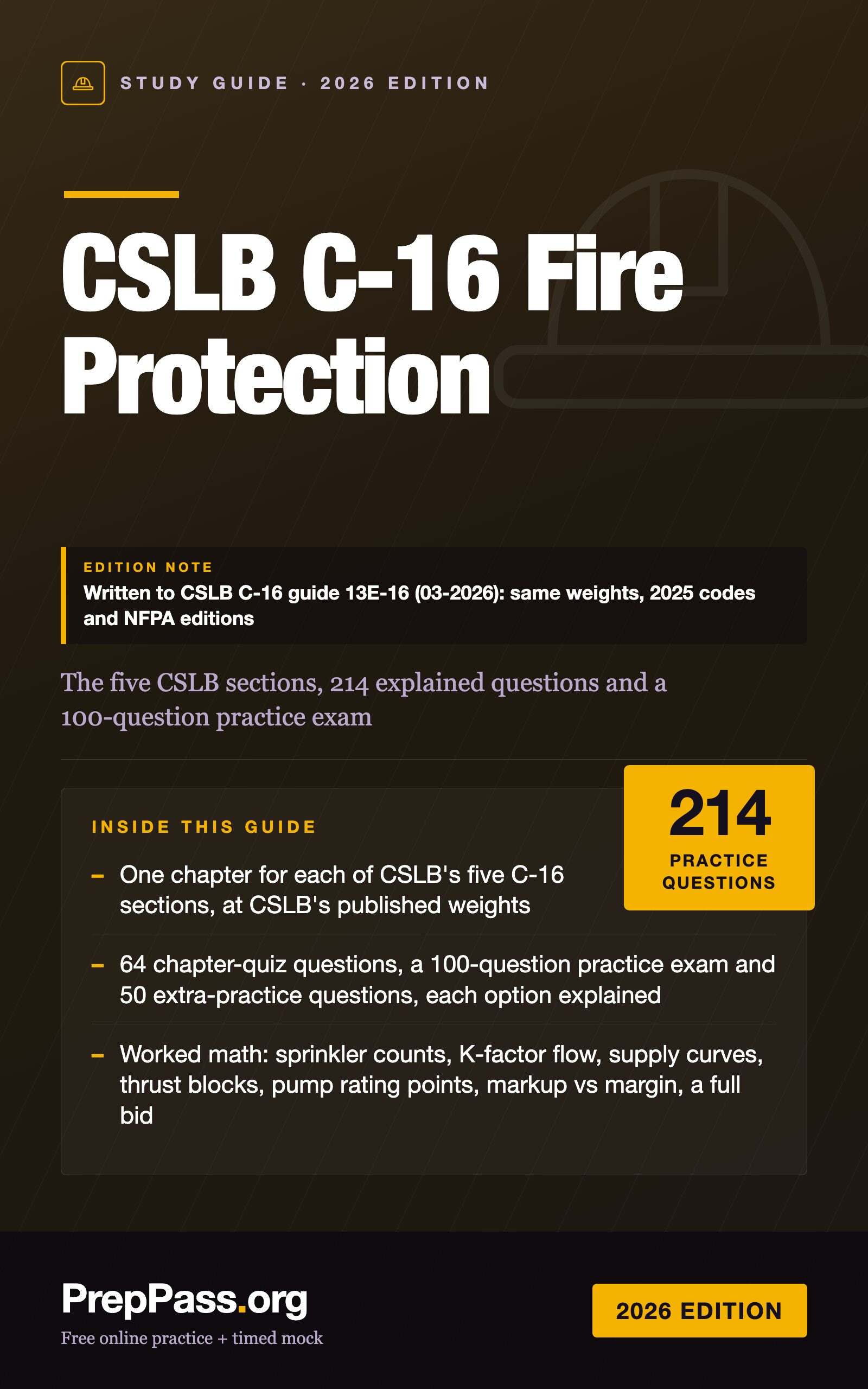
Practice stays free. The full CSLB C-16 Fire Protection study guide is the material itself, taught start to finish — a downloadable PDF + EPUB you keep.
| Administering body | Contractors State License Board (CSLB), California Department of Consumer Affairs — exam delivered by PSI Services LLC |
|---|---|
| Questions | Not published by CSLB What we read and found nothing in: CSLB — Step 7: Studying for the Examination |
| Time limit | 210 minutes |
| Passing score | Not published by CSLB What we read and found nothing in: CSLB — Step 7: Studying for the Examination |
| Fees |
Source: CSLB — List of All CSLB Fees |
| Languages offered | English |
Frequently asked questions
How many CSLB Trade — Fire Protection (C-16) practice questions are here?+
A full bank of original CSLB Trade — Fire Protection (C-16) practice questions across the official content areas, weighted like the real exam, with explanations. Free, no signup.
What is the CSLB Trade — Fire Protection (C-16) exam like?+
A multiple-choice exam, 210 minutes. Practice by topic here, then take the full timed mock exam to gauge readiness.
Are these the real exam questions?+
No. Every question is 100% original, written from public primary sources with explanations. We never copy real exam questions or paid prep material.
Can I study in Chinese or Spanish?+
PrepPass practice is in English, 中文 and Español. The official exam is in English — switch the question language to English any time to rehearse the exact terminology you'll see on test day.
Is there a study guide for the CSLB Trade — Fire Protection (C-16)?+
Yes. PrepPass sells CSLB C-16 Fire Protection Study Guide — 2026 Edition, a PDF + EPUB download, $24.99 one-time; the practice on this page stays free without it. See the study guide →
Sample practice questions
A few sample questions from this free bank, with full explanations. Use the practice tool above for the whole set.
- 1. Planning and Estimating
Which description matches the Board's C-16 classification?
- a.Designs fire protection systems as a licensed engineer
- b.Installs electrical alarm and detection systems
- c.Services and refills portable extinguishers on a route
- d.Lays out, fabricates and installs fire protection systems
Answer: d
Explanation: The classification covers laying out, fabricating and installing all types of fire protection systems and their associated equipment. Installing electrical alarm and detection systems is the work the definition expressly excludes. Servicing and refilling portable extinguishers on a route is a service activity, not the laying out and installing the definition describes. Designing systems as a licensed engineer is a separate professional license, not a contractor classification.
Source: CSLB C-16 classification text
- 2. Planning and Estimating
An owner's design standard tells designers to assume a 10 psi safety margin on hydrant and pump flow test results. Why?
- a.To compensate for the weight of the pipe
- b.To account for the sprinkler wrench torque
- c.To cover the cost of the building permit
- d.To allow for loss of static and residual pressure
Answer: d
Explanation: The standard assumes a 10 psi margin to allow for deterioration in static and residual pressures from the tests. Pipe weight, torque and permit cost are unrelated to supply pressure.
Source: Harvard Medical School Facilities Design Standard, Division 21
- 3. Planning and Estimating
Direct cost is $150,000. What is the price with a 20% margin on selling price?
- a.$175,000
- b.$120,000
- c.$187,500
- d.$180,000
Answer: c
Explanation: Price = 150,000 ÷ (1 − 0.20) = $187,500. Adding 20% to cost is markup and gives $180,000, subtracting 20% from cost gives $120,000, and $175,000 follows neither method.
Source: Estimating arithmetic (margin)
- 4. Installation of Underground Fire Main Systems
What test pressure applies to an underground main with a static pressure of 140 psi, under the Moreno Valley guideline?
- a.140 psi for 1 hour
- b.190 psi for 2 hours
- c.200 psi for 2 hours
- d.250 psi for 2 hours
Answer: c
Explanation: The test is 200 psi or 50 psi above static, whichever is greater, for 2 hours, so at 140 psi static the second figure is 190 psi and 200 psi governs. Testing at 140 psi for 1 hour is only the static pressure and half the duration. 190 psi for 2 hours applies the plus-50 rule alone and ignores the 200 psi floor. 250 psi for 2 hours adds 110 psi to static, which the rule does not call for.
Source: Moreno Valley Fire Department guideline
- 5. Installation of Fire Protection Systems
How long may a sprig be before it must be restrained against lateral movement?
- a.Longer than 1 foot
- b.Longer than 10 feet
- c.Longer than 4 feet
- d.Longer than 20 feet
Answer: c
Explanation: Sprigs greater than 4 feet are restrained from lateral movement under the checklist. One foot is too short a threshold, and 10 and 20 feet are too long.
Source: Idaho State Fire Marshal acceptance checklist
- 6. Installation of Fire Protection Systems
Which test applies to a double-interlock system in addition to the hydrostatic test?
- a.A dry-pipe tank pressure test
- b.A forward flow test of the detectors
- c.A 100 psi water test for 1 hour
- d.A 40 psi air leak test for 24 hours
Answer: d
Explanation: Dry and double-interlock systems are tested at 200 psi for 2 hours and also hold a 40 psi air leak test for 24 hours with less than 1.5 psi loss. A dry-pipe tank pressure test is not a test the checklist calls for. A forward flow test of the detectors tests backflow devices, not detection. A 100 psi water test for 1 hour is below the 200 psi for 2 hours requirement.
Source: Idaho State Fire Marshal acceptance checklist
- 7. Installation of Fire Protection Systems
What minimum run time does the trade article suggest for an automatic-stop electric motor pump controller?
- a.10 minutes
- b.30 minutes
- c.1 minute
- d.2 hours
Answer: a
Explanation: The article says the timer is set for 10 minutes for an electric motor and 30 minutes for a diesel engine. One minute and two hours are not those figures.
Source: Fire Engineering, Testing Building Fire Pumps Part 2
- 8. Maintenance and Repair of Fire Protection Systems
Who must perform testing and maintenance of automatic fire extinguishing systems, with listed exceptions?
- a.Persons licensed under H&S Code 13196.5
- b.A certified welder from the trades
- c.The building's own maintenance engineer
- d.A person the building owner designates
Answer: a
Explanation: Testing and maintenance is performed by those licensed under Health and Safety Code 13196.5, with exceptions such as fire departments with a waiver. A certified welder holds a trade certificate unrelated to servicing extinguishing systems. The building's maintenance engineer is not licensed under that section. A person the owner designates is the rule for inspection, not for testing and maintenance.
Source: 2025 CFC 901.6 (Title 19 text)
- 9. Safety
Who is responsible for first aid on a multi-employer construction project, under section 1512?
- a.The general contractor on the project
- b.The nearest hospital or clinic
- c.The owner of the building site
- d.Each employer, who may pool trained persons
Answer: d
Explanation: Each employer ensures availability of emergency medical services for its employees and trained first aid persons, and employers may form a pool large enough for the combined work force. The general contractor and the site owner are not assigned the whole duty. A nearby hospital or clinic is a resource for emergency care, not the party responsible for first aid on site.
Source: Title 8 section 1512
- 10. Safety
What is the longest single-cleat job-made ladder between supports?
- a.30 feet
- b.40 feet
- c.50 feet
- d.12 feet
Answer: a
Explanation: Single cleat ladders shall not exceed 30 feet in length between supports, and longer runs use offset ladders with a platform. The other lengths are not the limit.
Source: Title 8 section 1676