CSLB C-21 Building Moving and Demolition (Trade Exam) Practice Test
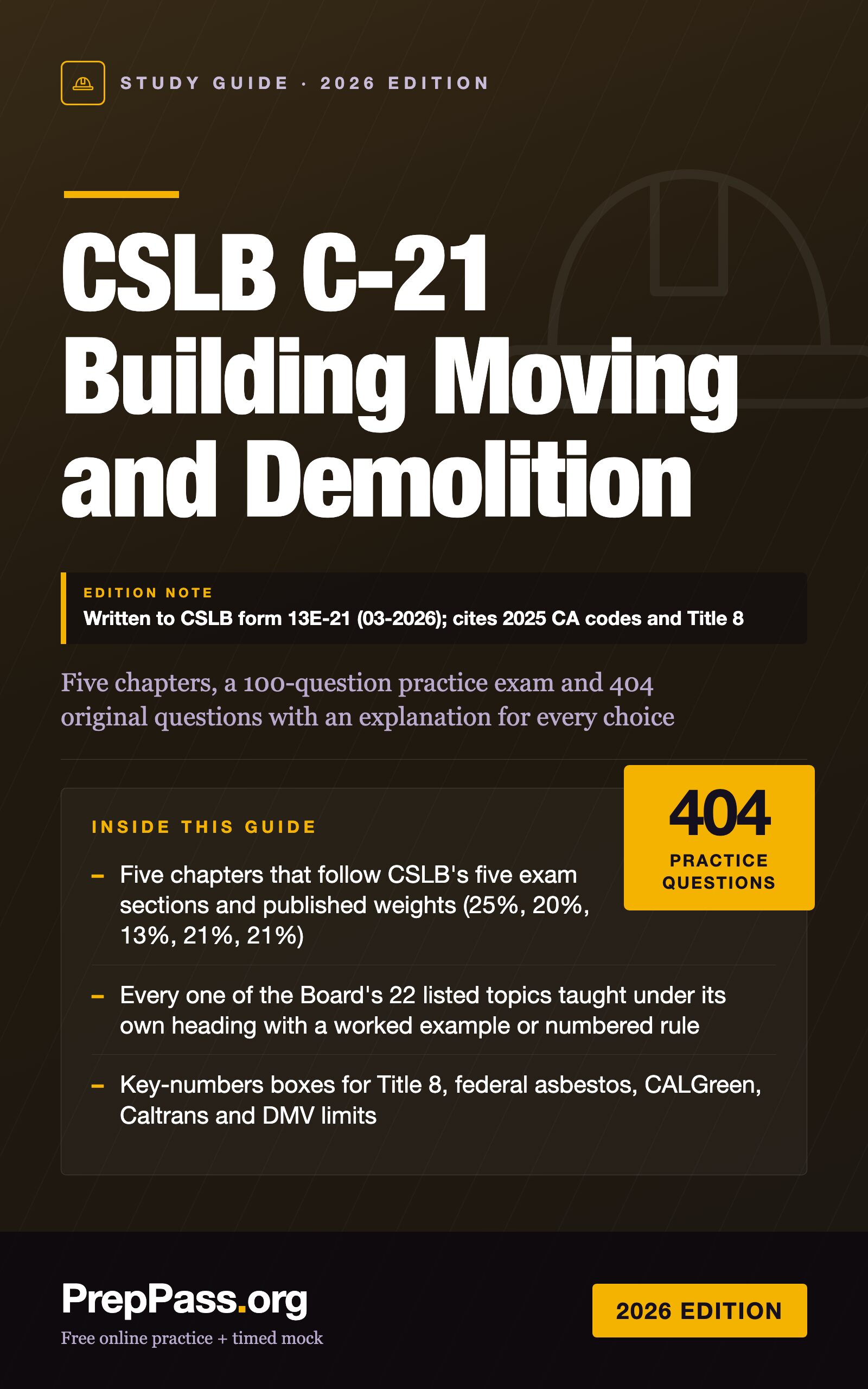
Practice stays free. The full CSLB C-21 Building Moving and Demolition study guide is the material itself, taught start to finish — a downloadable PDF + EPUB you keep.
| Administering body | Contractors State License Board (CSLB), California Department of Consumer Affairs — exam delivered by PSI Services LLC |
|---|---|
| Questions | Not published by CSLB What we read and found nothing in: CSLB — Step 7: Studying for the Examination |
| Time limit | 210 minutes |
| Passing score | Not published by CSLB What we read and found nothing in: CSLB — Step 7: Studying for the Examination |
| Fees |
Source: CSLB — List of All CSLB Fees |
| Languages offered | English |
Frequently asked questions
How many CSLB Trade — Building Moving and Demolition (C-21) practice questions are here?+
A full bank of original CSLB Trade — Building Moving and Demolition (C-21) practice questions across the official content areas, weighted like the real exam, with explanations. Free, no signup.
What is the CSLB Trade — Building Moving and Demolition (C-21) exam like?+
A multiple-choice exam, 210 minutes. Practice by topic here, then take the full timed mock exam to gauge readiness.
Are these the real exam questions?+
No. Every question is 100% original, written from public primary sources with explanations. We never copy real exam questions or paid prep material.
Can I study in Chinese or Spanish?+
PrepPass practice is in English, 中文 and Español. The official exam is in English — switch the question language to English any time to rehearse the exact terminology you'll see on test day.
Is there a study guide for the CSLB Trade — Building Moving and Demolition (C-21)?+
Yes. PrepPass sells CSLB C-21 Building Moving and Demolition Study Guide — 2026 Edition, a PDF + EPUB download, $24.99 one-time; the practice on this page stays free without it. See the study guide →
Sample practice questions
A few sample questions from this free bank, with full explanations. Use the practice tool above for the whole set.
- 1. Planning and Estimating
In a building move, what is cribbing used for?
- a.Stacked blocking that holds the raised structure in position
- b.A tool for measuring the level of the beams under the structure
- c.A trailer axle assembly used under the load for the trip
- d.A coating applied to the beams to prevent rust during storage
Answer: a
Explanation: Cribbing is temporary stacked blocking that supports the structure at each stage of a lift, so the load is not left on jacks alone. Cribbing is a support, not a coating. It is not a measuring tool. Axles belong to the transport equipment, not the cribbing.
Source: CSLB 16 CCR §832.21 classification text; CSLB 13E-21 (03-2026)
- 2. Planning and Estimating
A fence-line wall 6 feet high is to be demolished 3 feet from the lot line. What does the Building Code table require?
- a.Construction railings
- b.No protection
- c.A barrier and a covered walkway
- d.A barrier
Answer: a
Explanation: Work 8 feet high or less and less than 5 feet from the lot line needs construction railings. A barrier and covered walkway applies to work more than 8 feet high. A barrier alone applies to taller work at greater distances. Protection is not waived at under 5 feet.
Source: 2025 CBC Table 3306.1
- 3. Planning and Estimating
A job produces 38 cubic yards of debris and the bins hold 12 cubic yards each. How many bin hauls are needed?
- a.5 hauls
- b.26 hauls
- c.3 hauls
- d.4 hauls
Answer: d
Explanation: 38 ÷ 12 = 3.17, and a partial bin is still a haul, so the count rounds up to 4. Three hauls rounds down and leaves 2 cubic yards. Five hauls over-counts. Twenty-six subtracts 12 from 38.
Source: CSLB 13E-21 (03-2026), computation questions
- 4. Project Preparation
Which item is one of the five federal universal waste categories?
- a.Lamps
- b.Concrete block
- c.Structural steel
- d.Roofing felt
Answer: a
Explanation: The federal categories are batteries, pesticides, mercury-containing equipment, lamps and aerosol cans. Roofing felt is not on the list. Block is not on the list. Structural steel is not on the list.
Source: EPA universal waste (40 CFR Part 273)
- 5. Project Preparation
Manual scraping of lead-containing paint is presumed to produce exposure at what level until an assessment is done?
- a.Above the PEL but not more than 10 times it
- b.Above 50 times the PEL
- c.Above 10 times the PEL but not more than 50 times it
- d.Below the action level
Answer: a
Explanation: Manual demolition, manual scraping and heat gun use are Level 1 tasks presumed above the PEL and not above ten times it. That band belongs to Level 2 tasks. That band belongs to Level 3 tasks. Trigger tasks are presumed to exceed the PEL.
Source: Cal. Code Regs., tit. 8, §1532.1(d)(2)(A)
- 6. Building Moving
Which finding in a pre-move inspection most directly threatens the lift?
- a.Faded exterior paint on the siding of the house
- b.A decayed sill plate under a bearing wall
- c.A squeaky stair tread on the main stairway
- d.A dripping faucet in the kitchen of the house
Answer: b
Explanation: A decayed sill under a bearing wall cannot safely take lifting loads. Faded paint does not affect structure. A leak is a plumbing issue and does not threaten the lift. A squeak is not a structural defect.
Source: NPS Moving Historic Buildings guide, preparing the structure for the move
- 7. Structure Demolition
Where must service lines such as gas, water, steam and sewer be controlled before demolition work starts, under the federal rule?
- a.At the roof penetrations
- b.At the meter inside the building
- c.At each fixture inside the building
- d.Outside the building line
Answer: d
Explanation: Service lines shall be shut off, capped or otherwise controlled outside the building line before demolition starts. Control is at the building line and not at each fixture. Roof penetrations are not the control point. Interior meters are not the stated location.
Source: 29 CFR 1926.850(c)
- 8. Structure Demolition
A foreman proposes a shed that extends 6 feet from the building face over an employee entrance. Does it meet the rule?
- a.No, since the shed must extend at least 12 feet
- b.Yes, if the shed is rated for 150 pounds per square foot
- c.No, since the protection must extend at least 8 feet
- d.Yes, since 6 feet is enough to clear the doorway
Answer: c
Explanation: The protection must extend from the face of the building for a minimum of 8 feet. Clearing the doorway is not the test. The load rating does not replace the projection. The minimum is 8 feet, not 12.
Source: Cal. Code Regs., tit. 8, §1735(j)
- 9. Safety
Which tailgate meeting schedule meets Title 8's "at least every 10 working days" rule?
- a.Working days 1 and 25
- b.Working days 1, 8 and 15
- c.Working days 1, 11 and 22
- d.Working days 1, 12 and 24
Answer: b
Explanation: Gaps of 7 working days are shorter than 10, so the schedule satisfies the rule. A gap of 11 working days is longer than 10. A gap of 24 working days is far longer than 10. Gaps of 10 and 11 working days include one that exceeds 10.
Source: Cal. Code Regs., tit. 8, §1509(e)
- 10. Safety
Which worker exposure requires personal fall protection when no other protection is provided?
- a.A worker at an unprotected leading edge 9 feet above the next level
- b.A worker on a stepladder 5 feet above the floor of the room
- c.A worker on a scaffold plank 3 feet above the floor level
- d.A worker standing on a concrete slab at ground level
Answer: a
Explanation: Personal fall protection is required where work exposes employees to a fall of more than 7-1/2 feet from edges, openings and similar locations. Three feet is below the 7-1/2 foot trigger. Five feet is below the 7-1/2 foot trigger. Ground level has no fall exposure.
Source: Cal. Code Regs., tit. 8, §1670(a)