Study guide · 2026 Edition
CSLB C-21 Building Moving and Demolition Study Guide — 2026 Edition
PrepPass's independent 2026 study guide for the CSLB C-21 Building Moving and Demolition exam is 255 pages including 404 practice questions with a full answer key, PDF + EPUB, $24.99 one-time; it is not affiliated with the exam provider. The book does not include PrepPass's separate online timed mock for this exam (100 questions, 210 minutes). The book also prints its own practice exam, which is separate.
Edition: Written to CSLB form 13E-21 (03-2026); cites 2025 CA codes and Title 8
- Length
- 255 pages
- Practice questions in the book
- 404
- PrepPass online timed mock
- 100 questions · 210 min
- Exam facts checked, file updated
- November 2026
- Delivery
- PDF + EPUB · English · instant download
What is in the CSLB C-21 Building Moving and Demolition study guide?
The real exam: CSLB Building Moving and Demolition (C-21) Trade Examination — Questions: Not published by CSLB · 210 minutes · Passing score: Not published by CSLB.
Five chapters, a 100-question practice exam and 404 original questions with an explanation for every choice
Examination registration (each registration, first attempt or retake): $51.43 per attempt, paid to PSI Services LLC. A retake pays it again. This guide: $24.99, one time.
Exam facts, who it suits and what changed
About the exam itself
| Administering body | Contractors State License Board (CSLB), California Department of Consumer Affairs — exam delivered by PSI Services LLC |
|---|---|
| Questions | Not published by CSLB What we read and found nothing in: CSLB — Step 7: Studying for the Examination |
| Time limit | 210 minutes |
| Passing score | Not published by CSLB What we read and found nothing in: CSLB — Step 7: Studying for the Examination |
| Fees |
Source: CSLB — List of All CSLB Fees |
| Languages offered | English |
Look inside the book
Three real pages, rendered straight from the PDF you download — a reference page, a teaching page, and a worked question, always in that order. Nothing here was redrawn to look better.
- Quick referenceChapter 2 — Project Preparation (20%) · PDF page 53
A page you can turn back to: the numbers, deadlines or terms gathered in one place.
- How it's taughtPractice exam answer key and explanations · PDF page 151
An explanation page: the material taught in prose, in the order the exam tests it.
- A question, workedChapter 1 — Planning and Estimating (25%) · PDF page 35
A practice question with its answer and the reasoning behind it — not just a key.
Exam inside two weeks?
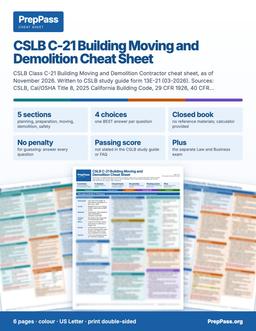
This guide is the teaching, read over weeks. If your exam is inside two weeks, the printable colour cheat sheet is the other product: the figures the exam turns on, laid out by section.
See the CSLB C-21 Building Moving and Demolition cheat sheet PDF — $9.99 →
6 pages · US Letter · printable PDF · yours to keep
What's included — and what isn't
Included
- Five chapters that follow CSLB's five exam sections and published weights (25%, 20%, 13%, 21%, 21%)
- Every one of the Board's 22 listed topics taught under its own heading with a worked example or numbered rule
Not included
- No printed copy is shipped — this is a file you download and can print yourself
- No video course, instructor or tutoring comes with the book — the free videos on the site are separate
Everything included, and everything that isn't
Included
- Key-numbers boxes for Title 8, federal asbestos, CALGreen, Caltrans and DMV limits
- Worked estimates: tons, cubic yards, truck loads, crew days, markup and margin, backfill and compaction
- 404 original questions: 44 chapter-quiz, a 100-question practice exam and 260 extra-practice questions, each explaining every choice
- Appendices: exam at a glance, terms, formulas and key numbers, pairs the exam likes to confuse
Not included
- Not your exam registration or the testing centre's fee, which you still pay to the official body
Contents
See 18 sections and the page each one starts on
- Chapter 1 — Planning and Estimating (25%)p. 13
- Chapter 2 — Project Preparation (20%)p. 38
- Chapter 3 — Building Moving (13%)p. 58
- Chapter 4 — Structure Demolition (21%)p. 77
- Chapter 5 — Safety (21%)p. 97
- Answer key & explanationsp. 112
- Practice exam — 100 questionsp. 116
- Section 1 — Planning and Estimating (25 questions)p. 116
- Section 2 — Project Preparation (20 questions)p. 122
- Section 3 — Building Moving (13 questions)p. 126
- Section 4 — Structure Demolition (21 questions)p. 129
- Section 5 — Safety (21 questions)p. 134
- Practice exam answer key and explanationsp. 139
- Appendix A — The exam at a glance, in one tablep. 153
- Appendix B — Terms the exam expects you to use preciselyp. 156
- Appendix C — Formulas and key numbers Formulasp. 158
- Appendix D — Pairs the exam likes to confusep. 161
- Appendix E — Extra practice setsp. 163
Taken from the PDF you download, with the page each one starts on — not typed here.
Read a chapter free, in full
One complete chapter, exactly as it ships in the eBook. Scroll the window to read it right here; no download, no email.
Read chapter 1 here, without leaving the page
The Board gives Planning and Estimating about 25% of the C-21 examination, the largest single section, and lists five knowledge statements under it: evaluating plans and specifications, evaluating hazardous materials surveys, evaluating job site readiness, determining job methods and equipment, and estimating project costs.[1] Everything later in this book (permits, mobilizing, moving, demolishing, safety) is a decision you make here first, on paper, before a crew or a machine arrives.
Each unit below has the same parts: what the Board's statement asks of you, numbered rules to carry in your head, at least one worked example done step by step, and the traps that the exam writers like. The exam is closed book, so the rules and numbers are collected again in the key-numbers table at the end of the chapter.
1.1 Evaluating plans and specifications
What a C-21 contractor is licensed to do
Start with the license, because scope questions are planning questions. The Board's classification text says a building moving/demolition contractor "raises, lowers, cribs, underpins, demolishes and moves or removes structures, including their foundations."[2] Read that as a list of verbs: raise, lower, crib, underpin, demolish, move, remove. Each verb is something you may do to a structure, and the foundation goes with the structure.
The sentence that limits the license comes next: the classification "does not include the alterations, additions, repairs or rehabilitation of the permanently retained portions of such structures."[2] That is the edge. If the drawings show a wing coming down and the other wing staying, the removal is C-21 work, but the new framing, the patched exterior wall on the retained side and the rebuilt roof tie-in belong to whoever holds the classification for that work. A C-21 estimate prices the taking-away and the support needed to do it safely; it does not quietly absorb the rebuild.
The documents, and what each one tells you
A set of documents for a moving or demolition job has more parts than a typical building set. Learn what each one is for:
- Contract and general conditions. Who owns the debris, who pays for permits, whether salvage belongs to the owner, liquidated damages, work hours.
- Drawings. The site plan (property lines, adjacent structures, utilities, access), the existing-conditions plan, the demolition plan (what comes out, what stays, the limit-of-work line) and, for a move, the route plan and the receiving-site foundation plan.
- Specifications. Methods and sequence restrictions, dust and noise limits, recycling requirements, protection of items to remain, disposal rules.
- Surveys and reports. The structural survey, the hazardous materials survey (Unit 1.2) and any geotechnical report.
- Permit conditions. Anything the building official, the air district or the utility added when the permit was issued.
A good habit is to read the legend and the notes before the drawing. Demolition sheets use line types and abbreviations for "remove", "existing to remain", "protect in place" and "salvage". Misreading a dashed line is how a retained wall comes down.
The code anchors for the paperwork
Four rules tell you what has to be in writing before work starts.
- The Building Code requires a permit for anyone who intends to "construct, enlarge, alter, repair, move, demolish or change the occupancy of a building or structure." Moving and demolishing are named.[3]
- Chapter 33 says "Construction documents and a schedule for demolition shall be submitted where required by the building official."[4]
- Cal/OSHA requires that "a qualified person shall make a survey of the structure to determine the condition of the framing, floors, and walls," that the survey be "in written form, kept on the job-site and made available to the Division upon request," and that adjacent structures where employees may be exposed be checked too.[5]
- Federal OSHA says the same in other words: an engineering survey "by a competent person," with written evidence that it was done.[6]
Rule 1.1-1 — The two surveys are different documents
The structural survey answers "will this thing fall down while we take it apart?" and is a Cal/OSHA requirement. The hazardous materials survey answers "what is in it that can hurt people or the environment?" and is a different requirement with different authors. A plan review that finds one and assumes the other is complete has found half the problem.
Rule 1.1-2 — Height decides the Cal/OSHA permit
Cal/OSHA requires a permit before demolishing or dismantling "any building or structure more than 36 feet in height." The Project Administrator (the party with overall onsite responsibility, such as the general contractor or owner-builder) holds a Project Permit, and "all other employers directly engaging in demolition or dismantling activity shall hold an Annual Permit."[7] The permit-required list in the same section also includes trenches or excavations "5 feet or deeper into which any person is required to descend."[7] Read the height off the elevation drawings, not off the number of stories.
Worked example 1.1a — Does this job need the Cal/OSHA demolition permit?
A two-story building is shown on the existing-conditions elevation with these dimensions: grade to first floor 2 ft, first floor to second floor 10 ft, second floor to eave 9 ft, eave to ridge 7 ft.
- Ask what "height" means for the structure: the Board's rule says "more than 36 feet in height," so measure the whole structure from grade to its highest point.
- Add: 2 + 10 + 9 + 7 = 28 ft.
- Compare: 28 ft is not more than 36 ft, so the 36-foot demolition permit trigger is not met on height. A trench or excavation 5 feet deep or more that a person descends into, such as a basement foundation being removed by hand, would be a separate permit trigger.[7]
If the same building had a 12-ft parapet and a 20-ft tower, the tower alone would make the structure taller than 36 feet and the permit would be required.
Worked example 1.1b — What the plans must tell you before you bid a partial demolition
A drawing set shows the north wing marked "remove" and the south wing marked "existing to remain". Ask these in order:
- Where exactly is the limit-of-work line, and is it a structural line (a bearing wall) or a drawn line?
- Is the retained wing sharing a foundation, a roof or a wall with the part coming down?
- Who rebuilds the exposed edge: you, or another contractor?
- Is there a hazardous materials survey that covers the whole wing, including the shared wall?
If the answer to question 3 is "you", check that you hold the classification for that work; the C-21 definition excludes repairs to the permanently retained portions.[2]
Named traps — plans and specifications
- "The permit is the contractor's job, so the survey is not." The written structural survey is required before employees start demolition, whoever pulled the permit.[5]
- Counting stories instead of feet. The Cal/OSHA permit trigger is a height in feet.[7]
- Assuming the license covers the rebuild. It does not cover alterations or repairs to the portions that stay.[2]
- Surveying only your own building. Adjacent structures where employees may be exposed must be checked as well.[5]
1.2 Evaluating hazardous materials surveys
What "evaluate" means
The Board says "evaluating hazardous materials surveys." You are not asked to write the survey; you are asked to read it critically and decide what it means for cost, schedule, permits and crew protection. A usable survey tells you what the material is, where it is, how much there is, in what condition, and how that was established (sampled and analyzed, or presumed). Missing any of those five is a reason to ask questions before bidding.
The federal inspection requirement
For asbestos the federal rule is plain: before demolition begins, the owner or operator must "thoroughly inspect the affected facility or part of the facility where the demolition or renovation operation will occur for the presence of asbestos."[8] If a survey does not cover every part that will be disturbed, it is incomplete for your purposes.
Cal/OSHA also names the places to look: "Pipe-covering insulation, steel beam and column fire protection, and heating, ventilating and air-conditioning duct work shall be surveyed for asbestos."[9] It also says hazardous chemicals, gases, explosives and flammable materials that may have been used in pipes, tanks or equipment on the property must be identified, and when they are apparent or suspected, "testing and purging shall be performed and the hazard eliminated before demolition is started."[9]
What counts as asbestos-containing
Cal/OSHA defines asbestos-containing material (ACM) as "any material containing more than one percent asbestos."[10] It also defines presumed asbestos-containing material (PACM) as "thermal system insulation and surfacing material found in buildings constructed no later than 1980."[10] Presumed means you treat it as asbestos unless it is tested and shown not to be. A survey that says "not tested" on a building constructed in 1980 or earlier is telling you to assume.
Thresholds that change your obligations
The federal demolition rule applies its full set of requirements when the combined amount of regulated asbestos-containing material (RACM) in a building being demolished is "at least 80 linear meters (260 linear feet) on pipes or at least 15 square meters (160 square feet) on other facility components," or "at least 1 cubic meter (35 cubic feet) off facility components" where the length or area could not be measured.[8] Below those amounts, in a building being demolished, the rule still requires notification before demolition, but not the full removal and work-practice package.[8]
California adds its own thresholds. A contractor may not engage in asbestos-related work involving "100 square feet or more of surface area of asbestos containing materials" unless it holds a C-22 Asbestos Abatement classification or its qualifier has passed the asbestos certification examination.[11] Cal/OSHA registration is required for contractors that remove asbestos with fiber content of more than 0.1% and 100 square feet or more of surface area.[12]
Lead and silica in the survey
A hazardous materials survey for demolition is often asbestos-only. The exam expects you to notice what it leaves out. Cal/OSHA's lead standard covers "Demolition or salvage of structures where lead or materials containing lead are present."[13] Its permissible exposure limit is 10 micrograms per cubic meter as an 8-hour average, and its action level is 2 micrograms per cubic meter.[13] Lead-painted surfaces in an older building are common, so "no lead survey" on an old building is a gap to price, not a reason to ignore the question.
Concrete, masonry and mortar release respirable crystalline silica when cut, drilled or broken. The silica standard sets a permissible exposure limit of 50 micrograms per cubic meter as an 8-hour average.[14] Jackhammers and handheld power tools used on silica-containing materials are on the standard's table of specified controls.[14]
Finally, fluorescent lamps and mercury-containing equipment such as thermostats are universal wastes. EPA lists five categories: "batteries, pesticides, mercury-containing equipment, lamps and aerosol cans."[15] A survey that walks the building and counts them is doing you a favor, because they must come out before the building comes down.
Rule 1.2-1 — Survey gaps are priced before the bid, not after the award
When a survey is missing an area, missing a hazard class (asbestos, lead, silica, universal waste, chemicals in tanks and pipes), or is old, the answer is a written question to the owner and, where needed, a supplemental survey. Pricing around an unknown is the cheaper mistake only until the material is found with a crew standing next to it.
Rule 1.2-2 — Compare quantities with the thresholds, component by component
The pipe-insulation threshold is in linear feet; the other-components threshold is in square feet; the off-component threshold is in cubic feet. Each is tested against its own unit. Do not add linear feet to square feet.
Worked example 1.2a — Does the survey put this building above the federal thresholds?
A survey of a building to be demolished reports: 190 linear feet of pipe insulation, 85 square feet of thermal insulation on a boiler and 60 square feet of floor mastic that is friable when disturbed.
- Pipe insulation: 190 linear feet is less than 260 linear feet.[8]
- Other facility components: 85 + 60 = 145 square feet is less than 160 square feet.[8]
- Both are below their thresholds, so only the notification requirements apply under the federal rule, and that notice is due at least 10 working days before demolition begins.[8]
- California's rules are separate and use their own measure. The 145 square feet of non-pipe material is already more than 100 square feet of surface area, so the C-22 or certification question and the Cal/OSHA registration question must be answered on their own, whatever the federal result.[11, 12]
The example shows why the exam gives you the thresholds as numbers. A quantity that is only slightly below a threshold on paper is above it after one more room is found.
Worked example 1.2b — Reading a survey for what it does not say
A survey of a 1962 commercial building lists asbestos in floor tile and in the boiler room only. It does not mention pipe insulation, ductwork wrap, steel fireproofing, lead paint or lamps.
- The building was constructed in 1962, which is no later than 1980, so thermal system insulation and surfacing material would be presumed asbestos-containing unless tested.[10]
- Cal/OSHA names pipe-covering insulation, steel beam and column fire protection and HVAC ductwork as places that must be surveyed.[9]
- Demolition is within the lead standard's scope where lead is present.[13]
- Conclusion: the survey is incomplete. The estimator asks for a supplemental survey, or prices the pipe, duct and fireproofing as presumed asbestos until tested.
Named traps — hazardous materials surveys
- Treating a survey as complete because it exists. Check the areas covered against the areas disturbed.
- Adding unlike units. Linear feet, square feet and cubic feet are separate thresholds.[8]
- Believing a construction date proves asbestos is absent. The date creates a presumption of asbestos for insulation and surfacing, not an assurance.[10]
- Thinking "asbestos survey" means "hazardous materials survey". Lead, silica, universal waste and chemicals are separate questions.[9, 13]
Sources cited in this excerpt
- CSLB License Examination Study Guide: Building Moving and Demolition (C-21), form 13E-21 (03-2026), for examinations scheduled on or after July 1, 2024. Contractors State License Board (CSLB), 2026-03; read 2026-11-08. https://www.cslb.ca.gov/Resources/StudyGuides/C21StudyGuide.pdf
- CSLB Licensing Classifications: C-21 Building Moving/Demolition Contractor (16 CCR section 832.21 text). Contractors State License Board (CSLB), read 2026-11-08. https://www.cslb.ca.gov/About_Us/Library/Licensing_Classifications/Licensing_Classifications_Detail.aspx?Class=C21
- 2025 California Building Code (Cal. Code Regs., tit. 24, part 2), Chapter 1 Scope and Administration. California Building Standards Commission (code text via UpCodes), 2025 edition, effective 2026-01-01; read 2026-11-08. https://up.codes/viewer/california/ca-building-code-2025/chapter/1/scope-and-administration
- 2025 California Building Code (Cal. Code Regs., tit. 24, part 2), Chapter 33 Safeguards During Construction. California Building Standards Commission (code text via UpCodes), 2025 edition, effective 2026-01-01; read 2026-11-08. https://up.codes/viewer/california/ca-building-code-2025/chapter/33/safeguards-during-construction
- Cal. Code Regs., tit. 8, section 1734, Supervision. California Department of Industrial Relations (Cal/OSHA), regulation text, read 2026-11-08. https://www.dir.ca.gov/title8/1734.html
- 29 CFR Part 1926 Subpart T, Demolition (sections 1926.850 to 1926.860). U.S. Department of Labor, OSHA (eCFR text), eCFR as of 2026-11-01; read 2026-11-08. https://www.ecfr.gov/current/title-29/part-1926/subpart-T
- Cal. Code Regs., tit. 8, section 341, Permits Required. California Department of Industrial Relations (Cal/OSHA), regulation text, read 2026-11-08. https://www.dir.ca.gov/title8/341.html
- 40 CFR 61.145 Standard for demolition and renovation (asbestos NESHAP). U.S. Environmental Protection Agency (eCFR text), eCFR as of 2026-11-01; read 2026-11-08. https://www.ecfr.gov/current/title-40/part-61/section-61.145
- Cal. Code Regs., tit. 8, section 1735, Demolishing Buildings. California Department of Industrial Relations (Cal/OSHA), regulation text, read 2026-11-08. https://www.dir.ca.gov/title8/1735.html
- Cal. Code Regs., tit. 8, section 1529, Asbestos. California Department of Industrial Relations (Cal/OSHA), regulation text, read 2026-11-08. https://www.dir.ca.gov/title8/1529.html
- CSLB ASB - Asbestos Certification (Business and Professions Code section 7058.5). Contractors State License Board (CSLB), read 2026-11-08. https://www.cslb.ca.gov/About_Us/Library/Licensing_Classifications/ASB_-_Asbestos_Certification.aspx
- Cal/OSHA: Asbestos and Carcinogen Unit (asbestos information). California Department of Industrial Relations, Division of Occupational Safety and Health, read 2026-11-08. https://www.dir.ca.gov/dosh/asbestos.html
- Cal. Code Regs., tit. 8, section 1532.1, Lead. California Department of Industrial Relations (Cal/OSHA), regulation text, read 2026-11-08. https://www.dir.ca.gov/title8/1532_1.html
- Cal. Code Regs., tit. 8, section 1532.3, Occupational Exposures to Respirable Crystalline Silica. California Department of Industrial Relations (Cal/OSHA), regulation text, read 2026-11-08. https://www.dir.ca.gov/title8/1532_3.html
- EPA: Universal Waste. U.S. Environmental Protection Agency, read 2026-11-08. https://www.epa.gov/hw/universal-waste
Questions buyers ask
How do I get it?
Pay, and the download appears on this page straight away. The links are also emailed to you. No account is required.
What if it isn't for me?
Email us within 14 days for a full refund, no questions asked.
Is the free practice going away?
No. Every practice question, the timed mock and the free chapters on this site stay free. This book is the studying half, not a gate around the free half.
More questions (17)
Can I read it on my phone?
Yes — the EPUB is for phones and e-readers, the PDF is for printing and tabbing. You get both.
What has changed on the CSLB C-21 Building Moving and Demolition exam?
Written to CSLB form 13E-21 (03-2026); cites 2025 CA codes and Title 8.
Is a study guide enough for the CSLB C-21 Building Moving and Demolition exam, or do I need a course?
A book is exam review: it does not replace any education, training or experience Contractors State License Board (CSLB), California Department of Consumer Affairs requires before you may sit the exam, so check those requirements first. For the exam content itself, this 255-page guide teaches the material chapter by chapter with 404 practice questions and explanations inside, and 260 more practice questions are free on PrepPass. A prep course adds live instruction and a set schedule; whether you need one beyond any required education is your call.
What is the cheapest way to prepare for the CSLB C-21 Building Moving and Demolition exam?
Start with what costs nothing: 260 practice questions on PrepPass, with explanations and no signup. If you want it taught in one file you keep, the full study guide is $24.99 once; the printable cheat sheet for the last days is $9.99. No subscription on any of them.
Who administers the CSLB Building Moving and Demolition (C-21) Trade Examination?
Contractors State License Board (CSLB), California Department of Consumer Affairs — exam delivered by PSI Services LLC. CSLB's legal existence is set by Business and Professions Code § 7000.5. CSLB states it has contracted with PSI to administer its examinations.
How many questions are on the CSLB Building Moving and Demolition (C-21) Trade Examination?
Not published by CSLB. CSLB says only that “All trade examinations consist of multiple-choice questions.” No count appears in the study guide, the Examinations FAQ, or PSI's candidate bulletin.
How long is the CSLB Building Moving and Demolition (C-21) Trade Examination?
210 minutes. CSLB: “You will be given 3-1/2 hours to complete each examination.” It is per examination, not per sitting — a candidate taking Law and Business plus a trade exam gets 3-1/2 hours for each.
What is the passing score for the CSLB Building Moving and Demolition (C-21) Trade Examination?
Not published by CSLB. CSLB: “You will be informed at the test site about the percentage of correct answers needed to pass each examination,” and, in Get Licensed to Build Q14, that the percentage “varies for each exam”. Passing candidates are never shown their own score. PrepPass states no passing score for this exam.
How much does the CSLB Building Moving and Demolition (C-21) Trade Examination cost?
$450 — Original application (exam or waiver, one classification) (CSLB, one-time); $51.43 — Examination registration (each registration, first attempt or retake) (PSI Services LLC, per attempt); $200 — Initial license fee (sole owner) (CSLB, one-time); $350 — Initial license fee (non-sole owner: partnership, corporation, LLC, joint venture) (CSLB, one-time). Two payees: application and license fees go to CSLB, the per-exam registration fee to PSI. CSLB's 2023 “Get Licensed to Build” PDF still names a $100 rescheduling fee; it appears neither on CSLB's current fee list nor in Business and Professions Code § 7137 as amended effective 1 January 2026, so it is not stated here. The application fee is charged once per original license application and covers both required exams.
What languages is the CSLB Building Moving and Demolition (C-21) Trade Examination offered in?
English. CSLB names ten exams that have Spanish versions and C-21 is not one of them, so the C-21 exam is English only. For trade exams without a Spanish version, CSLB says accommodations may be made for a candidate to be joined by an approved translator.
Does the CSLB C-21 Building Moving and Demolition study guide come as a PDF?
Yes — CSLB C-21 Building Moving and Demolition Study Guide — 2026 Edition downloads as PDF and EPUB, 255 pages. The download link is emailed the moment payment clears and does not expire.
How much does the CSLB C-21 Building Moving and Demolition study guide cost?
$24.99, once. There is no subscription and no account to create; the PDF and EPUB files are yours to keep.
Are there free CSLB C-21 Building Moving and Demolition practice questions?
Yes — 260 of them, free to use with no signup and an explanation on every one. They are separate from this study guide, which is what you are buying here. The same free, no-account system also has practice modes (adaptive, new questions, spaced review of misses, weak-topic focus, saved, my mistakes); a timed mock exam (100 questions, 210 minutes) with a score report by topic; a 10-question readiness check (about 5 minutes); 5 study chapters. None of it needs this study guide.
Can I read part of the CSLB C-21 Building Moving and Demolition study guide before buying?
Yes. A full chapter is free to read on this page — not a summary of one, the chapter itself.
What is the difference between the CSLB C-21 Building Moving and Demolition study guide and the cheat sheet?
The study guide ($24.99) teaches the material chapter by chapter and is meant to be read over weeks. The cheat sheet ($9.99, 6 pages) drops the teaching and keeps the figures: every number on the exam grouped by value so the confusable ones sit together, each reference page paired with a recall page that blanks the answers, and four routes by days left — 14, 7, 3, or tonight. They are separate purchases; neither replaces the other.
Is there a cheaper way to buy the CSLB C-21 Building Moving and Demolition study guide with anything else?
Yes. CSLB Law & Business + CSLB C-21 Building Moving and Demolition is $30.99 for 4 files in one checkout — 57% less than the $72.96 those items cost bought separately today. It adds CSLB Law & Business — Complete Study Guide (2026), CSLB Law & Business — Cheat Sheet (2026), CSLB C-21 Building Moving and Demolition — Cheat Sheet (2026). The saving is measured against the items' real current prices; there is no struck-through "original" price on this site.
Is this the official CSLB C-21 Building Moving and Demolition study guide?
No. This is an independent study guide and is not affiliated with or endorsed by the exam's awarding body. It is written from CSLB C-21 study guide 13E-21 (03-2026) and the CSLB Examination FAQ, with the primary sources listed in the book's Sources chapter, read November 2026. Always confirm current requirements with the body that issues your licence.
Why buy the book when the practice is free?
Our practice questions and timed mock stay free — nothing on the site moves behind this book. The $24.99 book is the studying half: the material itself, taught in order, in a file you own.
- Systematic teaching — every exam section explained chapter by chapter, start to finish, not just questions
- Print it & tab it — a paper-ready PDF you can highlight, mark up, and bring to your study table
- Study anywhere, offline — EPUB on your phone or e-reader; no wifi, no browser tabs
- Everything in one place — the chapters and the practice questions in one file
- Yours for life — one-time $24.99, instant download, no subscription
The details
- Verified from the official source(CSLB C-21 study guide 13E-21 (03-2026) and the CSLB Examination FAQ, with the primary sources listed in the book's Sources chapter, read November 2026)
- 260 free practice questions
A CSLB exam prep course runs $200–$800. This book teaches the same exam — same rules, verified to current standards — for a one-time $24.99 you keep for life.
Also free on PrepPass for CSLB C-21 Building Moving and Demolition
Beside this guide, PrepPass has a free study system for the same exam. It needs no account, and buying the guide does not unlock or change it: 260 practice questions with explanations; practice modes (adaptive, new questions, spaced review of misses, weak-topic focus, saved, my mistakes); a timed mock exam (100 questions, 210 minutes) with a score report by topic; a 10-question readiness check (about 5 minutes); 5 study chapters.
Progress is saved in your browser; a free account keeps it across devices. The readiness gauge reflects your own practice, not a prediction of the real exam result. How the practice works
One-time purchase, lifetime access to the download. The eBook is the full CSLB C-21 Building Moving and Demolition study guide in PDF and EPUB. Educational summary, not professional or legal advice — always confirm the current rules with the official source. Last updated: November 2026.