CSLB C-39 Roofing (Trade Exam) Practice Test
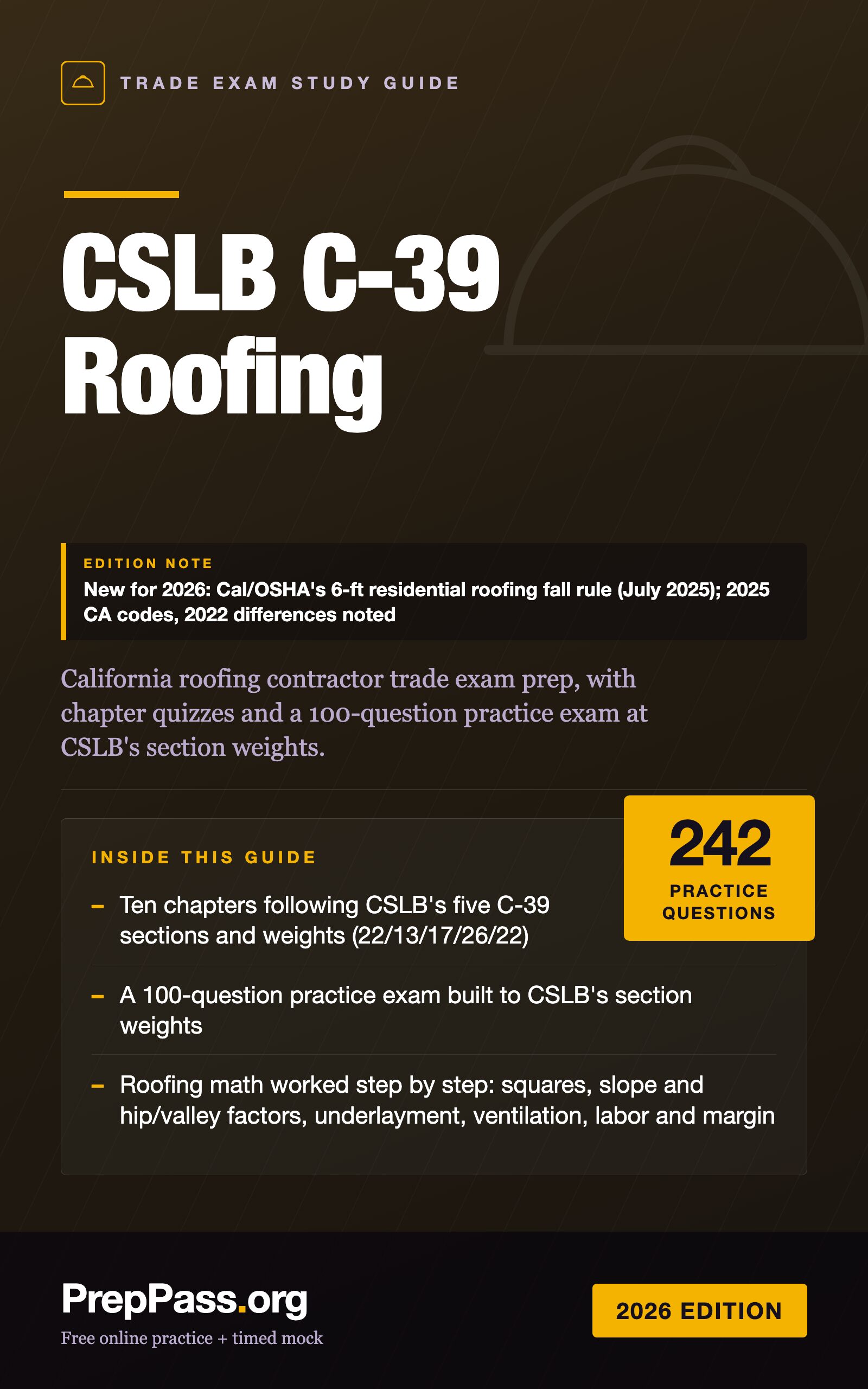
Practice stays free. The full CSLB C-39 Roofing study guide is the material itself, taught start to finish — a downloadable PDF + EPUB you keep.
| Administering body | Contractors State License Board (CSLB), California Department of Consumer Affairs — exam delivered by PSI Services LLC |
|---|---|
| Questions | Not published by CSLB What we read and found nothing in: CSLB — Step 7: Studying for the Examination |
| Time limit | 210 minutes |
| Passing score | Not published by CSLB What we read and found nothing in: CSLB — Step 7: Studying for the Examination |
| Fees |
Source: CSLB — List of All CSLB Fees |
| Languages offered | English · Spanish |
Frequently asked questions
How many CSLB Trade — Roofing (C-39) practice questions are here?+
A full bank of original CSLB Trade — Roofing (C-39) practice questions across the official content areas, weighted like the real exam, with explanations. Free, no signup.
What is the CSLB Trade — Roofing (C-39) exam like?+
A multiple-choice exam, 210 minutes. Practice by topic here, then take the full timed mock exam to gauge readiness.
Are these the real exam questions?+
No. Every question is 100% original, written from public primary sources with explanations. We never copy real exam questions or paid prep material.
Can I study in Chinese or Spanish?+
PrepPass practice is in English, 中文 and Español. The official exam is in English — switch the question language to English any time to rehearse the exact terminology you'll see on test day.
Is there a study guide for the CSLB Trade — Roofing (C-39)?+
Yes. PrepPass sells CSLB C-39 Roofing Trade Exam Study Guide (2026), a PDF + EPUB download, $24.99 one-time; the practice on this page stays free without it. See the study guide →
Sample practice questions
A few sample questions from this free bank, with full explanations. Use the practice tool above for the whole set.
- 1. Planning and Estimating
Which material is named in CSLB's definition of the C-39 Roofing classification?
- a.Structural steel
- b.Urethane foam
- c.Gypsum drywall
- d.Ceramic floor tile
Answer: b
Explanation: CSLB's C-39 definition lists roofing materials including urethane foam, metal roofing systems, shakes, shingles, tile and slate. Structural steel, drywall and floor tile belong to other classifications.
Source: Cal. Code Regs. tit. 16 §832.39 (C-39 classification)
- 2. Job Site Preparation
Asbestos-containing roofing is being removed next to rooftop air handlers. What must be done with the air intakes?
- a.Isolate them or shut the system down
- b.Nothing if the crew wears respirators
- c.Point a fan at them
- d.Tape a sign on each unit
Answer: a
Explanation: During removal of asbestos-containing roofing, roof-level heating and ventilation air intake sources must be isolated or the ventilation system shut down.
Source: Cal. Code Regs. tit. 8 §1529
- 3. Low-Slope Roof Projects
Which standard covers coal-tar pitch used in roofing?
- a.ASTM D312
- b.ASTM D41
- c.ASTM D450
- d.ASTM D6083
Answer: c
Explanation: Coal tar used in roofing is listed under ASTM D450, Type I or II. D312 is roofing asphalt, D41 asphalt primer and D6083 acrylic coating.
Source: 2025 CRC Table R905.9.2
- 4. Steep-Slope Roof Projects
Where must required attic ventilation openings open?
- a.Into the garage
- b.Directly outdoors
- c.Into the living space
- d.Into a wall cavity
Answer: b
Explanation: Required ventilation openings must open directly to the outside air and be protected against birds, rodents, snakes and similar creatures.
Source: 2025 CRC R806.1
- 5. Planning and Estimating
In the CBC, a Class A roof assembly is one that is effective against which level of fire-test exposure?
- a.Moderate exposure
- b.Severe exposure
- c.Exposure to windborne embers
- d.Light exposure
Answer: b
Explanation: The CBC describes Class A assemblies as effective against severe fire test exposure. Moderate exposure describes Class B, light exposure describes Class C, and the classes are not defined by embers alone.
Source: 2025 CBC 1505.2
- 6. Planning and Estimating
Felt rolls cover 2 squares net after laps. How many rolls does a 38-square roof need if it is built with four plies and no waste is added?
- a.76 rolls
- b.19 rolls
- c.38 rolls
- d.152 rolls
Answer: a
Explanation: Four plies on 38 squares is 152 squares of felt, and at 2 squares per roll that is 76 rolls. 19 rolls counts a single ply, 38 rolls counts only two plies, and 152 treats each roll as 1 square.
Source: Roofing math
- 7. Job Site Preparation
Intact asbestos-containing roofing has been removed and is waiting on the roof. By when must it be lowered to the ground?
- a.By the end of the work week in which it is removed
- b.Within seven days after the material is removed
- c.After the entire roof job is finished and cleaned
- d.As soon as practicable, and by the end of the shift
Answer: d
Explanation: Intact asbestos-containing material must be lowered as soon as practicable and in any event no later than the end of the work shift. Seven days, the end of the week or the end of the job all leave debris on the roof too long.
Source: Cal. Code Regs. tit. 8 §1529
- 8. Low-Slope Roof Projects
A membrane is to be adhered with chemical adhesive in cool weather. What does the DOE say about the membrane?
- a.It bonds best when it is cooled below ambient air
- b.It must reach and hold a minimum temperature
- c.It needs a primer coating before it is adhered
- d.It needs ballast stone over the wet adhesive
Answer: b
Explanation: Membranes attached with chemical adhesives must reach and maintain a minimum temperature to bond properly. Chilling it, adding ballast or pre-coating does not address that.
Source: DOE Guidelines for Selecting Cool Roofs
- 9. Steep-Slope Roof Projects
How far must joints in adjacent courses of wood shakes be offset from one another?
- a.At least 3/8 inch
- b.At least 6 inches
- c.At least 1-1/2 inches
- d.At least 3 inches
Answer: c
Explanation: Wood shakes are laid with a side lap of not less than 1-1/2 inches between joints in adjacent courses. 3/8 inch is part of the spacing range, and 3 and 6 inches exceed the code minimum.
Source: 2025 CRC R905.8.7
- 10. Safety
How must personal protective equipment be selected under the Construction Safety Orders?
- a.To fit each affected employee properly
- b.To be one standard size for the crew
- c.To match the contractor's colors
- d.To be the cheapest rated model
Answer: a
Explanation: PPE must be selected so that it properly fits each affected employee. A single size, lowest cost or color matching does not ensure protection.
Source: Cal. Code Regs. tit. 8 §1514(f)