CSLB C-39 Roofing · 2026 Edition
CSLB C-39 Roofing Trade Exam Study Guide (2026)
Edition noteNew for 2026: Cal/OSHA's 6-ft residential roofing fall rule (July 2025); 2025 CA codes, 2022 differences noted
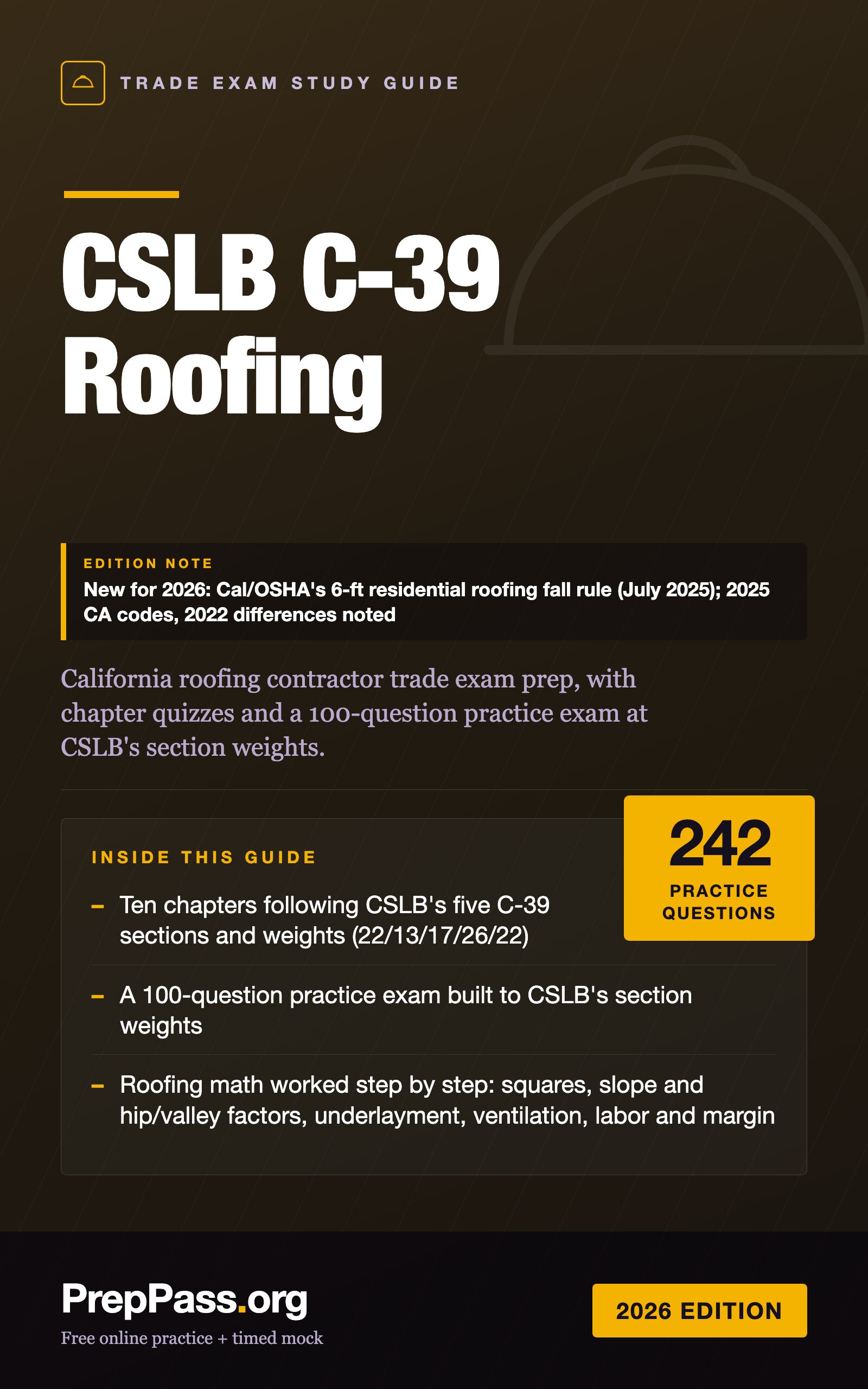
California roofing contractor trade exam prep, with chapter quizzes and a 100-question practice exam at CSLB's section weights.
- 242 original CSLB roofing trade-exam practice questions, each with a worked explanation, in one PDF + EPUB you keep
PDF + EPUB · English · 226 pages · $24.99 one-time
This book is written in English.
Instant download after payment — no account needed, no subscription.
14-day money-back guarantee: not satisfied for any reason? Email support@preppass.org within 14 days of purchase for a full refund. Refund policy
Read a free sample chapter first
Studying more than one? There's a bundle price
- CSLB Law & Business — Complete Study Guide (2026)$24.99
- CSLB C-39 Roofing Trade Exam Study Guide (2026)$24.99
- CSLB Law & Business — Cram Sheet (2026)$9.99
Buy all 3: $30.99 — save $28.98 vs buying separately
Separately $59.97 · 48% off · One checkout, all 3 items.
Already bought CSLB Law & Business? Don't buy the bundle — it includes that book and you'd pay for it twice. Get CSLB C-39 Roofing on its own for $24.99. CSLB C-39 Roofing · What's in the bundle →
Try 10 questions first — free
Answer all 10, then see every answer explained — with the section of this guide that teaches it. About 5 minutes, no sign-up.
Start 10 free questionsLook inside the book
Three real pages, rendered straight from the PDF you download — a reference page, a teaching page, and a worked question, always in that order. Nothing here was redrawn to look better.
- Quick referenceChapter 3; Section 3 (Low-Slope Roof Projects) is Chapters 4 and 5; Section 4 · PDF page 6
A page you can turn back to: the numbers, deadlines or terms gathered in one place.
- How it's taughtChapter 4 — Low-Slope Roofs: Flashing, Ventilation, Underlayment and Drainage · PDF page 70
An explanation page: the material taught in prose, in the order the exam tests it.
- A question, workedPart 6, the Energy Code, sets cool-roof and insulation requirements · PDF page 19
A practice question with its answer and the reasoning behind it — not just a key.
About the exam itself
| Administering body | Contractors State License Board (CSLB), California Department of Consumer Affairs — exam delivered by PSI Services LLC |
|---|---|
| Questions | Not published by CSLB What we read and found nothing in: CSLB — Step 7: Studying for the Examination |
| Time limit | 210 minutes |
| Passing score | Not published by CSLB What we read and found nothing in: CSLB — Step 7: Studying for the Examination |
| Fees |
Source: CSLB — List of All CSLB Fees |
| Languages offered | English · Spanish |
Questions buyers ask
- What has changed on the CSLB C-39 Roofing exam?
- New for 2026: Cal/OSHA's 6-ft residential roofing fall rule (July 2025); 2025 CA codes, 2022 differences noted.
- Is a study guide enough for the CSLB C-39 Roofing exam, or do I need a course?
- A book is exam review: it does not replace any education, training or experience Contractors State License Board (CSLB), California Department of Consumer Affairs requires before you may sit the exam, so check those requirements first. For the exam content itself, this 226-page guide teaches the material chapter by chapter with 242 practice questions and explanations inside, and 100 more practice questions are free on PrepPass. A prep course adds live instruction and a set schedule; whether you need one beyond any required education is your call.
- What is the cheapest way to prepare for the CSLB C-39 Roofing exam?
- Start with what costs nothing: 100 practice questions on PrepPass, with explanations and no signup. If you want it taught in one file you keep, the full study guide is $24.99 once. No subscription on any of them.
- Who administers the CSLB Roofing (C-39) Trade Examination?
- Contractors State License Board (CSLB), California Department of Consumer Affairs — exam delivered by PSI Services LLC. CSLB's legal existence is set by Business and Professions Code § 7000.5. CSLB states it has contracted with PSI to administer its examinations.
- How many questions are on the CSLB Roofing (C-39) Trade Examination?
- Not published by CSLB. CSLB says only that “All trade examinations consist of multiple-choice questions.” No count appears in the study guide, the Examinations FAQ, or PSI's candidate bulletin.
- How long is the CSLB Roofing (C-39) Trade Examination?
- 210 minutes. CSLB: “You will be given 3-1/2 hours to complete each examination.” It is per examination, not per sitting — a candidate taking Law and Business plus a trade exam gets 3-1/2 hours for each.
- What is the passing score for the CSLB Roofing (C-39) Trade Examination?
- Not published by CSLB. CSLB: “You will be informed at the test site about the percentage of correct answers needed to pass each examination,” and, in Get Licensed to Build Q14, that the percentage “varies for each exam”. Passing candidates are never shown their own score. PrepPass states no passing score for this exam.
- How much does the CSLB Roofing (C-39) Trade Examination cost?
- $450 — Original application (exam or waiver, one classification) (CSLB, one-time); $51.43 — Examination registration (each registration, first attempt or retake) (PSI Services LLC, per attempt); $200 — Initial license fee (sole owner) (CSLB, one-time); $350 — Initial license fee (non-sole owner: partnership, corporation, LLC, joint venture) (CSLB, one-time). Two payees: application and license fees go to CSLB, the per-exam registration fee to PSI. CSLB's 2023 “Get Licensed to Build” PDF still names a $100 rescheduling fee; it appears neither on CSLB's current fee list nor in Business and Professions Code § 7137 as amended effective 1 January 2026, so it is not stated here. The application fee is charged once per original license application and covers both required exams.
- What languages is the CSLB Roofing (C-39) Trade Examination offered in?
- English · Spanish. CSLB publishes Spanish versions of 10 exams and names this one among them. Candidates requesting a translator for those exams are required to take the Spanish version instead.
- Does the CSLB C-39 Roofing study guide come as a PDF?
- Yes — CSLB C-39 Roofing Trade Exam Study Guide (2026) downloads as PDF and EPUB, 226 pages. The download link is emailed the moment payment clears and does not expire.
- How much does the CSLB C-39 Roofing study guide cost?
- $24.99, once. There is no subscription and no account to create; the PDF and EPUB files are yours to keep.
- Are there free CSLB C-39 Roofing practice questions?
- Yes — 100 of them, free to use with no signup and an explanation on every one. They are separate from this study guide, which is what you are buying here.
- Can I read part of the CSLB C-39 Roofing study guide before buying?
- Yes. A full chapter is free to read on this page — not a summary of one, the chapter itself.
- Is there a cheaper way to buy the CSLB C-39 Roofing study guide with anything else?
- Yes. CSLB Law & Business + CSLB C-39 Roofing is $30.99 for 3 files in one checkout — 48% less than the $59.97 those items cost bought separately today. It adds CSLB Law & Business — Complete Study Guide (2026), CSLB Law & Business — Cram Sheet (2026). The saving is measured against the items' real current prices; there is no struck-through "original" price on this site.
- Is this the official CSLB C-39 Roofing study guide?
- No. This is an independent study guide and is not affiliated with or endorsed by the exam's awarding body. It is written from CSLB Roofing (C-39) study guide 13E-39 (03-2026), the 2025 California Residential and Building Codes and Cal. Code Regs. tit. 8, read September 2026. Always confirm current requirements with the body that issues your licence.
Free CSLB C-39 Roofing practice questions and study chapters →
What's included — and what isn't
Included
- Ten chapters following CSLB's five C-39 sections and weights (22/13/17/26/22)
- A 100-question practice exam built to CSLB's section weights
- Roofing math worked step by step: squares, slope and hip/valley factors, underlayment, ventilation, labor and margin
- Cal/OSHA fall protection as amended July 1, 2025, beside the commercial roofing rules
- Key-numbers appendix, math reference, glossary and a table of the pairs the exam confuses
- 242 original questions, each with a worked explanation citing its source
- PDF + EPUB you keep
Not included
- No printed copy is shipped — this is a file you download and can print yourself
- No video course, instructor or tutoring comes with the book — the free videos on the site are separate
- Not your exam registration or the testing centre's fee, which you still pay to the official body
Contents
See 22 sections and the page each one starts on
- Chapter 3; Section 3 (Low-Slope Roof Projects) is Chapters 4 and 5; Section 4p. 5
- Chapter 1 — Planning Roof Projectsp. 10
- Part 6, the Energy Code, sets cool-roof and insulation requirementsp. 12
- Chapter 2 — Estimating Roof Projectsp. 30
- Chapter 3 — Job Site Preparation for Roof Projectsp. 47
- Chapter 4 — Low-Slope Roofs: Flashing, Ventilation, Underlayment and Drainagep. 67
- Chapter 5 — Low-Slope Roof Systems and Repairsp. 82
- Chapter 6 — Steep-Slope Roofs: Flashing, Ventilation and Underlaymentp. 99
- Chapter 7 — Steep-Slope Systems I: Asphalt Shingles, Metal and Roll Roofingp. 114
- Chapter 8 — Steep-Slope Systems II: Tile, Slate and Wood; Steep-Slope Repairsp. 128
- Chapter 9 — Safety I: Personnel and Job Site Safetyp. 143
- Chapter 10 — Safety II: Fall Protectionp. 158
- Practice Exam — 100 Questionsp. 177
- Section 1 — Planning and Estimating (22 questions)p. 177
- Section 2 — Job Site Preparation for Roof Projects (13 questions)p. 184
- Section 3 — Low-Slope Roof Projects (17 questions)p. 188
- Section 4 — Steep-Slope Roof Projects (26 questions)p. 194
- Section 5 — Safety (22 questions)p. 202
- Appendix A — Key Numbersp. 209
- Appendix B — Roofing Math Quick Reference Area and squaresp. 213
- Appendix C — Glossaryp. 215
- Appendix D — Pairs the Examination Likes to Confusep. 219
Taken from the PDF you download, with the page each one starts on — not typed here.
Read a chapter free, in full
One complete chapter, exactly as it ships in the eBook. Scroll the window to read it right here; no download, no email.
Read chapter 10 here, without leaving the page
We didn't give you the easy intro — the free chapter opens on one of the hardest-working parts of the book, so you can judge the teaching where the exam gets difficult.
Falls are the defining hazard of the roofing trade, and California's fall protection rules for roofing are more detailed — and changed more recently — than any other part of this examination. The first question in every fall-protection problem is which rule applies: residential-type roofing (Section 1731) or other roofing (Section 1730). The second is the slope, and the third is the height. Get those three right and the answer follows.
10.1 Which rule applies
Section 1731 — residential-type roofing activities. Roofing work under 1731 "consists of roofing and re-roofing work, including roof removal performed on single-family homes, townhouses, duplexes and other structures covered by Section 1716.2"[1]. It also includes loading and installing roofing materials, related insulation, sheet metal integral to the roofing system and vapor barrier work — but not construction of the roof deck[1].
Section 1730 — roof hazards (other roofing). Section 1730 governs roofing operations generally and says expressly: "This section does not apply to residential-type roofing activities as defined in Section 1731."[2]
Both sit on top of the general program rules: roofing employers comply with the IIPP section and train employees per Section 1510[2].
10.2 Residential-type roofing (Section 1731) — the 2025 rule
Section 1731 was amended effective July 1, 2025[1, 3]. Its current text:
- Roof slopes 0:12 up to and including 7:12: employees must be protected from falling "when on a roof surface where the employee fall distance is 6 feet or more above the grade or level below"[1].
- Roof slopes greater than 7:12: employees must be protected "regardless of height"[1].
Methods (for both slope ranges): personal fall protection systems, scaffolding, safety nets or guardrails — or, only if the employer demonstrates that conventional methods are infeasible, a fall protection plan with safety monitors and controlled access zones under Sections 1671.1 and 1671.2[1].
Measuring height: the fall height is "the vertical distance from the employee's walking/working surface to the ground or level below," and "the height of parapets shall not be included"[1].
Training: in addition to the IIPP, each affected employee is trained in the specific fall hazards of roofing work, including work on or near gable ends, slipping hazards, roof holes and openings, skylights, ladders and scaffolds, roof access, placement of materials, impalement hazards, and the care and use of fall protection systems[1], with training documented per Section 3203[1].
What changed
The Standards Board's rulemaking notice describes the old rule: protection keyed to work at elevations above 15 feet[4], with an express exclusion for "custom-built homes, re-roofing operations, roofing replacements or additions on existing dwelling units"[4]. The amendment reduced the trigger to a fall distance of six feet or more[4] and brought re-roofing inside the rule.
Trap: using "15 feet" for residential roofing. That was the old rule. Since July 1, 2025, it is 6 feet for slopes through 7:12, and any height above 7:12.
Worked example — Residential decisions
| Situation | Rule | Protection required? |
|---|---|---|
| Reroof, single-story house, 5:12, fall distance 10 ft | 1731(c)(1) | Yes — 6 ft or more |
| Tear-off, townhouse, 3:12, fall distance 5 ft | 1731(c)(1) | Not by the 6-ft trigger |
| New roof, duplex, 8:12, fall distance 7 ft | 1731(c)(2) | Yes — regardless of height |
| House, 10:12 dormer roof, fall distance 4 ft | 1731(c)(2) | Yes — regardless of height |
| Parapet 30 in high, flat residential roof, fall distance 12 ft to ground | 1731(c)(1); parapet not counted in height | Yes |
10.3 Other roofing (Section 1730)
Section 1730 is organised by roof covering type and slope. "Single-unit (monolithic)" coverings are membranes such as built-up and single-ply; "multiple-unit" coverings are shingles, tile and the like.
Low-slope monolithic roofs, 0:12 to 4:12
Employees must be protected from falls from roofs more than 20 feet high by one or a combination of the section's methods[2] — and where felt-laying machines or other equipment pulled by an operator walking backwards are in use, regardless of height[2].
The section's default method is the warning line system:
- Rope, wire or similar lines flagged with highly visible material at about 6-foot intervals, 34 to 45 inches above the roof[2], with a minimum tensile strength of 500 pounds[2].
- Headers — sheets of roofing laid parallel to the edge — also, unless conditions prohibit[2].
- Warning lines and headers no closer than 5 feet from the roof edge[2].
- Where backwards-pulled equipment or ride-on equipment is used, headers no closer than 10 feet and warning lines no closer than 5 feet from edges perpendicular to the direction of travel[2].
- Access points, material handling areas and storage areas connected to the work area by a clear path formed by two warning lines[2].
- Employees instructed to stay inside the warning lines except for edge work[2]; application outside the lines closely supervised by a qualified person[2].
- A backwards-walking operator stays no closer than 3 feet to edges parallel to the direction of travel, and ride-on equipment is never used or stored between the warning line and the edge[2].
The warning-line rules do not apply when employees are protected instead by personal fall protection, catch platforms, scaffold platforms, eave barriers, standard railings and toeboards, or parapets at least 24 inches high (36 inches at edges facing moving equipment)[2].
Steep monolithic roofs, greater than 4:12
Roofs more than 20 feet high need parapets of 24 inches or more, personal fall protection, catch platforms, scaffold platforms, eave barriers, or standard railings and toeboards[2]. And equipment pulled by an operator walking backwards may not be used on roofs steeper than 4:12[2].
Multiple-unit coverings (shingles, tile)
- 0:12 through 5:12, more than 20 feet high: a roof jack system per Section 1724(a), a parapet at least 24 inches high, or equivalent protection[2].
- Greater than 5:12, more than 20 feet high: a 24-inch parapet, personal fall protection, catch platforms or scaffold platforms[2].
Trap: applying Section 1730's 20-foot trigger to a house. Section 1730 does not apply to residential-type roofing. On a single-family reroof, the 1731 rules (6 feet, or any height above 7:12) govern.
10.4 The roofing protection systems (Section 1724)
Section 1724 specifies the equipment that Sections 1730 and 1731 refer to:
- Roof jacks: spans between jacks not over 10 feet[5]; planks of at least 2 × 6 selected lumber[5]; rope supports of at least ¾-inch first-grade Manila[5].
- Crawling boards: at least 10 inches wide and 1 inch thick, with 1 × 1½-inch cleats spaced not more than 24 inches[5]; running ridge to eave where the building permits[5]; with a ¾-inch Manila handhold line beside each board[5]; secured by ridge hooks or other effective means[5].
- Catch platforms: close below the eaves, extending at least 2 feet horizontally beyond the eave projection, with standard railings and toeboards[5], fully planked[5].
- Eave barriers: anchored at eave level or tied back to substantial anchorages on the roof[5].
- Personal fall protection: installed per Article 24, with safety lines attached "in a secure manner to substantial anchorages on the roof"[5].
10.5 Personal fall arrest, restraint and positioning (Section 1670)
When personal fall protection is worn generally
Outside the roofing-specific sections, Section 1670 requires approved personal fall arrest, restraint or positioning systems for employees exposed to falling more than 7½ feet from the perimeter of a structure and from sloped roof surfaces steeper than 7:12 not otherwise protected[6].
Personal fall arrest system (PFAS) rules
- No body belts as part of a personal fall arrest system[6]; the harness attachment point is in the center of the back near shoulder level or above the head[6].
- Lanyards and vertical lifelines: minimum breaking strength 5,000 pounds[6]; one employee per vertical lifeline[6].
- Self-retracting lifelines that limit free fall to 2 feet or less: at least 3,000 pounds tensile[6].
- Horizontal lifelines: designed, installed and used under a qualified person, with a safety factor of at least two[6].
- Anchorages: capable of supporting 5,000 pounds per employee attached, or designed by a qualified person with a safety factor of two[6].
- Performance when a fall is arrested: maximum arresting force 1,800 pounds with a harness[6]; free fall not more than 6 feet, with no contact with a lower level[6]; deceleration distance not more than 3.5 feet[6].
- Rescue: the employer provides for prompt rescue, or ensures employees can rescue themselves[6].
- Inspection: before each use[6], and at least twice a year by a competent person, documented[6].
- Not to guardrails or hoists[6]; harnesses and lanyards are never used to hoist materials[6].
- After a fall: any component subjected to in-service loading is removed from service permanently[6].
Restraint and positioning
- Fall restraint keeps the worker from reaching the edge: rigged so the employee can move only as far as the sides of the working area[6], on anchorages capable of 4 times the intended load[6].
- Positioning devices limit free fall to 2 feet[6].
Worked example — Clearance under a lanyard
A roofer ties off with a 6-foot shock-absorbing lanyard to an anchor at foot level. Why is that a problem?
The rule is a free fall of not more than 6 feet with no contact with any lower level[6], and "where practicable, the anchor end of the lanyard shall be secured at a level not lower than the employee's waist"[6]. An anchor at foot level adds the distance from the harness D-ring down to the anchor to the free fall, pushing it past 6 feet, and then the deceleration distance (up to 3.5 feet) and the worker's own height are added below that. On a one-story roof, the worker can hit the ground before the system stops the fall. Use a higher anchor, a shorter lanyard, a self-retracting lifeline or fall restraint.
10.6 Nets, fall protection plans and controlled access zones
Safety nets
Where the elevation is 25 feet or more and personal fall arrest and more conventional protection are clearly impractical, safety nets are required at the perimeter[7].
Fall protection plan (Section 1671.1)
A fall protection plan is the last resort, not a choice:
- "There is a presumption that conventional fall protection is feasible and will not create a greater hazard."[8]
- The plan is prepared by a qualified person, specific to the site, and kept up to date[8]; a copy is kept at the job site[8]; implementation is supervised by a competent person[8].
- It documents why conventional systems — guardrails, personal fall arrest or safety nets — are infeasible or more hazardous[8].
- After a fall or a near miss, the employer investigates and changes the plan as needed[8].
Controlled access zones and safety monitors (Section 1671.2)
- Control lines are erected 6 to 25 feet from the unprotected edge[9], flagged at not more than 6-foot intervals[9], rigged so the lowest point is at least 39 inches and the highest not more than 45 inches above the working surface[9], with a minimum breaking strength of 200 pounds[9].
- The safety monitor is a competent person, within visual sighting distance of and in communication with the employees monitored[9], with no other responsibilities that could distract from monitoring[9].
Trap: the working foreman as safety monitor. A monitor who is also running the crew or laying shingles has other responsibilities; the rule forbids it.
Trap: warning lines versus control lines. Section 1730 warning lines: 34–45 inches high, 500-pound strength, at least 5 feet from the edge. Section 1671.2 control lines: 39–45 inches, 200-pound strength, 6 to 25 feet from the edge. The examination tests whether you keep them apart.
Sources cited in this excerpt
- Cal. Code Regs., tit. 8, sec. 1731: Residential-type Roofing Activities. California Department of Industrial Relations (Cal/OSHA), accessed 2026-09-24. https://www.dir.ca.gov/title8/1731.html
- Cal. Code Regs., tit. 8, sec. 1730: Roof Hazards. California Department of Industrial Relations (Cal/OSHA), accessed 2026-09-24. https://www.dir.ca.gov/title8/1730.html
- Fall Protection in Residential Construction — rulemaking status (Sections 1671.1, 1716.2, 1730 and 1731). Occupational Safety and Health Standards Board (DIR), accessed 2026-09-24. https://www.dir.ca.gov/OSHSB/Fall-Protection-in-Residential-Construction.html
- Notice of Proposed Rulemaking and Informative Digest: Fall Protection in Residential Construction. Occupational Safety and Health Standards Board (DIR), 2024-01-18 hearing. https://www.dir.ca.gov/oshsb/documents/noticeJan2024-Fall-Protection-in-Residential-Construction.pdf
- Cal. Code Regs., tit. 8, sec. 1724: Roofing--General. California Department of Industrial Relations (Cal/OSHA), accessed 2026-09-24. https://www.dir.ca.gov/title8/1724.html
- Cal. Code Regs., tit. 8, sec. 1670: Personal Fall Arrest Systems, Personal Fall Restraint Systems and Positioning Devices. California Department of Industrial Relations (Cal/OSHA), accessed 2026-09-24. https://www.dir.ca.gov/title8/1670.html
- Cal. Code Regs., tit. 8, sec. 1671: Safety Nets. California Department of Industrial Relations (Cal/OSHA), accessed 2026-09-24. https://www.dir.ca.gov/title8/1671.html
- Cal. Code Regs., tit. 8, sec. 1671.1: Fall Protection Plan. California Department of Industrial Relations (Cal/OSHA), accessed 2026-09-24. https://www.dir.ca.gov/title8/1671_1.html
- Cal. Code Regs., tit. 8, sec. 1671.2: Controlled Access Zones and Safety Monitoring Systems. California Department of Industrial Relations (Cal/OSHA), accessed 2026-09-24. https://www.dir.ca.gov/title8/1671_2.html
Before you buy
- How do I get it?
- Pay, and the download appears on this page straight away. The links are also emailed to you. No account is required.
- What if it isn't for me?
- Email us within 14 days for a full refund, no questions asked.
- Is the free practice going away?
- No. Every practice question, the timed mock and the free chapters on this site stay free. This book is the studying half, not a gate around the free half.
- Can I read it on my phone?
- Yes — the EPUB is for phones and e-readers, the PDF is for printing and tabbing. You get both.
The details
California roofing contractor trade exam prep, with chapter quizzes and a 100-question practice exam at CSLB's section weights.
- Format: PDF + EPUB download · 226 pages
- 242 practice questions in the book, with a full answer key
- 100 free practice questions for this exam on PrepPass, included at no cost
- $24.99 one-time — no subscription
- 14-day money-back guarantee · refund policy
- Cross-referenced against: CSLB Roofing (C-39) study guide 13E-39 (03-2026), the 2025 California Residential and Building Codes and Cal. Code Regs. tit. 8, read September 2026
- Verified from the official source(CSLB Roofing (C-39) study guide 13E-39 (03-2026), the 2025 California Residential and Building Codes and Cal. Code Regs. tit. 8, read September 2026)
- 100 free practice questions
- Instant download, yours for life
A CSLB exam prep course runs $200–$800. This book teaches the same exam — same rules, verified to current standards — for a one-time $24.99 you keep for life.
Why buy the book when the practice is free?
Our practice questions and timed mock stay free — nothing on the site moves behind this book. The $24.99 book is the studying half: the material itself, taught in order, in a file you own.
- Systematic teaching — every exam section explained chapter by chapter, start to finish, not just questions
- Print it & tab it — a paper-ready PDF you can highlight, mark up, and bring to your study table
- Study anywhere, offline — EPUB on your phone or e-reader; no wifi, no browser tabs
- Everything in one place — the chapters and the practice questions in one file
- Yours for life — one-time $24.99, instant download, no subscription
And it's risk-free: 14-day money-back guarantee — not satisfied? Email us for a full refund, no questions asked. See the refund policy.
14-day money-back guarantee · full refund, no questions asked.
One-time purchase, lifetime access to the download. The eBook is the full CSLB C-39 Roofing study guide in PDF and EPUB. Educational summary, not professional or legal advice — always confirm the current rules with the official source.