Planning and Estimating
CSLB weights Planning and Estimating at about 28% of the C-8 exam. It covers two things: planning a concrete job (documents, approvals, the mix and the day of the pour) and estimating it (volumes, forms, steel, trucks and labor). Some questions require arithmetic; a calculator is provided. For worked examples, traps and full explanations, see the PrepPass CSLB C-8 Concrete Study Guide.
Plans, specifications and approvals
The design strength of the concrete and the grade of the steel are usually in the General Notes of the plans. Referenced standard details are part of the contract. Before digging, the excavator marks the area in white and calls 811 at least two working days (not more than 14 calendar days) ahead; a ticket lasts 28 days. Cal/OSHA requires a permit for trenches or excavations 5 ft or deeper that workers enter, and state stormwater permit coverage applies when a project disturbs an acre or more.
Ordering and receiving concrete
Order to the specification: strength, slump, cement type and admixtures. Check every delivery ticket against the approved mix. Water may be added only within the mix design's water-cement ratio; re-tempering stiffened concrete is prohibited. On Caltrans work, loads without a retarder must be discharged within 250 drum revolutions or 90 minutes of batching (300 and 120 with a retarder), and concrete must be 50–90 °F at placement.
Estimating quantities
Convert every dimension to feet, multiply, and divide cubic feet by 27 for cubic yards. Footings are measured on the centerline (outside perimeter minus four footing widths for a rectangle). Piers use pi times radius squared. Bars across a width equal the number of spaces plus one. Orders round up to the supplier's increment after a waste allowance; trucks round up too.
Keep going: the full CSLB C-8 Concrete guide covers every section of the exam. CSLB C-8 Concrete Trade Exam Study Guide (2026) — PDF + EPUB, $24.99 · 14-day refund →
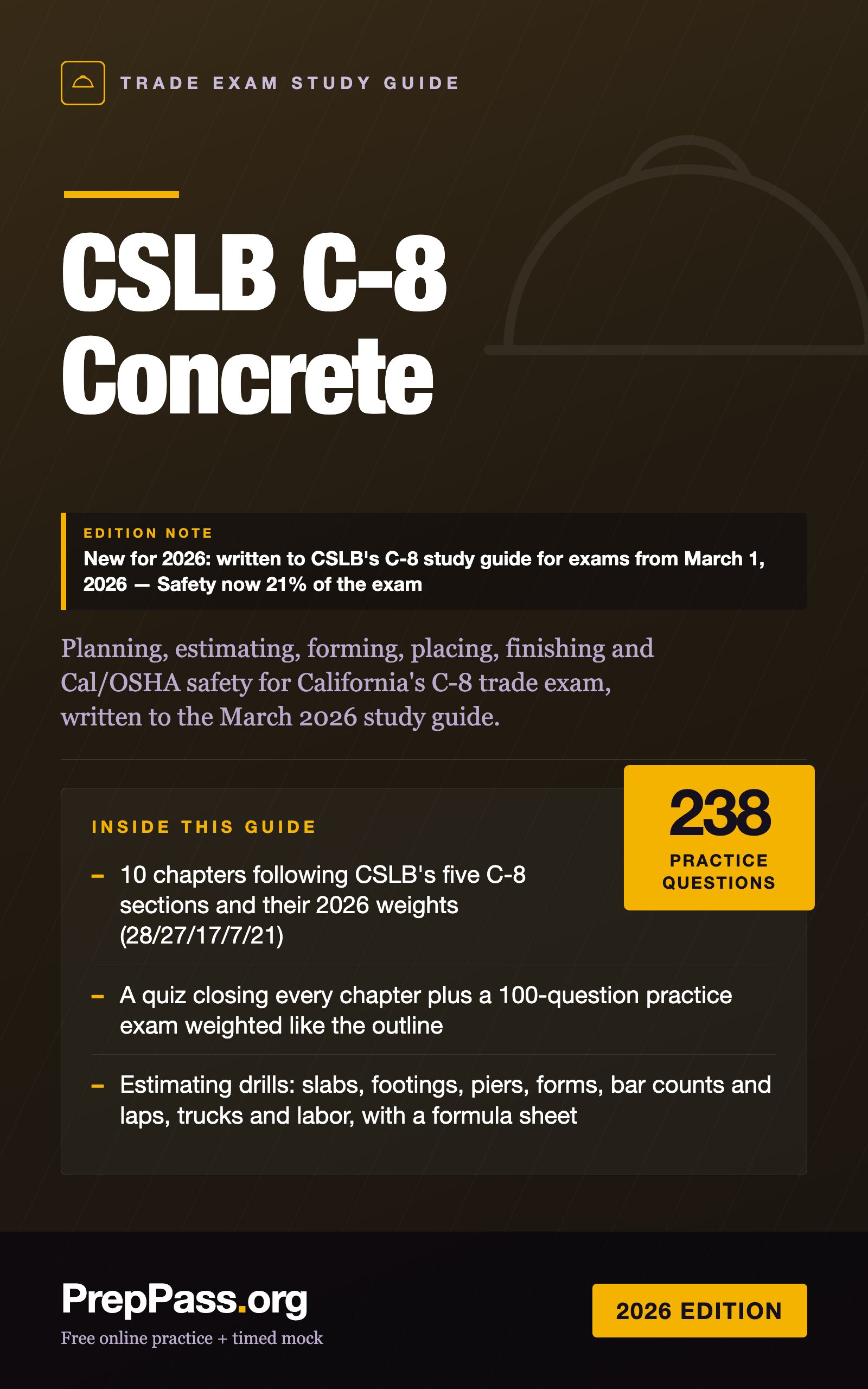
Practice stays free. The full CSLB C-8 Concrete study guide is the material itself, taught start to finish — a downloadable PDF + EPUB you keep.