CSLB C-8 Concrete (Trade Exam) Practice Test
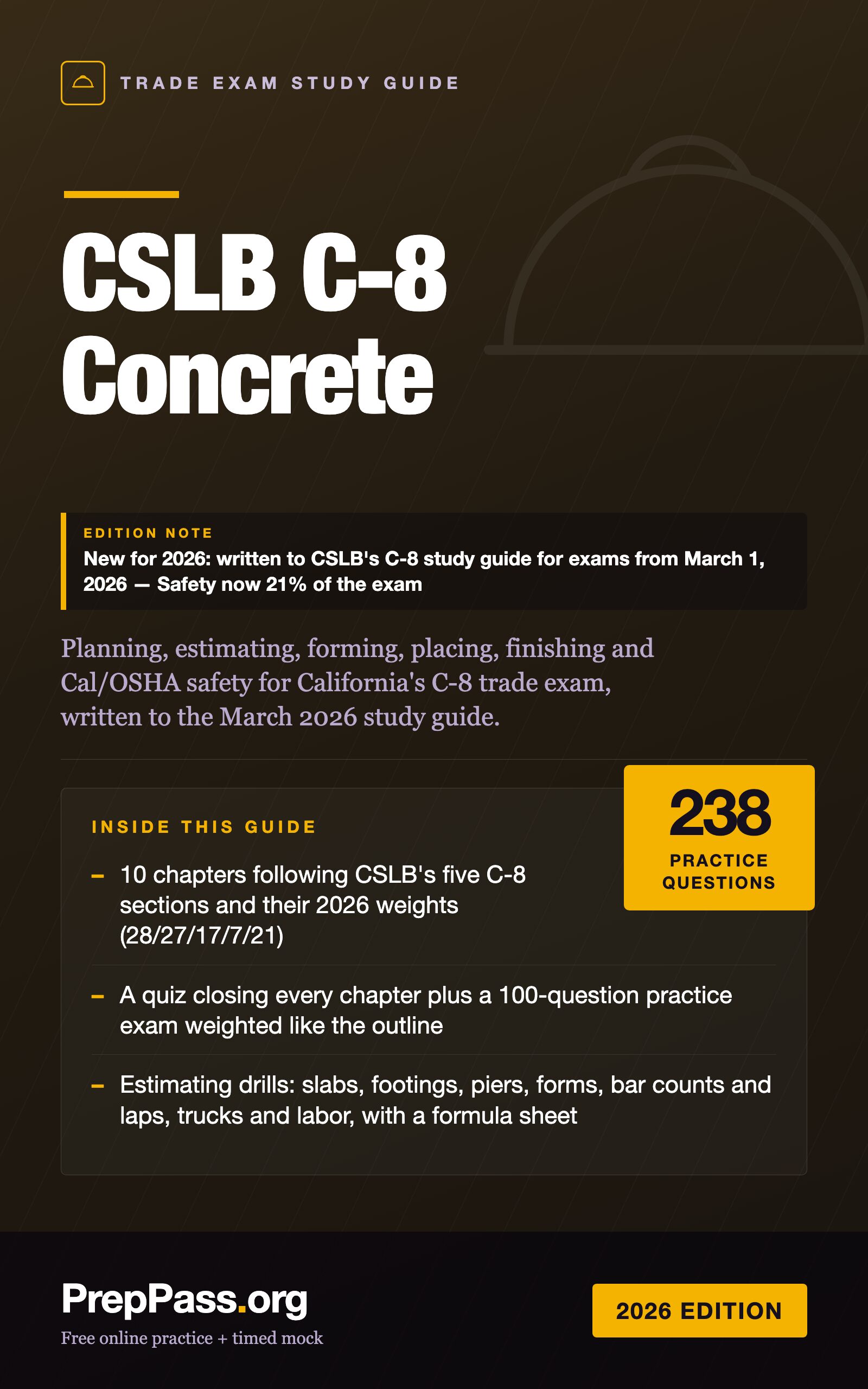
Practice stays free. The full CSLB C-8 Concrete study guide is the material itself, taught start to finish — a downloadable PDF + EPUB you keep.
| Administering body | Contractors State License Board (CSLB), California Department of Consumer Affairs — exam delivered by PSI Services LLC |
|---|---|
| Questions | Not published by CSLB What we read and found nothing in: CSLB — Step 7: Studying for the Examination |
| Time limit | 210 minutes |
| Passing score | Not published by CSLB What we read and found nothing in: CSLB — Step 7: Studying for the Examination |
| Fees |
Source: CSLB — List of All CSLB Fees |
| Languages offered | English · Spanish |
Frequently asked questions
How many CSLB Trade — Concrete (C-8) practice questions are here?+
A full bank of original CSLB Trade — Concrete (C-8) practice questions across the official content areas, weighted like the real exam, with explanations. Free, no signup.
What is the CSLB Trade — Concrete (C-8) exam like?+
A multiple-choice exam, 210 minutes. Practice by topic here, then take the full timed mock exam to gauge readiness.
Are these the real exam questions?+
No. Every question is 100% original, written from public primary sources with explanations. We never copy real exam questions or paid prep material.
Can I study in Chinese or Spanish?+
PrepPass practice is in English, 中文 and Español. The official exam is in English — switch the question language to English any time to rehearse the exact terminology you'll see on test day.
Is there a study guide for the CSLB Trade — Concrete (C-8)?+
Yes. PrepPass sells CSLB C-8 Concrete Trade Exam Study Guide (2026), a PDF + EPUB download, $24.99 one-time; the practice on this page stays free without it. See the study guide →
Sample practice questions
A few sample questions from this free bank, with full explanations. Use the practice tool above for the whole set.
- 1. Planning and Estimating
A shed slab is 16 ft by 20 ft and 4 in thick. How much concrete does it contain?
- a.About 3.5 cubic yards
- b.About 4.0 cubic yards
- c.About 47.4 cubic yards
- d.About 11.9 cubic yards
Answer: b
Explanation: 16 × 20 = 320 sq ft; 4 in = 0.333 ft; 320 × 0.333 = 106.7 cu ft; ÷ 27 = 4.0 cu yd. Dividing by 9 gives 11.9, and multiplying by 4 without converting inches gives 47.4.
Source: NIST Handbook 44 (2026), Appendix C
- 2. Planning and Estimating
An excavator's 811 ticket expires while trenching is still going on. What must happen?
- a.Keep going if marks are visible.
- b.Finish that day, then renew.
- c.Call the operator directly instead.
- d.Stop and get a new ticket.
Answer: d
Explanation: If a ticket expires while work is ongoing, the excavator must immediately cease excavation, contact the regional notification center and get a new ticket before resuming.
Source: Cal. Gov. Code §§4216–4216.9
- 3. Pre-placement Preparation
On a Caltrans job, the plans do not state the clear cover for a formed retaining wall. What cover does Caltrans describe as typical?
- a.2 inches minimum
- b.3/4 inch minimum
- c.No cover is needed
- d.6 inches minimum
Answer: a
Explanation: Caltrans states clear cover is typically 2 inches minimum unless specified otherwise, with more for cast-in-drilled-hole piles (3 in) and severe environments. Three-quarters of an inch is an interior-slab value in other specifications.
Source: Caltrans Reinforced Concrete Construction Manual (June 2025), ch. 4
- 4. Post-placement Tasks
Small surface holes appear on a wall cast against steel forms. What most likely caused them?
- a.Too much reinforcing steel
- b.Trapped air bubbles
- c.Late sawing of joints
- d.Excess curing compound
Answer: b
Explanation: Bug holes come from air bubbles trapped against forms, especially impervious forms such as steel or plastic liners; proper vibration or revibration helps prevent them.
Source: Caltrans Reinforced Concrete Construction Manual (June 2025), ch. 5
- 5. Planning and Estimating
Which document must accompany every load of ready-mixed concrete delivered to a Caltrans-type job?
- a.A weighmaster certificate, commonly called the concrete ticket
- b.A batch-plant inspection report signed by the project engineer
- c.The 811 ticket number for the delivery address
- d.A manufacturer's certificate of compliance for the cement alone
Answer: a
Explanation: The weighmaster certificate (concrete ticket) travels with each load, and its quantities are compared with the mix design. A certificate of compliance for one material does not replace it, and material that does not meet the contract can be rejected even with one. A plant inspection report is not the delivery document, and the 811 number belongs to excavation, not delivery.
Source: Caltrans Reinforced Concrete Construction Manual (June 2025), ch. 5
- 6. Planning and Estimating
A sidewalk is 4 ft wide and 4 in thick. About how many linear feet does one cubic yard of concrete cover?
- a.About 81 linear feet
- b.About 20 linear feet
- c.About 27 linear feet
- d.About 6.8 linear feet
Answer: b
Explanation: The cross-section is 4 ft × 0.333 ft = 1.33 sq ft, so 27 cu ft ÷ 1.33 sq ft = 20.25 linear feet. 81 is the square-foot coverage at 4 in, not a length for a 4-ft-wide walk, 6.8 divides 27 by the width and ignores the thickness, and 27 treats cubic feet as feet.
Source: NIST Handbook 44 (2026), Appendix C
- 7. Pre-placement Preparation
Below what oxygen percentage is an atmosphere in an excavation considered oxygen deficient?
- a.19.5 percent
- b.10 percent
- c.21 percent
- d.16 percent
Answer: a
Explanation: Title 8 treats atmospheres with less than 19.5 percent oxygen as deficient. 10 and 16 percent are far below the trigger and would let workers enter too late, while 21 percent is ordinary air.
Source: Cal. Code Regs. tit. 8, §1541
- 8. Pre-placement Preparation
Which reinforcement may not be lap spliced under Caltrans guidance?
- a.Small #3 and #4 bars in walls
- b.Any bars placed in a footing
- c.#14 and #18 bars, and all hoops
- d.Any bars larger than a #6 bar
Answer: c
Explanation: Lap splicing is not allowed for #14 and #18 bars or for any hoops. Small bars are routinely lapped, footing bars can be lapped, and bars above #6 (up to #11) are lapped by the diameter rules.
Source: Caltrans Reinforced Concrete Construction Manual (June 2025), ch. 4
- 9. Placing and Finishing
For specified textures, what does the referenced specification require the contractor to build?
- a.A photograph that the owner approves
- b.A mock-up only after a complaint
- c.A lab sample sent to the inspector
- d.A test panel for each type of texture
Answer: d
Explanation: The specification requires test panels for each type of specified texture so the finish can be approved before the work proceeds. Lab samples, complaint-driven mock-ups, and photographs do not show the actual finish.
Source: Caltrans Reinforced Concrete Construction Manual (June 2025), ch. 5
- 10. Safety
A worker wants to wash cement off his hands in a bucket used to clean tools. What does the guidance say?
- a.Fine, as long as the bucket water is kept warm
- b.Fine, if the bucket is refilled with water every hour
- c.No; rinse with clean water only
- d.Fine, because any water at all will dilute the cement
Answer: c
Explanation: Hands should not be washed in water from buckets used for cleaning tools, since that water carries cement. Dilution, warm water, and an hourly refill do not make it clean.
Source: CPWR/eLCOSH, Cement Hazards and Controls