CSLB C-8 Concrete (Trade Exam) Practice Test
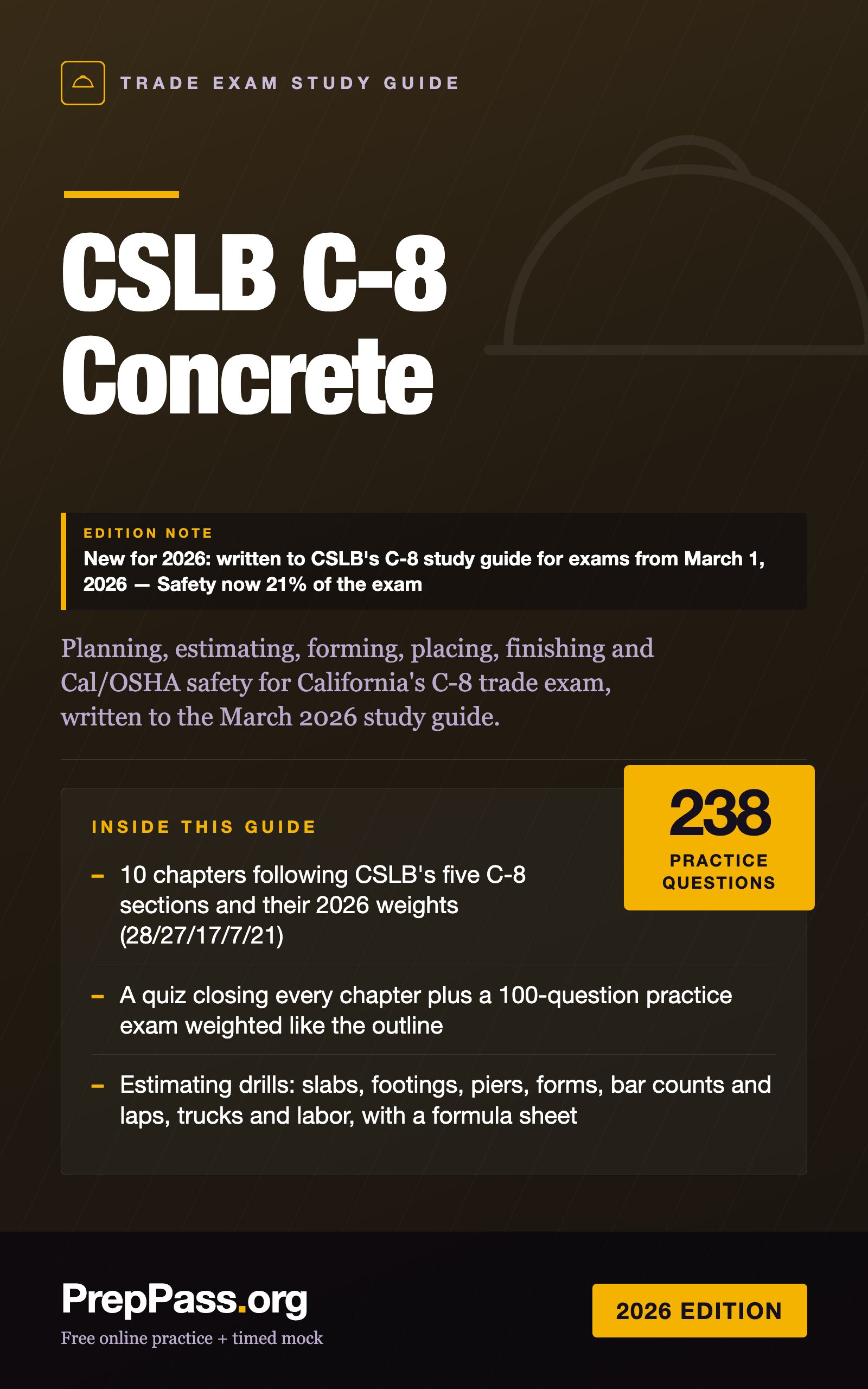
Practice stays free. The full CSLB C-8 Concrete study guide is the material itself, taught start to finish — a downloadable PDF + EPUB you keep.
| Administering body | Contractors State License Board (CSLB), California Department of Consumer Affairs — exam delivered by PSI Services LLC |
|---|---|
| Questions | Not published by CSLB What we read and found nothing in: CSLB — Step 7: Studying for the Examination |
| Time limit | 210 minutes |
| Passing score | Not published by CSLB What we read and found nothing in: CSLB — Step 7: Studying for the Examination |
| Fees |
Source: CSLB — List of All CSLB Fees |
| Languages offered | English · Spanish |
Frequently asked questions
How many CSLB Trade — Concrete (C-8) practice questions are here?+
A full bank of original CSLB Trade — Concrete (C-8) practice questions across the official content areas, weighted like the real exam, with explanations. Free, no signup.
What is the CSLB Trade — Concrete (C-8) exam like?+
A multiple-choice exam, 210 minutes. Practice by topic here, then take the full timed mock exam to gauge readiness.
Are these the real exam questions?+
No. Every question is 100% original, written from public primary sources with explanations. We never copy real exam questions or paid prep material.
Can I study in Chinese or Spanish?+
PrepPass practice is in English, 中文 and Español. The official exam is in English — switch the question language to English any time to rehearse the exact terminology you'll see on test day.
Is there a study guide for the CSLB Trade — Concrete (C-8)?+
Yes. PrepPass sells CSLB C-8 Concrete Trade Exam Study Guide (2026), a PDF + EPUB download, $24.99 one-time; the practice on this page stays free without it. See the study guide →
Sample practice questions
A few real questions from this free bank, with full explanations. Use the practice tool above for the whole set.
- 1. Planning and Estimating
A shed slab is 16 ft by 20 ft and 4 in thick. How much concrete does it contain?
- a.About 3.5 cubic yards
- b.About 4.0 cubic yards
- c.About 47.4 cubic yards
- d.About 11.9 cubic yards
Answer: b
Explanation: 16 × 20 = 320 sq ft; 4 in = 0.333 ft; 320 × 0.333 = 106.7 cu ft; ÷ 27 = 4.0 cu yd. Dividing by 9 gives 11.9, and multiplying by 4 without converting inches gives 47.4.
Source: NIST Handbook 44 (2026), Appendix C
- 2. Planning and Estimating
A 23-cubic-yard pour will come in trucks carrying 10 cubic yards each. How many loads must be ordered?
- a.4
- b.2
- c.1
- d.3
Answer: d
Explanation: 23 ÷ 10 = 2.3, and a partial load is still a truck, so 3 loads. Two loads bring only 20 cu yd.
Source: NIST Handbook 44 (2026), Appendix C
- 3. Planning and Estimating
Why might a pump be chosen over a crane and bucket under a low roof or canopy?
- a.Pumps allow water to be added.
- b.Pumps need less overhead clearance.
- c.Pumps place concrete more slowly.
- d.Pumps need no setup inspection.
Answer: b
Explanation: Caltrans notes that pumps normally require less headroom than a crane and bucket. Pumps also place faster, and they still require inspection and follow the water limits.
Source: Caltrans Reinforced Concrete Construction Manual (June 2025), ch. 5
- 4. Pre-placement Preparation
A dry, semi-porous subgrade will receive a footing. What does the federal guide specification say to do?
- a.Flood it to 2 inches deep.
- b.Cover it with dry cement.
- c.Leave it dry for better bond.
- d.Sprinkle it to eliminate suction.
Answer: d
Explanation: The specification says to sprinkle a semi-porous, dry subgrade to eliminate suction when concrete is deposited, or seal it with the specified vapor retarder. Flooding leaves standing water, which must be removed.
Source: UFGS 03 30 00 Cast-in-Place Concrete (Chg 10, Aug 2025)
- 5. Pre-placement Preparation
A rectangular form layout measures 36 ft and 40 ft on its two diagonals. What does that tell you?
- a.Only the sides are wrong.
- b.The slab is 38 ft long.
- c.The layout is square.
- d.The layout is not square.
Answer: d
Explanation: A true rectangle has equal diagonals; unequal diagonals mean the layout is a parallelogram and a corner is out of square.
Source: Field layout practice (rectangle geometry)
- 6. Pre-placement Preparation
On a Caltrans job, the plans do not state the clear cover for a formed retaining wall. What cover does Caltrans describe as typical?
- a.2 inches minimum
- b.3/4 inch minimum
- c.No cover is needed
- d.6 inches minimum
Answer: a
Explanation: Caltrans states clear cover is typically 2 inches minimum unless specified otherwise, with more for cast-in-drilled-hole piles (3 in) and severe environments. Three-quarters of an inch is an interior-slab value in other specifications.
Source: Caltrans Reinforced Concrete Construction Manual (June 2025), ch. 4
- 7. Placing and Finishing
Concrete is placed around epoxy-coated reinforcement. What kind of vibrator head is required?
- a.A rubber- or plastic-coated one
- b.A bare steel head only
- c.No vibrator may be used
- d.An oversized steel head
Answer: a
Explanation: Where epoxy-coated rebar is used, vibrators must be coated with plastic or hard rubber to avoid damaging the coating.
Source: Caltrans Reinforced Concrete Construction Manual (June 2025), ch. 5
- 8. Placing and Finishing
Which ASTM standard does the federal guide specification cite for sampling freshly mixed concrete?
- a.ASTM C143
- b.ASTM C172
- c.ASTM C1074
- d.ASTM C39
Answer: b
Explanation: The specification collects samples of fresh concrete per ASTM C172. C39 is the compression test of cylinders, C143 the slump test, and C1074 the maturity method.
Source: UFGS 03 30 00 Cast-in-Place Concrete (Chg 10, Aug 2025)
- 9. Safety
What must a construction employer's first-aid kit be kept in?
- a.A locked office cabinet
- b.The foreman's truck only
- c.A weatherproof container
- d.Any cardboard box
Answer: c
Explanation: Title 8 §1512 requires at least one first-aid kit in a weatherproof container, regularly inspected and restocked.
Source: Cal. Code Regs. tit. 8, §1512
- 10. Safety
Where must the mid-rail of a standard guardrail be?
- a.Anywhere below 30 inches
- b.Halfway between top rail and floor
- c.At the same height as the top rail
- d.Six inches above the floor
Answer: b
Explanation: Title 8 §1620 places the mid-rail halfway between the top rail and the floor, platform, runway or ramp.
Source: Cal. Code Regs. tit. 8, §1620