Free practice + study guide

NHA EKG Technician (CET)

NHA Certified EKG Technician (CET) Exam — 120 questions (100 scored, 20 unscored pretest) · 120 minutes · Passing score: Scaled score of 390 on a 200–500 scale. PrepPass also publishes a complete study guide for this exam as a downloadable book (56 pages, 55 practice questions inside, $14.99).

Exam inside two weeks?

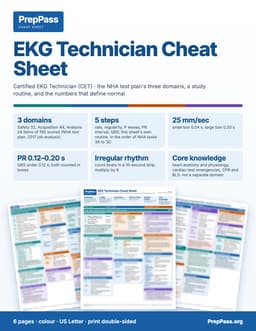
A printable colour cheat sheet for the exam: the format, the content areas and the figures it turns on, each checked against a named source and dated.

EKG Technician cheat sheet PDF — $9.99 →

6 pages · US Letter · printable PDF · yours to keep

01

Test what you know · free, all of it

Five ways to practise.

The same 300 questions, dealt five ways. Pick the one that fits the time you have.

02

Learn what the questions test

Practice finds the gaps. Reading closes them. The four chapters below are free to read online. The study guide book is a separate download, sold on its own page.

Practice · free
300
questions, each explained — finds what you don't know yet
Learn · the guide
56
pages in the study guide book, section by section

The four sections, as chapters

free to read online
  1. 1Rhythm Identification and InterpretationRhythm Interpretation · 35% of the exam — the largest sectionRead free →
  2. 2EKG Acquisition, Lead Placement, and TroubleshootingEKG Acquisition · 28%Read free →
  3. 3Safety, Communication, and Professional ResponsibilitiesSafety & Professionalism · 19%Read free →
  4. 4Cardiac Anatomy, Physiology, and Common ConditionsAnatomy & Physiology · 18%Read free →
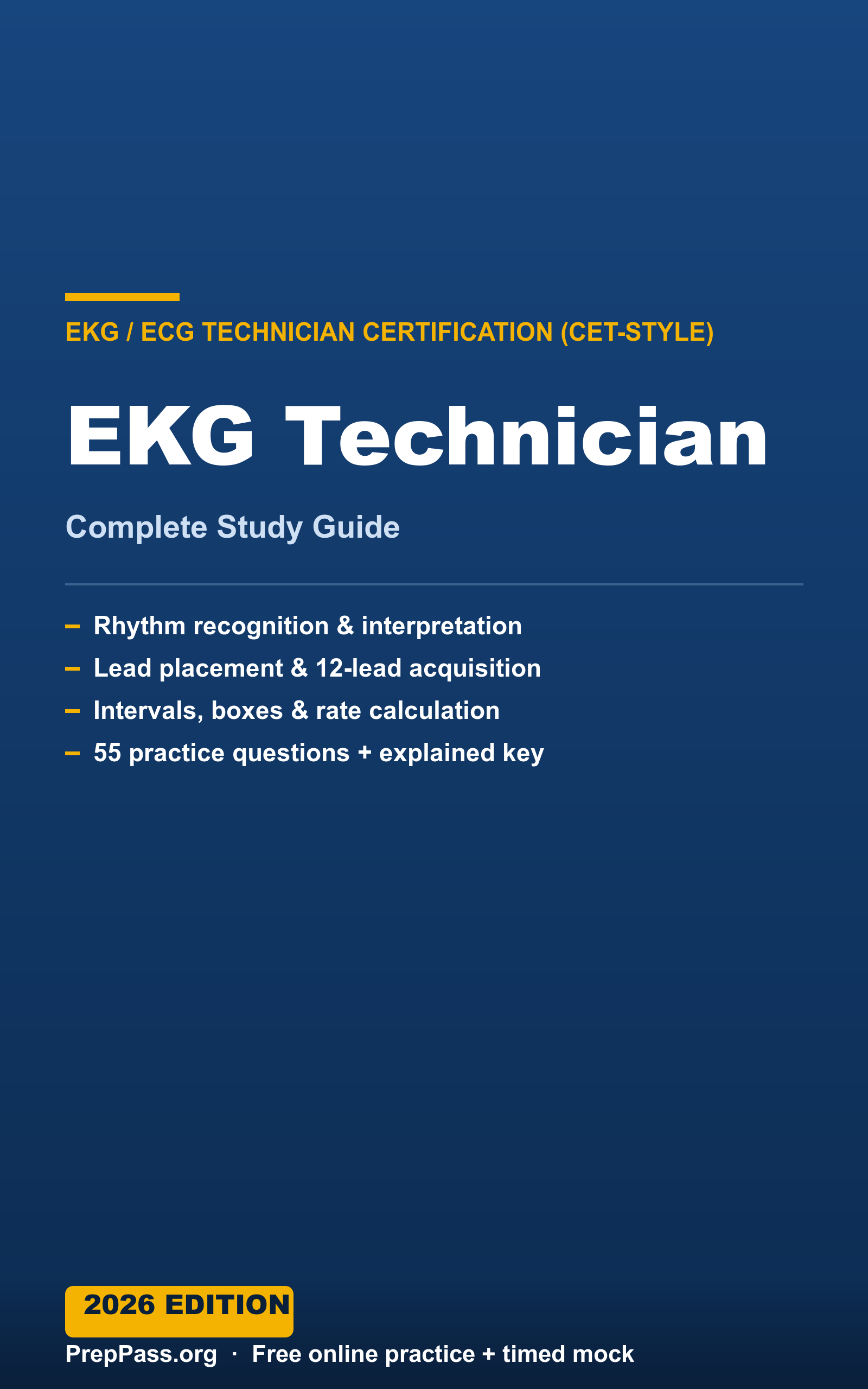
Cover: EKG Technician — Complete Study Guide (2026)
Study guide · PDF + EPUB
EKG Technician — Complete Study Guide (2026)
56 pages · 55 practice questions inside · updated 2026-10-23
$14.99 one-time · yours to keep
03

Before you sit

Know the exam you're walking into.

04

See the questions first

Two from the bank, answered.

Real items, with the answer marked and the reason written out — the same format as all 300.

Rhythm Interpretation

A technician measures the distance from the beginning of the P wave to the beginning of the QRS complex on a strip and counts four small boxes. What is the PR interval, and is it normal?

  1. A0.04 second, which is shorter than normal
  2. B0.16 second, which is normalCorrect
  3. C0.08 second, which is normal
  4. D0.40 second, which is longer than normal

Why: Each small box equals 0.04 second at the standard paper speed of 25 mm/sec, so four small boxes equal 0.16 second. The normal PR interval is 0.12 to 0.20 second, so 0.16 second falls in range. The 0.04 and 0.08 answers miscount the boxes, and 0.40 second would require ten small boxes and would indicate a first-degree AV block.

EKG Acquisition

Where is the V1 electrode placed for a 12-lead EKG?

  1. AFifth intercostal space, right sternal border
  2. BFourth intercostal space, right sternal borderCorrect
  3. CFifth intercostal space, left midclavicular line
  4. DFourth intercostal space, left sternal border

Why: V1 sits in the fourth intercostal space at the right sternal border, and it is located by walking down from the sternal angle to the second rib, then counting the second, third, and fourth spaces. The fourth space at the left sternal border is V2. The fifth space at the left midclavicular line is V4, and there is no standard chest lead at the fifth space on the right sternal border.

Read all 300 questions with answers →

06

The exam itself

NHA EKG Technician (CET), by the numbers.

Questions120 questions (100 scored, 20 unscored pretest)100 scored items plus 20 unscored pretest items, per NHA's test plan.
Time120 minutes
SectionsRhythm Interpretation · EKG Acquisition · Safety & Professionalism · Anatomy & Physiology
Passing scoreScaled score of 390 on a 200–500 scaleThis is a scaled score, not a percentage. NHA weights items by difficulty and does not publish the raw-to-scaled conversion, so it cannot be restated as a percentage or as a number of correct answers. Score reports additionally rate each content area as above, near or below the passing standard.
Our bank300 questions · updated August 2026Written from National Healthcareer Association (NHA)
LanguagesEnglish
SourceNational Healthcareer Association (NHA)Verified 2026-09-24

Full facts and sources →

07

Helpful resources

The board's own page, and what else helps.

Register — NHA (official) →

Recommended prep — books & tools

  • Rapid Interpretation of EKG's (Dubin)

    The classic, beginner-friendly guide to reading EKGs.

    See it on Amazon →

This section contains affiliate links. As an Amazon Associate, PrepPass earns from qualifying purchases. We may earn a commission if you buy through these links, at no extra cost to you.

08

Allied Health Certification Exams

On the same path.

09

Questions

Asked before starting.

Is the practice really free, or does it stop after a few questions?

All 300 questions, the timed mock and the report are free with no sign-up. A free account only adds saving your progress. The study guide book is sold separately, $14.99 one-time; nothing in the practice requires it.

Is your mock the same as the real NHA EKG Technician (CET)?

No. Ours is 100 questions in 90 minutes; the real exam is 120 questions in 120 minutes. Use the mock for stamina and section timing, not as a score predictor.

What score do I need?

Scaled score of 390 on a 200–500 scale — as published by National Healthcareer Association (NHA). Confirm the current rule with them before your exam date.

Is there a study guide for the NHA EKG Technician (CET)?

Yes. PrepPass sells EKG Technician — Complete Study Guide (2026), a PDF + EPUB download, $14.99 one-time; the practice on this page stays free without it. See the study guide →

Practice questions are AI-assisted study material written from National Healthcareer Association (NHA) and reviewed by PrepPass — for practice only, not official exam questions. Bank updated August 2026. PrepPass is an independent study resource and is not affiliated with, endorsed by, or approved by National Healthcareer Association (NHA). Always confirm current exam details with National Healthcareer Association (NHA).
Report