MPRE — Multistate Professional Responsibility Exam Practice Test
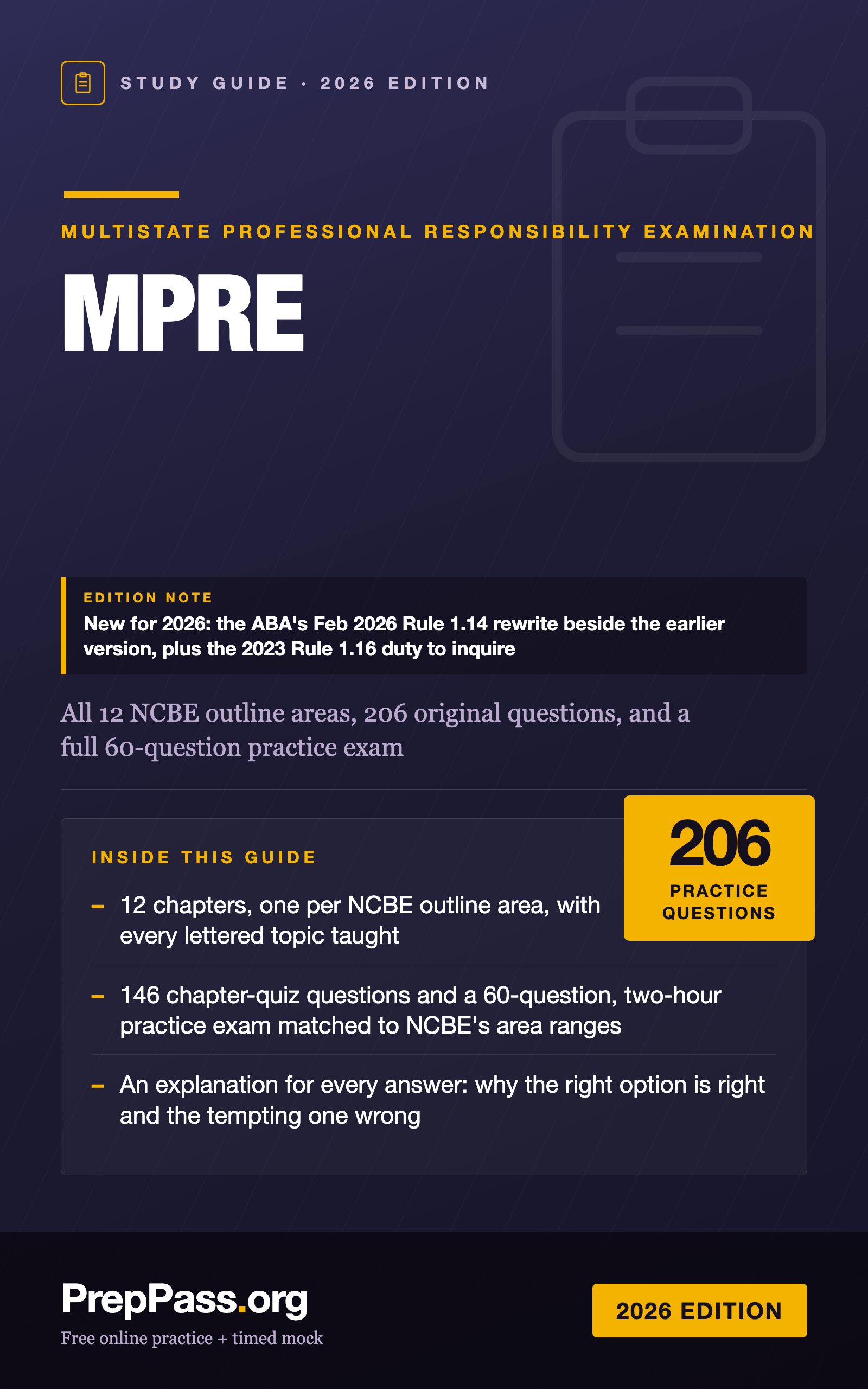
Practice stays free. The full MPRE — Multistate Professional Responsibility Examination study guide is the material itself, taught start to finish — a downloadable PDF + EPUB you keep.
Frequently asked questions
How many MPRE — Multistate Professional Responsibility Exam practice questions are here?+
A full bank of original MPRE — Multistate Professional Responsibility Exam practice questions across the official content areas, weighted like the real exam, with explanations. Free, no signup.
What is the MPRE — Multistate Professional Responsibility Exam exam like?+
About 60 questions, 120 minutes. Practice by topic here, then take the full timed mock exam to gauge readiness.
Are these the real exam questions?+
No. Every question is 100% original, written from public primary sources with explanations. We never copy real exam questions or paid prep material.
Can I study in Chinese or Spanish?+
PrepPass practice is in English, 中文 and Español. The official exam is in English — switch the question language to English any time to rehearse the exact terminology you'll see on test day.
Is there a study guide for the MPRE — Multistate Professional Responsibility Exam?+
Yes. PrepPass sells MPRE Study Guide — 2026 Edition, a PDF + EPUB download, $24.99 one-time; the practice on this page stays free without it. See the study guide →
Sample practice questions
A few real questions from this free bank, with full explanations. Use the practice tool above for the whole set.
- 1. Conflicts of Interest
A lawyer wants to represent a new client in a matter directly adverse to an existing client in an unrelated matter. Under Model Rule 1.7, the lawyer may proceed only if, among other requirements:
- a.The lawyer discloses the conflict to the court only
- b.The lawyer charges both clients a reduced fee
- c.At least one client consents orally
- d.Each affected client gives informed consent, confirmed in writing
Answer: d
Explanation: Rule 1.7(b) permits representation despite a concurrent conflict only if the lawyer reasonably believes the representation will be competent and diligent, it is not prohibited by law, it does not involve one client's claim against another in the same litigation, and "each affected client gives informed consent, confirmed in writing." Oral consent from one client is insufficient.
- 2. Client Confidentiality
Under Model Rule 1.6(b), a lawyer is permitted to reveal client information to the extent reasonably necessary to:
- a.Satisfy the curiosity of a third party
- b.Prevent reasonably certain death
- c.Win any case for the client
- d.Advance the lawyer's business interests
Answer: b
Explanation: Rule 1.6(b)(1) permits disclosure "to prevent reasonably certain death or substantial bodily harm." None of the other purposes is an exception to confidentiality.
- 3. Conflicts of Interest
A lawyer represents a driver in a traffic case and is asked to cross-examine that driver, as an adverse witness, in an unrelated civil trial for another client. What is the best description of the situation?
- a.A likely concurrent conflict that Rule 1.7 governs.
- b.A conflict that only the court can resolve.
- c.A former-client conflict under Rule 1.9.
- d.No conflict, because the matters are unrelated.
Answer: a
Explanation: Rule 1.7(a) defines a concurrent conflict to include direct adversity to a current client and a significant risk of material limitation. The comment notes that loyalty forbids acting as an advocate against a current client "even when the matters are wholly unrelated." The driver is a current client, so Rule 1.9 does not apply.
- 4. Conflicts of Interest
An employer pays for a lawyer to defend its employee in a lawsuit. Which condition is required by Rule 1.8(f)?
- a.The lawyer must represent the employer too.
- b.The employer must receive copies of all client communications.
- c.The employer must approve all settlement decisions.
- d.The employee must give informed consent to the arrangement.
Answer: d
Explanation: Rule 1.8(f) permits compensation from a third party only if "the client gives informed consent," there is "no interference with the lawyer's independence of professional judgment," and client information is protected under Rule 1.6. The payer gets no control or access by paying.
- 5. The Client-Lawyer Relationship
A client asks a lawyer to explain the tax consequences of two settlement options so she can choose between them. What does Rule 1.4(b) require?
- a.Recommending one option and nothing more.
- b.Providing a written opinion signed by two lawyers.
- c.Enough explanation for an informed choice.
- d.Referring the client to an accountant.
Answer: c
Explanation: Rule 1.4(b) states that "a lawyer shall explain a matter to the extent reasonably necessary to permit the client to make informed decisions regarding the representation."
- 6. Litigation & Advocacy
A lawyer's partner is likely to be a necessary witness at trial, and the testimony will not conflict with the client's interests. May the lawyer try the case?
- a.Yes, absent a conflict of interest.
- b.No, because the whole firm is disqualified.
- c.No, unless the partner's testimony is uncontested.
- d.Yes, but only if the client consents in writing.
Answer: a
Explanation: Rule 3.7(b) provides that "a lawyer may act as advocate in a trial in which another lawyer in the lawyer's firm is likely to be called as a witness unless precluded from doing so by Rule 1.7 or Rule 1.9."
- 7. Client Confidentiality
Which body of law protects client information that a lawyer learns from a public court file?
- a.The ethical duty of confidentiality.
- b.None, because public information is unprotected.
- c.The attorney-client privilege.
- d.The work-product doctrine.
Answer: a
Explanation: The comment to Rule 1.6 explains that the confidentiality rule "applies not only to matters communicated in confidence by the client but also to all information relating to the representation, whatever its source." The privilege covers only confidential communications.
- 8. Competence & Malpractice
A lawyer has handled several unrelated matters for a client over many years. After finishing the last one, she wants to make clear she is no longer representing the client. What does the comment to Rule 1.3 recommend?
- a.Sending the client's file to the state bar.
- b.Refunding all fees from the last matter.
- c.Clarify its status, preferably in writing.
- d.Nothing, because the relationship ends automatically.
Answer: c
Explanation: The comment to Rule 1.3 notes that a long-time client "sometimes may assume that the lawyer will continue to serve," and "doubt about whether a client-lawyer relationship still exists should be clarified by the lawyer, preferably in writing."
- 9. Communications About Legal Services
Which communication is NOT a "solicitation" under Rule 7.3(a)?
- a.A letter to a specific person known to need a lawyer for a pending foreclosure.
- b.A call to a specific accident victim offering representation.
- c.A website describing the lawyer's services to the public.
- d.A text to a specific person known to be facing a lawsuit.
Answer: c
Explanation: Rule 7.3(a) defines solicitation as a communication "directed to a specific person the lawyer knows or reasonably should know needs legal services in a particular matter." The comment says a communication "directed to the general public, such as through … a website" is not solicitation.
- 10. Safekeeping Property
A lawyer serves only as an escrow agent in a real-estate sale and gives no legal advice to anyone. Which law governs his handling of the escrow funds?
- a.The law of fiduciaries, not Rule 1.15.
- b.No law, because no legal services were given.
- c.Rule 1.15 only.
- d.Rule 1.8, business transactions with clients.
Answer: a
Explanation: The comment to Rule 1.15 says "a lawyer who serves only as an escrow agent is governed by the applicable law relating to fiduciaries even though the lawyer does not render legal services in the transaction and is not governed by this Rule."