MPRE — Multistate Professional Responsibility Exam Practice Test
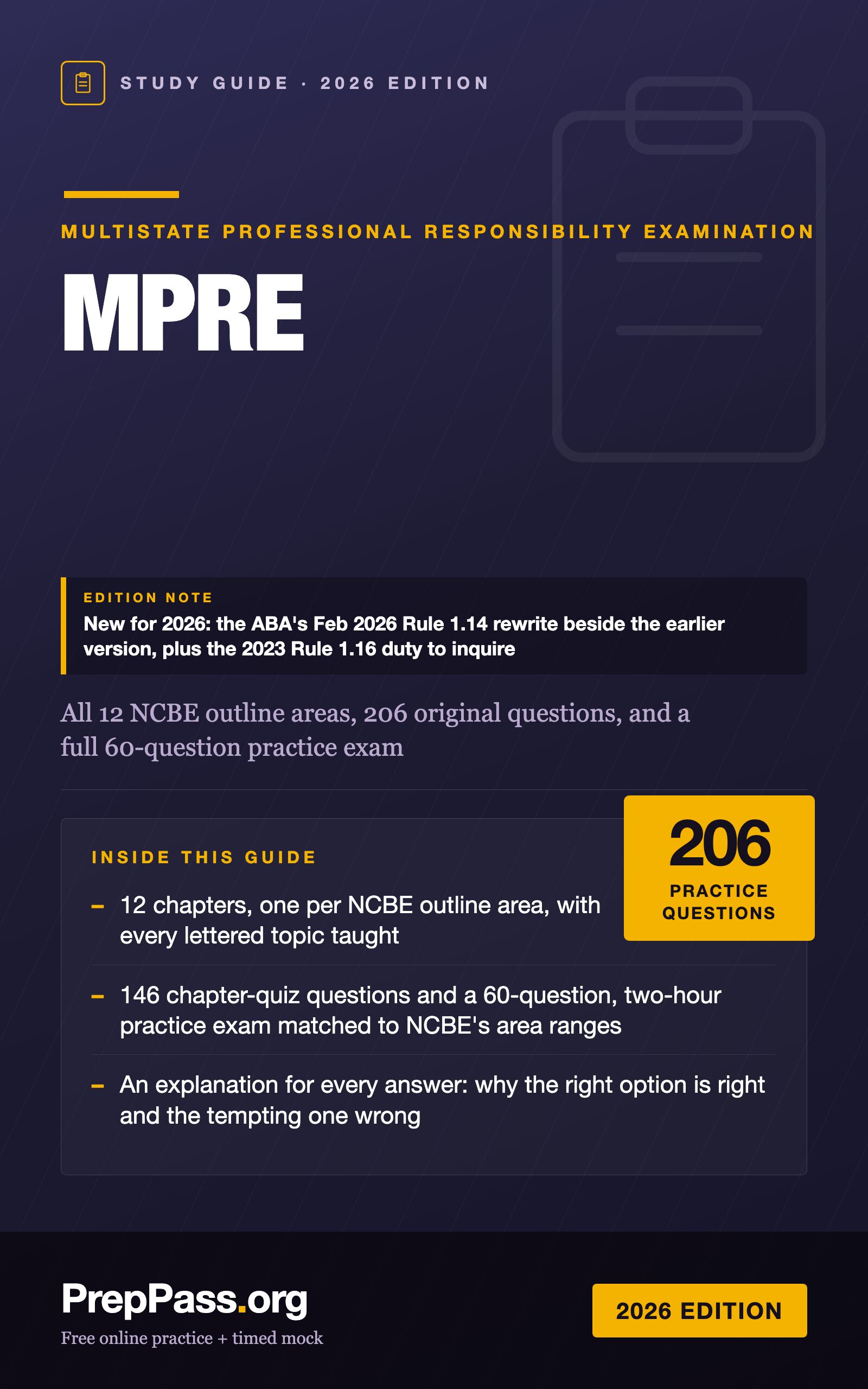
Practice stays free. The full MPRE — Multistate Professional Responsibility Examination study guide is the material itself, taught start to finish — a downloadable PDF + EPUB you keep.
Frequently asked questions
How many MPRE — Multistate Professional Responsibility Exam practice questions are here?+
300 original MPRE — Multistate Professional Responsibility Exam practice questions with explanations. Free, no signup.
What is the MPRE — Multistate Professional Responsibility Exam exam like?+
About 60 questions, 120 minutes. Practice by topic here, then take a timed mock exam to gauge readiness.
Are these the real exam questions?+
No. Every question is 100% original, written from public primary sources with explanations. We never copy real exam questions or paid prep material.
What languages are the MPRE — Multistate Professional Responsibility Exam practice questions in?+
English. The MPRE — Multistate Professional Responsibility Exam practice questions here have not been translated yet.
Is there a study guide for the MPRE — Multistate Professional Responsibility Exam?+
Yes. PrepPass sells MPRE Study Guide — 2026 Edition, a PDF + EPUB download, $24.99 one-time; the practice on this page stays free without it. See the study guide →
Sample practice questions
A few real questions from this free bank, with full explanations. Use the practice tool above for the whole set.
- 1. Conflicts of Interest
A lawyer wants to represent a new client in a matter directly adverse to an existing client in an unrelated matter. Under Model Rule 1.7, the lawyer may proceed only if, among other requirements:
- a.The lawyer discloses the conflict to the court only
- b.The lawyer charges both clients a reduced fee
- c.At least one client consents orally
- d.Each affected client gives informed consent, confirmed in writing
Answer: d
Explanation: Rule 1.7(b) permits representation despite a concurrent conflict only if the lawyer reasonably believes the representation will be competent and diligent, it is not prohibited by law, it does not involve one client's claim against another in the same litigation, and "each affected client gives informed consent, confirmed in writing." Oral consent from one client is insufficient.
- 2. Conflicts of Interest
A lawyer who has left Firm A joins Firm B. At Firm A she never worked on, or learned anything about, Firm A's representation of Delta Corp. Firm B now wants her to help sue Delta in that same matter. Is she personally disqualified?
- a.Yes, unless Firm A consents.
- b.No, because she learned nothing protected about Delta.
- c.Yes, because her former firm represented Delta in the matter.
- d.No, because conflicts never follow lawyers between firms.
Answer: b
Explanation: Rule 1.9(b) disqualifies a lawyer whose former firm represented a client only if the lawyer "had acquired information protected by Rules 1.6 and 1.9(c) that is material to the matter." Without such information she is not disqualified.
- 3. Litigation & Advocacy
A lawyer's partner is likely to be a necessary witness at trial, and the testimony will not conflict with the client's interests. May the lawyer try the case?
- a.Yes, absent a conflict of interest.
- b.No, because the whole firm is disqualified.
- c.No, unless the partner's testimony is uncontested.
- d.Yes, but only if the client consents in writing.
Answer: a
Explanation: Rule 3.7(b) provides that "a lawyer may act as advocate in a trial in which another lawyer in the lawyer's firm is likely to be called as a witness unless precluded from doing so by Rule 1.7 or Rule 1.9."
- 4. Judicial Conduct
Under the Model Code of Judicial Conduct, how far does the degree of relationship extend that can require a judge's disqualification?
- a.To the second degree of relationship.
- b.To any relative at all.
- c.Only to the judge's spouse and children.
- d.To the third degree of relationship.
Answer: d
Explanation: Rule 2.11(A)(2) requires disqualification when "a person within the third degree of relationship" to the judge or the judge's spouse or domestic partner is a party, a lawyer in the proceeding, an interested person, or a likely material witness.
- 5. Conflicts of Interest
A lawyer is asked to represent a buyer in negotiating to purchase a business from a seller whom the lawyer currently represents in an unrelated lease dispute. Under Model Rule 1.7, the lawyer may accept only if:
- a.The buyer alone consents in writing, because only the new client is affected by the existing relationship
- b.The lawyer reasonably believes she can represent both competently and each client gives informed consent, confirmed in writing
- c.The lawyer tells the seller about the new matter in a letter and the seller does not object within thirty days
- d.The two matters are unrelated, in which case no consent is needed from either the buyer or the seller
Answer: b
Explanation: Acting directly adverse to a current client, even in an unrelated matter, is a concurrent conflict under Rule 1.7(a)(1). It can be cured only by the conditions of Rule 1.7(b), including informed consent from each affected client, confirmed in writing. Silence is not consent, and unrelatedness does not remove the conflict.
- 6. The Client-Lawyer Relationship
A client asks a lawyer how to structure cash deposits so that the bank will not file reports the client knows are legally required. Under Rule 1.2(d), the lawyer:
- a.Must report the client to the bank before ending the meeting
- b.Must not assist, but may discuss the legal consequences of the proposed conduct
- c.May assist if the client pays the fee in advance and in full
- d.May assist, because the client alone bears responsibility for the plan
Answer: b
Explanation: Rule 1.2(d) forbids counseling or assisting a client in conduct the lawyer knows is criminal or fraudulent. The lawyer may discuss the legal consequences of any proposed course of conduct. No reporting duty arises from the rule.
- 7. Litigation & Advocacy
A lawyer asks the client's friend, who is not a relative or employee, to avoid talking to opposing counsel. Under Rule 3.4(f), the request is:
- a.Improper only if the friend has already been served with a subpoena
- b.Improper, because the friend is not a relative, employee or other agent of the client
- c.Proper, because a lawyer may ask any person not to give information to an opponent
- d.Proper, so long as the friend is not offered money or anything else of value
Answer: b
Explanation: Rule 3.4(f) forbids requesting a person other than a client to refrain from voluntarily giving relevant information, unless the person is a relative, employee or other agent of the client and the lawyer reasonably believes the person's interests will not be harmed.
- 8. Client Confidentiality
A client dies after the matter ends. Under the comments to Rule 1.6 and Rule 1.9(c), the lawyer's duty of confidentiality:
- a.Continues after the client-lawyer relationship has terminated
- b.Ends at the client's death, since a dead person has no interests left to protect
- c.Passes to the client's heirs, who may release it only by a court order
- d.Ends on the day the final bill is paid or the file is closed, whichever happens first
Answer: a
Explanation: Comment [20] to Rule 1.6 states that the duty of confidentiality continues after the client-lawyer relationship has terminated; Rule 1.9(c) bars using or revealing a former client's information.
- 9. Competence & Malpractice
A lawyer drafts a contract with an ambiguous clause, realizes the error before any harm occurs, and says nothing to the client. Under Rule 1.4, the lawyer:
- a.May stay silent, since no harm has yet occurred and none may ever occur
- b.May stay silent, if she intends to waive part of her fee at the end
- c.Should inform the client of the material error so the client can make informed decisions
- d.Must report herself to the disciplinary authority instead of the client
Answer: c
Explanation: Rule 1.4 requires keeping the client reasonably informed and explaining matters to permit informed decisions. ABA Formal Opinion 481 reads this to require disclosure of a material error to a current client.
- 10. Transactions with Non-Clients
A lawyer serves a sweeping subpoena on an opposing party's elderly mother, who knows nothing about the case, solely to pressure the opponent. Under Rule 4.4(a), the lawyer has:
- a.Acted properly, so long as the subpoena was served in the manner required by law
- b.Violated only the rules of civil procedure, which a court may enforce, and no Rule of Professional Conduct at all
- c.Used means with no substantial purpose other than to embarrass, delay or burden a third person
- d.Acted properly, because every subpoena issued in a pending case is privileged
Answer: c
Explanation: Rule 4.4(a) prohibits using means that have no substantial purpose other than to embarrass, delay or burden a third person, and using methods of obtaining evidence that violate a third person's legal rights.