National Counselor Examination (NCE) Practice Test
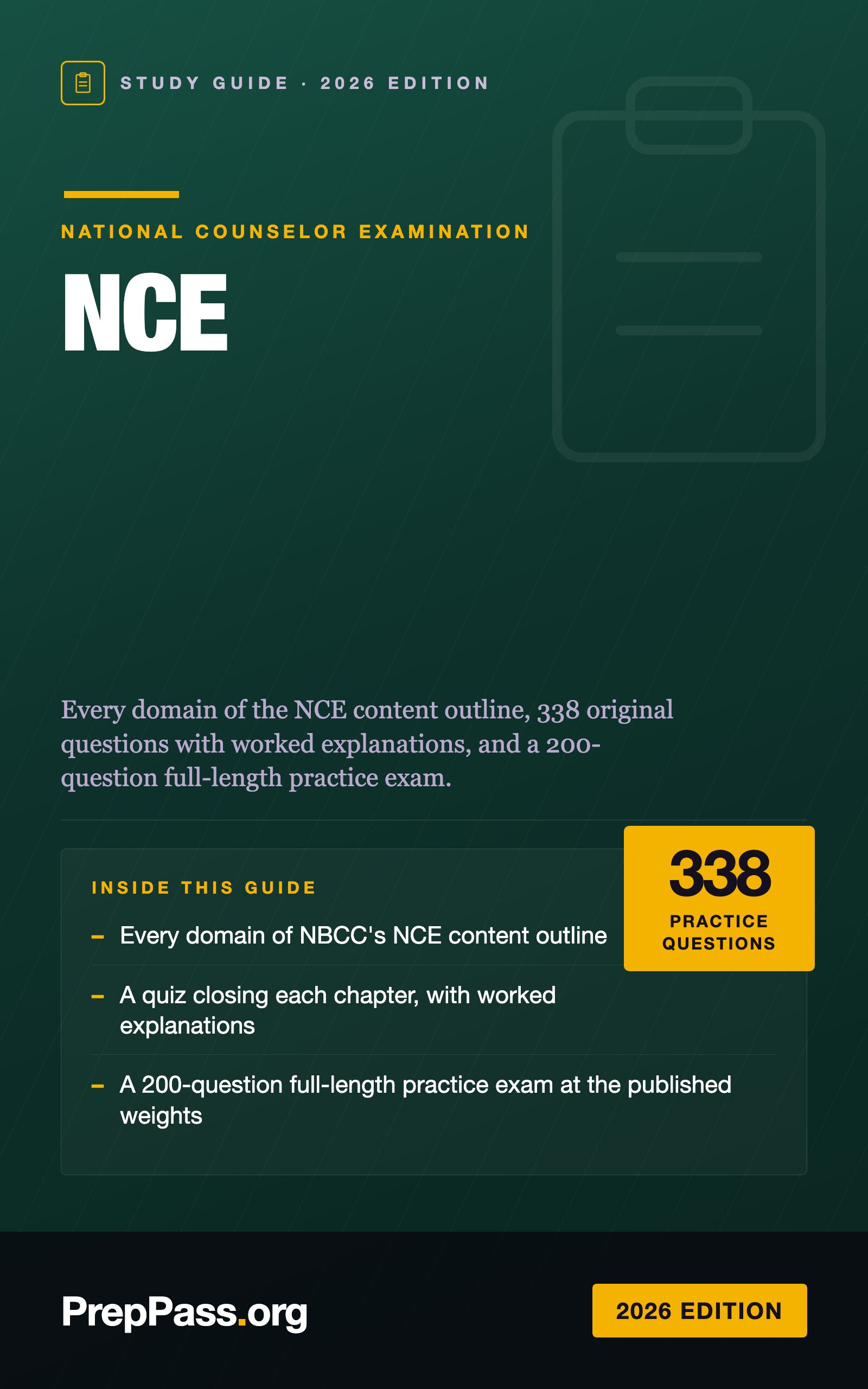
Practice stays free. The full NCE — National Counselor Examination study guide is the material itself, taught start to finish — a downloadable PDF + EPUB you keep.
| Administering body | National Board for Certified Counselors, Inc. (NBCC) — exam delivered by Pearson VUE |
|---|---|
| Questions | 200 questions (160 scored, 40 unscored pretest) |
| Time limit | 225 minutes |
| Passing score | Not published by NBCC What we read and found nothing in: NBCC — Candidate Handbook for State Licensure, National Counselor Examination (NCE) (Revised September 24, 2024, PDF) |
| Fees |
Source: NBCC — National Certified Counselor (Application Fees for Certification) |
| Languages offered | Not published by NBCC What we read and found nothing in: NBCC — Candidate Handbook for State Licensure, National Counselor Examination (NCE) (Revised September 24, 2024, PDF) |
Frequently asked questions
How many National Counselor Examination (NCE) practice questions are here?+
A full bank of original National Counselor Examination (NCE) practice questions across the official content areas, weighted like the real exam, with explanations. Free, no signup.
What is the National Counselor Examination (NCE) exam like?+
About 200 questions, 225 minutes. Practice by topic here, then take the full timed mock exam to gauge readiness.
Are these the real exam questions?+
No. Every question is 100% original, written from public primary sources with explanations. We never copy real exam questions or paid prep material.
Can I study in Chinese or Spanish?+
PrepPass practice is in English, 中文 and Español. The official exam is in English — switch the question language to English any time to rehearse the exact terminology you'll see on test day.
Is there a study guide for the National Counselor Examination (NCE)?+
Yes. PrepPass sells NCE Study Guide — 2026 Edition, a PDF + EPUB download, $19.99 one-time; the practice on this page stays free without it. See the study guide →
Sample practice questions
A few real questions from this free bank, with full explanations. Use the practice tool above for the whole set.
- 1. Professional Practice and Ethics
Three years after counseling ended, a former client contacts her counselor and asks him out on a date. Under the ACA Code of Ethics (2014), what applies?
- a.A romantic relationship is permitted once a colleague has approved it
- b.A romantic relationship is permitted because more than 2 years have passed
- c.A romantic relationship is permitted because the former client initiated it
- d.It is prohibited for 5 years after the last professional contact
Answer: d
Explanation: ACA Code A.5.c prohibits sexual and/or romantic relationships with former clients for 5 years following the last professional contact, and even after 5 years the counselor must document forethought about possible exploitation or harm. A 2-year rule does not appear in the ACA Code. Who initiates the contact and a colleague's approval do not lift the prohibition.
- 2. Professional Practice and Ethics
A current client sends her counselor a friend request on a personal social media account. According to the NBCC Code of Ethics (2023), how should the counselor respond?
- a.Accept after termination, as social media rules end with counseling
- b.Decline, since connecting with clients online is to be avoided
- c.Accept, provided the account has strict privacy settings
- d.Accept, as long as the counselor never comments on the client's posts
Answer: b
Explanation: NBCC Code directive 114 requires counselors to avoid non-professional relationships with clients online, including connecting with or following client social media accounts, and ACA Code A.5.e prohibits personal virtual relationships with current clients. Privacy settings or silence on the platform do not change the relationship, and directive 109 requires a social media policy that covers former clients as well as current ones.
- 3. Intake, Assessment, and Diagnosis
A client scores 16 on the PHQ-9. Using the severity bands published by the instrument's developers, this score indicates depression that is:
- a.severe
- b.moderate
- c.mild
- d.moderately severe
Answer: d
Explanation: Kroenke, Spitzer and Williams (2001) set PHQ-9 cut points of 5, 10, 15 and 20 for mild, moderate, moderately severe and severe depression, so 15 to 19 is moderately severe. A score of 16 is above the moderate range (10 to 14) and below the severe range (20 to 27). The screen informs, but does not replace, a diagnostic interview.
- 4. Areas of Clinical Focus
A client enjoys teaching, helping, and counseling others and prefers working with people over machines. In Holland's typology, the matching personality type is:
- a.Conventional
- b.Realistic
- c.Social
- d.Investigative
Answer: c
Explanation: Holland's RIASEC model describes the Social type as preferring to inform, train, help, or care for people. The Realistic type prefers work with tools, machines, or animals; the Conventional type prefers orderly work with data and procedures; and the Investigative type prefers observing and analyzing problems.
- 5. Areas of Clinical Focus
In the IS PATH WARM mnemonic in SAMHSA TIP 50, what does "Trapped" refer to?
- a.Being physically confined in a hospital or residential facility
- b.Feeling pressured by family members to enter substance use treatment
- c.Feeling there is no escape from a terrible situation
- d.Being unable to stop using a substance
Answer: c
Explanation: TIP 50 explains that "Trapped" refers to perceiving a terrible situation from which there is no escape. It is not about physical confinement or family pressure, and substance abuse is a separate letter (S) in the mnemonic.
- 6. Areas of Clinical Focus
A devout client says her faith is central to how she copes with her divorce. How does the ACA Code of Ethics describe the counselor's role regarding her religious community?
- a.Avoid discussing religion altogether so as not to impose personal values
- b.Refer the client to clergy instead of counseling
- c.Ask her religious leader for background information without telling her
- d.Consider involving religious leaders as resources, with client consent
Answer: d
Explanation: ACA Code A.1.d says counselors recognize that support networks hold various meanings and consider enlisting religious/spiritual/community leaders, family members, and friends as positive resources, when appropriate, with client consent. Avoiding the topic ignores a stated strength, replacing counseling with clergy is not required, and contacting anyone without consent breaches confidentiality.
- 7. Treatment Planning
A client reports a specific plan to kill herself tonight, has the means at home, and refuses to take part in safety planning. What is the most appropriate next step?
- a.Give her the 988 number and end the session as planned
- b.Arrange an immediate emergency evaluation
- c.Schedule a follow-up session for later in the week
- d.Have the client sign a no-suicide contract and go home
Answer: b
Explanation: SAMHSA TIP 50 treats direct warning signs (suicidal communication, access to a method, preparations) as highest priority and calls for ensuring safety, which with a specific plan, means, and refusal to engage means an immediate emergency evaluation. TIP 50 states that no-suicide contracts are not recommended and never sufficient. A later appointment or a hotline number alone does not address imminent risk.
- 8. Counseling Skills and Interventions
In Ellis's ABC model, a client fails a test (A) and feels worthless (C). Where does rational emotive behavior therapy focus its disputing?
- a.The beliefs about failing (B)
- b.The client's childhood memories
- c.The feeling of worthlessness (C)
- d.The test itself (A)
Answer: a
Explanation: In REBT the activating event (A) does not directly cause the emotional consequence (C); the beliefs (B) about the event do. Disputing (D) targets irrational beliefs such as "I must succeed or I am worthless." REBT does not dispute the event or the feeling itself, and it is present-focused rather than centered on childhood.
- 9. Counseling Skills and Interventions
After being scolded by his supervisor, a man comes home and yells at his dog. Which defense mechanism is this?
- a.Projection
- b.Displacement
- c.Rationalization
- d.Sublimation
Answer: b
Explanation: Displacement redirects an impulse from a threatening target to a safer one. Projection attributes one's own unacceptable feelings to someone else, sublimation channels impulses into socially valued activity, and rationalization offers acceptable-sounding reasons for behavior.
- 10. Counseling Skills and Interventions
According to SAMHSA TIP 50, what is true of no-suicide contracts?
- a.They are the preferred intervention whenever a client is at acute risk
- b.They should be signed by every new client
- c.They are never sufficient on their own to ensure a client's safety
- d.They protect the counselor from liability if the client later attempts suicide
Answer: c
Explanation: TIP 50 states that suicide contracts are not recommended, that contracts for safety are never sufficient to ensure a client's safety, and that there is no evidence they protect against litigation. A collaboratively built safety plan is recommended instead.