Free · printable · no signup
ServSafe Manager Cheat Sheet (2026)
The highest-yield facts on the ServSafe Food Protection Manager exam, grouped by the exam's real domain weights. Every temperature, time, and threshold below is verified to the 2022 FDA Food Code, with the code section on each fact. Print it, tape it to the wall, and drill the ones you miss.
Most-tested temperatures, times & rules
The figures that decide the most questions. Memorize these first.
| Temperature Danger Zone | 41°F to 135°F (5°C–57°C). Bacteria grow fastest 70°F–125°F.FDA §3-501.16 |
|---|---|
| Cold holding | 41°F (5°C) or belowFDA §3-501.16 |
| Hot holding | 135°F (57°C) or aboveFDA §3-501.16 |
| Cook: poultry, stuffing, stuffed foods | 165°F for <1 second (instantaneous)FDA §3-401.11 |
| Cook: ground meat, injected meat, ground fish, eggs held for service | 155°F for 17 secondsFDA §3-401.11 |
| Cook: seafood, whole cuts of beef/pork, eggs cooked to order | 145°F for 15 secondsFDA §3-401.11 |
| Cook: fruits, vegetables, grains, legumes for hot holding | 135°FFDA §3-401.11 |
| Reheat TCS food for hot holding | 165°F for 15 seconds, within 2 hoursFDA §3-403.11 |
| Cooling (two stages) | 135°F → 70°F within 2 hours, then 70°F → 41°F within 4 more hours (6 hours total)FDA §3-501.14 |
| Date marking (ready-to-eat TCS) | Discard within 7 days at 41°F; the prep day counts as day 1FDA §3-501.17 |
| Handwashing | Scrub at least 20 seconds; wash for the whole procedure ~20 secFDA §2-301.12 |
| Handwashing-sink water | At least 100°F (38°C)FDA §5-202.12 |
| Ready-to-eat food | No bare-hand contact — use gloves, tongs, deli tissue, or utensilsFDA §3-301.11 |
| Thawing (4 approved methods) | In a cooler ≤41°F; under running water ≤70°F; in a microwave if cooked immediately; or as part of cookingFDA §3-501.13 |
| Certified Food Protection Manager | At least one required on staff (per most local health codes)FDA §2-102.12 |
| Illnesses a food handler must report (Big 6) | Norovirus, Hepatitis A, Salmonella Typhi, nontyphoidal Salmonella, Shigella spp., Shiga toxin-producing E. coliFDA §2-201.11 |
| Major food allergens | 9 — milk, eggs, fish, crustacean shellfish, tree nuts, peanuts, wheat, soybeans, sesame (sesame added by the FASTER Act, eff. Jan 1, 2023) |
Foodborne Illness & the Danger Zone
15% of the exam- TCS food
- Time/Temperature Control for Safety foods (meat, poultry, seafood, dairy, eggs, cooked rice/beans, cut melons/tomatoes/leafy greens, garlic-in-oil) support fast pathogen growth.
- FAT TOM
- Pathogens grow with Food, Acidity, Temperature, Time, Oxygen, Moisture. Controlling temperature and time is the manager's main lever.
- Danger Zone
- 41°F to 135°F; keep TCS food out of it. Growth is fastest 70°F–125°F.· FDA §3-501.16
- The Big 6
- Highly contagious pathogens a food handler must report: Norovirus, Hepatitis A, Salmonella Typhi, nontyphoidal Salmonella, Shigella spp., STEC (E. coli).· FDA §2-201.11
- Highly susceptible populations
- Young children, older adults, pregnant people, and the immunocompromised are at greater risk — no bare-hand contact and no undercooked TCS for these settings.
Preparation & Cooking
15% of the exam- 165°F <1 sec
- Poultry, stuffing, stuffed meats/pasta, and dishes made from previously cooked TCS ingredients.· FDA §3-401.11
- 155°F for 17 sec
- Ground meat, mechanically tenderized or injected meat, ground fish, and eggs that will be held for service.· FDA §3-401.11
- 145°F for 15 sec
- Seafood, steaks/chops of beef, pork, veal, lamb, and shell eggs cooked to order and served immediately.· FDA §3-401.11
- 135°F
- Fruits, vegetables, grains, and legumes cooked for hot holding.· FDA §3-401.11
- Thawing
- Only four ways: refrigeration ≤41°F, under running water ≤70°F, microwave (cook immediately), or as part of cooking. Never at room temperature.· FDA §3-501.13
- Partial cooking
- If partially cooking, heat no more than 60 minutes, cool, and finish later to the required temperature; a written procedure is required.
Personal Hygiene
13% of the exam- Handwashing
- Wet, soap, scrub at least 20 seconds (including under nails), rinse, and dry with a single-use towel. Wash in a designated handwashing sink only.· FDA §2-301.12
- Handwashing-sink water
- Reach at least 100°F (38°C); the sink is for handwashing only.· FDA §5-202.12
- No bare-hand contact
- Never touch ready-to-eat food with bare hands — use gloves, tongs, deli tissue, or utensils.· FDA §3-301.11
- Exclude for the Big 6 / symptoms
- Exclude a handler with vomiting, diarrhea, jaundice, or a diagnosed Big 6 illness; jaundice or a diagnosed illness also requires notifying the regulatory authority.· FDA §2-201.12
- Sore throat with fever
- Restrict a handler with a sore throat and fever from working with exposed food (exclude in high-risk settings).
- Bandaged wound
- Cover a hand wound with a waterproof bandage and a single-use glove.
Holding & Service
13% of the exam- Hot holding
- 135°F or above; check with a cleaned, calibrated thermometer at least every 4 hours.· FDA §3-501.16
- Cold holding
- 41°F or below.· FDA §3-501.16
- Cooling
- 135°F → 70°F within 2 hours, then 70°F → 41°F within 4 more hours (6 hours total). Use shallow pans, ice baths, or ice paddles.· FDA §3-501.14
- Reheating for hot holding
- Reach 165°F for 15 seconds within 2 hours.· FDA §3-403.11
- Time as a public-health control
- Without temperature control, hold up to 4 hours if starting from a safe temperature, then discard; a written procedure and labeling are required.· FDA §3-501.19
- Date marking
- Ready-to-eat TCS food held over 24 hours is discarded within 7 days at 41°F; the prep day is day 1.· FDA §3-501.17
Contamination, Allergens & the Flow of Food
12% of the exam- Three hazard types
- Biological (pathogens), chemical (cleaners, sanitizers, toxic metals), and physical (glass, metal, bone).
- Cross-contamination
- Transfer of pathogens between foods/surfaces — e.g., raw poultry juices onto ready-to-eat produce. Separate raw from ready-to-eat.
- The 9 major allergens
- Milk, eggs, fish, crustacean shellfish, tree nuts, peanuts, wheat, soybeans, and sesame (sesame added by the FASTER Act, effective Jan 1, 2023).
- Prevent cross-contact
- Clean and sanitize surfaces and utensils, wash hands, and use separate/clean equipment when preparing allergen-free orders.
- Storage order (top → bottom)
- Ready-to-eat; seafood; whole cuts of beef/pork; ground meat/fish; then poultry (cooked highest, raw poultry lowest — by final cook temperature).
Purchasing, Receiving & Storage
12% of the exam- Approved suppliers
- Buy from approved, reputable suppliers that meet applicable laws and can show inspection compliance.
- Receive cold TCS
- At 41°F or below.· FDA §3-202.11
- Receive shell eggs
- At an air temperature of 45°F or below.· FDA §3-202.11
- Receive live shellfish
- With a shellstock identification tag; keep the tag 90 days from the last item used.· FDA §3-203.12
- Reject signs
- Off temperatures, abnormal color/odor/texture, damaged or leaking packaging, pest damage, or a broken use-by date.
- FIFO
- First In, First Out — store the earliest use-by dates in front; store food at least 6 inches off the floor.
Food Safety Management & HACCP
10% of the exam- Active managerial control
- The manager designs systems (training, SOPs, monitoring) to control the CDC's common risk factors for foodborne illness.
- HACCP — 7 principles
- 1) Hazard analysis 2) Critical control points 3) Critical limits 4) Monitoring 5) Corrective actions 6) Verification 7) Recordkeeping.
- When a HACCP plan is required
- Obtain a variance and a HACCP plan for specialized processes — smoking/curing for preservation, reduced-oxygen packaging, sprouting seeds, or using additives to preserve.· FDA §3-502.11
- Certified Food Protection Manager
- At least one CFPM required on staff under most local codes.· FDA §2-102.12
- Imminent health hazard
- Close and notify the regulatory authority for events like a sewage backup, no safe water, fire, or flood.
Facilities, Cleaning & Pest Control
10% of the exam- Clean vs. sanitize
- Cleaning removes food and soil; sanitizing reduces pathogens on an already-clean surface to safe levels. You must clean before you sanitize.
- Chlorine sanitizer
- About 50–99 ppm, per the Food Code concentration/temperature/pH table.· FDA §4-501.114
- Iodine / quats
- Iodine ~12.5–25 ppm; quaternary ammonium per the manufacturer's label. Follow the label for concentration and contact time.· FDA §4-501.114
- Hot-water sanitizing
- Manual immersion: sanitize in water at least 171°F (77°C); a mechanical dish machine final rinse reaches the temperature on its data plate.· FDA §4-703.11
- Clean food-contact surfaces
- After each use, when switching tasks/foods, or every 4 hours during continuous use.· FDA §4-602.11
- Integrated pest management
- Deny pests food/water/shelter, keep them out (screens, door sweeps), and work with a licensed pest-control operator; keep the service report.
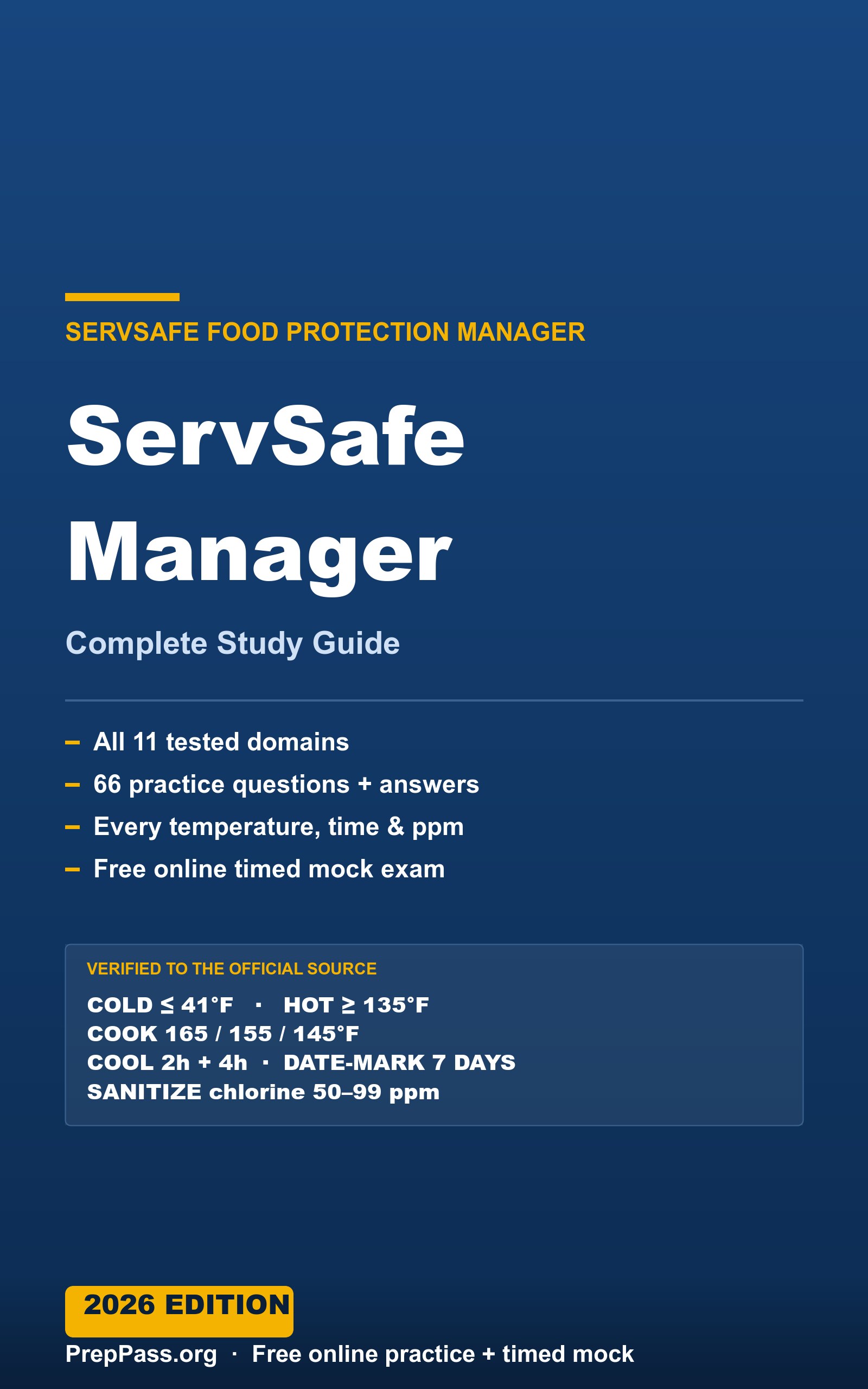
In the ServSafe Food Protection Manager guide: A quiz closing each of the 8 chapters, with an answer key that explains every one. Practice here stays free.
Now prove you know them
Reading temperatures is not the same as recalling them under exam pressure. Drill the free ServSafe Manager practice questions to find your weak domains, then sit a full timed mock — no signup, no paywall.
Want the full picture? Read the free ServSafe Manager study guide →
Every temperature, time, and threshold above is verified against the FDA Food Code 2022, with the code section shown on each fact.
Study aid, not a substitute for the official material — always confirm the current rule with your local health department, which adopts and may amend the FDA Food Code. Last verified: August 18, 2026.