TExES Pedagogy and Professional Responsibilities EC–12 (160) Practice Test
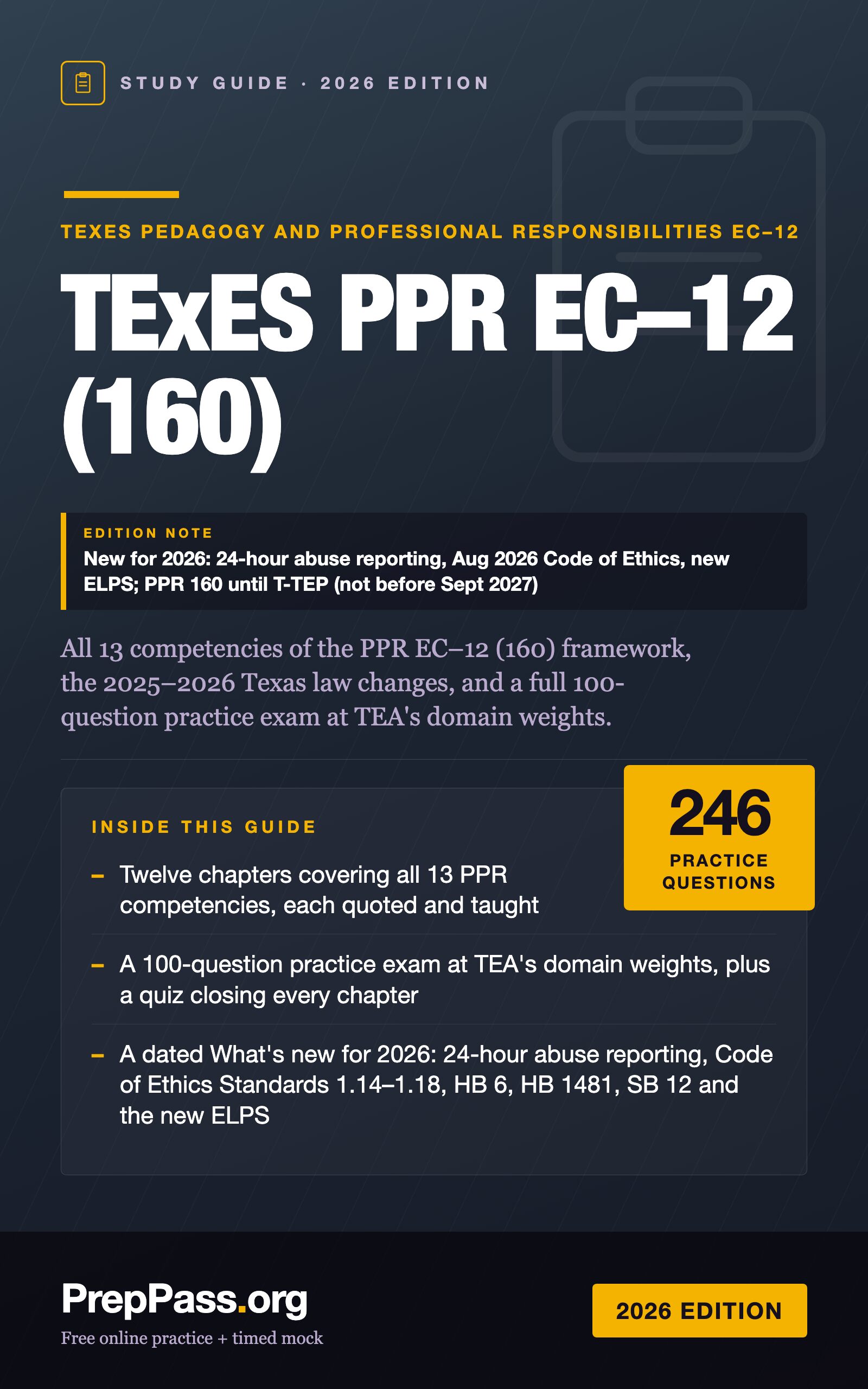
Practice stays free. The full TExES Pedagogy and Professional Responsibilities EC–12 (160) study guide is the material itself, taught start to finish — a downloadable PDF + EPUB you keep.
| Administering body | Texas Education Agency (TEA) and the State Board for Educator Certification (SBEC) — exam delivered by Pearson |
|---|---|
| Questions | 100 questions |
| Time limit | 285 minutes |
| Passing score | Scaled score of 240 on a 100–300 scale Source: Pearson, Texas Educator Certification Examination Program — Understanding Your Test Results |
| Fees |
|
| Languages offered | Not published by TEA / Pearson What we read and found nothing in: Pearson, Texas Educator Certification Examination Program — Pedagogy and Professional Responsibilities EC–12 (160) exam page |
Frequently asked questions
How many TExES Pedagogy and Professional Responsibilities EC–12 (160) practice questions are here?+
A full bank of original TExES Pedagogy and Professional Responsibilities EC–12 (160) practice questions across the official content areas, weighted like the real exam, with explanations. Free, no signup.
What is the TExES Pedagogy and Professional Responsibilities EC–12 (160) exam like?+
About 100 questions, 285 minutes. Practice by topic here, then take the full timed mock exam to gauge readiness.
Are these the real exam questions?+
No. Every question is 100% original, written from public primary sources with explanations. We never copy real exam questions or paid prep material.
Can I study in Chinese or Spanish?+
PrepPass practice is in English, 中文 and Español. The official exam is in English — switch the question language to English any time to rehearse the exact terminology you'll see on test day.
Is there a study guide for the TExES Pedagogy and Professional Responsibilities EC–12 (160)?+
Yes. PrepPass sells TExES PPR EC–12 (160) Study Guide — 2026 Edition, a PDF + EPUB download, $24.99 one-time; the practice on this page stays free without it. See the study guide →
Sample practice questions
A few real questions from this free bank, with full explanations. Use the practice tool above for the whole set.
- 1. Designing Instruction and Assessment to Promote Student Learning
A preschool teacher wants children to learn the difference between heavy and light. Which activity fits their development best?
- a.Tracing the words heavy and light on a worksheet
- b.Listening to the teacher explain what weight means
- c.Watching a cartoon about a scale at the market
- d.Sorting objects by how heavy each one feels
Answer: d
Explanation: Young children rely on "motor and sensory input and direct experience," so handling objects teaches the concept directly. The cartoon is tempting because it is visual, but it is secondhand experience. A Piagetian paper adds that such manipulation "is essential" for real comprehension.
Source: PPR framework, Competency 004
- 2. Designing Instruction and Assessment to Promote Student Learning
A teacher wants students of different readiness levels to work on the same science concept. Which strategy fits?
- a.The same task with no changes for any student
- b.Extra worksheets for students who finish early
- c.A separate, easier topic for the struggling students
- d.A tiered task with different levels of support
Answer: d
Explanation: Tiered activities let "all learners work with the same important understandings and skills" with different support. An easier topic is tempting because it seems kind, but it changes what those students learn.
Source: ERIC ED443572 (differentiation)
- 3. Designing Instruction and Assessment to Promote Student Learning
Which four subjects make up the Texas foundation curriculum?
- a.English, science, fine arts and technology applications
- b.English language arts, mathematics, science and social studies
- c.Mathematics, science, health and career education
- d.Reading, writing, mathematics and physical education
Answer: b
Explanation: Texas's foundation curriculum is "English language arts; mathematics; science; and social studies." The option with fine arts is tempting, but fine arts and technology applications are in the enrichment curriculum.
Source: 19 TAC 74.1
- 4. Designing Instruction and Assessment to Promote Student Learning
Which set of skills does the PPR framework say teachers teach, model and monitor?
- a.Only skills tested on state assessments
- b.Only the content in the state standards
- c.Only skills students choose to learn
- d.Skills like note-taking and summarizing
Answer: d
Explanation: The framework says a teacher "Teaches, models and monitors age-appropriate study skills (e.g., using graphic organizers, outlining, note-taking, summarizing, test-taking)." State-tested skills is tempting because tests matter, but study skills are part of the teacher's role regardless.
Source: PPR framework, Competency 004
- 5. Creating a Positive, Productive Classroom Environment
When a Texas teacher sends a student out to maintain discipline under §37.002, whose office does the student go to?
- a.A parent volunteer's
- b.The regional service center's
- c.The campus behavior coordinator's
- d.The school nurse's
Answer: c
Explanation: A teacher "may send a student to the campus behavior coordinator's office to maintain effective discipline," and each campus designates one person as coordinator. The nurse is tempting as a support person, but discipline goes to the coordinator.
Source: Texas Education Code 37.002, 37.0012
- 6. Implementing Effective, Responsive Instruction and Assessment
About how much classroom time has research found is spent in question and response?
- a.About 90%
- b.None at all
- c.About 5%
- d.As much as 40%
Answer: d
Explanation: Research indicates that "as much as 40% of classroom time is spent in a question-response mode." Ninety percent is tempting in question-heavy classes, but the research figure is 40%.
Source: ERIC ED383706 (wait time)
- 7. Implementing Effective, Responsive Instruction and Assessment
Which practice reflects the file management skills in the Technology Applications TEKS?
- a.Using random file names to save time
- b.Saving every file to the desktop
- c.Clear names and organized folders
- d.Keeping one copy with no backup
Answer: c
Explanation: Students are expected to "identify effective file management strategies such as file naming conventions, local and remote locations, backup, hierarchy, folder structure." Saving to the desktop is tempting because it is easy, but it ignores organization and backup.
Source: 19 TAC 126 (Technology Applications)
- 8. Implementing Effective, Responsive Instruction and Assessment
Before writing a performance assessment, what should a teacher identify first?
- a.The number of students who will pass
- b.Timing
- c.Its purpose and objectives
- d.The grade each student deserves
Answer: c
Explanation: "Before a performance assessment or a scoring rubric is written or selected, the teacher should clearly identify the purpose of the activity." The number who will pass is tempting as planning, but purpose and objectives come first.
Source: ERIC ED481714 (performance assessment)
- 9. Fulfilling Professional Roles and Responsibilities
Research on parent involvement links it to which student outcomes?
- a.No measurable effect on students
- b.Lower attendance and more discipline problems
- c.Only better handwriting
- d.Better grades and behavior
Answer: d
Explanation: Children with involved parents "have better grades, test scores, long-term academic achievement, attitudes, and behavior." No measurable effect is tempting as a skeptical view, but the research reports clear benefits.
Source: ERIC ED312776 (parent involvement)
- 10. Fulfilling Professional Roles and Responsibilities
How many performance levels does the T-TESS rubric use?
- a.Six
- b.Three
- c.Five
- d.Four
Answer: c
Explanation: The T-TESS rubric has "5 performance levels: Distinguished, Accomplished, Proficient, Developing, and Improvement Needed." Four is tempting because the rubric has four domains, but it has five levels.
Source: TEA, T-TESS