TExES Pedagogy and Professional Responsibilities EC–12 (160) · 2026 Edition
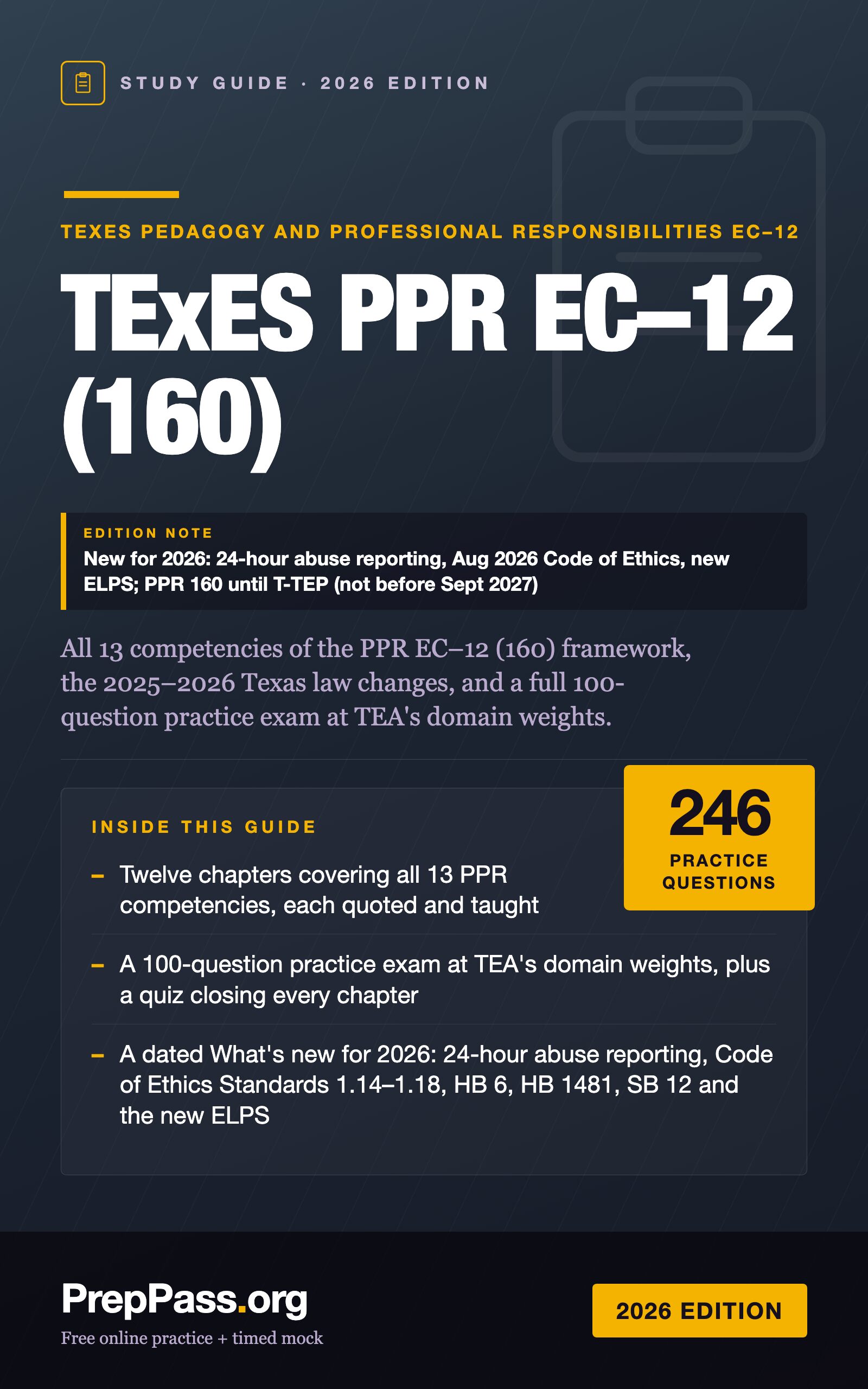
TExES PPR EC–12 (160) Study Guide — 2026 Edition
Edition noteNew for 2026: 24-hour abuse reporting, Aug 2026 Code of Ethics, new ELPS; PPR 160 until T-TEP (not before Sept 2027)
All 13 competencies of the PPR EC–12 (160) framework, the 2025–2026 Texas law changes, and a full 100-question practice exam at TEA's domain weights.
- 246 original TExES PPR (Pedagogy and Professional Responsibilities) practice questions, each with a worked explanation, in one PDF + EPUB you keep
PDF + EPUB · English · 239 pages · $24.99 one-time
This book is written in English.
Instant download after payment — no account needed, no subscription.
14-day money-back guarantee: not satisfied for any reason? Email support@preppass.org within 14 days of purchase for a full refund. Refund policy
Try 10 questions first — free
Answer all 10, then see every answer explained — with the section of this guide that teaches it. About 5 minutes, no sign-up.
Start 10 free questionsLook inside the book
Three real pages, rendered straight from the PDF you download — a reference page, a teaching page, and a worked question, always in that order. Nothing here was redrawn to look better.
- Quick referenceChapter 4 — How Students Learn (Competency 004) · PDF page 66
A page you can turn back to: the numbers, deadlines or terms gathered in one place.
- How it's taughtAnswer key & explanations · PDF page 89
An explanation page: the material taught in prose, in the order the exam tests it.
- A question, workedChapter 8 — Technology for Teaching and Learning (Competency 009) · PDF page 124
A practice question with its answer and the reasoning behind it — not just a key.
About the exam itself
| Administering body | Texas Education Agency (TEA) and the State Board for Educator Certification (SBEC) — exam delivered by Pearson |
|---|---|
| Questions | 100 questions |
| Time limit | 285 minutes |
| Passing score | Scaled score of 240 on a 100–300 scale Source: Pearson, Texas Educator Certification Examination Program — Understanding Your Test Results |
| Fees |
|
| Languages offered | Not published by TEA / Pearson What we read and found nothing in: Pearson, Texas Educator Certification Examination Program — Pedagogy and Professional Responsibilities EC–12 (160) exam page |
Questions buyers ask
- What has changed on the TExES Pedagogy and Professional Responsibilities EC–12 (160) exam?
- New for 2026: 24-hour abuse reporting, Aug 2026 Code of Ethics, new ELPS; PPR 160 until T-TEP (not before Sept 2027). Pedagogy and Professional Responsibilities EC–12 (160) exam framework, TEA Preparation Manual Section 3 (page marked Copyright 2019): TEA has published no new PPR framework. Its Educator Testing page lists the Texas Test of Educator Proficiency (T-TEP), a performance-based assessment, as "No earlier than September 2027" and "Pending SBEC action", and its T-TEP FAQ (updated October 2025) says T-TEP would replace the PPR as the required pedagogy assessment for standard certification.
- Is a study guide enough for the TExES Pedagogy and Professional Responsibilities EC–12 (160) exam, or do I need a course?
- Check eligibility first — per Texas Education Agency (TEA) and the State Board for Educator Certification (SBEC): you must have test approval before registering. If you are in an educator preparation program, your program approves you for one exam attempt at a time, and you must request approval again for each retake. A book does not replace those requirements. For the exam content itself, this 239-page guide teaches the material chapter by chapter with 246 practice questions and explanations inside, and 105 more practice questions are free on PrepPass. A prep course adds live instruction and a set schedule; whether you need one beyond any required education is your call.
- What is the cheapest way to prepare for the TExES Pedagogy and Professional Responsibilities EC–12 (160) exam?
- Start with what costs nothing: 105 practice questions on PrepPass, with explanations and no signup. If you want it taught in one file you keep, the full study guide is $24.99 once. No subscription on any of them.
- What happens if I fail the TExES Pedagogy and Professional Responsibilities EC–12 (160) exam?
- You can retake it under Texas Education Agency (TEA) and the State Board for Educator Certification (SBEC)'s rule: you may retake the exam after 30 days. You are limited to five attempts in total, the first attempt plus four retakes, unless TEA approves a test-limit waiver. Confirm the current policy with Texas Education Agency (TEA) and the State Board for Educator Certification (SBEC) before you book.
- Who administers the TExES Pedagogy and Professional Responsibilities EC–12 (160)?
- Texas Education Agency (TEA) and the State Board for Educator Certification (SBEC) — exam delivered by Pearson. The exam is part of TEA's Texas Educator Certification Examination Program and is delivered by Pearson as a computer-administered test, by appointment year round at test sites in Texas and nationwide. Framework domains (approximate share of the exam): Designing Instruction and Assessment to Promote Student Learning 34%, Creating a Positive, Productive Classroom Environment 13%, Implementing Effective, Responsive Instruction and Assessment 33%, Fulfilling Professional Roles and Responsibilities 20%. TEA lists the Texas Test of Educator Proficiency (T-TEP), a performance-based assessment, as a planned replacement for the PPR no earlier than September 2027, pending SBEC action.
- How many questions are on the TExES Pedagogy and Professional Responsibilities EC–12 (160)?
- 100 questions. All 100 questions are selected-response. The exam may include questions that are being evaluated for future forms and do not affect the score; Pearson does not say how many.
- How long is the TExES Pedagogy and Professional Responsibilities EC–12 (160)?
- 285 minutes. 4 hours 45 minutes of testing time, within a 5-hour appointment that also includes 15 minutes for the computer tutorial and compliance agreement.
- What is the passing score for the TExES Pedagogy and Professional Responsibilities EC–12 (160)?
- Scaled score of 240 on a 100–300 scale. TExES scores are reported on a scale of 100 to 300 with 240 as the minimum passing score. This is a scaled score, not a percentage of questions answered correctly; the final scaled score is based only on scored questions.
- How much does the TExES Pedagogy and Professional Responsibilities EC–12 (160) cost?
- $116 — Exam fee (Pearson, per attempt). Pearson's exam page adds that additional fees may apply. The $116 figure is the fee SBEC rule 19 TAC §230.101 sets for selected-response-only assessments.
- What languages is the TExES Pedagogy and Professional Responsibilities EC–12 (160) offered in?
- Not published by TEA / Pearson. Neither the exam page, the preparation manual's framework nor TEA's Certification Exams page states which languages the PPR is offered in, so PrepPass names none.
- Does the TExES Pedagogy and Professional Responsibilities EC–12 (160) study guide come as a PDF?
- Yes — TExES PPR EC–12 (160) Study Guide — 2026 Edition downloads as PDF and EPUB, 239 pages. The download link is emailed the moment payment clears and does not expire.
- How much does the TExES Pedagogy and Professional Responsibilities EC–12 (160) study guide cost?
- $24.99, once. There is no subscription and no account to create; the PDF and EPUB files are yours to keep.
- Are there free TExES Pedagogy and Professional Responsibilities EC–12 (160) practice questions?
- Yes — 105 of them, free to use with no signup and an explanation on every one. They are separate from this study guide, which is what you are buying here.
- Can I read part of the TExES Pedagogy and Professional Responsibilities EC–12 (160) study guide before buying?
- Yes. A full chapter is free to read on this page — not a summary of one, the chapter itself.
- Is this the official TExES Pedagogy and Professional Responsibilities EC–12 (160) study guide?
- No. This is an independent study guide and is not affiliated with or endorsed by the exam's awarding body. It is written from TEA's PPR EC–12 (160) preparation manual and framework, Pearson's TX160 exam page, the Texas Education and Family Codes and SBEC rules (19 TAC), read September 2026. Always confirm current requirements with the body that issues your licence.
What's included — and what isn't
Included
- Twelve chapters covering all 13 PPR competencies, each quoted and taught
- A 100-question practice exam at TEA's domain weights, plus a quiz closing every chapter
- A dated What's new for 2026: 24-hour abuse reporting, Code of Ethics Standards 1.14–1.18, HB 6, HB 1481, SB 12 and the new ELPS
- A six-week study plan, and appendices of key numbers, terms and the pairs the exam likes to confuse
- 246 original questions, each with a worked explanation citing its source
- PDF + EPUB you keep
Not included
- No printed copy is shipped — this is a file you download and can print yourself
- No video course, instructor or tutoring comes with the book — the free videos on the site are separate
- Not your exam registration or the testing centre's fee, which you still pay to the official body
Contents
See 19 sections and the page each one starts on
- Chapter 1 — Human Development, Early Childhood Through Grade 12 (Competency 001)p. 12
- Chapter 2 — Responding to the Variety of Students (Competency 002)p. 29
- Chapter 3 — Designing Coherent Instruction and Assessment (Competency 003)p. 45
- Chapter 4 — How Students Learn (Competency 004)p. 60
- Chapter 5 — The Classroom Environment and Managing Behavior (Competencies 005 and 006)p. 75
- Answer key & explanationsp. 88
- Chapter 6 — Communicating Effectively (Competency 007)p. 91
- Chapter 7 — Engaging Students in Learning (Competency 008)p. 103
- Chapter 8 — Technology for Teaching and Learning (Competency 009)p. 115
- Chapter 9 — Monitoring Learning and Giving Feedback (Competency 010)p. 127
- Chapter 10 — Working With Families (Competency 011)p. 138
- Chapter 11 — Colleagues, Appraisal and Professional Growth (Competency 012)p. 149
- Chapter 12 — Legal and Ethical Requirements and the Texas Education System (Competency 013)p. 160
- Practice exam answer key and explanationsp. 201
- Appendix A — Registration and exam-day reference Before exam dayp. 217
- Appendix B — Terms to know preciselyp. 219
- Appendix C — The thirteen competencies on one pagep. 223
- Appendix D — The numbers and deadlines that decide questionsp. 226
- Appendix E — Pairs the exam likes to confusep. 229
Taken from the PDF you download, with the page each one starts on — not typed here.
Read a chapter free, in full
One complete chapter, exactly as it ships in the eBook. Scroll the window to read it right here; no download, no email.
Read chapter 12 here, without leaving the page
We didn't give you the easy intro — the free chapter opens on one of the hardest-working parts of the book, so you can judge the teaching where the exam gets difficult.
Competency 013 closes Domain IV (about 20% of the exam)[1]: "The teacher understands and adheres to legal and ethical requirements for educators and is knowledgeable of the structure of education in Texas"[1].
Its statements cover legal requirements "related to special education, students' and families' rights, student discipline, fairness, child abuse"; legal and ethical use of resources and technology; the Code of Ethics and Standard Practices for Texas Educators; accurate student records; procedures for "state- and district-mandated assessments"; the structure of the state education system; and advocacy for students and the profession[1].
This is the chapter where the "best" answer is sometimes simply what the law requires. Several requirements changed in 2025 and 2026; the dates are given with each.
12.1 Reporting child abuse and neglect — now 24 hours
The duty. Texas Family Code §261.101(b) requires a professional — which includes "an individual who is licensed or certified by the state," such as a certified teacher — who has "reasonable cause to believe that a child has been abused or neglected or may be abused or neglected" to report "not later than the 24th hour after the hour the professional first has reasonable cause to believe" it[2]. This deadline was shortened from 48 hours by Senate Bill 571, effective June 20, 2025[2].
Key points, each tested:
- Reasonable cause, not proof. The teacher does not investigate or confirm; suspicion based on reasonable cause triggers the duty.
- Personal and non-delegable. "A professional may not delegate to or rely on another person to make the report"[2]. TEA puts it plainly: "Telling a supervisor or administrator does not meet this requirement. Each individual is responsible for making their own report"[3]. A teacher may also inform the principal or counselor under campus procedures, but that does not replace the teacher's own report.
- To whom. A report goes to "a law enforcement agency," the Department of Family and Protective Services, or the state agency that licenses the facility where the abuse occurred[2]. DFPS's Texas Abuse Hotline is 1-800-252-5400[4]. Since September 1, 2023, DFPS does not accept anonymous reports; reporters give a name and phone number, and "Reporters' names are confidential by law"[4].
- Protection and penalty. A person reporting "in good faith" is "immune from civil or criminal liability"[2]. A professional who "knowingly fails to make a report" commits an offense — a Class A misdemeanor, or a state jail felony if the failure was intended to conceal the abuse[2].
- Consent is not required. The duty to report is not affected by the parental-consent rules; the consent statute expressly does not "affect the duty to report child abuse or neglect"[5].
What a teacher does when a student discloses abuse. Listen calmly; do not press for details, promise secrecy or confront the alleged abuser; reassure the student that telling was right; make the report within 24 hours; document what the student said in the student's words; follow campus procedures to notify administration as well.
12.2 Reporting educator misconduct
Senate Bill 571 also created Texas Education Code Chapter 22A on misconduct by school employees[3]. TEA summarizes: "Principals must report educator misconduct to their superintendent within 48 hours of becoming aware of the information," and "Superintendents must report qualifying allegations of misconduct to the Texas Education Agency (TEA) or the State Board for Educator Certification (SBEC) within 48 hours"[3]. The statute sets the 48-hour rule for the serious categories of misconduct and a seventh-business-day rule for others[6]. Reportable conduct includes an educator's violation of "the assessment instrument security procedures"[6]. Reporting "boundary violations and inappropriate communications" is now required as well[3].
12.3 The Educators' Code of Ethics
SBEC's Code of Ethics (19 TAC §247.2) applies "to educators and candidates for certification"[7] and is enforced through certification discipline[7]. It has three groups of enforceable standards. The ones below are the most tested; the numbering is the rule's own.
Professional ethical conduct (Standards 1.1–1.18).
- 1.2 — do not misappropriate "monies, personnel, property, or equipment" for personal gain[7].
- 1.5 — do not "accept nor offer gratuities, gifts, or favors that impair professional judgment," though tokens "offered and accepted openly from students, parents ... in recognition or appreciation of service" are allowed[7].
- 1.6 — "shall not falsify records or direct or coerce others to do so"[7].
- 1.7 — comply with "state regulations, written local school board policies, and other state and federal laws"[7].
- 1.13 — no alcohol "on school property or during school activities when students are present"[7].
- New, effective August 2, 2026: Standards 1.14 to 1.18 require compliance with the "prohibitions on diversity, equity, and inclusion duties in Texas Education Code (TEC), §11.005," the "prohibitions on assistance with social transitioning in TEC, §11.401," the "restrictions on instruction regarding sexual orientation and gender identity in TEC, §28.0043," and "the requirements to provide full information to a parent concerning a student in TEC, §26.008," and forbid promoting certain illegal conduct in a way visible to students[7].
Conduct toward colleagues (2.1–2.8). Do not reveal colleagues' "confidential health or personnel information" without a lawful purpose; do not make knowingly false statements about a colleague; do not discriminate against, coerce, retaliate against or sexually harass colleagues[7].
Conduct toward students (3.1–3.9).
- 3.1 — "shall not reveal confidential information concerning students unless disclosure serves lawful professional purposes or is required by law"[7].
- 3.2 — do not treat a student "in a manner that adversely affects or endangers the learning, physical health, mental health, or safety"[7].
- 3.3 — do not "misrepresent facts regarding a student"[7].
- 3.4 — do not exclude a student from a program, deny benefits or grant an advantage "on the basis of race, color, gender, disability, national origin, religion, family status, or sexual orientation"[7].
- 3.6 — "shall not solicit or engage in sexual conduct or a romantic relationship with a student or minor"[7].
- 3.8 — "maintain appropriate professional educator-student relationships and boundaries based on a reasonably prudent educator standard," considering factors such as contact "beyond the professional role," "transporting the student without permission," photos or video "beyond the professional role," and "showing favoritism or isolation through gifts, rewards, or privileges"[7].
- 3.9 — refrain from "inappropriate communication with a student," including electronic communication, judged by factors such as timing, subject matter and "whether the communication was made openly"[7].
How ethics questions work. The answer is usually the transparent, professional one: communicate through school channels, involve parents, keep boundaries, keep records honest, and follow district policy.
12.4 Students' and families' rights: records and privacy
Under FERPA, "education records" are records directly related to a student and maintained by the school[8]. Key rules:
- Parents' access. Parents may inspect their child's records; the school must comply "not more than 45 days after it has received the request"[9]. Texas law gives parents access to "all written records of a school district concerning the parent's child"[5].
- Disclosure within the school. Records may be shared with "other school officials, including teachers, within the agency or institution whom the agency or institution has determined to have legitimate educational interests"[10]. A teacher who needs a student's IEP to teach him has a legitimate interest; a teacher curious about a neighbor's child does not.
- Directory information. Schools may release designated directory information after giving parents notice and the right to refuse[11]; Texas requires the notice at the start of each school year[5].
- Sole-possession notes. Records "kept in the sole possession of the maker, are used only as a personal memory aid, and are not accessible or revealed to any other person" are not education records[8].
- Accurate records. A teacher "Follows procedures and requirements for maintaining accurate student records"[1]; changing a grade or attendance record falsely violates Standard 1.6[7].
12.5 Special education and Section 504: the legal essentials
- FAPE. Under IDEA, each state ensures a free appropriate public education for eligible children[12]; Section 504 separately requires districts to "provide a free appropriate public education to each qualified handicapped person"[13].
- Child find. Children suspected of a disability are "identified, located, and evaluated" — including those "advancing from grade to grade"[14].
- Consent to evaluate. The school must "obtain informed consent ... from the parent of the child before conducting the evaluation," and consent to evaluate is not consent to services[15].
- The IEP team. It includes "The parents of the child," "Not less than one regular education teacher of the child (if the child is, or may be, participating in the regular education environment)," a special education teacher or provider, a district representative, someone who can interpret evaluation results, others with expertise, and the child when appropriate[16]. In Texas, this is the ARD committee[17]. The general education teacher's presence is required, and the teacher must implement the IEP.
- LRE. Children with disabilities are educated with nondisabled peers "To the maximum extent appropriate"[18].
- Discipline. Schools may remove a child with a disability for code-of-conduct violations "for not more than 10 consecutive school days" as they would other students; after 10 school days of removal in a year, services must continue, and longer disciplinary changes involve a manifestation determination[19].
- Dyslexia. Texas treats dyslexia as "an example of and meets the definition of a specific learning disability" under IDEA[17].
12.6 Fairness, discipline and other student rights
- Nondiscrimination. Code Standard 3.4 bars excluding or advantaging students on protected bases[7].
- Discipline law. Chapter 5 covered teacher removal (including the 2025 single-incident rule), restraint and time-out, corporal punishment opt-outs and the phone law[20].
- Parents' rights. Chapter 10 covered access to materials, full information (including the one-business-day notice of a suspected crime against the child), and written consent for psychological tests, surveys and recordings[5].
12.7 State- and district-mandated assessments
A teacher "Understands the importance of and adheres to required procedures for administering state- and district-mandated assessments"[1]. The commissioner "shall establish procedures for the administration of assessment instruments ... including procedures designed to ensure the security of the assessment instruments"[21], and a superintendent must report an educator who "violated the assessment instrument security procedures"[6]. In practice: follow the test administrator manual word for word; keep materials secure; do not read, copy, discuss or coach on secure items; give only the accommodations documented for each student; and report irregularities. "Helping" students on a state test — pointing at an answer, rewording a question not allowed to be read, giving extra time not in a plan — is a violation, not kindness.
The same duty applies to your own certification exam: a candidate who helps develop, take or administer an examination "shall not reveal or cause to be revealed the contents of the examination to any other person"[22].
12.8 The structure of education in Texas
A teacher uses "knowledge of the structure of the state education system, including relationships among campus, local and state components, to seek information and assistance"[1].
| Level | Body | What it does | Source |
|---|---|---|---|
| State | Texas Education Agency (TEA) | "The commissioner of education and the agency staff comprise the Texas Education Agency"; carries out functions the Code delegates to it | [23] |
| State | State Board of Education (SBOE) | Elected board; "shall establish curriculum and graduation requirements," adopts rules for the required curriculum (the TEKS), adopts instructional materials, sets gifted-education criteria | [23] |
| State | State Board for Educator Certification (SBEC) | "shall regulate and oversee all aspects of the certification, continuing education, and standards of conduct of public school educators" | [24] |
| Regional | Regional education service centers (ESCs) — "not more than 20" | Assist districts "in improving student performance" and operating efficiently | [25] |
| Local | District board of trustees; superintendent | Board governs and sets policy; superintendent is "the educational leader and the chief executive officer of the school district" | [26] |
| Campus | Principal; campus-level committee | Principal is "the instructional leader of the school"; campuses plan through site-based decision-making | [26] |
The Code also reserves to districts anything not specifically given to the state: "An educational function not specifically delegated to the agency or the board under this code is reserved to and shall be performed by school districts or open-enrollment charter schools"[23].
Seeking help at the right level. A question about a student's schedule goes to the counselor; a question about certification renewal goes to SBEC/TEA; a curriculum question starts with the campus and district; a regional training need might be met by the ESC.
Sources cited in this excerpt
- Preparation Manual, Section 3: Overview and Exam Framework — Pedagogy and Professional Responsibilities EC–12 (160). Texas Education Agency / Pearson (Texas Educator Certification Examination Program), online manual (page marked Copyright 2019 TEA); accessed 2026-09-25. https://www.tx.nesinc.com/Content/StudyGuide/TX_SG_obj_160.htm
- Texas Family Code, Chapter 261, Investigation of Report of Child Abuse or Neglect. Texas Legislative Council (Texas Constitution and Statutes), text in force; accessed 2026-09-25. https://tcss.legis.texas.gov/resources/FA/htm/FA.261.htm
- Educators' Duty to Protect Students. Texas Education Agency, accessed 2026-09-25. https://tea.texas.gov/educators/investigations/educators-duty-protect-students
- Report Abuse or Neglect. Texas Department of Family and Protective Services, accessed 2026-09-25. https://www.dfps.texas.gov/Contact_Us/report_abuse.asp
- Texas Education Code, Chapter 26. Texas Legislative Council (Texas Constitution and Statutes), text in force; accessed 2026-09-25. https://tcss.legis.texas.gov/resources/ED/htm/ED.26.htm
- Texas Education Code, Chapter 22A. Texas Legislative Council (Texas Constitution and Statutes), text in force; accessed 2026-09-25. https://tcss.legis.texas.gov/resources/ED/htm/ED.22A.htm
- 19 TAC Chapter 247, Educators' Code of Ethics (§§247.1–247.2). State Board for Educator Certification (published by TEA), August 2026 update; §247.2 amended effective 2026-08-02. https://tea.texas.gov/laws-and-rules/sbec-rules-tac/sbec-tac-currently-effect/ch247.pdf
- 34 CFR §99.3 Definitions. U.S. Department of Education (Electronic Code of Federal Regulations), current eCFR text; accessed 2026-09-25. https://www.ecfr.gov/current/title-34/part-99/section-99.3
- 34 CFR §99.10 Rights to inspect and review education records. U.S. Department of Education (Electronic Code of Federal Regulations), current eCFR text; accessed 2026-09-25. https://www.ecfr.gov/current/title-34/part-99/section-99.10
- 34 CFR §99.31 Disclosure without consent. U.S. Department of Education (Electronic Code of Federal Regulations), current eCFR text; accessed 2026-09-25. https://www.ecfr.gov/current/title-34/part-99/section-99.31
- 34 CFR §99.37 Directory information. U.S. Department of Education (Electronic Code of Federal Regulations), current eCFR text; accessed 2026-09-25. https://www.ecfr.gov/current/title-34/part-99/section-99.37
- 34 CFR §300.101 Free appropriate public education (FAPE). U.S. Department of Education (Electronic Code of Federal Regulations), current eCFR text; accessed 2026-09-25. https://www.ecfr.gov/current/title-34/part-300/section-300.101
- 34 CFR §104.33 Free appropriate public education (Section 504). U.S. Department of Education (Electronic Code of Federal Regulations), current eCFR text; accessed 2026-09-25. https://www.ecfr.gov/current/title-34/part-104/section-104.33
- 34 CFR §300.111 Child find. U.S. Department of Education (Electronic Code of Federal Regulations), current eCFR text; accessed 2026-09-25. https://www.ecfr.gov/current/title-34/part-300/section-300.111
- 34 CFR §300.300 Parental consent. U.S. Department of Education (Electronic Code of Federal Regulations), current eCFR text; accessed 2026-09-25. https://www.ecfr.gov/current/title-34/part-300/section-300.300
- 34 CFR §300.321 IEP Team. U.S. Department of Education (Electronic Code of Federal Regulations), current eCFR text; accessed 2026-09-25. https://www.ecfr.gov/current/title-34/part-300/section-300.321
- Texas Education Code, Chapter 29. Texas Legislative Council (Texas Constitution and Statutes), text in force; accessed 2026-09-25. https://tcss.legis.texas.gov/resources/ED/htm/ED.29.htm
- 34 CFR §300.114 LRE requirements. U.S. Department of Education (Electronic Code of Federal Regulations), current eCFR text; accessed 2026-09-25. https://www.ecfr.gov/current/title-34/part-300/section-300.114
- 34 CFR §300.530 Authority of school personnel (discipline). U.S. Department of Education (Electronic Code of Federal Regulations), current eCFR text; accessed 2026-09-25. https://www.ecfr.gov/current/title-34/part-300/section-300.530
- Texas Education Code, Chapter 37. Texas Legislative Council (Texas Constitution and Statutes), text in force; accessed 2026-09-25. https://tcss.legis.texas.gov/resources/ED/htm/ED.37.htm
- Texas Education Code, Chapter 39. Texas Legislative Council (Texas Constitution and Statutes), text in force; accessed 2026-09-25. https://tcss.legis.texas.gov/resources/ED/htm/ED.39.htm
- 19 TAC Chapter 230, Subchapter C, Assessment of Educators (§230.21). State Board for Educator Certification (published by TEA), text in force; accessed 2026-09-25. https://tea.texas.gov/laws-and-rules/sbec-rules-tac/sbec-tac-currently-effect/ch230c.pdf
- Texas Education Code, Chapter 7. Texas Legislative Council (Texas Constitution and Statutes), text in force; accessed 2026-09-25. https://tcss.legis.texas.gov/resources/ED/htm/ED.7.htm
- Texas Education Code, Chapter 21. Texas Legislative Council (Texas Constitution and Statutes), text in force; accessed 2026-09-25. https://tcss.legis.texas.gov/resources/ED/htm/ED.21.htm
- Texas Education Code, Chapter 8. Texas Legislative Council (Texas Constitution and Statutes), text in force; accessed 2026-09-25. https://tcss.legis.texas.gov/resources/ED/htm/ED.8.htm
- Texas Education Code, Chapter 11. Texas Legislative Council (Texas Constitution and Statutes), text in force; accessed 2026-09-25. https://tcss.legis.texas.gov/resources/ED/htm/ED.11.htm
Before you buy
- How do I get it?
- Pay, and the download appears on this page straight away. The links are also emailed to you. No account is required.
- What if it isn't for me?
- Email us within 14 days for a full refund, no questions asked.
- Is the free practice going away?
- No. Every practice question, the timed mock and the free chapters on this site stay free. This book is the studying half, not a gate around the free half.
- Can I read it on my phone?
- Yes — the EPUB is for phones and e-readers, the PDF is for printing and tabbing. You get both.
The details
All 13 competencies of the PPR EC–12 (160) framework, the 2025–2026 Texas law changes, and a full 100-question practice exam at TEA's domain weights.
- Format: PDF + EPUB download · 239 pages
- 246 practice questions in the book, with a full answer key
- 105 free practice questions for this exam on PrepPass, included at no cost
- $24.99 one-time — no subscription
- 14-day money-back guarantee · refund policy
- Cross-referenced against: TEA's PPR EC–12 (160) preparation manual and framework, Pearson's TX160 exam page, the Texas Education and Family Codes and SBEC rules (19 TAC), read September 2026
- Verified from the official source(TEA's PPR EC–12 (160) preparation manual and framework, Pearson's TX160 exam page, the Texas Education and Family Codes and SBEC rules (19 TAC), read September 2026)
- 105 free practice questions
- Instant download, yours for life
Why buy the book when the practice is free?
Our practice questions and timed mock stay free — nothing on the site moves behind this book. The $24.99 book is the studying half: the material itself, taught in order, in a file you own.
- Systematic teaching — every exam section explained chapter by chapter, start to finish, not just questions
- Print it & tab it — a paper-ready PDF you can highlight, mark up, and bring to your study table
- Study anywhere, offline — EPUB on your phone or e-reader; no wifi, no browser tabs
- Everything in one place — the chapters and the practice questions in one file
- Yours for life — one-time $24.99, instant download, no subscription
And it's risk-free: 14-day money-back guarantee — not satisfied? Email us for a full refund, no questions asked. See the refund policy.
14-day money-back guarantee · full refund, no questions asked.
One-time purchase, lifetime access to the download. The eBook is the full TExES Pedagogy and Professional Responsibilities EC–12 (160) study guide in PDF and EPUB. Educational summary, not professional or legal advice — always confirm the current rules with the official source.