Guía de estudio · Edición 2026
CPC Exam Study Guide (2026) — Written to AAPC's Exam Outline
Every area on AAPC's published CPC outline, one chapter each.
- Extensión
- 480 páginas
- Preguntas de práctica en el libro
- 500
- Datos verificados y archivo actualizado
- octubre de 2026
- Entrega
- PDF + EPUB · en inglés · descarga inmediata
Léelo antes de comprar: This is an independent study aid, not affiliated with or endorsed by the AAPC or the AMA.
Leer el resto de este aviso
CPT® is a registered trademark of the AMA, used here only to identify the exam this guide helps you prepare for. The guide does not reproduce AMA CPT descriptors or code tables and is not a code book: the exam is open book and you need the current-year CPT Professional Edition, ICD-10-CM and HCPCS Level II manuals. Code sets and guidelines update every year; confirm current-year codes and rules before you rely on any figure.
Sobre este libro
Every area on AAPC's published CPC outline, one chapter each: terminology and anatomy, ICD-10-CM and HCPCS Level II, the six CPT surgery series, radiology, pathology and laboratory, medicine, E/M and anesthesia, with modifiers, the open-book method, worked cases and explained practice questions, plus a Start Here part for readers new to coding. Exam review, not a code book and not a course: keep your CPT, ICD-10-CM and HCPCS manuals beside it.
Datos del examen, a quién le sirve y qué cambió
Sobre el examen en sí
| Organismo administrador | AAPC Fuente: AAPC — Taking the CPC Exam |
|---|---|
| Preguntas | 100 preguntas Fuente: AAPC — Taking the CPC Exam |
| Tiempo límite | 240 minutos Fuente: AAPC — Taking the CPC Exam |
| Puntuación para aprobar | 70% Fuente: AAPC — Taking the CPC Exam |
| Tarifas |
Fuente: AAPC — Taking the CPC Exam |
| Idiomas disponibles | No publicado por AAPC Lo que leímos y donde no aparece: AAPC — Taking the CPC Exam |
Mira dentro del libro
Tres páginas reales, renderizadas directamente del PDF que descargas — una página de referencia, una de explicación y una pregunta resuelta, siempre en ese orden. Nada se rediseñó para verse mejor.
- Referencia rápidaChapter 6 — Modifiers · Página 94 del PDF
Una página a la que puedes volver: cifras, plazos o términos reunidos en un solo lugar.
- Cómo se enseñaPART VIII — ANSWER KEY AND EXPLANATIONS · Página 426 del PDF
Una página de explicación: el material enseñado en prosa, en el orden en que lo evalúa el examen.
- Una pregunta resueltaChapter 3 — Anatomy by Body System · Página 64 del PDF
Una pregunta de práctica con su respuesta y el razonamiento detrás — no solo la clave.
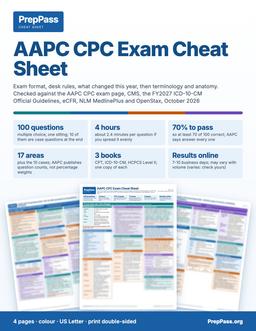
¿Examen en menos de dos semanas?
Esta guía es la enseñanza, para leer durante semanas. Si tu examen es en menos de dos semanas, la hoja de referencia a color imprimible es el otro producto: las cifras clave, por secciones.
4 páginas · US Letter · PDF imprimible · tuyo para siempre
How this book compares
AAPC, which awards the CPC, sells its own study guide. This book follows AAPC's published exam outline area by area; Mometrix sells a CPC study guide with a practice test. None of them replaces the current code books.
| Resource | Price | What you get | Choose it if |
|---|---|---|---|
| This bookCPC Exam Study Guide (2026) — Written to AAPC's Exam OutlinePrepPass | $14.99 | Downloadable study guide written to AAPC's published CPC exam outline
| Choose this book if you want every exam area, the modifier, diagnosis-coding and E/M rules, and worked cases in one downloadable guide. You still need your current code manuals. |
| From the exam body2026 CPC Study Guide (opens the publisher's page in a new tab)AAPC | $149.95; $99.95 for AAPC members | The credentialing body's own study guide
| Choose AAPC's guide if you want the full course-style review from the organization that writes the exam. |
| AlternativeCPC Exam Secrets (opens the publisher's page in a new tab)Mometrix Test Preparation | $28.99 ebook; $33.99 printed book | Study guide with a practice test
| Choose Mometrix if you want a full-length practice test in print. |
This book
CPC Exam Study Guide (2026) — Written to AAPC's Exam Outline
PrepPass
- Price
- $14.99
- What you get
Downloadable study guide written to AAPC's published CPC exam outline
- 500 practice questions, each explained with the rule it rests on
- 480 pages, PDF + EPUB
- Choose it if
- Choose this book if you want every exam area, the modifier, diagnosis-coding and E/M rules, and worked cases in one downloadable guide. You still need your current code manuals.
From the exam body
2026 CPC Study Guide (opens the publisher's page in a new tab)
AAPC
- Price
- $149.95; $99.95 for AAPC members
- What you get
The credentialing body's own study guide
- Ten review questions per chapter and 200+ Test Your Knowledge questions with answers and rationales
- Choose it if
- Choose AAPC's guide if you want the full course-style review from the organization that writes the exam.
Alternative
CPC Exam Secrets (opens the publisher's page in a new tab)
Mometrix Test Preparation
- Price
- $28.99 ebook; $33.99 printed book
- What you get
Study guide with a practice test
- A full-length practice test with detailed answer explanations; 5th edition (per the product title)
- Choose it if
- Choose Mometrix if you want a full-length practice test in print.
Other resources' prices and contents are as listed on each publisher's or seller's own page, checked September 24, 2026. Prices change; confirm on the linked page before you buy. This book's price and contents come from our own catalog.
Sources (2)
- https://www.aapc.com/shop2/study-guides/cpc-study-guide.aspx — read September 24, 2026
- https://www.mometrix.com/studyguides/cpc/ — read September 24, 2026
Qué incluye — y qué no
Incluido
- Who this book is for: exam review written to AAPC's published outline, for people who have taken or are taking a coding course. A short Start Here part orients newer readers and Chapters 1-3 give the foundations (exam method, medical terminology, anatomy), but it does not replace training: it is not an introduction to medical coding and not a code book
- A chapter for every area on AAPC's published CPC outline — terminology, anatomy, compliance, coding guidelines, ICD-10-CM, HCPCS Level II, the six CPT surgery series, radiology, pathology and laboratory, medicine, E/M and anesthesia — plus the case section, with AAPC's question counts shown against each
No incluido
- No se envía copia impresa — es un archivo que descargas y puedes imprimir tú
- El libro no incluye curso en vídeo, instructor ni tutorías — los vídeos gratis del sitio van aparte
Todo lo incluido y todo lo que no
Incluido
- A Start Here part before Chapter 1 for readers new to coding: how a claim travels, the three code sets, a six-step lookup method worked through one case, a decoder for the abbreviations, how to read the citations, a beginner reading order with a week-by-week study plan, and a warm-up quiz with explained answers — a map for the exam-review chapters, not a replacement for training
- Modifiers taught by function, the ICD-10-CM Official Guidelines (FY2026, with the FY2027 changes flagged), NCCI edits and the Medicare global surgical package, each rule cited to its CMS or CDC source
- A key-facts box, worked examples and a list of named exam traps in every chapter, and a chapter on working an open-book exam
- A chapter of ten fully worked coding cases, and ten practice cases of your own to code
- 500 practice questions in sets that follow AAPC's published counts, each explained with the rule it rests on and its source
- An independent exam-review guide, not AAPC- or AMA-affiliated, not a code book and not a course — keep your current CPT, ICD-10-CM and HCPCS manuals beside it
- PDF (print & tab it) + EPUB (phone / e-reader)
No incluido
- No incluye tu inscripción al examen ni la tasa del centro, que sigues pagando al organismo oficial
Contenido
Ver 35 secciones y la página en la que empieza cada una
- PART I — FOUNDATIONSp. 44
- Chapter 1 — Working an Open- Book Examp. 45
- Chapter 2 — Medical Terminologyp. 51
- Chapter 3 — Anatomy by Body Systemp. 57
- PART II — THE RULES THAT GOVERN EVERY CODEp. 66
- Chapter 4 — Compliance and Regulatoryp. 67
- Chapter 5 — CPT Conventions and Guidelinesp. 79
- Chapter 6 — Modifiersp. 86
- Chapter 7 — ICD-10-CM: Structure, Conventions and General Guidelinesp. 97
- Chapter 8 — ICD-10-CM: Chapter-Specific and Outpatient Guidelinesp. 107
- Chapter 9 — HCPCS Level IIp. 119
- PART III — CPT SURGERY BY SERIESp. 128
- Chapter 10 — Surgery Rules: Global Package, Separate Procedure, Multiple Proceduresp. 129
- Chapter 11 — Integumentary System (10000 Series)p. 137
- Chapter 12 — Musculoskeletal System (20000 Series)p. 145
- Chapter 13 — Respiratory, Cardiovascular, Hemic and Lymphatic, Mediastinum (30000 Series)p. 154
- Chapter 14 — Digestive System (40000 Series)p. 164
- Chapter 15 — Urinary, Genital, Maternity and Endocrine (50000 Series)p. 173
- Section I.C.15 is unchanged in FY2027 (effective October 1, 2026).p. 178
- Chapter 16 — Nervous System (60000 Series), with an Eye and Ear Orientationp. 182
- PART IV — RADIOLOGY, PATHOLOGY AND LABORATORY, MEDICINE, E/M, ANESTHESIAp. 189
- Chapter 17 — Radiologyp. 190
- Chapter 18 — Pathology and Laboratoryp. 201
- Chapter 19 — Medicinep. 210
- Chapter 20 — Evaluation and Managementp. 220
- Chapter 21 — Anesthesiap. 232
- PART V — CASESp. 239
- Chapter 22 — Coding the Casesp. 240
- PART VI — APPENDICESp. 250
- Appendix A — Quick Referencep. 251
- Appendix B — Glossary and Abbreviationsp. 261
- Appendix C — Exam-Day Checklist and Time Planp. 266
- Appendix D — Sources and Datesp. 271
- PART VII — PRACTICE QUESTIONSp. 274
- PART VIII — ANSWER KEY AND EXPLANATIONSp. 402
Tomado del PDF que descargas, con la página en la que empieza cada uno — no escrito a mano aquí.
Lee un capítulo completo gratis
Un capítulo completo, tal como viene en el eBook. Desplázate en la ventana para leerlo aquí; sin descargas ni correo.
Lee el capítulo 6 aquí, sin salir de la página
The free chapter is Chapter 6, Modifiers, one of the harder chapters, where one wrong choice changes the whole claim. It shows the level of Chapter 5 onward: exam review that assumes you can already find a code in your code books. If you are new to coding, the Start Here part before Chapter 1 is written for you; this guide does not replace training.
On the exam: AAPC lists Coding guidelines as 7 of the 100 questions (7 percent of the questions), and names modifier use as one of its three parts, beside the ICD-10-CM Official Guidelines and the CPT guidelines and parenthetical notes. HCPCS Level II is a separate area of 3 of the 100 questions (3 percent) that also covers modifiers (Chapter 9). Some questions from other areas also use this material: surgery, radiology, laboratory and E/M questions often turn on a modifier.
A modifier is a two-character addition that tells the payer how a service was performed without changing what the code describes. CPT modifiers are in Appendix A, HCPCS modifiers in the HCPCS Level II file. Learn what each modifier signals and the test it must pass; read the exact definition in your book.
6.1 The rules that apply to every modifier
- Justify with facts, not edits. A modifier is appended "only if the clinical circumstances justify" it and never "solely to bypass an NCCI PTP edit" (NCCI Policy Manual, Chapter I, section E).
- Four modifiers per line, payment-changing ones first (payers differ). The CMS-1500 holds four (Medicare Claims Processing Manual, Chapter 26, section 10.4, item 24D). Modifier 99 means more apply than fit, and the full list goes in item 19.
6.2 Evaluation and management modifiers: 24, 25, 57
| Modifier | What it tells the payer | Right when | Wrong when |
|---|---|---|---|
| 24 | Unrelated E/M by the same physician in a postoperative period | The visit is for a different problem than the surgery | Routine recovery or a complication |
| 25 | Significant, separately identifiable E/M the same day as a procedure or other service | Work goes beyond the usual pre- and post-procedure work | It only covers the decision to do a minor procedure |
| 57 | The E/M at which the decision for surgery was made | A major (90-day global) surgery follows; the visit is the day before or the day of | Minor procedure (0 or 10 day global) |
- 24. A diagnosis that clearly shows the visit is unrelated is acceptable (Claims Processing Manual, Chapter 12, section 40.2.A.7). Prepayment edits catch global-period E/M services billed without 24, 25, 57, 78 or 79 (section 40.3.B).
- 25. NCCI allows 25 for an E/M on the day of a minor procedure (global 000 or 010) or an XXX procedure. The diagnosis may be the same or different, a new patient alone is not enough, and deciding to do a minor procedure is included in the procedure (NCCI Chapter I, sections D and E.b). 25 goes on the E/M, never on the procedure.
- 57. Medicare bills the E/M that results in the decision for a major surgery, the day before or the day of, with 57 and "not 25." Not used with minor surgery, whose global does not include the day before (Claims Processing Manual, Chapter 12, section 40.2.A.4).
6.3 Global-period surgery modifiers
Chapter 10 explains the global package; these modifiers describe who did what inside it.
| Modifier | Meaning | Key test |
|---|---|---|
| 58 | Staged, planned, more extensive, or therapeutic procedure by the same physician in the global period | Planned or anticipated, not a complication |
| 78 | Unplanned return to the operating room for a related procedure | Related, and an operating room is needed |
| 79 | Unrelated procedure by the same physician in the global period | Unrelated to the first surgery |
| 54 / 55 / 56 | Surgical care only / postoperative care only / preoperative care only | Care split between physicians |
| 62 / 66 | Two surgeons on one procedure / surgical team | Each reports the same code with 62 or 66 |
| 80 / 81 / 82 / AS | Assistant at surgery | 81 minimum assistant; 82 no qualified resident available; AS physician assistant, nurse practitioner or clinical nurse specialist |
| 63 | Procedure on an infant | CPT limits it by patient size and code; read Appendix A |
Medicare rules (Claims Processing Manual, Chapter 12, sections 40.2.A and 40.8).
- 58 and 79. Both start a new postoperative period. 58 is not for a problem that requires a return to the OR (sections 40.2.A.6-7).
- 78. Needs a return to a place "specifically equipped and staffed for the sole purpose of performing procedures": for example a cardiac catheterization, laser or endoscopy suite. A patient room, minor treatment room, recovery room or ICU generally does not (section 40.1.B). Bill the code for the procedure done on the return, not the original code, unless the identical procedure repeats (section 40.2.A.5).
- 54 and 55. Same date of service, same procedure code, written transfer of care. The receiving physician cannot bill until providing at least one service (section 40.2.A.3). 56 is CPT-only.
- 62. Each co-surgeon is paid 62.5 percent of the fee schedule amount. Team surgery (66) is paid by report (section 40.8.B).
- 80, 81, 82, AS. Physician assistant-at-surgery payment is 16 percent of the amount otherwise applicable. Medicare may not pay an assistant where physicians assist in fewer than 5 percent of cases (section 20.4.3), or when co-surgeons or a team are paid (section 40.9).
6.4 Multiples, bilateral, repeats, reduced and discontinued services
50 (bilateral). For a procedure not already described as bilateral, Medicare wants one line with 50, paid at 150 percent when the bilateral indicator is 1. The manual notes this "differs from the CPT coding guidelines" (two line items) (Chapter 12, section 40.7.B). If the descriptor already says bilateral, or "unilateral or bilateral," do not add 50.
51 (multiple procedures). Medicare says to report the major procedure without 51 and additional ones with 51 (Chapter 12, section 40.6.B), but its system finds multiples on the same day anyway (section 40.6.C.1), so the reduction does not depend on 51. Some MACs say not to append 51 at all because their system adds it (Noridian JF Part B, September 30, 2025). Never append 51 to add-ons or codes designated exempt.
52 and 53. 52 is reduced services, 53 is discontinued. For 22 and 52 Medicare requires a short statement of how the service differs and the operative report (section 40.2.A.10). For 53, the Fee Schedule carries separate RVUs only for colonoscopy codes 44388 and 45378 (and HCPCS G0105 and G0121), paid since 2016 at a rate built from one-half the value of the code's inputs (section 30.1.B). Other codes with 53 are individually priced (CMS RVU26D). 53 is for physician services, not hospital outpatient services (Claims Processing Manual, Chapter 4, section 20.6.4).
73 and 74. Facility versions for hospital outpatient and ASC procedures. 73 is discontinued before anesthesia, paid at 50 percent of the OPPS rate. 74 is discontinued after anesthesia or the start of the procedure, paid at the full rate (Chapter 4, section 20.6.4).
76 and 77. Repeat procedure by the same physician (76) or another physician (77). Neither is PTP-associated, so neither bypasses an edit (NCCI Chapter I, section E).
91, 90, 92. 91 repeats a clinical lab test the same day when medically necessary (NCCI Chapter I, section N); Appendix A limits it further. 90 is reference (outside) laboratory. 92 is CPT's alternate laboratory platform modifier.
6.5 Distinct services: 59 and the X modifiers
NCCI procedure-to-procedure (PTP) edits are code pairs: the Column One code is paid and the Column Two code is denied unless a PTP-associated modifier is clinically appropriate (section A). The PTP-associated modifiers are the anatomic ones (LT, RT, E1-E4, FA, F1-F9, TA, T1-T9 and a few others), the global surgery ones (24, 25, 57, 58, 78, 79), and 27, 59, 91, XE, XS, XP, XU (section E). 22, 76 and 77 are not.
Each edit carries a Correct Coding Modifier Indicator: 0 means PTP-associated modifiers cannot bypass it; 1 means they may, when the facts fit; 9 means "not specified" (section E). Find it on the PTP edit table.
59 shows two procedures at different anatomic sites or different patient encounters. NCCI says it "shall only be used if no other modifier more appropriately describes" the relationship, and that XE, XP, XS and XU "may be used in lieu of modifier 59 whenever possible" (Chapter I, sections E.d and E.e).
| Modifier | Distinct because |
|---|---|
| XE | Separate encounter on the same date (morning clinic, afternoon return) |
| XS | Separate organ, structure, or lesion |
| XP | Separate practitioner |
| XU | Unusual non-overlapping service |
Different diagnoses are not enough: the codes "remain bundled unless the procedures/surgeries are performed at different anatomic sites or separate patient encounters" (section E.d).
6.6 Professional component, technical component, and special-circumstance modifiers
26 and TC. 26 is the professional component (the interpretation); TC is the technical component (equipment and staff). The Fee Schedule PC/TC indicator decides which applies. Indicator 1 codes accept 26 and TC. Indicator 2 codes (93010, ECG interpretation) are professional only and indicator 3 codes (93005, ECG tracing) technical only; on both, 26 and TC "cannot be used" (CMS RVU26D, Attachment A). No modifier means the global service.
22 (increased procedural services). Substantially more work than usual. Medicare asks for a short statement and the operative report, and 22 applies only to codes with a global period of 0, 10 or 90 days (section 40.2.A.10). Payment rises only in "very unusual circumstances" (section 20.4.6). 22 does not bypass an NCCI edit (NCCI Chapter I, section E.a).
6.7 HCPCS Level II modifiers
Titles are from the HCPCS Level II file, October 2026 release.
- Anatomic: LT, RT, E1-E4 (eyelids), FA and F1-F9 (fingers), TA and T1-T9 (toes). They are PTP-associated and can bypass an edit when sites really differ.
- ABN family (Chapter 4): GA (waiver of liability statement on file), GX (voluntary notice of liability), GY (statutorily excluded), GZ (expected to be denied as not reasonable and necessary).
- KX and QW: KX means the medical policy's requirements are met (documented compliance, not a way around denial). QW is a CLIA waived test. Anesthesia modifiers are in Chapter 21.
- JW and JZ: JW reports drug amount discarded; JZ reports none was. Since July 1, 2023, Medicare requires JZ on separately payable single-dose container drugs when nothing was discarded; discarded amounts go on a second line with JW. Neither applies to multi-dose containers (Claims Processing Manual, Chapter 17, section 40).
- Telehealth: CMS names POS 02 (patient not at home) or POS 10 (at home) for Medicare professional claims; the POS sets the rate (CMS Telehealth FAQ, updated 10/8/26, Q8). The Claims Processing Manual also pairs the POS with 93 (audio-only) or 95 (audio and video) (Chapter 26, section 10.5, CY2024 text); the FAQ does not repeat that, so check your MAC.
- GC and FT: GC means a resident performed part of the service under teaching physician direction. FT marks an unrelated E/M on the same day as another E/M or during a global procedure period (HCPCS file; Chapter 12, section 40.2.A.9).
6.8 Reading the payment indicators in the Fee Schedule file
The CMS relative value file (RVU26D layout, CY2026; examples from the October 2026 release) gives each code these indicators.
| Field | Values | Examples |
|---|---|---|
| Multiple procedure | 0 no reduction; 2 standard (100 percent, then 50 percent for the next four, then by report); 3 endoscopy family; 4 imaging TC; 5 therapy practice expense; 6 cardiovascular TC; 7 ophthalmology TC; 9 not applicable | 27447: 2. 29881: 3. 70450: 4. 97110: 5. 99213: 0 |
| Bilateral | 0 no 150 percent; 1 150 percent applies; 2 already bilateral; 3 each side paid at 100 percent (mostly radiology and diagnostic tests); 9 not applicable | 29881: 1. 27395: 2. 70120: 3 |
| Assistant at surgery | 0 restricted unless documented; 1 statutory restriction, may not be paid; 2 may be paid; 9 not applicable | 29881: 0. 43239: 1. 27447: 2 |
| Co-surgeon | 0 not permitted; 1 permitted with documentation; 2 permitted; 9 not applicable | 29881: 0. 27447: 1. 58262: 2 |
| Team surgery | 0 not permitted; 1 with documentation; 2 permitted (both by report); 9 not applicable | 27447: 0. 47999: 1. 33945: 2 |
Indicator 9 fills every field for bundled codes such as 99024. For endoscopy indicator 3 the file carries the family's base code (29881 shows 29870). The bilateral adjustment is applied before the multiple-procedure ranking (RVU26D). Chapter 10 works the arithmetic.
Key facts
- 24, 25, 57 go on E/M codes; 58, 78, 79 on procedures in a global period. Medicare uses 57, not 25, for a decision for major surgery (Ch. 12, section 40.2.A.4).
- 58 planned, 78 unplanned related return to the OR, 79 unrelated.
- Medicare: 50 is one line, 150 percent when the indicator is 1. 62 pays 62.5 percent each. Assistant is 16 percent. Team is by report.
- 59 only when no more specific modifier fits; XE, XS, XP, XU are more specific (NCCI Ch. I, section E).
- PTP-associated modifiers bypass an edit only when its indicator is 1 and the facts fit. 22, 76, 77 never do.
- 73 and 74 are the facility pair; 53 is not for outpatient hospital services.
Preguntas frecuentes
¿Cómo lo recibo?
Paga y la descarga aparece en esta página al instante. Los enlaces también se te envían por correo. No hace falta cuenta.
¿Y si no es para mí?
Escríbenos dentro de 14 días para un reembolso total, sin preguntas.
¿Va a desaparecer la práctica gratis?
No. Todas las preguntas, el simulacro cronometrado y los capítulos gratis del sitio siguen gratis. Este libro es la mitad de estudio, no una valla alrededor de lo gratuito.
Más preguntas (1)
¿Puedo leerlo en el móvil?
Sí — el EPUB es para móviles y e-readers, el PDF para imprimir y marcar. Recibes ambos.
¿Por qué comprar el libro si la práctica es gratis?
Nuestras preguntas de práctica y el simulacro cronometrado siguen gratis: nada del sitio se esconde tras este libro. El libro de $14.99 es la mitad de estudio: el material en sí, explicado en orden, en un archivo tuyo.
- Enseñanza sistemática — cada sección del examen explicada capítulo a capítulo, de principio a fin, no solo preguntas
- Imprímelo y márcalo — un PDF listo para papel que puedes resaltar, anotar y llevar a tu mesa de estudio
- Estudia en cualquier lugar, sin conexión — EPUB en tu teléfono o e-reader; sin wifi, sin pestañas
- Todo en un solo lugar — los capítulos y las preguntas de práctica en un archivo
- Tuyo de por vida — pago único de $14.99, descarga instantánea, sin suscripción
Los detalles
- Verificado con la fuente oficial(AAPC exam pages (read 2026-10-13), ICD-10-CM Official Guidelines FY2026, NCCI Policy Manual 2026, CMS fee schedule and HCPCS files — checked against the primary sources)
- 299 preguntas de práctica gratis
Un AAPC CPC certification course cuesta $1,500–$3,000. Este libro enseña el mismo examen — las mismas reglas, verificadas a los estándares actuales — por un pago único de $14.99 que conservas de por vida.
Compra única, acceso de por vida a la descarga. El eBook es la guía completa de AAPC CPC (Medical Coding) en PDF y EPUB. Resumen educativo, no asesoría profesional ni legal — confirma siempre las reglas vigentes con la fuente oficial. Última actualización: October 2026.