ASVAB · Edición 2026
ASVAB — Complete Study Guide (2026)
All ten ASVAB tests in nine chapters — the four AFQT tests that decide enlistment eligibility taught first, and Assembling Objects included.
- Los 9 capítulos de subpruebas, cada uno con cifras clave, ejemplos resueltos, trampas nombradas y autoevaluación
- Un examen de práctica completo al final, con el razonamiento detrás de cada respuesta
- 8 apéndices de consulta: formulario maestro, fórmulas de puntajes compuestos, raíces, vocabulario, planes de estudio, estrategia del día del examen, preguntas para el reclutador y glosario
$19.99pago único · descarga de por vida · sin suscripción
PDF + EPUB · en inglés · 328 páginas · $19.99 pago único
Este libro está escrito en inglés — el PDF y el EPUB que descargas están en inglés.
Descarga inmediata tras el pago — sin cuenta y sin suscripción.
Garantía de devolución de 14 días: ¿no te convence por cualquier motivo? Escribe a support@preppass.org en los 14 días siguientes a la compra y te devolvemos el importe completo. Es una descarga, así que no hay nada que devolver por correo. Política de reembolso
Datos del examen verificados por última vez con fuentes oficiales: septiembre de 2026.
Prueba primero 10 preguntas — gratis
Responde las 10, y al terminar verás cada respuesta explicada — con la sección de esta guía que la enseña. Unos 5 minutos, sin registro.
Empezar 10 preguntas gratisMira dentro del libro
Tres páginas reales, renderizadas directamente del PDF que descargas — una página de referencia, una de explicación y una pregunta resuelta, siempre en ese orden. Nada se rediseñó para verse mejor.
- Referencia rápidaChapter 3 — Word Knowledge (WK) · Página 71 del PDF
Una página a la que puedes volver: cifras, plazos o términos reunidos en un solo lugar.
- Cómo se enseñaChapter 1 — Scores, Line Scores, and the Job You Actually Want · Página 26 del PDF
Una página de explicación: el material enseñado en prosa, en el orden en que lo evalúa el examen.
- Una pregunta resueltaChapter 1 — Scores, Line Scores, and the Job You Actually Want · Página 21 del PDF
Una pregunta de práctica con su respuesta y el razonamiento detrás — no solo la clave.
¿Preparas ambos? Hay precio de pareja
- ASVAB — Complete Study Guide (2026)$19.99
- ASVAB — Cheat Sheet (2026)$9.99
Compra ambos: $22.99 — ahorras $6.99 frente a comprarlos por separado
Por separado $29.98 · 23% de descuento · Un pago, los dos productos.
¿Ya compraste ASVAB? No compres el paquete — lo incluye y pagarías dos veces por él. Consigue ASVAB por separado por $19.99. ASVAB · Qué incluye →
¿Examen en menos de dos semanas?
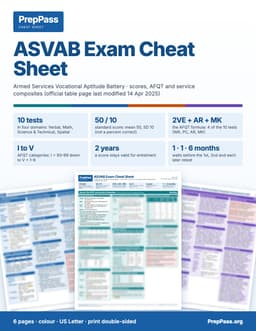
Esta guía es la enseñanza, para leer durante semanas. Si tu examen es en menos de dos semanas, la hoja de referencia a color imprimible es el otro producto: las cifras clave, por secciones.
6 páginas · US Letter · PDF imprimible · tuyo para siempre
Sobre el examen en sí
| Organismo administrador | U.S. Department of Defense Fuente: Official ASVAB — What to Expect When You Take the ASVAB |
|---|---|
| Preguntas | 135 preguntas Fuente: Official ASVAB — ASVAB Fact Sheet, Enlistment Testing Program (PDF, revised April 2025) |
| Tiempo límite | 197 minutos Fuente: Official ASVAB — ASVAB Fact Sheet, Enlistment Testing Program (PDF, revised April 2025) |
| Puntuación para aprobar | No hay nota de aprobación. La elegibilidad para alistarse depende de la puntuación AFQT, que se calcula con cuatro de las pruebas (Arithmetic Reasoning, Mathematics Knowledge, Paragraph Comprehension, Word Knowledge) y se informa como un percentil entre 1-99: una posición frente a una muestra nacional de 1997 de jóvenes de 18 a 23 años, no un porcentaje de respuestas correctas. Las páginas del ASVAB del Departamento de Defensa no indican un AFQT mínimo para alistarse. Lo que leímos y donde no aparece: Official ASVAB — Understanding ASVAB Scores |
| Tarifas | No publicado por U.S. Department of Defense Lo que leímos y donde no aparece: Official ASVAB — What to Expect When You Take the ASVAB |
| Idiomas disponibles | Inglés Fuente: Official ASVAB — Frequently Asked Questions (applicants) |
Qué incluye — y qué no
Incluido
- Key numbers & facts boxed in every test chapter, plus a self-check to close it
- Worked examples with the arithmetic shown, and the common traps named — not just the answer
- All 10 tests in 9 chapters, with the AFQT four (AR, WK, PC, MK) taught first — Assembling Objects included
- Math and algebra/geometry worked step by step with checked arithmetic
- General science, electronics, mechanical, and auto & shop review
- Word Knowledge roots and Paragraph Comprehension strategy
- 120 original practice questions with answer explanations
- PDF (print & tab it) + EPUB (phone / e-reader)
No incluido
- No se envía copia impresa — es un archivo que descargas y puedes imprimir tú
- El libro no incluye curso en vídeo, instructor ni tutorías — los vídeos gratis del sitio van aparte
- No incluye tu inscripción al examen ni la tasa del centro, que sigues pagando al organismo oficial
Contenido
Ver 26 secciones y la página en la que empieza cada una
- Part I — What the ASVAB actually decidesp. 6
- Chapter 1 — Scores, Line Scores, and the Job You Actually Wantp. 6
- Part II — The nine tests, taughtp. 6
- Answer Key with Explanations.p. 8
- Chapter 2 — Arithmetic Reasoning (AR)p. 41
- Chapter 3 — Word Knowledge (WK)p. 70
- Chapter 4 — Paragraph Comprehension (PC)p. 102
- Chapter 5 — Mathematics Knowledge (MK)p. 122
- Part I — The coordinate plane Quantity Formulap. 145
- Chapter 6 — General Science (GS)p. 150
- Part I — Astronomyp. 168
- Chapter 7 — Electronics Information (EI)p. 174
- Part I — Magnetism and machinesp. 191
- Chapter 8 — Mechanical Comprehension (MC)p. 196
- Chapter 9 — Auto & Shop Information (AS)p. 220
- Part I — Shop: cutting, striking, driving, grippingp. 236
- Chapter 10 — Assembling Objects (AO)p. 246
- Answer Key with Explanationsp. 283
- Appendix A — Master formula & fact sheetp. 295
- Appendix B — The composite formulas, on one pagep. 306
- Appendix C — Word parts for Word Knowledgep. 309
- Appendix D — High-frequency vocabularyp. 315
- Appendix E — Study plansp. 320
- Appendix F — Exam-day strategyp. 322
- Appendix G — What to ask your recruiterp. 324
- Appendix H — Glossary of key termsp. 326
Tomado del PDF que descargas, con la página en la que empieza cada uno — no escrito a mano aquí.
Lee un capítulo completo gratis
Un capítulo completo, tal como viene en el eBook. Desplázate en la ventana para leerlo aquí; sin descargas ni correo.
Lee el capítulo 5 aquí, sin salir de la página
No te dimos la introducción fácil — el capítulo gratis abre en una de las partes más exigentes del libro, para que juzgues la enseñanza donde el examen se pone difícil.
AFQT test. Appears in 11 of the 19 published service composites — and is doubled in the Navy's Basic Electricity and Electronics composite.
Introduction
Arithmetic Reasoning hides the math inside a story. Mathematics Knowledge hands it to you directly: solve this equation, simplify this expression, find this area, evaluate this exponent. There is no translation step, which means there is nowhere to hide either. You either know the rule or you do not.
That makes MK the most memorizable of the four AFQT tests, and therefore the fastest one to improve. Every formula this test uses fits on one sheet of paper — Appendix A of this book is that sheet. A candidate with three weeks and a weak MK score is in a far better position than a candidate with three weeks and a weak WK score, because a formula can be learned on Tuesday and used on Wednesday.
MK also does double duty. The same algebra that MK tests directly is the algebra you need for Ohm's law in Chapter 7 and for mechanical advantage in Chapter 8. Learning to rearrange a formula here pays off in two more chapters.
This chapter works thirty-three examples across every topic the test uses. Work them with a pencil.
Learning objectives
After working this chapter you should be able to:
- Apply the order of operations correctly, including to nested and signed expressions.
- Use the laws of exponents and simplify square roots.
- Identify factors, multiples, primes, the greatest common factor and the least common multiple.
- Add, subtract, multiply and divide fractions, including mixed numbers.
- Combine like terms, distribute, multiply two binomials, and factor simple quadratics.
- Solve one-step, two-step and variables-on-both-sides linear equations, and check by substitution.
- Rearrange a formula to isolate any variable in it.
- Solve linear inequalities, including the sign flip.
- Solve a system of two linear equations by substitution or elimination.
- Apply the angle rules for lines, triangles and parallel lines cut by a transversal.
- Use the Pythagorean theorem and recognise the common triples and special right triangles.
- Compute perimeter, area, circumference, volume and surface area for the standard figures.
- Find slope, midpoint and distance on the coordinate plane.
Key formulas & facts
| Topic | Formula / rule |
|---|---|
| Order of operations | Parentheses → Exponents → Multiply/Divide (left to right) → Add/Subtract (left to right) |
| Exponent: product | aᵐ × aⁿ = aᵐ⁺ⁿ |
| Exponent: quotient | aᵐ ÷ aⁿ = aᵐ⁻ⁿ |
| Exponent: power of a power | (aᵐ)ⁿ = aᵐⁿ |
| Exponent: zero | a⁰ = 1 (for a ≠ 0) |
| Exponent: negative | a⁻ⁿ = 1 ÷ aⁿ |
| Square root | √a × √b = √(ab); √144 = 12 |
| Signed numbers | Subtracting a negative adds; a negative times a negative is positive |
| Distribution | a(b + c) = ab + ac |
| FOIL | (a + b)(c + d) = ac + ad + bc + bd |
| Difference of squares | a² − b² = (a + b)(a − b) |
| Perfect square | (a + b)² = a² + 2ab + b² |
| Solving equations | Do the same inverse operation to both sides |
| Inequalities | Multiplying or dividing by a negative reverses the inequality sign |
| Straight angle | 180 degrees; a full turn is 360 degrees |
| Complementary / supplementary | Sum to 90 / sum to 180 degrees |
| Triangle angle sum | 180 degrees |
| Pythagorean theorem | a² + b² = c², c the hypotenuse |
| Common triples | 3-4-5, 5-12-13, 8-15-17, and any multiple |
| 45-45-90 triangle | legs x, x; hypotenuse x√2 |
| 30-60-90 triangle | short leg x, long leg x√3, hypotenuse 2x |
| Area of a triangle | ½ × base × height |
| Rectangle | area = lw; perimeter = 2l + 2w |
| Parallelogram / trapezoid | bh / ½(b₁ + b₂)h |
| Circle | circumference = 2πr = πd; area = πr² (π ≈ 3.14) |
| Rectangular solid | volume = lwh; surface area = 2(lw + lh + wh) |
| Cube | volume = s³; surface area = 6s² |
| Cylinder | volume = πr²h |
| Slope | (y₂ − y₁) ÷ (x₂ − x₁) |
| Midpoint | ((x₁ + x₂)/2 , (y₁ + y₂)/2) |
| Distance | √((x₂ − x₁)² + (y₂ − y₁)²) |
Part A — Number properties and operations
Order of operations
Evaluate in this order, and never out of it:
- Parentheses (and anything inside a radical or above/below a fraction bar, which act as invisible parentheses)
- Exponents
- Multiplication and division, left to right — they have equal priority
- Addition and subtraction, left to right — equal priority
The two places people go wrong are both about "equal priority." Multiplication does not outrank division, and addition does not outrank subtraction. When operations of equal priority sit side by side, work left to right.
Worked example 1 — order of operations, written out
Evaluate 4² + 3³.
Exponents first. 4² = 4 × 4 = 16. 3³ = 3 × 3 × 3 = 27. Then add. 16 + 27 = 43. The trap. Adding first: 4 + 3 = 7, then something with the exponents. Exponents outrank addition, always.
Worked example 2 — equal priority, left to right
Evaluate 24 ÷ 6 × 2.
Division and multiplication have equal priority, so work left to right. 24 ÷ 6 = 4. Then 4 × 2 = 8. The trap. Doing the multiplication first because "multiplication comes before division in the mnemonic": 6 × 2 = 12, then 24 ÷ 12 = 2. That gives 2, which is wrong, and 2 will be among the choices. The rule to fix in your mind. The mnemonic lists multiplication and division together on one line, and addition and subtraction together on another. Within a line, left to right.
Worked example 3 — nested parentheses and a negative
Evaluate 3 × (8 − (5 − 9)) ÷ 2.
Innermost parentheses first. 5 − 9 = −4. Next parentheses. 8 − (−4). Subtracting a negative adds: 8 + 4 = 12. Now left to right through the multiplication and division. 3 × 12 = 36. Then 36 ÷ 2 = 18. The two traps in one problem. Doing 8 − 5 first (ignoring the inner parentheses) and mishandling the double negative. Write each stage on its own line; that is what stops both.
Exponents
An exponent counts repeated multiplication: 3³ = 3 × 3 × 3 = 27. The laws you need:
- Same base, multiplying — add the exponents. 2³ × 2⁴ = 2⁷ = 128.
- Same base, dividing — subtract the exponents. 5⁶ ÷ 5² = 5⁴ = 625.
- A power raised to a power — multiply the exponents. (3²)³ = 3⁶ = 729.
- Anything to the zero power is 1 (except zero itself). 7⁰ = 1.
- A negative exponent means the reciprocal. 2⁻³ = 1 ÷ 2³ = 1/8.
Worked example 4 — the exponent laws, applied
Simplify (2³ × 2²) ÷ 2⁴.
Numerator — same base, multiplying, so add exponents. 2³ × 2² = 2⁵. Now divide — same base, so subtract exponents. 2⁵ ÷ 2⁴ = 2¹ = 2. Check the long way. 8 × 4 = 32; 32 ÷ 16 = 2. ✓ The trap. Multiplying the exponents in the numerator: 3 × 2 = 6, giving 2⁶ ÷ 2⁴ = 4. Exponents multiply only when a power is raised to a power, not when two powers are multiplied.
Square roots
The square root of a number is the value that, multiplied by itself, gives it: √144 = 12 because 12 × 12 = 144.
Memorize the perfect squares to 15 — they appear constantly, in geometry as well as here:
| n | 1 | 2 | 3 | 4 | 5 | 6 | 7 | 8 | 9 | 10 | 11 | 12 | 13 | 14 | 15 |
|---|---|---|---|---|---|---|---|---|---|---|---|---|---|---|---|
| n² | 1 | 4 | 9 | 16 | 25 | 36 | 49 | 64 | 81 | 100 | 121 | 144 | 169 | 196 | 225 |
Simplifying a root: pull out the largest perfect-square factor. √50 = √(25 × 2) = √25 × √2 = 5√2.
Worked example 5 — simplifying a radical
Simplify √72.
Find the largest perfect square that divides 72. The perfect squares are 4, 9, 16, 25, 36… and 36 divides 72. 72 = 36 × 2. √72 = √36 × √2 = 6√2. Check it numerically. 6 × 1.414 ≈ 8.49, and 8.49² ≈ 72.1. ✓ A slower but safe route if you do not spot 36: 72 = 4 × 18, so √72 = 2√18; then 18 = 9 × 2, so 2√18 = 2 × 3√2 = 6√2. Same answer. Pulling out squares in stages always works.
Factors, multiples, primes
- A factor divides a number evenly. The factors of 12 are 1, 2, 3, 4, 6, 12.
- A multiple is that number times a whole number. The multiples of 12 are 12, 24, 36, 48…
- A prime has exactly two factors, 1 and itself: 2, 3, 5, 7, 11, 13, 17, 19, 23, 29. Two is the only even prime, and 1 is not prime.
- The greatest common factor (GCF) is the largest number dividing both.
- The least common multiple (LCM) is the smallest number both divide into.
Worked example 6 — GCF and LCM
Find the GCF and the LCM of 12 and 18.
Prime-factorize both. 12 = 2 × 2 × 3 = 2² × 3 18 = 2 × 3 × 3 = 2 × 3² GCF — take the lowest power of each shared prime. Shared primes are 2 and 3. Lowest power of 2 is 2¹; lowest power of 3 is 3¹. GCF = 2 × 3 = 6. LCM — take the highest power of every prime that appears. Highest power of 2 is 2²; of 3 is 3². LCM = 4 × 9 = 36. Check both. 6 divides 12 and 18. ✓ 36 is divisible by 12 (three times) and by 18 (twice). ✓ A useful cross-check. GCF × LCM = the product of the two numbers: 6 × 36 = 216, and 12 × 18 = 216. ✓ That identity holds for any pair and is a free way to catch an error.
Signed numbers
Three rules cover almost everything:
- Subtracting a negative is adding. 5 − (−3) = 5 + 3 = 8.
- A negative times a negative is positive; a negative times a positive is negative.
- A negative raised to an even power is positive; to an odd power, negative. (−2)² = 4, but (−2)³ = −8.
And one notational trap: −2² and (−2)² are different. Without parentheses, the exponent attaches to the 2 alone and the minus sign is applied afterwards: −2² = −(2²) = −4. With parentheses, the whole −2 is squared: (−2)² = +4.
Part B — Fractions
The four operations
- Multiply: multiply straight across, then reduce. (2/3) × (3/4) = 6/12 = 1/2.
- Divide: invert the second fraction and multiply. (2/3) ÷ (3/4) = (2/3) × (4/3) = 8/9.
- Add or subtract: get a common denominator first, then combine the numerators only.
- Mixed numbers: convert to improper fractions before doing anything else.
Worked example 7 — adding fractions with unlike denominators
Compute 3/4 + 5/6.
Find the LCM of the denominators. 4 = 2², 6 = 2 × 3, so the LCM is 2² × 3 = 12. Convert both. 3/4 = 9/12 (multiply top and bottom by 3). 5/6 = 10/12 (multiply top and bottom by 2). Add the numerators only. 9/12 + 10/12 = 19/12. Convert to a mixed number. 19 ÷ 12 = 1 remainder 7, so 1 7/12. The trap, named. Adding denominators: 3/4 + 5/6 = 8/10. This is the most common fraction error there is. Denominators tell you what size the pieces are; you do not add the sizes, you make them the same and then add how many you have.
Worked example 8 — dividing mixed numbers
Compute 2½ ÷ 1¼.
Convert to improper fractions first. 2½ = (2 × 2 + 1)/2 = 5/2. 1¼ = (1 × 4 + 1)/4 = 5/4. Divide by inverting the second and multiplying. (5/2) ÷ (5/4) = (5/2) × (4/5). Cancel before multiplying — it keeps the numbers small. The 5s cancel; 4 ÷ 2 = 2. Result: 2. Check. 1¼ × 2 = 2½. ✓ The trap. Trying to divide the whole parts and the fractions separately. Convert to improper fractions and the problem becomes mechanical.
Worked example 9 — comparing fractions without decimals
Which is larger, 5/8 or 7/11?
Cross-multiply, comparing the products in the right positions. 5 × 11 = 55 (this belongs to 5/8) 7 × 8 = 56 (this belongs to 7/11) 56 > 55, so 7/11 is larger. Check with decimals. 5/8 = 0.625; 7/11 = 0.636… ✓ Why cross-multiplication works. You are multiplying both fractions by the same positive quantity (8 × 11), which cannot change which is bigger. It is faster than long division and it does not round.
Antes de comprar
- ¿Cómo lo recibo?
- Paga y la descarga aparece en esta página al instante. Los enlaces también se te envían por correo. No hace falta cuenta.
- ¿Y si no es para mí?
- Escríbenos dentro de 14 días para un reembolso total, sin preguntas.
- ¿Va a desaparecer la práctica gratis?
- No. Todas las preguntas, el simulacro cronometrado y los capítulos gratis del sitio siguen gratis. Este libro es la mitad de estudio, no una valla alrededor de lo gratuito.
- ¿Puedo leerlo en el móvil?
- Sí — el EPUB es para móviles y e-readers, el PDF para imprimir y marcar. Recibes ambos.
Los detalles
All ten ASVAB tests in nine chapters — the four AFQT tests that decide enlistment eligibility taught first, and Assembling Objects included.
- Format: PDF + EPUB download · 328 pages
- 120 practice questions in the book, with a full answer key
- 800 free practice questions for this exam on PrepPass, included at no cost
- $19.99 one-time — no subscription
- 14-day money-back guarantee · refund policy
- Cross-referenced against: ASVAB subtest outline / officialasvab.com
- Last updated: September 2026
- Verificado con la fuente oficial(ASVAB subtest outline / officialasvab.com)
- 800 preguntas de práctica gratis
- Descarga instantánea, tuyo de por vida
Un ASVAB prep course cuesta $88–$118. Este libro enseña el mismo examen — las mismas reglas, verificadas a los estándares actuales — por un pago único de $19.99 que conservas de por vida.
¿Por qué comprar el libro si la práctica es gratis?
Nuestras preguntas de práctica y el simulacro cronometrado siguen gratis: nada del sitio se esconde tras este libro. El libro de $19.99 es la mitad de estudio: el material en sí, explicado en orden, en un archivo tuyo.
- Enseñanza sistemática — cada sección del examen explicada capítulo a capítulo, de principio a fin, no solo preguntas
- Imprímelo y márcalo — un PDF listo para papel que puedes resaltar, anotar y llevar a tu mesa de estudio
- Estudia en cualquier lugar, sin conexión — EPUB en tu teléfono o e-reader; sin wifi, sin pestañas
- Todo en un solo lugar — los capítulos y las preguntas de práctica en un archivo
- Tuyo de por vida — pago único de $19.99, descarga instantánea, sin suscripción
Y sin riesgo: Garantía de reembolso de 14 días — ¿no te convence? Escríbenos para un reembolso total, sin preguntas. Consulta la política de reembolso.
Garantía de reembolso de 14 días · reembolso total, sin preguntas.
Compra única, acceso de por vida a la descarga. El eBook es la guía completa de ASVAB en PDF y EPUB. Resumen educativo, no asesoría profesional ni legal — confirma siempre las reglas vigentes con la fuente oficial. Última actualización: September 2026.