HESI A2 Admission Assessment · Edición 2026
HESI A2 Exam — Complete Study Guide (2026)
Seven subjects — Math, Reading, Vocabulary, Grammar, Biology, Chemistry, and Anatomy & Physiology — with worked examples in every one but Grammar; each nursing program sets its own cut score.
- Las 7 áreas temáticas que cubre, en un PDF + EPUB que conservas
- Una lista de trampas frecuentes del examen y una autoevaluación al cierre de cada una de las 7 materias
- Una prueba de práctica completa al final, con el razonamiento detrás de cada respuesta
$29.99pago único · descarga de por vida · sin suscripción
PDF + EPUB · en inglés · 780 páginas · $29.99 pago único
Este libro está escrito en inglés — el PDF y el EPUB que descargas están en inglés.
Descarga inmediata tras el pago — sin cuenta y sin suscripción.
Garantía de devolución de 14 días: ¿no te convence por cualquier motivo? Escribe a support@preppass.org en los 14 días siguientes a la compra y te devolvemos el importe completo. Es una descarga, así que no hay nada que devolver por correo. Política de reembolso
Léelo antes de comprar: Your nursing program chooses which HESI A2 sections you sit and sets its own score requirement — there is no single national HESI exam.
Leer el resto de este aviso
This guide covers Math, Reading, Vocabulary, Grammar, Biology, Chemistry and Anatomy & Physiology. It does not cover Physics, Critical Thinking, or the personality and learning-style inventories some programs add. Check your program's own requirement before you buy.
Prueba primero 10 preguntas — gratis
Responde las 10, y al terminar verás cada respuesta explicada — con la sección de esta guía que la enseña. Unos 5 minutos, sin registro.
Empezar 10 preguntas gratisMira dentro del libro
Tres páginas reales, renderizadas directamente del PDF que descargas — una página de referencia, una de explicación y una pregunta resuelta, siempre en ese orden. Nada se rediseñó para verse mejor.
- Referencia rápidaPágina 187 del PDF
Una página a la que puedes volver: cifras, plazos o términos reunidos en un solo lugar.
- Cómo se enseñaPágina 406 del PDF
Una página de explicación: el material enseñado en prosa, en el orden en que lo evalúa el examen.
- Una pregunta resueltaPágina 502 del PDF
Una pregunta de práctica con su respuesta y el razonamiento detrás — no solo la clave.
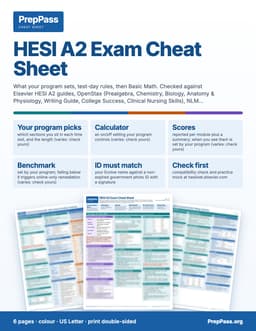
¿Examen en menos de dos semanas?
Esta guía es la enseñanza, para leer durante semanas. Si tu examen es en menos de dos semanas, la hoja de referencia a color imprimible es el otro producto: las cifras clave, por secciones.
6 páginas · US Letter · PDF imprimible · tuyo para siempre
Qué incluye — y qué no
Incluido
- Math, Reading, Vocabulary, Grammar, Biology, Chemistry and Anatomy & Physiology — the areas Elsevier's own review book covers
- Nursing math worked step by step (fractions, ratios, conversions)
- Reading, vocabulary, and grammar strategy with modeled questions
- Biology, chemistry, and anatomy science review
- 120 original practice questions with answer explanations
- PDF (print & tab it) + EPUB (phone / e-reader)
No incluido
- No se envía copia impresa — es un archivo que descargas y puedes imprimir tú
- El libro no incluye curso en vídeo, instructor ni tutorías — los vídeos gratis del sitio van aparte
- No incluye tu inscripción al examen ni la tasa del centro, que sigues pagando al organismo oficial
Lee un capítulo completo gratis
Un capítulo completo, tal como viene en el eBook. Desplázate en la ventana para leerlo aquí; sin descargas ni correo.
Lee el capítulo 1 aquí, sin salir de la página
Everyday arithmetic done by hand — fractions, decimals, percents, ratios, conversions and simple algebra, with every method shown the way you would write it on paper.
Introduction
What this section really tests
The maths on a nursing-school admission assessment is not hard mathematics. There is no trigonometry, no quadratic formula, no geometry proof. What there is instead is a long list of small, ordinary calculations — a fraction added to a fraction, a weight turned from pounds into kilograms, a percentage taken off a price, a proportion scaled up — done accurately, one after another, under time pressure.
That distinction matters because it tells you where the points are actually lost. Candidates rarely fail this section because they do not know that you need a common denominator. They fail it because they found the common denominator, converted one fraction correctly, forgot to convert the other, and produced a number that was on the answer list anyway. The exam's wrong answers are not random. They are the results of the specific slips a rushed person makes, printed out and offered back to you as plausible choices.
So the skill being tested is not really "fractions." It is arithmetic reliability — the ability to run a four-step calculation by hand and arrive at the right number on the first attempt, then prove it was right in five seconds. Everything in this chapter is organized around that.
The content areas are stable and small: whole-number arithmetic, fractions, decimals, ratios and proportions, percentages, basic algebra, and measurement conversions including the metric system, household measures and temperature. Programs commonly weight this area heavily in admission decisions, and it is the area where focused practice pays back fastest, because unlike vocabulary or anatomy, there is nothing to memorize that you do not already half-know. You are tightening a method, not learning a subject.
The two habits that protect the score
Habit one: write it down and line it up. Almost every maths error on this test is a transcription error or a place-value error, not a conceptual one. You read 0.05 and wrote 0.5. You carried the 1 into the wrong column. You copied 154 from the question and worked with 145. None of those are failures of understanding, and none of them can be prevented by understanding harder. They are prevented by writing each number on its own line, with the digits stacked in vertical columns, and by reading the question a second time before you start.
Habit two: estimate before you compute. Before you do the real arithmetic, produce a rough answer in your head from round numbers. If 154 ÷ 2.2 should be "a bit less than 154 ÷ 2, so somewhere around 70," then an answer of 7 or 700 or 33.9 is visibly wrong before you check anything else. An estimate does not tell you that your answer is right. It tells you instantly when your answer is impossible, and a misplaced decimal point is the single most common way to produce an impossible answer.
Those two habits together catch the large majority of the errors this section punishes. Everything else in this chapter is technique built on top of them.
How to use this chapter
Work every example with a pencil before you read the solution. Reading a worked example is not practice; reproducing it is. When you get an answer that differs from the book's, do not scan the solution for the line where you went wrong — redo the whole problem from the original numbers first, because in about half of those cases the error is a copying slip that you will repeat if you only look at the middle.
Work everything by hand. Do not reach for a phone. A student who can only get the answer by typing it into something is a student who cannot check it, and checking is most of what this chapter teaches. Hand methods on numbers this small are also genuinely faster once they are fluent: 25 × 48 is one second of mental work and about eight seconds of typing.
Finally, do not skip the "wrong turn" paragraphs. Each one names a specific error and, more usefully, the specific wrong number that error produces. Recognizing that number on an answer list is a second line of defense.
### Remember this | Habit | What it prevents | |---|---| | Write each number on its own line, digits in columns | Carrying errors, place-value slips | | Re-read the question before computing | Working with the wrong number entirely | | Estimate first from round numbers | Misplaced decimal points, inverted divisions | | Reverse the operation to check | Nearly everything else | Wrong answers on this test are manufactured from predictable mistakes. If your answer appears on the list, that is not proof it is right.
Arithmetic without a calculator
Estimate first, compute second
An estimate is a cheap, deliberately sloppy version of the calculation, done with numbers you can handle in your head. Round each figure to one or two significant digits, do the easy operation, and hold the result. Then do the real arithmetic and compare.
The reason this works so well is that the errors hand arithmetic actually produces are not small. A carrying mistake shifts an answer by 10 or 100, not by 0.3. A misplaced decimal point moves it by a factor of ten. An inverted division turns 70 into 0.014. Every one of those is enormous compared with the gap between your estimate and the truth, so a rough estimate separates them cleanly.
Worked example — estimating before a multiplication.
Step 1 — The problem is 312 × 19. Round both numbers: 312 is about 300, and 19 is about 20.
Step 2 — Estimate: 300 × 20 = 6,000. So the true answer should be near 6,000, and slightly under, because you rounded 312 down only a little but rounded 19 up by a whole unit.
Step 3 — Now compute exactly. 312 × 19 is easier as 312 × 20 − 312.
Step 4 — 312 × 20 = 6,240. Subtract 312: 6,240 − 312 = 5,928.
Step 5 — Check against the estimate: 5,928 is just under 6,000, exactly as predicted.
Answer: 5,928. Had you written 592.8 or 59,280, the estimate would have caught it instantly.
The wrong turn. Students skip the estimate because it feels like doing the problem twice. It is not — it is doing a two-second version of the problem. The error it catches most often is the decimal shift: computing 0.4 × 0.05 and writing 0.2. An estimate ("less than a half of a twentieth, so tiny") makes 0.2 obviously wrong, while 0.02 survives.
Place-value discipline
Every digit in a written number has a value that depends only on its column. That is the whole idea of place value, and it is why hand arithmetic works at all: you add ones to ones, tens to tens, hundredths to hundredths, and carry when a column overflows past nine.
The practical consequence is that your columns have to be genuinely vertical. If you write 4.25 + 3.7 as a ragged pair, your eye will line the 7 up under the 5 and you will add seven hundredths to five hundredths. Writing the trailing zero — 3.70 — costs nothing and removes the ambiguity completely.
| Place | Value | Example digit in 3,482.517 |
|---|---|---|
| Thousands | 1000 | 3 |
| Hundreds | 100 | 4 |
| Tens | 10 | 8 |
| Ones | 1 | 2 |
| Tenths | 1/10 = 0.1 | 5 |
| Hundredths | 1/100 = 0.01 | 1 |
| Thousandths | 1/1000 = 0.001 | 7 |
Read that number aloud as "three thousand four hundred eighty-two and five hundred seventeen thousandths." The word "and" marks the decimal point. That habit matters later, when you have to decide whether 0.125 is an eighth or a sixteenth, or whether 2500 mL is more or less than 2.5 L.
Worked example — adding decimals by alignment.
Step 1 — Add 12.4 + 7.65 + 0.083. Write them stacked with the points in one vertical line, and pad every number to three decimal places: 12.400, 7.650, 0.083.
Step 2 — Add the thousandths column: 0 + 0 + 3 = 3.
Step 3 — Add the hundredths column: 0 + 5 + 8 = 13. Write 3, carry 1 into the tenths.
Step 4 — Tenths: 4 + 6 + 0 = 10, plus the carried 1 = 11. Write 1, carry 1 into the ones.
Step 5 — Ones: 2 + 7 + 0 = 9, plus the carried 1 = 10. Write 0, carry 1 into the tens.
Step 6 — Tens: 1 + 0 + 0 = 1, plus the carried 1 = 2.
Step 7 — Assemble: 20.133.
Check by estimating: 12 + 8 + 0 = 20, and the answer is 20.133. Answer: 20.133.
The wrong turn. Adding 12.4 + 7.65 right-aligned instead of point-aligned gives 12.4 stacked as if it were 12.40 shifted — the common result is 19.89 or 8.89, both far from 20. Padding with zeros first makes the mistake impossible.
Checking by reversing the operation
Every arithmetic operation has an inverse, and the inverse is a far better check than redoing the same steps. Redoing the same steps repeats the same mistake, because you will make it in the same place for the same reason. Reversing forces a different calculation.
| You did | Check by |
|---|---|
| Addition | Subtract one addend from the sum; you should get the other |
| Subtraction | Add the answer to the number you subtracted; you should get the start |
| Multiplication | Divide the product by one factor; you should get the other |
| Division | Multiply the quotient by the divisor, add any remainder |
| Converting a unit | Convert back and see whether you land on the original |
| Reducing a fraction | Multiply the reduced fraction back up by the factor you removed |
Worked example — checking a division by multiplying back.
Step 1 — You computed 4,725 ÷ 15 and got 315. Do not re-divide.
Step 2 — Multiply back: 315 × 15. Break it as 315 × 10 + 315 × 5.
Step 3 — 315 × 10 = 3,150. 315 × 5 = 1,575.
Step 4 — 3,150 + 1,575 = 4,725.
Step 5 — That is the original dividend, so 315 is correct.
Answer: 315, confirmed.
The wrong turn. Checking by re-reading your own work is not checking. If you divided 4,725 by 15 and got 305 because you dropped a digit in the middle, reading the same page again will very often reproduce the same drop. Multiplying 305 × 15 gives 4,575, which is visibly not 4,725, and the error surfaces in one line.
The mental shortcuts worth owning
A small set of shortcuts converts awkward products into easy ones. They are worth drilling until they are automatic, because each one saves twenty seconds and removes a chance to slip.
Halve and double. Multiplication does not care how a factor is split, so you may halve one factor and double the other without changing the product. 35 × 16 is awkward; halve the 16 and double the 35 to get 70 × 8 = 560. You can repeat it: 140 × 4 = 560 as well. Every version gives the same answer because you keep multiplying by 2 and dividing by 2 at the same time.
Multiply by 25 as "a quarter of a hundred." 25 × 48 = 48 × 100 ÷ 4 = 4,800 ÷ 4 = 1,200. Similarly 50 × n is n × 100 ÷ 2, and 5 × n is n × 10 ÷ 2.
Compensate to a round number. 312 × 19 became 312 × 20 − 312. 98 × 7 becomes 100 × 7 − 2 × 7 = 700 − 14 = 686.
Multiply by powers of ten by shifting the point. × 10 moves the decimal point one place right, × 100 two places, × 1000 three. Dividing moves it the same number of places left. This single rule does most of the metric system's work later in the chapter.
Worked example — halve and double under pressure.
Step 1 — Compute 45 × 12 without writing partial products.
Step 2 — Halve the 12 and double the 45: 90 × 6.
Step 3 — 90 × 6 = 540.
Step 4 — Check by a different route: 45 × 12 = 45 × 10 + 45 × 2 = 450 + 90 = 540.
Answer: 540.
The wrong turn. Halving the wrong factor, or halving both, breaks the identity. Halving both 35 and 16 gives 17.5 × 8 = 140, which is a quarter of the true 560. The guard is to say the trade out loud: "one gets smaller, the other gets bigger."
### Key numbers | Shortcut | Form | Example | |---|---|---| | Halve and double | a × b = (a÷2) × (b×2) | 35 × 16 = 70 × 8 = 560 | | Times 25 | n × 100 ÷ 4 | 25 × 48 = 4,800 ÷ 4 = 1,200 | | Times 5 | n × 10 ÷ 2 | 5 × 86 = 860 ÷ 2 = 430 | | Times 50 | n × 100 ÷ 2 | 50 × 36 = 3,600 ÷ 2 = 1,800 | | Compensate | a × b = a × (b+1) − a | 312 × 19 = 6,240 − 312 = 5,928 | | Powers of ten | shift the decimal point | 4.7 × 1000 = 4,700 |
Antes de comprar
- ¿Cómo lo recibo?
- Paga y la descarga aparece en esta página al instante. Los enlaces también se te envían por correo. No hace falta cuenta.
- ¿Y si no es para mí?
- Escríbenos dentro de 14 días para un reembolso total, sin preguntas.
- ¿Va a desaparecer la práctica gratis?
- No. Todas las preguntas, el simulacro cronometrado y los capítulos gratis del sitio siguen gratis. Este libro es la mitad de estudio, no una valla alrededor de lo gratuito.
- ¿Puedo leerlo en el móvil?
- Sí — el EPUB es para móviles y e-readers, el PDF para imprimir y marcar. Recibes ambos.
Los detalles
Seven subjects — Math, Reading, Vocabulary, Grammar, Biology, Chemistry, and Anatomy & Physiology — with worked examples in every one but Grammar; each nursing program sets its own cut score.
- Format: PDF + EPUB download · 780 pages
- 120 practice questions in the book, with a full answer key
- 400 free practice questions for this exam on PrepPass, included at no cost
- $29.99 one-time — no subscription
- 14-day money-back guarantee · refund policy
- Cross-referenced against: Elsevier / HESI A2 exam outline
- Last updated: September 2026
- Verificado con la fuente oficial(Elsevier / HESI A2 exam outline)
- 400 preguntas de práctica gratis
- Descarga instantánea, tuyo de por vida
Un HESI A2 prep course cuesta $50–$300. Este libro enseña el mismo examen — las mismas reglas, verificadas a los estándares actuales — por un pago único de $29.99 que conservas de por vida.
¿Por qué comprar el libro si la práctica es gratis?
Nuestras preguntas de práctica y el simulacro cronometrado siguen gratis: nada del sitio se esconde tras este libro. El libro de $29.99 es la mitad de estudio: el material en sí, explicado en orden, en un archivo tuyo.
- Enseñanza sistemática — cada sección del examen explicada capítulo a capítulo, de principio a fin, no solo preguntas
- Imprímelo y márcalo — un PDF listo para papel que puedes resaltar, anotar y llevar a tu mesa de estudio
- Estudia en cualquier lugar, sin conexión — EPUB en tu teléfono o e-reader; sin wifi, sin pestañas
- Todo en un solo lugar — los capítulos y las preguntas de práctica en un archivo
- Tuyo de por vida — pago único de $29.99, descarga instantánea, sin suscripción
Y sin riesgo: Garantía de reembolso de 14 días — ¿no te convence? Escríbenos para un reembolso total, sin preguntas. Consulta la política de reembolso.
Garantía de reembolso de 14 días · reembolso total, sin preguntas.
Compra única, acceso de por vida a la descarga. El eBook es la guía completa de HESI A2 Admission Assessment en PDF y EPUB. Resumen educativo, no asesoría profesional ni legal — confirma siempre las reglas vigentes con la fuente oficial. Última actualización: September 2026.