Guía de estudio · Edición 2026
Medication Aide Exam — Complete Study Guide (2026)
For the national MACE and state certified medication aide exams.
Edición: Written to the national MACE content outline read October 2026: three areas at 16%, 60% and 24%.
- Extensión
- 112 páginas
- Preguntas de práctica en el libro
- 63
- Simulacro en línea de PrepPass
- 100 preguntas · 120 min
- Archivo actualizado
- noviembre de 2026
- Entrega
- PDF + EPUB · en inglés · descarga inmediata
Léelo antes de comprar: An independent study guide, not affiliated with or endorsed by NCSBN, Credentia, any state board of nursing or any testing vendor.
Leer el resto de este aviso
Medication aide rules are set by each state: what you may give, by which routes, and which exam you sit. This book teaches the common core and marks where states differ; it is not a dosing reference. Confirm every rule with your state board, your training program and your facility before you rely on it.
Sobre este libro
For the national MACE and state certified medication aide exams: authorized duties, the rights and a safe medication pass, routes, storage and controlled substances, drug classes by body system, errors and reporting, abbreviations and measurements.
Datos del examen, a quién le sirve y qué cambió
Mira dentro del libro
Tres páginas reales, renderizadas directamente del PDF que descargas — una página de referencia, una de explicación y una pregunta resuelta, siempre en ese orden. Nada se rediseñó para verse mejor.
- Referencia rápidaChapter 7: Medication Categories by Body System · Página 46 del PDF
Una página a la que puedes volver: cifras, plazos o términos reunidos en un solo lugar.
- Cómo se enseñaAnswer Key and Explanations · Página 100 del PDF
Una página de explicación: el material enseñado en prosa, en el orden en que lo evalúa el examen.
- Una pregunta resueltaChapter 3: The Rights and a Safe Medication Pass · Página 28 del PDF
Una pregunta de práctica con su respuesta y el razonamiento detrás — no solo la clave.
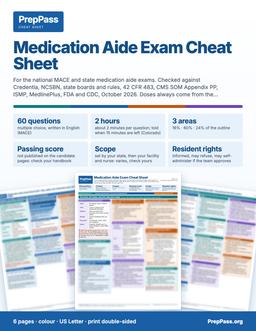
¿Examen en menos de dos semanas?
Esta guía es la enseñanza, para leer durante semanas. Si tu examen es en menos de dos semanas, la hoja de referencia a color imprimible es el otro producto: las cifras clave, por secciones.
6 páginas · US Letter · PDF imprimible · tuyo para siempre
Qué incluye — y qué no
Incluido
- Twelve chapters in the order of the MACE content areas, each with a Key facts box, a worked example and the exam traps
- The rights, a step-by-step safe medication pass, PRN rules and refusals
No incluido
- No se envía copia impresa — es un archivo que descargas y puedes imprimir tú
- El libro no incluye curso en vídeo, instructor ni tutorías — los vídeos gratis del sitio van aparte
Todo lo incluido y todo lo que no
Incluido
- Routes, storage, controlled substance schedules, counts and disposal
- Drug classes by body system, with the side effects to report
- Abbreviations to avoid, measurements, conversions and the 24-hour clock
- A chapter on the rules that vary by state, with state examples and a checklist for your own state
- A 63-question practice exam with an answer key and explanations
- PDF (print it) + EPUB (phone / e-reader)
No incluido
- No incluye tu inscripción al examen ni la tasa del centro, que sigues pagando al organismo oficial
Contenido
Ver 18 secciones y la página en la que empieza cada una
- Part 1 — Authorized Dutiesp. 9
- Chapter 1: Your Role, Delegation and the Limits of the Jobp. 10
- Part 2 — Medication Administration, Observation and Reportingp. 17
- Chapter 2: Orders, the MAR and Documentationp. 18
- Chapter 3: The Rights and a Safe Medication Passp. 23
- Chapter 4: Routes of Administrationp. 29
- Chapter 5: Storage, Controlled Substances and Disposalp. 36
- Chapter 6: How the Body Handles Medicinep. 41
- Chapter 7: Medication Categories by Body Systemp. 45
- Chapter 8: Resident Rights, Medication Errors, Observing and Reportingp. 54
- Part 3 — Medication Concepts and Measurementsp. 59
- Chapter 9: Terminology, Abbreviations and Forms of Medicationp. 60
- Chapter 10: Measurements and Simple Dose Arithmeticp. 67
- Chapter 11: Actions, Side Effects, Precautions and Interactionsp. 72
- Chapter 12: Rules Differ by State — Your Checklist and Exam-Day Strategyp. 76
- Practice Exam: 63 Questionsp. 83
- Answer Key and Explanationsp. 97
- Glossaryp. 106
Tomado del PDF que descargas, con la página en la que empieza cada uno — no escrito a mano aquí.
Lee un capítulo completo gratis
Un capítulo completo, tal como viene en el eBook. Desplázate en la ventana para leerlo aquí; sin descargas ni correo.
Lee el capítulo 3 aquí, sin salir de la página
The free chapter is The Rights and a Safe Medication Pass, the core of the largest content area, so you can judge the teaching where it matters most.
The rights of medication administration are the checklist you run for every dose. They are not a slogan: each one blocks a specific kind of error that has harmed residents.
3.1 The rights
Training programs list five, six or more rights. Ohio's rule for certified medication aide training (Ohio Administrative Code 4723-27-08), for example, lists six: the right person, drug, dose, time, route and documentation. The first five appear in every list:
- Right resident. The dose goes to the person whose name is on the order.
- Right drug (medication). The medication matches the order and the label.
- Right dose. The amount matches the order.
- Right route. The medication is given the way the order says (by mouth, under the tongue, in the eye, and so on).
- Right time. The dose is given at the ordered time, within the window your facility's policy allows, and PRN doses respect the minimum interval.
Most lists add:
- Right documentation. The dose is charted correctly, after it is given.
Some programs and states add more, for example right reason (the medication is being given for the condition it was ordered for), right response (you observe and report what the medication does) and the right to refuse. Learn the list your training program uses; knowing extra rights does no harm, but make sure you know the first six well.
What the rights are not. The Institute for Safe Medication Practices has pointed out that the rights are broadly stated goals that do not tell you how to reach them. You reach them by doing the checks every time, in the same order, without shortcuts.
3.2 Right resident: identification
Use at least two identifiers that your facility approves, such as the resident's name and date of birth, a photo on the MAR, or a wristband, and match them to the MAR. Ask the resident to say their name and date of birth when they can; do not ask "Are you Mrs. Lee?", because a confused or hard-of-hearing resident may say yes to any name.
Never identify a resident by room number, bed position or where they are sitting. Residents move, swap seats and visit each other's rooms.
3.3 Right time
The order sets the time; your facility's policy sets how early or late a dose may be given and still count as on time. For reference, federal nursing-home surveyors count a wrong-time error when a dose is given 60 or more minutes earlier or later than scheduled and the timing could cause the resident discomfort or harm (CMS State Operations Manual, Appendix PP). Some medications are time-sensitive: for example, some must be given before meals or on an empty stomach, and some must be spaced evenly. A dose given outside the allowed window, or a dose missed, is a medication error that must be reported.
For PRN medications, check the MAR for when the last dose was given before you give another. Giving a PRN dose before the minimum interval has passed is a wrong-time error and can be an overdose.
3.4 Before the pass
- Wash or sanitize your hands. CDC guidance for healthcare settings: use an alcohol-based hand rub for most hand hygiene, and wash with soap and water when hands are visibly soiled.
- Check the cart: locked, clean, stocked with cups, water, straws, applesauce or pudding if ordered as a vehicle, gloves and the supplies you need.
- Know your residents' allergies, and check them on the MAR before each new medication.
- Never leave the cart unlocked or out of your sight when you step away. Medications left at a bedside or on top of the cart can be taken by the wrong person.
3.5 The steps for each resident
- Read the MAR for the resident and note the medications due now, any parameters (such as a pulse or blood pressure check ordered before a dose) and any special instructions.
- Take each container from storage and compare the label with the MAR (first check).
- Prepare the dose without touching tablets with your hands: pour from the bottle into the cap and then into the cup, or keep unit-dose packages sealed until you are at the bedside. Compare again (second check).
- Compare a third time before you put the container back, or at the bedside before you open the unit-dose package.
- Identify the resident with two identifiers.
- Explain what you are giving and why, in words the resident understands.
- Check anything the order requires first, such as a pulse, a blood pressure or a blood glucose result, if your state and facility allow you to take or read it. If a value is outside the order's parameters, hold the medication and tell the nurse.
- Position the resident upright (sitting as upright as possible for oral medications) to make swallowing safe.
- Give the medication and stay until it is swallowed. Never leave medications at the bedside unless there is an order and a facility assessment allowing the resident to keep them.
- Offer water or other fluid unless the resident is on a fluid restriction or the medication should not be taken with water (sublingual tablets, for example). Use only the liquid consistency in the resident's diet order or care plan: if thickened liquids are ordered, do not give thin water with medications. If the resident coughs or chokes, stop and tell the nurse.
- Document on the MAR right away.
- Observe and report effects and side effects.
3.6 Preparing oral medications
- Do not crush or split a tablet unless the order or the pharmacist allows it, and never crush a product whose manufacturer says "do not crush". Extended-release, delayed-release and enteric-coated products are generally in that group. MedlinePlus warns, for example, that crushing or chewing extended-release oxycodone tablets can release too much drug at once, and tells patients to swallow bisacodyl tablets and omeprazole delayed-release tablets whole, without crushing or chewing them. The ISMP publishes a list of oral dosage forms that should not be crushed, and federal surveyors treat crushing a "do not crush" product as a possible medication error. Chapter 9 explains the letters that mark these products.
- Do not open capsules unless the pharmacist says it is safe.
- If a resident cannot swallow a medication, do not improvise. Tell the nurse, who may get a different form ordered.
- Mixing with food (applesauce, pudding) needs an order or facility approval, and the resident must know the medication is in it. Hiding medication in food without the resident's knowledge is not allowed.
- A tablet that falls on the floor is discarded following your facility's waste procedure, documented, and replaced. Controlled substances that are dropped or refused are wasted with a witness as your state and facility require.
3.7 PRN medications
Before giving a PRN dose, check, in this order:
- first, your state's and facility's rule: whether medication aides may give PRN doses at all, and whether the nurse must assess the resident or authorize each dose (Washington's rule treats PRN doses as nursing judgment that its medication assistants may not exercise; Texas requires the licensed nurse's authorization each time the symptoms occur). If a nurse's assessment or authorization is required, get it before anything else;
- that the resident has the condition named in the order (for example, the resident tells you about pain, and the order says "for pain");
- that the interval since the last dose has passed;
- that the maximum allowed in 24 hours, if the order or label sets one, will not be exceeded.
Afterward, document the reason, the time and, later, the result.
3.8 When a resident refuses
A resident has the right to refuse a medication (42 CFR 483.10(c)(6) gives nursing-home residents the right to request, refuse or discontinue treatment). Your job is to:
- Find out why, calmly. The reason may be a side effect, difficulty swallowing, a taste, confusion, or a belief that it is the wrong pill (which may be correct).
- Explain what the medication is for, without pressure or threats.
- Never force, trick or hide a medication in food or drink.
- Offer again later if your facility's policy allows it and the time window permits. A later offer is a freshly prepared dose, never the tablet that was poured and refused.
- Document the refusal and tell the nurse. A refused dose is disposed of or returned exactly as your facility's policy says, never kept loose and given later.
Key facts: Chapter 3
- The first six rights: resident, drug, dose, route, time, documentation. Some programs add reason, response and the right to refuse.
- Two identifiers, never the room number or seat.
- Three label checks against the MAR.
- Hand hygiene: alcohol-based hand rub for most situations; **soap and water when hands are visibly soiled** (CDC).
- Never crush or chew extended-release or enteric-coated products. If the resident cannot swallow one, tell the nurse; a different form may be ordered. Do not open capsules unless the pharmacist says it is safe.
- Stay until the medication is swallowed.
- Refusal: find out why, explain, never force or hide it, document, tell the nurse.
Worked example
Mr. Haddad's MAR shows a PRN order for acetaminophen for pain, every 6 hours as needed. At 14:00 he tells you his knee hurts. The MAR shows the last PRN dose was charted at 10:30.
What you do: Do not give it yet. Only three and a half hours have passed and the order requires at least six. Tell Mr. Haddad when the next dose may be given, tell the nurse about the pain so it can be assessed, and document per facility policy.
Why: Giving it now is a wrong-time error that also risks exceeding the safe daily total.
Exam traps
- "Are you Mr. Haddad?" Asking a yes/no identification question is wrong; ask the resident to state their name, and use two identifiers.
- Leaving the cup on the tray to "let the resident take it after breakfast". You stay until it is swallowed.
- Crushing everything for a resident with swallowing trouble. Check whether each product can be crushed, and go to the nurse.
- Saving a refused dose to try again at the next pass. Refused doses are disposed of or returned exactly as policy says.
Preguntas frecuentes
¿Cómo lo recibo?
Paga y la descarga aparece en esta página al instante. Los enlaces también se te envían por correo. No hace falta cuenta.
¿Y si no es para mí?
Escríbenos dentro de 14 días para un reembolso total, sin preguntas.
¿Va a desaparecer la práctica gratis?
No. Todas las preguntas, el simulacro cronometrado y los capítulos gratis del sitio siguen gratis. Este libro es la mitad de estudio, no una valla alrededor de lo gratuito.
Más preguntas (1)
¿Puedo leerlo en el móvil?
Sí — el EPUB es para móviles y e-readers, el PDF para imprimir y marcar. Recibes ambos.
¿Por qué comprar el libro si la práctica es gratis?
Nuestras preguntas de práctica y el simulacro cronometrado siguen gratis: nada del sitio se esconde tras este libro. El libro de $14.99 es la mitad de estudio: el material en sí, explicado en orden, en un archivo tuyo.
- Enseñanza sistemática — cada sección del examen explicada capítulo a capítulo, de principio a fin, no solo preguntas
- Imprímelo y márcalo — un PDF listo para papel que puedes resaltar, anotar y llevar a tu mesa de estudio
- Estudia en cualquier lugar, sin conexión — EPUB en tu teléfono o e-reader; sin wifi, sin pestañas
- Todo en un solo lugar — los capítulos y las preguntas de práctica en un archivo
- Tuyo de por vida — pago único de $14.99, descarga instantánea, sin suscripción
Los detalles
- Verificado con la fuente oficial(Credentia MACE content outline, 42 CFR 483.10 and 483.45, CMS State Operations Manual Appendix PP, ISMP, MedlinePlus, FDA, CDC and state agency pages)
- 250 preguntas de práctica gratis
Compra única, acceso de por vida a la descarga. El eBook es la guía completa de Medication Aide (CMA / MACE) en PDF y EPUB. Resumen educativo, no asesoría profesional ni legal — confirma siempre las reglas vigentes con la fuente oficial. Última actualización: November 2026.