Guía de estudio · Edición 2026
California Real Estate Salesperson Exam — Complete Study Guide (2026)
The DRE salesperson exam — 150 questions, 3 hours, 70% to pass.
- Extensión
- 141 páginas
- Preguntas de práctica en el libro
- 180
- Simulacro en línea de PrepPass
- 150 preguntas · 180 min
- Datos del examen verificados
- septiembre de 2026
- Archivo actualizado
- octubre de 2026
- Entrega
- PDF + EPUB · en inglés · descarga inmediata
Léelo antes de comprar: Independent study aid, not affiliated with or endorsed by the California Department of Real Estate.
Leer el resto de este aviso
California figures are stated with their statute and the date read (September 2026). General educational information, not legal advice.
Sobre este libro
The DRE salesperson exam — 150 questions, 3 hours, 70% to pass — taught from the Real Estate Law and Civil Code, with a full 150-question practice exam at the DRE's content weights.
Datos del examen, a quién le sirve y qué cambió
Sobre el examen en sí
| Organismo administrador | California Department of Real Estate (DRE) Fuente: California DRE — Taking the Exam |
|---|---|
| Preguntas | 150 preguntas Fuente: California DRE — Taking the Exam |
| Tiempo límite | 180 minutos Fuente: California DRE — Taking the Exam |
| Puntuación para aprobar | 70% Fuente: California DRE — Taking the Exam |
| Tarifas |
Fuente: California DRE — Fees |
| Idiomas disponibles | No publicado por California DRE Lo que leímos y donde no aparece: California DRE — Salesperson Examination Content |
Mira dentro del libro
Tres páginas reales, renderizadas directamente del PDF que descargas — una página de referencia, una de explicación y una pregunta resuelta, siempre en ese orden. Nada se rediseñó para verse mejor.
- Referencia rápidaChapter 6 — Transfer of Property, Title, and Escrow · Página 85 del PDF
Una página a la que puedes volver: cifras, plazos o términos reunidos en un solo lugar.
- Cómo se enseñaChapter 6 — Transfer of Property, Title, and Escrow · Página 75 del PDF
Una página de explicación: el material enseñado en prosa, en el orden en que lo evalúa el examen.
- Una pregunta resueltaPractice Exam — 150 Questions · Página 122 del PDF
Una pregunta de práctica con su respuesta y el razonamiento detrás — no solo la clave.
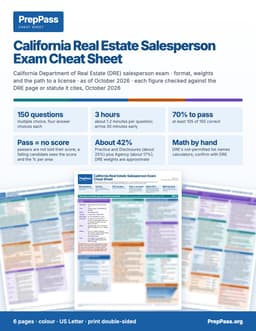
¿Examen en menos de dos semanas?
Esta guía es la enseñanza, para leer durante semanas. Si tu examen es en menos de dos semanas, la hoja de referencia a color imprimible es el otro producto: las cifras clave, por secciones.
6 páginas · US Letter · PDF imprimible · tuyo para siempre
How this book compares
The California DRE publishes the salesperson exam content outline and its Reference Book for free. This book turns that material into a study guide with a full practice exam. It does not replace the pre-license courses the DRE requires.
| Resource | Price | What you get | Choose it if |
|---|---|---|---|
| This bookCalifornia Real Estate Salesperson Exam — Complete Study Guide (2026)PrepPass | $14.99 | Downloadable study guide for the California salesperson exam
| Choose this book if you have your pre-license courses done or under way and want a focused exam review with a timed practice exam. |
| From the exam bodySalesperson Examination Content (opens the publisher's page in a new tab)California Department of Real Estate (DRE) | Free (web page) | The DRE's outline of what the exam covers
| Read it in any case to see how the exam is weighted. |
| From the exam bodyReference Book — A Real Estate Guide (opens the publisher's page in a new tab)California Department of Real Estate (DRE) | Free to read online; also sold at DRE offices | The DRE's own reference on California real estate practice and licensing
| Choose it if you want the DRE's full reference text rather than an exam-focused review. |
This book
California Real Estate Salesperson Exam — Complete Study Guide (2026)
PrepPass
- Price
- $14.99
- What you get
Downloadable study guide for the California salesperson exam
- 180 practice questions with explanations
- 141 pages, PDF + EPUB
- Choose it if
- Choose this book if you have your pre-license courses done or under way and want a focused exam review with a timed practice exam.
From the exam body
Salesperson Examination Content (opens the publisher's page in a new tab)
California Department of Real Estate (DRE)
- Price
- Free (web page)
- What you get
The DRE's outline of what the exam covers
- Seven subject areas, each with its approximate share of the exam
- Choose it if
- Read it in any case to see how the exam is weighted.
From the exam body
Reference Book — A Real Estate Guide (opens the publisher's page in a new tab)
California Department of Real Estate (DRE)
- Price
- Free to read online; also sold at DRE offices
- What you get
The DRE's own reference on California real estate practice and licensing
- Includes a chapter describing the type and scope of the license examinations
- Choose it if
- Choose it if you want the DRE's full reference text rather than an exam-focused review.
Other resources' prices and contents are as listed on each publisher's or seller's own page, checked September 24, 2026. Prices change; confirm on the linked page before you buy. This book's price and contents come from our own catalog.
Sources (2)
- https://www.dre.ca.gov/examinees/SalesExamContent.html — read September 24, 2026
- https://www.dre.ca.gov/examinees/Preparing.html — read September 24, 2026
Qué incluye — y qué no
Incluido
- A 150-question practice exam at the DRE's seven content weights, every answer explained
- Every rule tied to its section — B&P, Civil Code, CCP, 10 CCR
No incluido
- No se envía copia impresa — es un archivo que descargas y puedes imprimir tú
- El libro no incluye curso en vídeo, instructor ni tutorías — los vídeos gratis del sitio van aparte
Todo lo incluido y todo lo que no
Incluido
- Updated for the one-month security-deposit cap (AB 12) and the 2026 deposit-return rules
- Worked CA math without a calculator (transfer tax, prorations, cap rate, GRM)
- License law the exam tests: records, advertising, unlicensed assistants, the Consumer Recovery Account
- PDF + EPUB
No incluido
- No incluye tu inscripción al examen ni la tasa del centro, que sigues pagando al organismo oficial
Contenido
Ver 7 secciones y la página en la que empieza cada una
- Chapter 1 — Laws of Agency, Disclosures, and Fair Housingp. 10
- Chapter 2 — Real Estate Financingp. 24
- Chapter 3 — The Practice of Real Estate and Contractsp. 35
- Chapter 4 — Property Ownership and Land Use Controlsp. 49
- Chapter 5 — Valuation and Appraisalp. 60
- Chapter 6 — Transfer of Property, Title, and Escrowp. 71
- Practice Exam — 150 Questionsp. 90
Tomado del PDF que descargas, con la página en la que empieza cada uno — no escrito a mano aquí.
Lee un capítulo completo gratis
Un capítulo completo, tal como viene en el eBook. Desplázate en la ventana para leerlo aquí; sin descargas ni correo.
Lee el capítulo 1 aquí, sin salir de la página
Everything a licensee does flows from the agency relationship. Who is the client? What is owed to them? What must be disclosed, and to whom? This chapter is the foundation of the exam and of a lawful career. Master the fiduciary duties, the California disclosure package, and the fair-housing rules, and you have covered a large share of the two heaviest content areas.
The rule: agency creates the highest duties the law imposes
An agency relationship exists when one person, the agent, is authorized to act on behalf of another, the principal, in dealings with third parties. In real estate the broker is the agent. A salesperson is the agent of their employing broker, and owes the broker's clients the same duties the broker owes. The person represented is the principal (client); a person the agent deals with but does not represent is a customer, owed honesty and fair dealing but not fiduciary loyalty.
The agent owes the principal fiduciary duties, remembered by the mnemonic OLD CAR:
- Obedience — follow the principal's lawful instructions.
- Loyalty — put the principal's interests above the agent's own; no secret profit.
- Disclosure — reveal all material facts the agent knows.
- Confidentiality — protect the principal's private information (such as their lowest acceptable price) even after the deal closes.
- Accounting — account for all money and property handled.
- Reasonable care and diligence — act competently.
Agency is usually created by an express written agreement — most often a listing. In California a written, signed listing is required to enforce a commission claim, because the promise to pay a commission on the sale of real estate falls under the statute of frauds. Agency can also arise by implication (from conduct), by ratification (approving an act afterward), or by estoppel.
Dual agency — representing both buyer and seller in the same transaction — is legal in California only with the informed, written consent of both principals. A dual agent may not disclose to one party the other's confidential negotiating information: not the seller's lowest price, not the buyer's highest offer. Undisclosed dual agency, or a breach of that confidentiality, exposes the licensee to liability and DRE discipline.
It helps to see how the pieces fit together, because the exam builds many questions on the same skeleton. First, the broker — not the salesperson — is the party who actually holds the agency; a salesperson is an agent of their broker and a "sub-agent" of the broker's client. That is why a salesperson can never sue a seller directly for a commission and can never take a fee from anyone but their employing broker. Second, a broker is usually a special agent, hired for one specific transaction with limited authority, not a general agent (like a property manager, who manages an owner's affairs on an ongoing basis) or a universal agent (with broad power of attorney). Knowing which kind of agent is described tells you how much authority the agent has to bind the principal.
Agency also carries duties to the third party — the customer — even though they are not the client. To a customer, the agent owes honesty, fair dealing, and disclosure of known material facts, but not loyalty or confidentiality. A listing agent, for example, must not lie to a buyer about the roof, but is not obligated to negotiate on the buyer's behalf. This split — full fiduciary duty to the principal, honesty to everyone — resolves a large family of questions. The moment an agent puts their own interest ahead of the principal's (a secret profit, an undisclosed relationship with the buyer, steering the client toward the agent's own listing for a bigger fee) they have breached loyalty, the most heavily tested duty.
Finally, agency can be terminated by acts of the parties (completion, mutual agreement, expiration, revocation, or the principal or agent renouncing it) or by operation of law (death or incapacity of either party, destruction of the property, or bankruptcy). An agent who is fired before the listing expires may still be liable for the principal's damages, and a principal who revokes an exclusive listing early may owe the broker. Note that an agency coupled with an interest — where the agent has an ownership stake in the subject — generally cannot be revoked by the principal at will.
The rule: California's layered disclosures
California requires a stack of disclosures on the sale of residential property. The unifying principle: a seller and the seller's agent must disclose known material facts affecting the value or desirability of the property.
- Transfer Disclosure Statement (TDS) — required on a transfer of single-family residential property (Civ. Code § 1102(a)). That phrase is a defined term, and the definition is what the exam tests. Section 1102(b) applies the definitions of the Real Estate Law, and B&P Code § 10018.08 defines "single-family residential property" as (a) real property improved with one to four dwelling units, (b) a unit in a residential stock cooperative, condominium, or planned unit development, or (c) a mobilehome or manufactured home sold through a real estate broker. So a duplex, triplex, or fourplex needs a TDS just as a detached house does; a five-unit apartment building does not. AB 892 replaced the old wording ("not less than one nor more than four dwelling units") with the defined term effective January 1, 2020; the unit count did not change. (Civ. Code § 1102 as amended by Stats. 2019, ch. 310; B&P § 10018.08 as added by Stats. 2018, ch. 285; both read on leginfo.legislature.ca.gov, 23 September 2026.) The exempt transfers are listed at Civ. Code § 1102.2. The seller discloses the known condition of the property; the agent adds observations from a visual inspection. It cannot be waived — § 1102(c) makes any waiver void.
- Agency Disclosure — the statutory "Disclosure Regarding Real Estate Agency Relationship" must be provided, and the agency relationship disclosed, elected, and confirmed before the principal signs the purchase agreement.
- Natural Hazard Disclosure Statement (NHD) — tells the buyer whether the property lies in a designated flood, fire, seismic, or other hazard zone.
- Megan's Law notice — the statutory paragraph directing buyers to the sex-offender registry; the seller need not research individual offenders.
- Lead-based paint — for any home built before 1978, federal law requires disclosure of known hazards, delivery of the EPA pamphlet, and a 10-day inspection opportunity.
- Depending on the property: Mello-Roos special-tax disclosure, death on the property within the past three years, and point-of-sale retrofit items (smoke and carbon-monoxide detectors, water-heater strapping).
Timing and the buyer's right to cancel. The seller delivers the TDS as soon as practicable before transfer of title (Civ. Code § 1102.3(a)). If it — or a material amendment — is delivered after the buyer's offer, the buyer may terminate by written notice within 3 days after delivery in person or 5 days after delivery by mail (or 5 days after electronic delivery where the parties agreed to transact electronically) (Civ. Code § 1102.3(c)).
The agency disclosure itself follows a three-step choreography the exam loves to test — disclose, elect, confirm. First, the licensee discloses the possible agency relationships by delivering the statutory "Disclosure Regarding Real Estate Agency Relationship" form (to the seller before taking the listing, and to the buyer before writing an offer). Second, the parties elect the actual relationship — seller's agent, buyer's agent, or (with consent) both. Third, the relationship is confirmed in writing in or with the purchase agreement. Civ. Code § 2079.14 fixes the deadlines: the seller’s agent delivers the form before entering into the listing agreement; the buyer’s agent delivers it as soon as practicable before execution of a buyer-broker representation agreement and execution of the buyer’s offer to purchase — and where the buyer’s agent did not prepare the offer, not later than the next business day after receiving it from the buyer. The point is that a principal must know who represents whom before they are bound, so the confirmation cannot come after the fact. Miss the timing, and even a well-intentioned licensee has violated the statute.
Three ideas make the disclosure area manageable. The first is materiality: a fact must be disclosed if a reasonable buyer would consider it important in deciding whether, or how much, to buy. A leaking roof, a cracked foundation, permit problems, boundary disputes, prior flooding, and neighborhood nuisances are all material. The second is knowledge: the seller and agent must disclose what they know (and, for the listing agent, what a reasonably competent visual inspection would reveal); they are not liable for latent defects genuinely unknown to them and undiscoverable by ordinary inspection. The third is timing: most disclosures must reach the buyer early enough to act on them — the agency disclosure before the purchase agreement is signed, the TDS and other statutory disclosures promptly, and the lead-paint materials with a 10-day inspection window. A buyer who receives a required disclosure after signing generally gains a statutory right to cancel within a set number of days of delivery, so late delivery can unravel a deal.
The TDS deserves special attention because it is the workhorse. Per Civ. Code § 1102(a) it reaches a transfer of single-family residential property by sale, exchange, real property sales contract (as defined in Civ. Code § 2985), lease with an option to purchase, any other option to purchase, or ground lease coupled with improvements; Civ. Code § 1102.2 exempts, among others, sales requiring a public report, court-ordered sales, foreclosure and trustee’s sales, transfers by a fiduciary in the administration of an estate, transfers between co-owners, spousal transfers in a dissolution, and transfers to or from a government entity. It cannot be waived in a covered sale, and "as-is" language does not excuse the duty to disclose known defects — a common misconception the exam probes. The agent's portion of the TDS reflects the Easton visual-inspection duty discussed below. Separately, the Natural Hazard Disclosure is usually prepared by a third-party expert company, and the Mello-Roos and special-assessment disclosures alert buyers to bonded debt that rides with the property. When several disclosures overlap, deliver the full package rather than guessing which single form controls.
The rule: fair housing forbids discrimination — and California's list is long
Fair-housing law bans discrimination in the sale, rental, financing, and advertising of housing.
- The federal Fair Housing Act protects seven classes: race, color, religion, sex, national origin, disability, and familial status (families with children under 18).
- California adds to that list through two different statutes, with two different lists — a distinction worth keeping straight, because an exam item can name the wrong act.
- The Fair Employment and Housing Act (FEHA), Gov. Code § 12955, covers housing specifically: race, color, religion, sex, gender, gender identity, gender expression, sexual orientation, marital status, national origin, ancestry, familial status, source of income, disability, veteran or military status, and genetic information — and, under § 12955(m), a perception that a person has any of them or is associated with someone who does.
- The Unruh Civil Rights Act, Civ. Code § 51(b), binds all business establishments (a brokerage is one) and independently names citizenship, primary language, and immigration status. Age is not in the § 51(b) list; it reaches housing through Civ. Code § 51.2, which construes § 51 to bar age discrimination in the sale or rental of housing — subject to the qualifying senior-citizen housing exception that section sets out. Both lists above are quoted from the sections as read on 23 September 2026 (Gov. Code § 12955 as amended effective January 1, 2024; Civ. Code § 51 as amended effective January 1, 2025). The Legislature adds classes from time to time, so learn the pattern — California protects far more than the federal seven — rather than treating any list as closed.
Prohibited practices include steering (directing buyers toward or away from areas by protected class), blockbusting (inducing panic selling), and redlining (a lender's refusal to lend in an area by protected characteristics). Advertising may not express any preference or limitation based on a protected class. Housing providers must allow reasonable accommodations and reasonable modifications for persons with disabilities, including legitimate service and assistance animals despite a no-pets policy. The safest professional practice is to treat every client and customer identically and to document objective, non-discriminatory reasons for every decision.
The distinction between a reasonable accommodation and a reasonable modification is worth fixing. An accommodation is a change to a rule, policy, or service — waiving a no-pets policy for a service animal, assigning a closer parking space, allowing a live-in aide. A modification is a physical change to the unit — a wheelchair ramp, grab bars, a lowered counter. Under federal law a tenant generally pays for a modification (and may have to restore the unit at move-out), while the housing provider bears the cost of an accommodation. A provider may deny a request only if it imposes an undue financial or administrative burden or fundamentally alters the housing.
Advertising rules are a frequent exam target because they are easy to violate innocently. An ad may describe the property ("four bedrooms," "wheelchair accessible") but may not describe the ideal occupant ("perfect for a young Christian couple," "no children," "adults only," "near a Korean church"). Even words that seem neutral can imply a preference. Fair-housing law does recognize narrow, genuine exemptions — for example, certain owner-occupied buildings of four units or fewer, and single-family homes sold or rented by an owner without a broker and without discriminatory advertising, may be partially exempt under the federal Act. But a licensee is virtually never exempt: the moment a real estate professional is involved, the full weight of fair-housing law applies, and the Unruh Act independently bars a brokerage from arbitrary discrimination. When in doubt, describe the property, never the person, and serve every prospect the same way.
Preguntas frecuentes
¿Cómo lo recibo?
Paga y la descarga aparece en esta página al instante. Los enlaces también se te envían por correo. No hace falta cuenta.
¿Y si no es para mí?
Escríbenos dentro de 14 días para un reembolso total, sin preguntas.
¿Va a desaparecer la práctica gratis?
No. Todas las preguntas, el simulacro cronometrado y los capítulos gratis del sitio siguen gratis. Este libro es la mitad de estudio, no una valla alrededor de lo gratuito.
Más preguntas (1)
¿Puedo leerlo en el móvil?
Sí — el EPUB es para móviles y e-readers, el PDF para imprimir y marcar. Recibes ambos.
¿Por qué comprar el libro si la práctica es gratis?
Nuestras preguntas de práctica y el simulacro cronometrado siguen gratis: nada del sitio se esconde tras este libro. El libro de $14.99 es la mitad de estudio: el material en sí, explicado en orden, en un archivo tuyo.
- Enseñanza sistemática — cada sección del examen explicada capítulo a capítulo, de principio a fin, no solo preguntas
- Imprímelo y márcalo — un PDF listo para papel que puedes resaltar, anotar y llevar a tu mesa de estudio
- Estudia en cualquier lugar, sin conexión — EPUB en tu teléfono o e-reader; sin wifi, sin pestañas
- Todo en un solo lugar — los capítulos y las preguntas de práctica en un archivo
- Tuyo de por vida — pago único de $14.99, descarga instantánea, sin suscripción
Los detalles
- Verificado con la fuente oficial(California Real Estate Law + DRE rules)
- 418 preguntas de práctica gratis
Un CA 3-course pre-license package cuesta $100–$400. Este libro enseña el mismo examen — las mismas reglas, verificadas a los estándares actuales — por un pago único de $14.99 que conservas de por vida.
Compra única, acceso de por vida a la descarga. El eBook es la guía completa de California Real Estate Salesperson Exam en PDF y EPUB. Resumen educativo, no asesoría profesional ni legal — confirma siempre las reglas vigentes con la fuente oficial. Última actualización: October 2026.