Guía de estudio · Edición 2026
Series 3 Study Guide — 2026 Edition
Market knowledge and regulations for the NFA National Commodity Futures Examination, written to NFA's study outline, with worked calculations and two full 120-question practice exams.
Edición: Rebuilt Oct 2026 on NFA's study outline · Rules 2-8/2-9 amended Mar 18, 2026 · 120 Q, 150 min, 70% each part
- Extensión
- 414 páginas
- Preguntas de práctica en el libro
- 421
- Simulacro en línea de PrepPass
- 100 preguntas · 125 min
- Datos verificados y archivo actualizado
- octubre de 2026
- Entrega
- PDF + EPUB · en inglés · descarga inmediata
Sobre este libro
Tarifa del examen: $140 por intento, que se paga a FINRA. Repetir el examen vuelve a costarlo. Esta guía: $24.99, pago único.
Datos del examen, a quién le sirve y qué cambió
Sobre el examen en sí
| Organismo administrador | National Futures Association (NFA) Fuente: FINRA — Series 3 – National Commodities Futures Exam |
|---|---|
| Preguntas | 125 preguntas (120 calificadas, 5 de prueba sin calificar) Fuente: NFA — Study Outline for Futures Industry Exams (Series 3 section and exam table) |
| Tiempo límite | 150 minutos Fuente: NFA — Study Outline for Futures Industry Exams (Series 3 section and exam table) |
| Puntuación para aprobar | 70% Fuente: NFA — Study Outline for Futures Industry Exams (Series 3 section and exam table) |
| Tarifas |
Fuente: NFA — Study Outline for Futures Industry Exams (Series 3 section and exam table) |
| Idiomas disponibles | No publicado por NFA and FINRA Lo que leímos y donde no aparece: NFA — Study Outline for Futures Industry Exams (Series 3 section and exam table) |
Mira dentro del libro
Tres páginas reales, renderizadas directamente del PDF que descargas — una página de referencia, una de explicación y una pregunta resuelta, siempre en ese orden. Nada se rediseñó para verse mejor.
- Referencia rápidaChapter 1 — Futures Trading Theory and the Structure of Futures Markets · Página 29 del PDF
Una página a la que puedes volver: cifras, plazos o términos reunidos en un solo lugar.
- Cómo se enseñaSection I — FCMs and introducing brokers (9 questions) · Página 402 del PDF
Una página de explicación: el material enseñado en prosa, en el orden en que lo evalúa el examen.
- Una pregunta resueltaPart 1 — Market Knowledge (85 questions) · Página 323 del PDF
Una pregunta de práctica con su respuesta y el razonamiento detrás — no solo la clave.
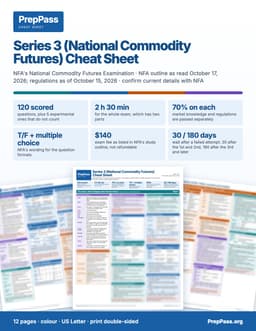
¿Examen en menos de dos semanas?
Esta guía es la enseñanza, para leer durante semanas. Si tu examen es en menos de dos semanas, la hoja de referencia a color imprimible es el otro producto: las cifras clave, por secciones.
12 páginas · US Letter · PDF imprimible · tuyo para siempre
Qué incluye — y qué no
Incluido
- An exam-review guide for candidates entering or working in the futures industry: terms are defined as they appear, but it assumes everyday market vocabulary and basic arithmetic, not a first course in trading
- 12 chapters in the order of NFA's Series 3 study outline as read on October 17, 2026
No incluido
- No se envía copia impresa — es un archivo que descargas y puedes imprimir tú
- El libro no incluye curso en vídeo, instructor ni tutorías — los vídeos gratis del sitio van aparte
Todo lo incluido y todo lo que no
Incluido
- Two full 120-question practice exams, each split 85 market knowledge / 35 regulations (PrepPass's split; NFA publishes none), scored part by part
- Step-by-step worked calculations: margin and variation, basis and hedges in the markets the outline names, spreads, speculative profit and return, option strategies and option spreads
- Current NFA and CFTC rules, including Rules 2-8, 2-9 and 3-1 as amended March 18, 2026, and the pending small-pool exemption proposal
- A common-mistakes list in every chapter, a formula and numbers sheet, a key-terms table and an exam-facts table
- 421 original questions, each with a worked explanation citing its source
- PDF + EPUB you keep
No incluido
- No incluye tu inscripción al examen ni la tasa del centro, que sigues pagando al organismo oficial
Contenido
Ver 28 secciones y la página en la que empieza cada una
- Chapter 1 — Futures Trading Theory and the Structure of Futures Marketsp. 11
- Chapter 2 — Futures and Options Terminologyp. 37
- Chapter 3 — Margins, Option Premiums, Price Limits, Settlement, Delivery, Exercise and Assignmentp. 57
- Chapter 4 — Orders, Customer Accounts and Price Analysisp. 87
- Chapter 5 — Hedging and Basis Calculationsp. 116
- Chapter 6 — Spreadingp. 144
- Chapter 7 — Speculating in Futures: Profit, Loss and Returnp. 160
- Chapter 8 — Options: Hedging, Speculating and Spreadingp. 176
- Chapter 9 — Registration, NFA Membership and Opening Customer Accountsp. 204
- Chapter 10 — FCMs and Introducing Brokersp. 231
- Chapter 11 — Commodity Pool Operators, Commodity Trading Advisors and Promotional Materialp. 257
- Chapter 12 — Arbitration, NFA Discipline and CFTC Enforcementp. 281
- Part 1, A: futures theory, 1-18 Chapters 1 and 2 market structure, terminologyp. 304
- Part 1, B: margins, limits, 19-30 Chapter 3 delivery, exercisep. 304
- Part 1, C: orders and price 31-40 Chapter 4 analysisp. 304
- Part 1, D: hedging and basis 41-55 Chapter 5p. 304
- Part 1, E: spreading 56-64 Chapter 6p. 304
- Part 1, F: speculation, profit, 65-72 Chapter 7 loss and returnp. 304
- Part 1, G: options strategies 73-85 Chapter 8p. 304
- Part 2, H: registration, NFA 1-11 Chapter 9 membership, customer accountsp. 304
- Part 2, I: FCMs and 12-20 Chapter 10 introducing brokersp. 304
- Part 2, J: CPOs, CTAs, 21-28 Chapter 11 promotional materialp. 304
- Part 2, K: arbitration, 29-35 Chapter 12 discipline, enforcementp. 304
- Part 1 — Market Knowledge (85 questions)p. 304
- Part 2 — Regulations (35 questions)p. 334
- Section I — FCMs and introducing brokers (9 questions)p. 336
- Appendix A — The exam at a glance, in one tablep. 404
- Appendix B — Terms the exam expects you to use preciselyp. 405
Tomado del PDF que descargas, con la página en la que empieza cada uno — no escrito a mano aquí.
Lee un capítulo completo gratis
Un capítulo completo, tal como viene en el eBook. Desplázate en la ventana para leerlo aquí; sin descargas ni correo.
Lee el capítulo 5 aquí, sin salir de la página
The free chapter is Chapter 5, hedging and basis calculations: worked examples at the pace of the whole book, which defines its terms in Chapters 1 and 2 and assumes everyday market vocabulary and basic arithmetic.
This is the chapter the market-knowledge part is built around. NFA's outline gives it three headings — short and long hedging, the basis, and hedging calculations — and then lists examples in grains, livestock, foodstuffs, metals, energy, lumber, Treasury notes and bonds, T-bills and 3-month SOFR, municipals, currencies and stock indices[1]. Every one of those examples is solved with the same small set of rules. Learn the rules, then practice until the sign of the basis never trips you.
The basis
Definition and sign
Basis is the difference between the cash (spot) price of a commodity and the price of the nearest futures contract for the same or a related commodity, typically calculated as cash minus futures[2].
Basis = cash price − futures price
If cash is $4.10 and futures are $4.35, the basis is −$0.25, spoken "25 under." If cash is $4.50 and futures $4.35, the basis is +$0.15, "15 over." Merchants quote cash prices this way: a basis quote is an offer or sale of a cash commodity in terms of the difference above or below a futures price, such as "10 cents over December corn"[2].
How the basis is determined
The CFTC notes that the basis is usually computed against the futures contract next to expire and may reflect differences in time, product form, grade or location[2]. In practice, four things set a local basis:
- Transportation costs. A futures contract prices the commodity at its delivery points[2]. A grain elevator far from a delivery point pays less for grain than the futures price, because someone must pay to ship it to where the contract is priced. Farther away, weaker basis; closer to demand, stronger basis.
- Variation in grades. Futures price the par grade[2]. A cash lot of better quality commands a premium; a lower grade, a discount[2]. That difference shows up in the basis.
- Time and carrying charges. A cash price today compared with a futures price for a later month reflects the cost of carrying the commodity until then[2]. That is why the basis in a normal market tends to strengthen (move toward zero) as delivery approaches: the remaining carrying cost shrinks.
- Local supply and demand. A local shortage strengthens the basis; a local glut weakens it.
Strengthening and weakening
Because the basis is a signed number, describe changes by direction rather than by "wider" or "narrower," which are ambiguous when the basis crosses zero:
- Strengthening — the basis becomes more positive (or less negative): −30 to −10, or +5 to +20. Cash is gaining on futures.
- Weakening — the basis becomes more negative (or less positive): −10 to −30, or +20 to +5. Cash is losing ground to futures.
NFA's outline also uses "narrowing or widening basis" in the spread section[1]. When you meet those words, translate them into strengthening or weakening by writing out the numbers.
Basis risk
Basis risk is the risk of an unexpected widening or narrowing of the basis between the time a hedge is placed and the time it is lifted[2]. A hedge converts price risk into basis risk. Price risk is large and unpredictable; basis risk is usually smaller and more predictable, because transportation, grade and carrying costs change slowly. That trade is the whole economic reason to hedge.
Long the basis, short the basis
The CFTC's definitions give the two positions their names:
- Long the basis — a person who has bought the spot commodity and hedged with a sale of futures[2]. This is the short hedger: long cash, short futures.
- Short the basis — the purchase of futures as a hedge against a commitment to sell in the cash market[2]. This is the long hedger, who is effectively short cash (committed to deliver, or needing to buy) and long futures.
The names tell you who benefits from a basis change, exactly as "long" and "short" do for prices:
Long the basis (short hedger) gains when the basis strengthens. Short the basis (long hedger) gains when the basis weakens.
Prove it once, then trust it. The short hedger owns cash and is short futures. If the basis strengthens, cash has risen relative to futures: the cash side gained more (or lost less) than the futures side lost (or gained). The hedger is long the thing that outperformed.
Short hedging
A short (selling) hedge sells futures to protect against falling prices[2]. Typical short hedgers are farmers, producers and holders of inventory[1].
Net price received
For a short hedger who sells the cash commodity and buys back the futures on the same day:
Net sale price = cash price received + futures gain (or − futures loss) = futures price when the hedge was placed + basis when the hedge is lifted
The second line is the shortcut: the hedge locks in the original futures price, and the basis at the end is added to it.
Worked example — basis strengthens. In June a farmer expects to harvest 30,000 bushels and sells six 5,000-bushel December futures at $4.80. Her local basis for harvest delivery has typically been 40 under.
In October she sells the cash corn at $4.15 when December futures are $4.45.
- Basis at lift: $4.15 − $4.45 = −$0.30 (30 under), stronger than the −$0.40 she expected.
- Futures gain: $4.80 − $4.45 = $0.35.
- Net price: $4.15 + $0.35 = $4.50 — which equals $4.80 + (−$0.30).
- The 10-cent basis improvement adds $0.10 × 30,000 = $3,000 compared with the $4.40 she had planned on.
Worked example — basis weakens. Same hedge, but at harvest cash is $3.95 and futures $4.45 (basis 50 under). Net price = $3.95 + $0.35 = $4.30 = $4.80 − $0.50. The weaker basis cost her 10 cents compared with the expected $4.40.
Holders of inventory
An elevator that buys grain and stores it is long the basis while it carries the grain. Worked example. In October an elevator buys corn at $4.05 when March futures are $4.55 (basis −50) and sells March futures to hedge. In February it sells the corn at $4.60 when March futures are $4.70 (basis −10).
- Cash gain: $4.60 − $4.05 = +$0.55.
- Futures loss: $4.55 − $4.70 = −$0.15.
- Net result: +$0.40 per bushel — exactly the 40-cent strengthening of the basis, from −50 to −10.
A storage hedger does not care where prices go; it earns the basis change, which is its payment for storing.
Long hedging
A long (buying) hedge buys futures to protect against increases in the cost of commodities[2]. Typical long hedgers are processors, manufacturers and exporters[1].
Net price paid
Net purchase price = cash price paid − futures gain (or + futures loss) = futures price when the hedge was placed + basis when the hedge is lifted
It is the same shortcut. A long hedger, being short the basis, wants that closing basis to be as weak (as negative) as possible.
Worked example. In March a feed manufacturer knows it will buy 50,000 bushels of soybeans in July. It buys July futures at $11.60 when its expected July basis is +$0.20. In July it buys cash at $12.30 when futures are $12.00.
- Basis at lift: $12.30 − $12.00 = +$0.30 (stronger than the expected +$0.20).
- Futures gain: $12.00 − $11.60 = +$0.40.
- Net purchase price: $12.30 − $0.40 = $11.90 = $11.60 + $0.30.
- The long hedger expected $11.80 and paid 10 cents more, because the basis strengthened against it.
Anticipatory hedges
A hedge placed before the hedger has the cash position — a processor buying futures for next quarter's needs, or a farmer selling futures before planting — is an anticipatory hedge. The CFTC's definition of a hedger covers someone who buys or sells futures "as a temporary substitute for a cash transaction that will occur later"[2]. An exporter that has agreed to sell grain abroad at a fixed price but has not yet bought it is short the cash commodity and hedges by buying futures.
Effect of the basis on the commodity actually delivered or purchased
Hedgers rarely deliver on futures; they buy and sell in their local cash market and offset their futures. That is why the local basis, not the futures price alone, determines the outcome. If a hedger does deliver against futures, the price received is the futures invoice price[2] adjusted for any grade premium or discount[2] — and the hedger bears the cost of getting the commodity to a delivery point[2]. A hedger far from a delivery point usually does better selling locally and buying back futures.
Hedging calculations: a method that never fails
For any hedge question, write four lines:
| Cash | Futures | Basis | |
|---|---|---|---|
| Start | price | price | cash − futures |
| End | price | price | cash − futures |
| Change | ± | ± | ± |
Then:
- Mark which side the hedger is long and which short.
- Gain or loss on each side = change × (+1 if long, −1 if short).
- Net result = sum of the two sides = basis change × (+1 if long the basis, −1 if short the basis).
- Net price = the actual cash price ± the futures result.
Worked example — the full table. A cattle feeder will sell 40,000 pounds of cattle in four months. She sells one 40,000-pound futures contract at $1.92 per pound when cash is $1.86.
| Cash | Futures | Basis | |
|---|---|---|---|
| Start | $1.86 | $1.92 short | −$0.06 |
| End | $1.78 | $1.81 buy back | −$0.03 |
| Change | −$0.08 | +$0.11 gain | +$0.03 (stronger) |
She is long the basis (long cattle, short futures), so she gains the 3-cent strengthening. Net price = $1.78 + $0.11 = $1.89 per pound = $1.92 + (−$0.03). In dollars: 40,000 × $1.89 = $75,600.
The basis in financial markets
Financial futures have a basis too, and the same arithmetic applies. What differs is what drives it.
Carry: short-term versus long-term rates
For a financial instrument, carrying costs are the cost of financing — the short-term rate — and the "income" of carrying is the instrument's own return. When financing costs less than the instrument earns, the CFTC calls it positive carry; when it costs more, negative carry[2]. With a positive yield curve (long-term rates above short-term)[2], holding a long-term bond financed at short-term rates earns positive carry, so deferred bond futures can trade below nearby futures and below cash. This is why financial markets often look "inverted" without any shortage — the outline's "short-term rates vs. long-term rates"[1].
Interest-rate hedges
Debt prices fall when yields rise[3], so:
- An investor holding Treasury notes or bonds (long cash) fears rising rates and sells note or bond futures — a short hedge.
- A borrower planning to issue debt or take a floating-rate loan fears rising rates and sells interest-rate futures (T-bill, SOFR, note or bond futures, depending on the maturity) — an anticipatory short hedge.
- An investor who will receive cash later and fears falling rates buys interest-rate futures — an anticipatory long hedge.
Treasury bills are short-term zero-coupon obligations of up to one year; notes run more than one and up to ten years; bonds more than ten[2]. Match the hedge to the maturity of the risk: short-term borrowing costs are hedged with short-term-rate contracts, long-term bond holdings with bond futures. Rates are measured in basis points; one basis point is 1/100 of one percent[2]. Don't confuse this with "the basis."
Cross-hedging: municipals and other close substitutes
A cross-hedge hedges a cash position with futures on a different but price-related commodity[2]. A dealer holding municipal bonds, for example, may hedge with Treasury futures or a municipal-bond-index contract because the prices tend to move together. Cross-hedges carry extra basis risk: the two prices can diverge for reasons that have nothing to do with the general level of rates. The hedge ratio — the value of futures bought or sold relative to the value of the cash position — is computed to minimize that basis risk[2].
Currencies
An exchange rate is the price of one currency in terms of another[2]. Currency hedges follow the ordinary rules once you ask "who is long the foreign currency?"
- A U.S. exporter that will receive euros in three months is long euros and fears the euro will fall; it sells euro futures.
- A U.S. importer that must pay yen in three months is short yen and fears the yen will rise; it buys yen futures.
Worked example. An importer owes ¥50,000,000 in 90 days. Today the spot rate and the futures price are both $0.006800 per yen (basis zero), so the bill would cost $340,000 at today's rate. The importer buys yen futures at $0.006800. At payment the spot rate is $0.007050 and futures are $0.007070, a basis of −$0.000020.
- Cash cost rose by $0.000250 × 50,000,000 = $12,500, to $352,500.
- Futures gained $0.000270 × 50,000,000 = $13,500.
- Net cost: $352,500 − $13,500 = $339,000 — slightly better than $340,000, because the basis weakened and the importer, a long hedger, is short the basis. Check: $0.006800 + (−$0.000020) = $0.006780 × 50,000,000 = $339,000.
Stock indices
Portfolio insurance is the CFTC's name for using stock index futures or options to protect a stock portfolio against market declines[2]. A manager holding stocks sells stock index futures (a short hedge); a manager expecting cash to invest who fears a rally buys them (an anticipatory long hedge). The number of contracts is set by the hedge ratio: portfolio value divided by the value of one futures contract, adjusted for how closely the portfolio tracks the index[2].
Worked example. A $6,000,000 portfolio moves in line with an index whose futures trade at 4,800 with a $50 multiplier. One contract is worth 4,800 × $50 = $240,000. Contracts to sell: $6,000,000 ÷ $240,000 = 25.
Sources cited in this excerpt
- Study Outline for Futures Industry Exams (Series 3 – National Commodity Futures Examination). National Futures Association, 2026-10-17. https://www.nfa.futures.org/registration-membership/study-outlines/index.html
- CFTC Glossary. U.S. Commodity Futures Trading Commission, 2026-10-17. https://www.cftc.gov/LearnAndProtect/EducationCenter/CFTCGlossary/index.htm
- Understanding Pricing and Interest Rates. U.S. Department of the Treasury, Bureau of the Fiscal Service (TreasuryDirect), 2026-10-17. https://www.treasurydirect.gov/marketable-securities/understanding-pricing/
Preguntas frecuentes
¿Cómo lo recibo?
Paga y la descarga aparece en esta página al instante. Los enlaces también se te envían por correo. No hace falta cuenta.
¿Y si no es para mí?
Escríbenos dentro de 14 días para un reembolso total, sin preguntas.
¿Va a desaparecer la práctica gratis?
No. Todas las preguntas, el simulacro cronometrado y los capítulos gratis del sitio siguen gratis. Este libro es la mitad de estudio, no una valla alrededor de lo gratuito.
Más preguntas (1)
¿Puedo leerlo en el móvil?
Sí — el EPUB es para móviles y e-readers, el PDF para imprimir y marcar. Recibes ambos.
¿Por qué comprar el libro si la práctica es gratis?
Nuestras preguntas de práctica y el simulacro cronometrado siguen gratis: nada del sitio se esconde tras este libro. El libro de $24.99 es la mitad de estudio: el material en sí, explicado en orden, en un archivo tuyo.
- Enseñanza sistemática — cada sección del examen explicada capítulo a capítulo, de principio a fin, no solo preguntas
- Imprímelo y márcalo — un PDF listo para papel que puedes resaltar, anotar y llevar a tu mesa de estudio
- Estudia en cualquier lugar, sin conexión — EPUB en tu teléfono o e-reader; sin wifi, sin pestañas
- Todo en un solo lugar — los capítulos y las preguntas de práctica en un archivo
- Tuyo de por vida — pago único de $24.99, descarga instantánea, sin suscripción
Los detalles
- Verificado con la fuente oficial(NFA Study Outline for Futures Industry Exams and NFA Rulebook, FINRA Series 3 exam page, CFTC regulations (eCFR) and the Commodity Exchange Act, read October 2026)
- 102 preguntas de práctica gratis
Un Series 3 exam prep course cuesta $150–$500. Este libro enseña el mismo examen — las mismas reglas, verificadas a los estándares actuales — por un pago único de $24.99 que conservas de por vida.
Compra única, acceso de por vida a la descarga. El eBook es la guía completa de Series 3 — National Commodity Futures Exam en PDF y EPUB. Resumen educativo, no asesoría profesional ni legal — confirma siempre las reglas vigentes con la fuente oficial. Última actualización: October 2026.