Guía de estudio · Edición 2026
Texas Journeyman Electrician Exam — Open-Book Study Guide (2026 NEC)
For the TDLR Journeyman Electrician exam PSI gives in two open-book portions.
Edición: Written to the 2026 NEC and PSI's bulletin updated 9/15/2026: two open-book portions, 70% on each.
- Extensión
- 299 páginas
- Preguntas de práctica en el libro
- 444
- Simulacro en línea de PrepPass
- 85 preguntas · 240 min
- Datos verificados y archivo actualizado
- noviembre de 2026
- Entrega
- PDF + EPUB · en inglés · descarga inmediata
Léelo antes de comprar: An independent study guide, not affiliated with or endorsed by the National Fire Protection Association (NFPA), the Texas Department of Licensing and Regulation (TDLR) or PSI.
Leer el resto de este aviso
It cites NEC section and table numbers so you can find each rule in your own Code book; it does not reproduce Code text or tables and does not replace the Code book. Every practice question is original, not a real or recalled exam item. NEC, NFPA 70 and National Electrical Code are registered trademarks of the NFPA.
Sobre este libro
For the TDLR Journeyman Electrician exam PSI gives in two open-book portions: how to set up your own 2026 NEC, where to open it for each kind of question, the calculation steps in order, and two full timed practice portions.
Tarifa del examen, ambas partes: $78 por intento, que se paga a PSI. Repetir el examen vuelve a costarlo. Esta guía: $14.99, pago único.
Datos del examen, a quién le sirve y qué cambió
Sobre el examen en sí
| Organismo administrador | Texas Department of Licensing and Regulation (TDLR) — examen administrado por PSI |
|---|---|
| Preguntas | 85 preguntas (80 calificadas, 5 de prueba sin calificar) |
| Tiempo límite | 240 minutos |
| Puntuación para aprobar | 70% |
| Tarifas |
|
| Idiomas disponibles | Inglés · Español |
Mira dentro del libro
Tres páginas reales, renderizadas directamente del PDF que descargas — una página de referencia, una de explicación y una pregunta resuelta, siempre en ese orden. Nada se rediseñó para verse mejor.
- Cómo se enseñaPart 4. Find-it drills · Página 154 del PDF
Una página de explicación: el material enseñado en prosa, en el orden en que lo evalúa el examen.
- Cómo se enseñaPart 4. Find-it drills · Página 156 del PDF
Una página de explicación: el material enseñado en prosa, en el orden en que lo evalúa el examen.
- Una pregunta resueltaChapter 5. Wiring Methods and Materials · Página 98 del PDF
Una pregunta de práctica con su respuesta y el razonamiento detrás — no solo la clave.
¿Examen en menos de dos semanas?
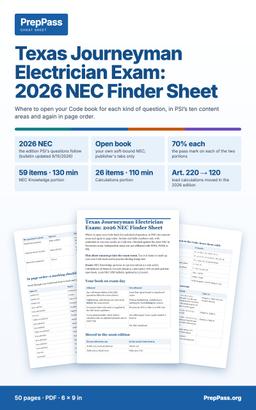
Esta guía es la enseñanza, para leer durante semanas. Si tu examen es en menos de dos semanas, el cuadernillo imprimible es el otro producto: cada cifra agrupada por valor, una cara para escribirla de memoria y una ruta para 14 días, 7, 3 o esta noche.
50 páginas · US Letter · PDF imprimible · tuyo para siempre
Qué incluye — y qué no
Incluido
- PSI's published content outline on one page: the scored items per content area for both portions (bulletin updated September 15, 2026)
- A 20-question diagnostic, two questions from each of PSI's ten content areas, to tell you which areas to study first
No incluido
- No se envía copia impresa — es un archivo que descargas y puedes imprimir tú
- El libro no incluye curso en vídeo, instructor ni tutorías — los vídeos gratis del sitio van aparte
Todo lo incluido y todo lo que no
Incluido
- Setting up your own 2026 NEC: the tabs and markings PSI allows, what moved in the 2026 edition, and a clock plan for each portion
- A finder table for each of the ten content areas: from the kind of question to the section or table to open
- Ten chapters in PSI's content areas, each ending with a short check, 40 questions in all
- 29 timed find-it drills, each answered with the section to open first
- Two full practice portions sized to PSI's scored items: 56 NEC Knowledge questions in 130 minutes and 24 Calculations questions in 110 minutes, every answer explained
- A question-bank appendix: 275 more questions in PSI's ten content areas, with answers and explanations, for 444 practice questions in the book
- Formula pages, a seven-day final plan and an A to Z index from key word to Code section
- Reads alongside your own 2026 NEC: section and table numbers with explanations in our own words, no Code text
- PDF (print it) + EPUB (phone / e-reader)
No incluido
- No incluye tu inscripción al examen ni la tasa del centro, que sigues pagando al organismo oficial
Contenido
Ver 15 secciones y la página en la que empieza cada una
- Part 1. Your Code book is the toolp. 15
- Chapter 9, Table 8 Conductor circular-mil areas for voltage dropp. 19
- Part 2. Finder: from the question to the pagep. 32
- Part 3. The ten content areasp. 64
- Chapter 1. Definitions, Theory and Plansp. 64
- Chapter 2. Services, Service Equipment and Separately Derived Systemsp. 71
- Chapter 3. Electrical Feeders: Sizing, Protection and Load Calculationsp. 79
- Chapter 4. Branch Circuits and Conductorsp. 88
- Chapter 5. Wiring Methods and Materialsp. 98
- Chapter 6. Electrical Equipment and Devicesp. 105
- Chapter 8. Control Devices and Disconnectingp. 121
- Chapter 9. Special Occupancies, Equipment and Conditionsp. 129
- Chapter 10. Renewable Energy Technologies: Photovoltaics and EV Chargersp. 138
- Part 4. Find-it drillsp. 146
- Part 5. Two full practice portionsp. 158
Tomado del PDF que descargas, con la página en la que empieza cada uno — no escrito a mano aquí.
Lee un capítulo completo gratis
Un capítulo completo, tal como viene en el eBook. Desplázate en la ventana para leerlo aquí; sin descargas ni correo.
Lee el capítulo 1 aquí, sin salir de la página
The free part is Part 1: the Code book PSI lets into the room, how to mark it up before exam day, what moved in the 2026 edition, working the clock and the formula pages.
The exam is open book. The Code book answers every Code question on the exam, but only if you reach the right page in time. This part is about that: a book that is legal to bring, marked so your eye lands on the right line, and a way of working the clock.
1.1 A book PSI will let into the room
PSI's bulletin (updated September 15, 2026) sets these rules for the Code book you bring:
| Allowed | Not allowed |
|---|---|
| Any soft-bound edition of the NEC (questions follow the 2026 edition) | Loose-leaf, spiral-bound or ring-bound copies |
| Highlighting, underlining and notes made before the exam session | Writing, highlighting, underlining or marking the book during the session |
| Permanent index tabs made or supplied by the NEC book's publisher | Homemade, DIY or other non-NEC tabs |
| A non-programmable, silent, battery calculator with no alphabet keyboard and no paper tape | Any added paper: loose, taped, stapled or stuck in |
| The NEC Handbook |
PSI provides an electronic notepad. A candidate who arrives with a book that breaks these rules is offered three choices: test without the book, remove the non-compliant tabs, or forfeit the fee and test another day.
Two practical points follow. First, do all of your marking at home; the pen and highlighter stay outside. Second, check your tabs: if they did not come from the Code book's publisher, take them off before exam day.
1.2 Mark it up before exam day
Highlighting and notes are allowed as long as they are in the book before the session starts. Use that. A marked book turns a search into a glance.
A workable system:
- One colour for numbers you will be asked for (a distance, a percentage, an ampere rating). Highlight the number and the two or three words that say what it applies to.
- A second colour for the words that flip an answer: "not less than", "not more than", "continuous", "dwelling", "other than".
- Mark exceptions as exceptions. PSI says not to use an exception unless the question tells you to. Bracket each one in the margin so you do not read it as the main rule under time pressure.
- Write the next stop in the margin. Where a calculation sends you from one section to a table, write the table number beside the section. Chapter by chapter, this book gives you those chains.
- Write on the table pages which column to use. For ampacity questions the terminal temperature rating picks the column; note that beside the table heading.
Tabs
PSI's bulletin allows permanent index tabs manufactured or provided by the publisher of your Code book, and bars homemade, DIY and non-NEC tabs. A set from any other maker is not on the allowed list: do not put it on. A candidate who arrives with such tabs has to remove them, test without the book, or forfeit the fee and come back another day.
Putting a tab set on well takes about an hour:
- Check every tab against the 2026 contents first. A set printed for an earlier edition carries article numbers that have moved (see section 1.3).
- Start at the back of the book and work forward, so the tabs already placed never hide the page you are looking for.
- Put each tab on the right-hand page where its article or table begins, and step the tabs down the edge in rows so that no tab covers another.
- Press each tab down firmly. The bulletin's word for the tabs it allows is permanent, and it bars any added paper, loose or attached.
- If you have more tabs than patience, place these first: Article 100, Article 110, Article 120, Article 210, Article 215, Article 230, Article 240, Article 250, Article 300, Article 310, Article 314, Article 406, Article 430, Article 500, Article 501, Article 690, Chapter 9 tables. They are the articles this book sends you to most often.
Tabs get you to the article. Your highlighting gets you to the line. You need both.
The list below is where to start. These are the 40 places in the 2026 Code that this book's chapters and practice bank point to most often. That is a measure of this book, taken from its own pages; it does not predict what PSI will ask.
| Open to | What to mark there |
|---|---|
| Article 100 | Continuous load; Feeder; Class A GFCI |
| §110.26 | Working space width; Dedicated electrical space; Headroom |
| Table 110.26(A)(1) | Working space depth; Depth by condition |
| Table 120.45 | Warehouse lighting demand; Lighting demand |
| §120.53 | Fastened-in-place appliances |
| Table 120.55 | Household ranges |
| §120.61 | Neutral load; Neutral reduction threshold; Neutral reduction amount |
| §210.11 | Small-appliance circuits; Laundry circuit; Bathroom circuit |
| §210.20 | Device for continuous load |
| §210.23 | Cord-and-plug limit; Fastened-in-place limit; Circuits over 50 amperes |
| §210.52 | Wall space; Countertop spacing; Countertop height; Garage receptacles |
| §215.4 | Feeder conductor ampacity; Feeder versus small service |
| §215.5 | Feeder overcurrent device |
| §230.24 | Clearance over driveways and streets; Clearance over roofs |
| §230.71 | Two to six disconnects; Maximum number |
| §230.79 | One-family dwelling minimum; Dwelling minimum rating |
| §240.21 | No rounding up on taps; 25-foot tap termination; Transformer tap length; High bay tap minimum |
| §250.52 | Concrete-encased electrode |
| §250.53 | Water pipe must be supplemented; Single rod resistance; Rod spacing |
| Table 250.66 | GEC sizing |
| Table 250.122 | Size by device rating; Grounding conductor size |
| §250.122 | Upsized conductors; Proportional increase; Upper limit |
| §300.6 | Bored holes in wood; Roof decking clearance |
| Table 300.7(A) | Minimum cover |
| §310.15 | Apply both factors; Neutral as current-carrying |
| §314.16 | Device yoke |
| §314.27 | Fan support; Ceiling luminaire box; Wall luminaire on another box; Fan box marking |
| §314.28 | Straight pull; Angle pull |
| §406.9 | Damp-location cover; Wet-location cover; Tub and shower zone |
| §430.22 | Single motor conductor |
| §430.24 | Motor feeder conductor |
| §430.32 | Separate overload device; Will not start; Integral thermal protector |
| Table 430.52(C)(1) | Squirrel-cage maximums; Wound-rotor breaker |
| §430.102 | Controller disconnect; Motor disconnect; One switch for both |
| §430.110 | General rating; Torque motor; Assumed locked-rotor current |
| §500.5 | Class I, Division 1; Ventilation-dependent room; Metal dust |
| §501.15 | Shared seal; Seal fill |
| §690.8 | Conductor ampacity; Parallel modules; Common-return conductor |
| §690.12 | Array boundary; Outside the boundary; Initiation device location |
| Chapter 9, Table 8 | Conductor circular-mil areas for voltage drop |
1.3 What moved in the 2026 edition
If you trained on an earlier edition, or your notes and tabs came from one, these are the moves that matter most on this exam. Each was confirmed on the 2026 page.
| If your old notes say | In the 2026 Code look in |
|---|---|
| Article 220, load calculations | Article 120 |
| Table 300.5, burial cover | Table 300.7(A) |
| 215.2, feeder conductor rating and size | 215.4 |
| 215.3, feeder overcurrent protection | 215.5 |
| "In Sight From" in Article 100 | 110.29 |
| 450.3 and its tables, transformer overcurrent protection | 450.5 and Tables 450.5(A) and 450.5(B) |
The load-calculation move is the big one: every section you knew as 220.xx is now in Article 120, and a 2023 tab set will send you to the wrong place.
1.4 Working the clock
The Knowledge portion gives you 59 items in 130 minutes, about 2.2 minutes each. The Calculations portion gives you 26 items in 110 minutes, about 4.2 minutes each. One question shows at a time, the minutes remaining show at the top of the screen, and PSI's bulletin says you can go back to any question and change your answer while time remains.
That makes a two-pass method possible:
- First pass: answer what you can find quickly. Read the question, pick out the key word, go to the article, answer. If you have not found the rule in about the average time per item, enter your best choice, note the question number on the electronic notepad and move on.
- Second pass: return to your noted questions with the time you saved. A long search on one item now costs you nothing else.
- Last five minutes: make sure nothing is blank.
Three reading habits prevent most wrong answers:
- Find the condition before the number. "Continuous", "dwelling unit", "75 degree C terminals", "aluminum", "more than three current-carrying conductors": each of these changes the table, the column or the multiplier.
- Main rule unless told otherwise. No exceptions and no optional calculation method unless the question names one.
- Copper unless told otherwise.
And one for the calculation portion: write every step on the notepad in the order the chapter gives it. The wrong options are usually the result of skipping a step, so a number that matches an option is not proof that it is right.
1.5 Formula pages
The only reference PSI's bulletin lists for the exam room is your Code book, and it bars any added paper. Notes written in the book before the session are allowed, so the formulas you want at hand can be written on the pages where you will use them, at home, ahead of time.
Circuit formulas (not in the Code; know them cold)
| To find | Formula |
|---|---|
| Voltage, current, resistance | E = I x R; I = E / R; R = E / I |
| Power, single-phase or dc | P = E x I; P = I x I x R; P = (E x E) / R |
| Power, three-phase | P = 1.732 x E x I x power factor |
| Current from volt-amperes, single-phase | I = VA / E |
| Current from volt-amperes, three-phase | I = VA / (1.732 x E) |
| Horsepower to watts | 1 hp = 746 W |
| Efficiency | output / input |
| Percent voltage drop | (volts dropped / circuit voltage) x 100 |
Voltage drop and fault current
| To find | Formula | Open to |
|---|---|---|
| Voltage drop, single-phase | VD = (2 x K x I x L) / circular mils. L is the one-way length in feet; this book's worked examples use K = 12.9 for copper | Chapter 9, Table 8 for the circular-mil area |
| Voltage drop, three-phase | VD = (1.732 x K x I x L) / circular mils | Chapter 9, Table 8 |
| Smallest conductor for a voltage-drop limit | circular mils = (2 x K x I x L) / volts allowed, then the first size in the table with at least that area | Chapter 9, Table 8 |
| Transformer full-load current | VA / E single-phase; VA / (1.732 x E) three-phase | |
| Available fault current at transformer terminals (estimate) | full-load current / impedance as a decimal (2% is 0.02) |
Code calculations: the rule, in our words, and where to read it
Each row is a reminder of a rule this book teaches. Read the Code text at the place named before you rely on it, and write the next stop in the margin there.
Load calculations
| Step or rule | What to do | Open to |
|---|---|---|
| Dwelling floor area | Measured from outside dimensions and excluding open porches. | §120.5(C) |
| Dwelling lighting load | 2 VA per square foot, which also covers general-use receptacles. | §120.41 |
| Lighting track | In other than dwelling units, 150 VA for each 2 ft or fraction of 2 ft. | §120.46(B) |
| Small-appliance and laundry load | 1,500 VA for each required circuit. | §120.52 |
| Fastened-in-place appliances | Four or more on the same dwelling feeder or service may be taken at 75 percent. | §120.53 |
| Dryer load | Use 5,000 VA or the nameplate rating, whichever is larger. | §120.54 |
| Neutral load | The maximum net calculated load between the neutral and any one ungrounded conductor. | §120.61(A) |
| Neutral reduction threshold | For general loads, only the unbalanced load above 200 amperes may be reduced; the range, oven, cooking-unit and dryer portion may be taken at 70 percent under 120.61(B)(1). | §120.61(B) |
| Neutral reduction amount | The portion over 200 amperes is taken at 70 percent. | §120.61(B)(2) |
| Optional method general loads | First 8 kVA at 100 percent and the rest at 40 percent. | §120.82(B) |
Continuous loads: branch circuits, feeders, services
| Step or rule | What to do | Open to |
|---|---|---|
| Conductor for continuous load | Branch-circuit conductors must have an ampacity of at least 125 percent of the continuous load. | §210.19(A)(1) |
| Device for continuous load | Rate the overcurrent device at not less than 125 percent of the continuous load. | §210.20(A) |
| Feeder conductor ampacity | The conductor must carry the noncontinuous load plus 125 percent of the continuous load. | §215.4(A)(1) |
| Feeder versus small service | A feeder carrying the full load of service conductors of 55 amperes or less may not have less ampacity than they do. | §215.4(C) |
| Feeder overcurrent device | Rate the device for the noncontinuous load plus 125 percent of the continuous load, then go to the next standard size. | §215.5 |
| Service conductor ampacity | At least the noncontinuous load plus 125 percent of the continuous load. | §230.42(A)(1) |
Ampacity, adjustment and correction
| Step or rule | What to do | Open to |
|---|---|---|
| Termination temperature | Circuits rated 100 amperes or less are based on the 60 degrees C column unless the equipment is listed and marked otherwise. | §110.14(C)(1) |
| Termination temperature | With 75 degree C terminations the final ampacity comes from the 75 degree C column, even for 90 degree C wire. | §110.14(C)(1)(b) |
| 400-ampere dwelling service | The dwelling table lists 400 kcmil copper. | Table 310.12(A) |
| Adjustment factors | More than three current-carrying conductors: 80 percent for 4 to 6, 70 percent for 7 to 9, 50 percent for 10 to 20. | Table 310.15(C)(1) |
| Apply both factors | Ambient correction and conductor-count adjustment are multiplied together on the table ampacity. | §310.15 |
| Neutral as current-carrying | Count the neutral of a 4-wire wye circuit when most of the load is nonlinear. | §310.15(E) |
| Table ampacity | Read the column that matches the insulation for derating and the termination rating for the final size. | Table 310.16 |
Grounding and bonding sizes
| Step or rule | What to do | Open to |
|---|---|---|
| GEC sizing | Selected by the size of the ungrounded service conductors, with parallel sets added together. | Table 250.66 |
| Cap for rod, pipe or plate | Never required to be larger than 6 AWG copper. | §250.66(A) |
| Cap for concrete-encased electrode | Never required to be larger than 4 AWG copper. | §250.66(B) |
| Bonding jumper table | Main and supply-side bonding jumpers are sized from the ungrounded conductors, and where parallel conductors total more than 1,100 kcmil copper the jumper is at least 12.5 percent of that total area. | Table 250.102(C)(1) |
| Size by device rating | Read the copper column at the row for the overcurrent device ahead of the feeder. | Table 250.122 |
| Upsized conductors | Increase the equipment grounding conductor in proportion to the circular-mil increase of the ungrounded conductors. | §250.122(D) |
| Upper limit | The grounding conductor need not be larger than the circuit conductors. | §250.122(A) |
Box fill and raceway fill
| Step or rule | What to do | Open to |
|---|---|---|
| Volume allowance per conductor | Each conductor takes the volume for its own size: 2.00 cubic inches for 14 AWG, 2.25 for 12 AWG, 2.50 for 10 AWG. | Table 314.16(B)(4) |
| Device yoke | A yoke or strap counts as two allowances based on the largest conductor connected to the device. | §314.16(B)(4) |
| Fill percentages | One conductor may fill 53 percent of the raceway, two may fill 31 percent, and more than two may fill 40 percent. | Chapter 9, Table 1 |
| Short nipple | A nipple 24 inches or shorter between enclosures may be filled to 60 percent. | Chapter 9, Table 1, Note 4 |
| Rounding the conductor count | For conductors all the same size, round up only when the decimal is 0.8 or larger. | Chapter 9, Table 1 and Notes to Tables, Note 7 |
| Conductor area for voltage drop | Circular mil areas come from the conductor properties table, for example 10,380 for 10 AWG and 16,510 for 8 AWG. | Chapter 9, Table 8 |
Motors and air-conditioning equipment
| Step or rule | What to do | Open to |
|---|---|---|
| Table current for wire and protection | Conductors and short-circuit and ground-fault protection are sized from the Code full-load current tables, not from the nameplate. | §430.6(A)(1) |
| Single motor conductor | Ampacity must be at least 125 percent of the table full-load current. | §430.22 |
| Duty-cycle conductor | Intermittent duty with a 15-minute rated motor is sized at 85 percent of nameplate current. | Table 430.22(E) |
| Motor feeder conductor | 125 percent of the highest-rated motor plus the sum of the other full-load currents. | §430.24 |
| Separate overload device | 125 percent of nameplate with a service factor of 1.15 or more or a rise of 40 degrees C or less, otherwise 115 percent. | §430.32(A)(1) |
| Will not start | The overload may be raised to 140 percent for the better-rated motors and 130 percent for all others. | §430.32(C) |
| Integral thermal protector | Trip current is limited to 170, 156 or 140 percent depending on the table full-load current. | §430.32(A)(2) |
| Number of overload units | Three for a three-phase motor, one for a single-phase two-wire motor. | Table 430.37 |
| Squirrel-cage maximums | 175 percent for dual-element fuses, 250 percent for inverse-time breakers, 300 percent for non-time-delay fuses. | Table 430.52(C)(1) |
| Next size up | If the calculated value is not a standard rating, the next higher standard size may be used. | §430.52(C)(1) |
| Motor feeder device | Not more than the largest branch device plus the other full-load currents, rounded down to a standard size. | §430.62(A) |
| Compressor protection | The short-circuit and ground-fault device is sized at no more than 175 percent of rated-load current. | §440.22(A) |
| Manufacturer's maximum values | Where the maximum protective device ratings on the manufacturer's overload relay table for use with a motor controller are lower than the 440.22(A) or (B) value, the device may not exceed those marked values. | §440.22(C) |
| Compressor conductors | Conductors to a single motor-compressor carry at least 125 percent of rated-load or branch-circuit selection current. | §440.32 |
Transformers
| Step or rule | What to do | Open to |
|---|---|---|
| Primary-only protection | With primary current of 9 amperes or more, the primary device may be 125 percent of that current, or the next higher standard rating. | Table 450.5(B) |
Photovoltaic circuits
| Step or rule | What to do | Open to |
|---|---|---|
| Conductor ampacity | Take 125 percent of short-circuit current for maximum current, then 125 percent again for the conductor. | §690.8 |
| Parallel modules | Sum the parallel short-circuit currents, then multiply by 125 percent. | §690.8(A)(1)(a)(1) |
| Common-return conductor | Its ampacity is at least the sum of the individual circuit overcurrent device ratings. | §690.8(C) |
Preguntas frecuentes
¿Cómo lo recibo?
Paga y la descarga aparece en esta página al instante. Los enlaces también se te envían por correo. No hace falta cuenta.
¿Y si no es para mí?
Escríbenos dentro de 14 días para un reembolso total, sin preguntas.
¿Va a desaparecer la práctica gratis?
No. Todas las preguntas, el simulacro cronometrado y los capítulos gratis del sitio siguen gratis. Este libro es la mitad de estudio, no una valla alrededor de lo gratuito.
Más preguntas (1)
¿Puedo leerlo en el móvil?
Sí — el EPUB es para móviles y e-readers, el PDF para imprimir y marcar. Recibes ambos.
¿Por qué comprar el libro si la práctica es gratis?
Nuestras preguntas de práctica y el simulacro cronometrado siguen gratis: nada del sitio se esconde tras este libro. El libro de $14.99 es la mitad de estudio: el material en sí, explicado en orden, en un archivo tuyo.
- Enseñanza sistemática — cada sección del examen explicada capítulo a capítulo, de principio a fin, no solo preguntas
- Imprímelo y márcalo — un PDF listo para papel que puedes resaltar, anotar y llevar a tu mesa de estudio
- Estudia en cualquier lugar, sin conexión — EPUB en tu teléfono o e-reader; sin wifi, sin pestañas
- Todo en un solo lugar — los capítulos y las preguntas de práctica en un archivo
- Tuyo de por vida — pago único de $14.99, descarga instantánea, sin suscripción
Los detalles
- Verificado con la fuente oficial(the 2026 NEC (NFPA 70), checked section by section in November 2026, and PSI's Texas Department of Licensing and Regulation Electricians Candidate Information Bulletin (updated September 15, 2026))
- 444 preguntas de práctica gratis
Compra única, acceso de por vida a la descarga. El eBook es la guía completa de Texas Journeyman Electrician (TDLR / PSI, 2026 NEC) en PDF y EPUB. Resumen educativo, no asesoría profesional ni legal — confirma siempre las reglas vigentes con la fuente oficial. Última actualización: November 2026.