Journeyman Electrician (NEC) Practice Test
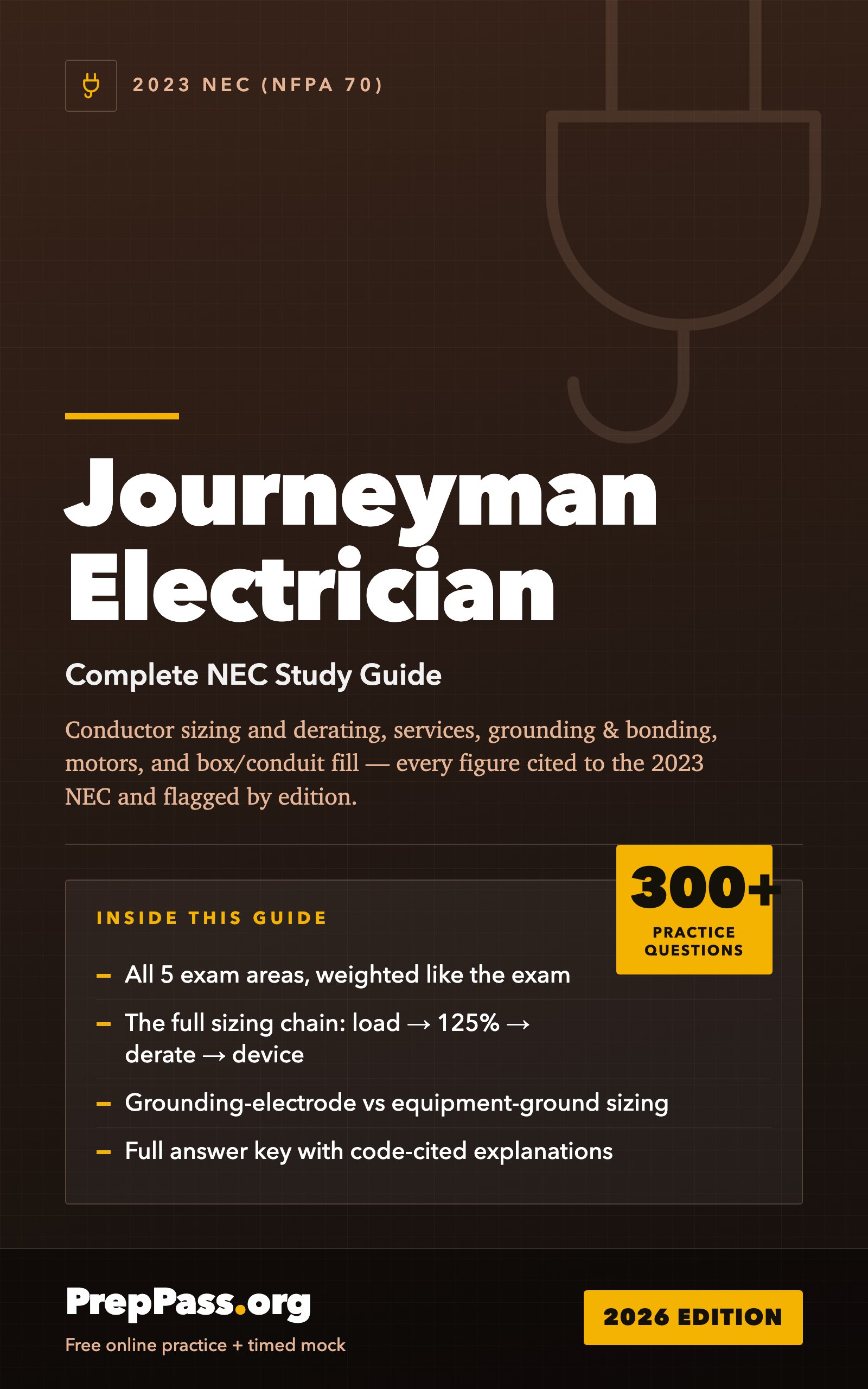
La práctica sigue gratis. La guía completa de Journeyman Electrician (NEC) es el material en sí, explicado de principio a fin — un PDF + EPUB descargable que conservas.
Preguntas frecuentes
¿Cuántas preguntas de práctica de Journeyman Electrician (NEC) hay aquí?+
Un banco completo de preguntas originales de Journeyman Electrician (NEC) en las áreas oficiales, con el peso del examen real y explicaciones. Gratis, sin registro.
¿Cómo es el examen Journeyman Electrician (NEC)?+
Unas 161 preguntas, 240 minutos, y necesitas 70% para aprobar. Practica por tema aquí y luego haz el simulacro cronometrado para medir tu preparación.
¿Estas son las preguntas reales del examen?+
No. Cada pregunta es 100% original, escrita de fuentes públicas con explicaciones. Nunca copiamos preguntas reales ni material de preparación pagado.
¿Puedo estudiar en chino o español?+
La práctica de PrepPass está en inglés, 中文 y español. El examen oficial es en inglés — cambia el idioma de las preguntas a inglés para ensayar la terminología del día del examen.
¿Hay una guía de estudio para Journeyman Electrician (NEC)?+
Sí: PrepPass vende Journeyman Electrician — Complete NEC Study Guide (2026), en descarga PDF + EPUB, $14.99 pago único; la práctica de esta página sigue siendo gratis sin ella. Ver la guía de estudio →
Preguntas de práctica de ejemplo
Algunas preguntas reales de este banco gratuito, con explicaciones completas. Usa la herramienta de arriba para el banco completo.
- 1. Branch Circuits & Feeders
A 208-volt, single-phase branch circuit supplies a continuous load of 24 amperes. What is the minimum standard overcurrent device rating permitted?
- a.30 amperes
- b.25 amperes
- c.24 amperes
- d.40 amperes
Respuesta: a
Explicación: An overcurrent device supplying a continuous load must be rated at not less than 125 percent of that load: 24 A x 1.25 = 30 A, which is a standard rating in 240.6(A). The 24 A and 25 A choices ignore or under-apply the 125 percent factor, and 40 A jumps past the next standard size above the calculated value.
Fuente: 2023 NEC §210.20(A)
- 2. Services, Grounding & Bonding
A service is supplied by two parallel sets of 250 kcmil copper conductors per phase. What is the minimum size copper grounding electrode conductor?
- a.4 AWG
- b.2 AWG
- c.1/0 AWG
- d.3/0 AWG
Respuesta: c
Explicación: With parallel conductors the equivalent area is the sum of the areas in one phase: 2 x 250 kcmil = 500 kcmil, which falls in the over 350 through 600 kcmil row and requires 1/0 copper. Using 2 AWG treats a single 250 kcmil conductor as the whole service, and 3/0 corresponds to services above 1,100 kcmil.
Fuente: 2023 NEC Table 250.66
- 3. Wiring Methods & Materials
A short raceway nipple no longer than 24 inches connects two enclosures. What fill percentage is permitted?
- a.31 percent
- b.40 percent
- c.53 percent
- d.60 percent
Respuesta: d
Explicación: Notes to Chapter 9, Table 1 permit a nipple not exceeding 24 inches in length to be filled to 60 percent of its total cross-sectional area, because heat buildup and pulling friction are both minimal over such a short run. The 40, 53 and 31 percent values are the normal fills for three or more, one, and two conductors respectively.
Fuente: 2023 NEC Chapter 9, Table 1, Note 4
- 4. Motors & Equipment
A continuous-duty motor over 1 horsepower has no marked service factor and no marked temperature rise. What is the maximum overload device rating as a percentage of nameplate full-load current?
- a.140 percent
- b.125 percent
- c.115 percent
- d.175 percent
Respuesta: c
Explicación: Motors that carry neither a service factor of 1.15 or greater nor a marked temperature rise of 40 degrees C or less are limited to 115 percent of nameplate current, because there is less thermal margin available. The 125 percent value applies to the better-rated motors, 140 percent is the permitted increase when the motor will not start, and 175 percent is a fuse sizing percentage.
Fuente: 2023 NEC §430.32(A)(1)
- 5. Branch Circuits & Feeders
A dwelling has a single household electric clothes dryer with a nameplate rating of 4.5 kilowatts. What value must be used for the dryer load in the service calculation?
- a.4,500 volt-amperes
- b.4,000 volt-amperes
- c.5,000 volt-amperes
- d.3,600 volt-amperes
Respuesta: c
Explicación: The load for a household electric clothes dryer is 5,000 volt-amperes or the nameplate rating, whichever is larger, so a 4,500-volt-ampere nameplate is calculated at the 5,000-volt-ampere floor. Using the nameplate 4,500 value violates the minimum, and the other figures apply factors that do not belong here.
Fuente: 2023 NEC §220.54
- 6. Theory & Safety
As defined in Article 100, ampacity is best described as which of the following?
- a.The maximum current a conductor can carry continuously under the conditions of use without exceeding its temperature rating
- b.The current that will instantly melt the conductor
- c.The rated current of the overcurrent device protecting the conductor, taken directly from the marking on the breaker or fuse without regard to installation conditions
- d.The current at which voltage drop reaches 3 percent
Respuesta: a
Explicación: Article 100 defines ampacity as the maximum current, in amperes, that a conductor can carry continuously under the conditions of use without exceeding its temperature rating. It is a property of the conductor and its environment, not the rating of the protective device ahead of it.
Fuente: 2023 NEC Art. 100
- 7. Branch Circuits & Feeders
A 480-volt three-phase feeder carries 30 amperes 300 feet on 4 AWG copper (41,740 circular mils). Using K = 12.9, what is the approximate voltage drop?
- a.4.8 volts
- b.9.6 volts
- c.5.6 volts
- d.2.8 volts
Respuesta: a
Explicación: Three-phase VD = (1.732 x K x I x L) / CM = (1.732 x 12.9 x 30 x 300) / 41,740, about 4.8 V. Using 2 instead of 1.732 gives the 5.6-V answer. See NEC Chapter 9, Table 8.
- 8. Services, Grounding & Bonding
A service uses two parallel sets of 600 kcmil copper conductors per phase. Using the 12.5 percent rule, what is the minimum copper main bonding jumper?
- a.2/0 AWG
- b.4/0 AWG
- c.3/0 AWG
- d.250 kcmil
Respuesta: c
Explicación: Where copper service conductors exceed 1,100 kcmil, the main bonding jumper must be at least 12.5 percent of that area: 2 x 600 = 1,200 kcmil, and 1,200 x 0.125 = 150 kcmil. 2/0 (133.1 kcmil) is too small; 3/0 (167.8 kcmil) qualifies. See NEC 250.28(D)(2).
- 9. Wiring Methods & Materials
A 15-ampere, 125-volt receptacle is installed in a damp location such as under a roofed open porch. What cover is required?
- a.A cover that is weatherproof when no attachment plug is inserted
- b.A cover that is weatherproof whether or not a plug is inserted
- c.No cover is required in a damp location
- d.A standard indoor wall plate
Respuesta: a
Explicación: In damp locations a receptacle needs an enclosure weatherproof when a plug is not inserted; the stricter in-use cover, weatherproof with a plug inserted, is required in wet locations. See NEC 406.9(A).
- 10. Wiring Methods & Materials
Type NM cable entering a single-gang nonmetallic box that has no cable clamps must be secured within what distance of the box?
- a.24 inches
- b.8 inches
- c.3 feet
- d.4 and 1/2 feet
Respuesta: b
Explicación: Where a single-gang nonmetallic box without internal clamps is used, the NM cable must be secured within 8 inches of the box. See NEC 314.17(C) Exception and 334.30(A).