NASAA Series 65 Practice Test
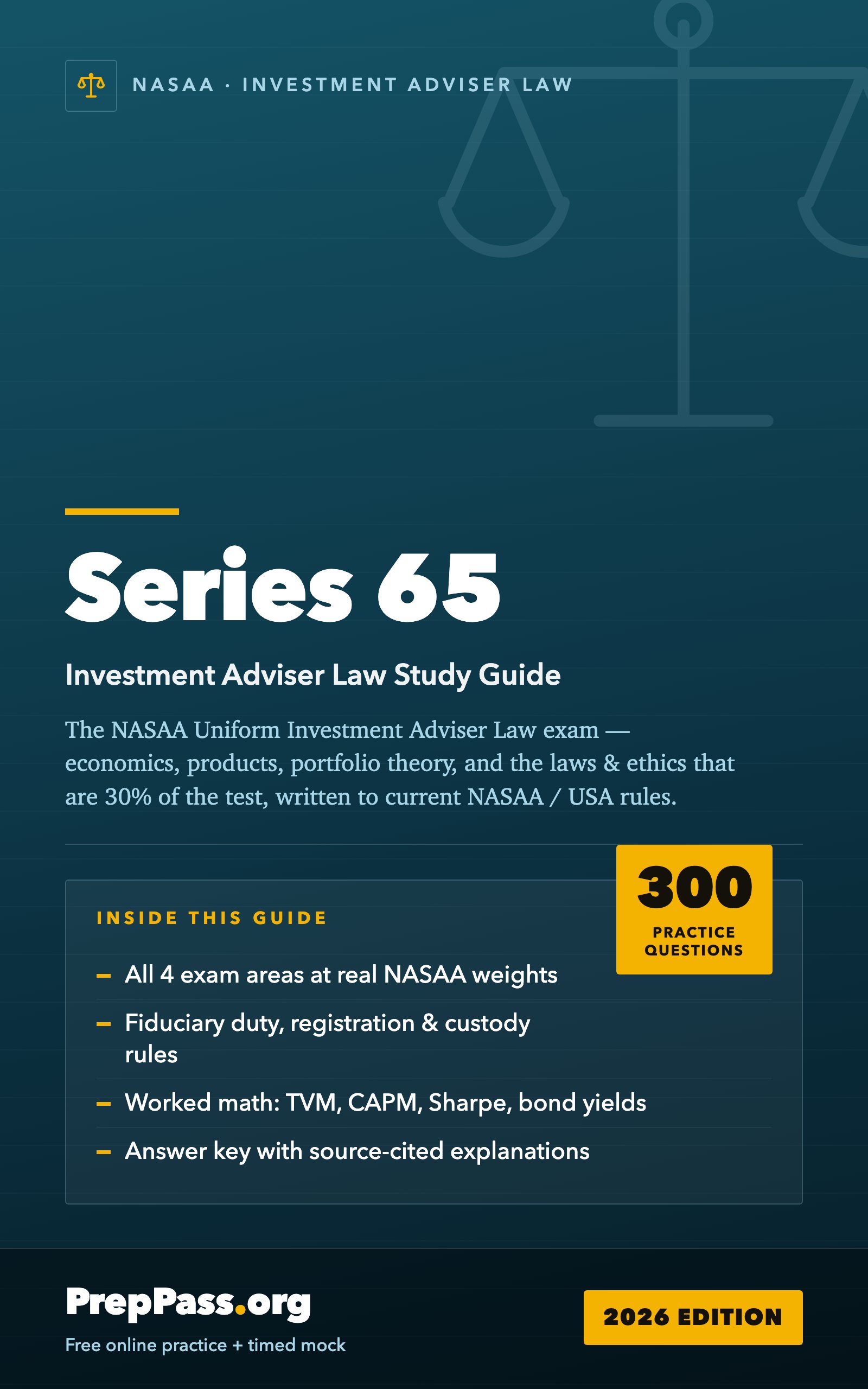
La práctica sigue gratis. La guía completa de Series 65 es el material en sí, explicado de principio a fin — un PDF + EPUB descargable que conservas.
Preguntas frecuentes
¿Cuántas preguntas de práctica de NASAA Series 65 hay aquí?+
Un banco completo de preguntas originales de NASAA Series 65 en las áreas oficiales, con el peso del examen real y explicaciones. Gratis, sin registro.
¿Cómo es el examen NASAA Series 65?+
Unas 140 preguntas, 180 minutos, y necesitas 71% para aprobar. Practica por tema aquí y luego haz el simulacro cronometrado para medir tu preparación.
¿Estas son las preguntas reales del examen?+
No. Cada pregunta es 100% original, escrita de fuentes públicas con explicaciones. Nunca copiamos preguntas reales ni material de preparación pagado.
¿Puedo estudiar en chino o español?+
La práctica de PrepPass está en inglés, 中文 y español. El examen oficial es en inglés — cambia el idioma de las preguntas a inglés para ensayar la terminología del día del examen.
Preguntas de práctica de ejemplo
Algunas preguntas reales de este banco gratuito, con explicaciones completas. Usa la herramienta de arriba para el banco completo.
- 1. Economics & Analysis
During the contraction phase of the business cycle, which of the following typically occurs?
- a.Gross domestic product rises for at least two consecutive quarters
- b.Unemployment rises while business inventories tend to increase
- c.The central bank aggressively raises short-term interest rates
- d.Consumer spending accelerates and corporate profits expand
Respuesta: b
Explicación: A contraction is marked by falling output, rising unemployment, and weakening demand, which often leaves unsold goods and swelling inventories. Two consecutive quarters of rising GDP describe an expansion, not a contraction. Central banks generally cut rates during downturns to stimulate activity.
- 2. Investment Vehicles
A Guaranteed Investment Contract (GIC) issued by an insurer is most similar in risk profile to which of the following?
- a.A speculative growth stock
- b.A tax-free municipal bond whose interest is fully exempt from both federal and state income tax
- c.A leveraged commodity future
- d.A fixed-income instrument dependent on the insurer's creditworthiness
Respuesta: d
Explicación: A GIC promises a fixed return over a set period and behaves like a fixed-income instrument, with its safety tied to the issuing insurer's financial strength. It carries credit risk of the insurer rather than market volatility of equities. It is neither speculative nor tax-exempt like a municipal bond.
- 3. Laws & Regulations
An investment adviser that has custody of client funds or securities is generally required to do which of the following?
- a.Take permanent title to client securities
- b.Follow the custody rule's safeguards, such as using a qualified custodian and providing account statements
- c.Commingle client assets with firm assets for efficiency
- d.Avoid any independent verification of holdings
Respuesta: b
Explicación: Under the custody rule, an adviser with custody must safeguard client assets by using a qualified custodian, ensuring clients receive account statements, and, in many cases, undergoing a surprise independent verification. Commingling client and firm assets is prohibited. These safeguards protect clients against misappropriation.
Fuente: Investment Advisers Act of 1940
- 4. Investment Vehicles
A Government National Mortgage Association (GNMA / Ginnie Mae) pass-through security is best described as:
- a.A tax-free municipal bond issued by a local housing authority whose interest is exempt from federal income tax and whose principal is separately guaranteed by the U.S. Treasury against any default
- b.A common stock issued by a housing company
- c.A zero-coupon Treasury bond
- d.A security representing an interest in a pool of mortgages that passes through principal and interest, backed by the full faith and credit of the U.S. government
Respuesta: d
Explicación: A Ginnie Mae pass-through gives investors an interest in a pool of federally insured mortgages, passing through monthly principal and interest, and is backed by the full faith and credit of the U.S. government. Its interest is fully taxable at all levels, and it carries prepayment risk. It is neither a stock nor a tax-free municipal bond.
- 5. Economics & Analysis
A company earns $5.00 per share and pays a $1.50 annual dividend. Its dividend payout ratio is:
- a.150%
- b.30%
- c.3.3%
- d.50%
Respuesta: b
Explicación: The payout ratio equals dividend per share divided by EPS: $1.50 divided by $5.00 equals 30%. The remaining 70% is the retention ratio reinvested in the business. Inverting the fraction gives distractor traps.
- 6. Investment Vehicles
In a corporate liquidation, a subordinated debenture is paid:
- a.After other general creditors and senior debt, but before preferred and common stockholders
- b.Before secured bondholders
- c.At the same time as common stockholders
- d.Before all other creditors of the company, ahead of even secured bondholders and general creditors, because subordinated status grants a first-priority claim
Respuesta: a
Explicación: Subordinated debt ranks below senior debt and general creditors but still ahead of equity holders. The liquidation priority runs secured creditors, then senior debt, then general creditors, then subordinated debt, then preferred, then common stock.
- 7. Recommendations & Strategies
To compare the skill of a portfolio manager independent of client deposits and withdrawals, the most appropriate performance measure is:
- a.The nominal coupon rate
- b.Time-weighted return
- c.Current yield
- d.Dollar-weighted return (internal rate of return)
Respuesta: b
Explicación: Time-weighted return removes the distorting effect of the timing and size of client cash flows, isolating the manager's investment decisions. Dollar-weighted return, the internal rate of return, instead reflects the investor's actual experience including cash-flow timing.
- 8. Laws & Regulations
An investment adviser placing client trades has a duty of best execution, which means it must:
- a.Direct all trades to an affiliated broker regardless of terms
- b.Always use the brokerage that pays the adviser the most
- c.Seek the most favorable overall terms reasonably available for the client's transactions
- d.Execute trades only once per year to save costs
Respuesta: c
Explicación: Best execution requires an adviser to seek the most favorable terms reasonably available, considering price, speed, and total cost, for client trades. Routing orders to maximize the adviser's own benefit at the client's expense breaches fiduciary duty under the Investment Advisers Act of 1940.
- 9. Recommendations & Strategies
An individual has $9,000 of net capital losses for the year and realized no capital gains. For federal income tax purposes the investor may:
- a.Deduct the entire $9,000 against ordinary income for this year
- b.Deduct $3,000 against ordinary income and carry $6,000 forward
- c.Carry the full $9,000 back and amend the two prior-year returns
- d.Deduct nothing until an offsetting capital gain is actually realized
Respuesta: b
Explicación: Net capital losses offset capital gains first. With no gains, an individual may deduct up to $3,000 of net capital loss against ordinary income in a year. The remainder, $9,000 - $3,000 = $6,000, is carried forward indefinitely to offset future gains or another $3,000 of ordinary income each year. Individuals may not carry capital losses back to prior years.
- 10. Economics & Analysis
A company's common shares trade at $45 while its book value per share is $30. Its price-to-book ratio is:
- a.15.0
- b.1.5
- c.1.15
- d.0.67
Respuesta: b
Explicación: Price-to-book = market price per share / book value per share = $45 / $30 = 1.5. The 0.67 figure inverts the ratio. A price-to-book above 1.0 means the market values the company above its accounting net worth, often because of intangible assets or expected growth that the balance sheet does not capture.
Consigue la guía completa de Series 65 — PDF + EPUB, $19.99 →