HSPA Sterile Processing (CRCST) Practice Test
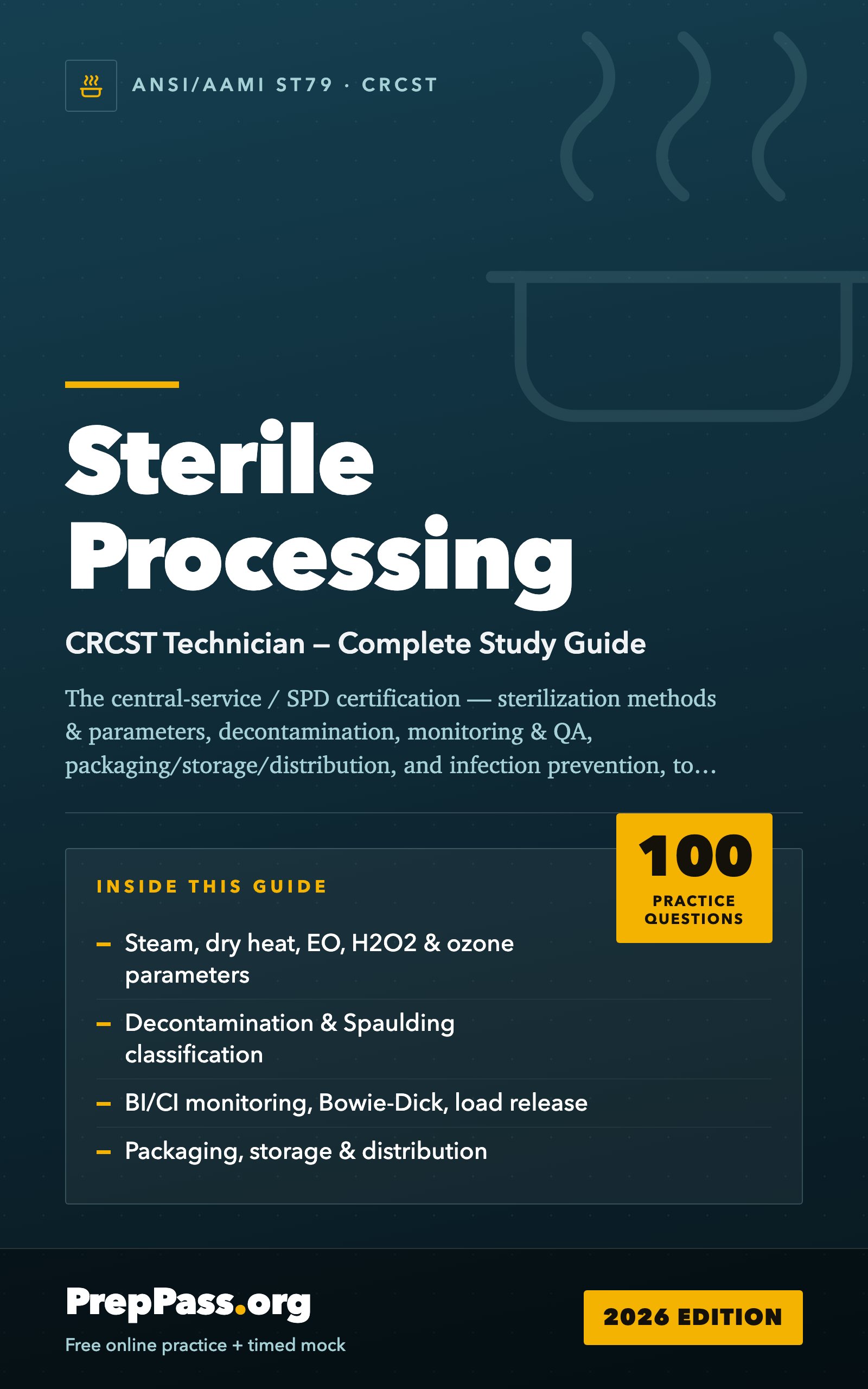
练习一直免费。完整的 Sterile Processing Technician (CRCST) 学习指南是知识本身,从头到尾讲清楚 —— 可下载的 PDF + EPUB,永久归你。
| 主管机构 | Healthcare Sterile Processing Association (HSPA), formerly IAHCSMM —— 考试由 Prometric 承办 来源: HSPA — Certification Handbook (PDF, revised January 2026) |
|---|---|
| 题目数量 | 150 道题 (125 道计分,25 道不计分预试题) 来源: HSPA — Certification Handbook (PDF, revised January 2026) |
| 考试时限 | 180 分钟 来源: HSPA — Certification Handbook (PDF, revised January 2026) |
| 及格标准 | HSPA 未公布 我们查阅但未找到该数据的来源: HSPA — Certification Handbook (PDF, revised January 2026) |
| 费用 |
来源: HSPA — Certification Handbook (PDF, revised January 2026) |
| 考试语言 | 英语 来源: HSPA — Certification Handbook (PDF, revised January 2026) |
常见问题
这里有多少道 HSPA Sterile Processing (CRCST) 练习题?+
一整套原创 HSPA Sterile Processing (CRCST) 练习题,覆盖官方内容板块、按真实考试权重分布、附解析。免费,无需注册。
HSPA Sterile Processing (CRCST) 考试是什么样的?+
大约 150 道题、180 分钟。先在这里按主题刷题,再做完整计时模考检验准备度。
这些是真实考题吗?+
不是。每道题都是 100% 原创,依据公开一手来源编写并附解析。我们从不抄袭真题或付费备考资料。
我可以用中文或西班牙语学吗?+
PrepPass 练习提供英文、中文、西班牙文。官方考试以英文进行 —— 你随时可以把题目语言切回英文,熟悉考试当天的确切术语。
样题与解析
以下是本题库中的部分真题与完整解析。完整题库请用上方的刷题工具。
- 1. Cleaning, Decontamination & Disinfection
A surgical case has just ended and the scrub person is preparing instruments for transport to the decontamination area. What is the correct point-of-use treatment?
- a.Perform a full manual wash at the sterile field before transport
- b.Allow the instruments to air dry so blood flakes off during transport
- c.Spray the instruments with saline and wrap them in a dry towel
- d.Remove gross soil and keep the instruments moist until they reach decontamination
答案: d
解析: Point-of-use treatment means wiping away gross soil and applying a moisture-retention product or damp towel so bioburden does not dry onto surfaces. Dried blood and protein are far harder to remove and can block sterilant contact. Saline is corrosive to instrument alloys, and full cleaning is never performed in the operating room because it creates contaminated aerosols in a sterile environment.
依据: AAMI ST79
- 2. Sterilization Process
Immediate-use steam sterilization (IUSS) is requested for a single dropped instrument during a case. Which statement is correct?
- a.IUSS eliminates the need for physical, chemical, and biological monitoring
- b.The item must still be thoroughly cleaned and decontaminated before it is placed in the sterilizer
- c.The item may be flash sterilized unwrapped and stored for later use if kept covered
- d.Cleaning may be abbreviated because the exposure temperature is higher
答案: b
解析: IUSS shortens the packaging and drying steps, not the cleaning step, and a device that is not properly cleaned cannot be sterilized by any cycle. Items processed by IUSS are transported for immediate use and are not stored for later cases. Physical monitors and chemical indicators are used with every IUSS cycle, and the sterilizer is monitored biologically at least daily or weekly per policy.
依据: AAMI ST79
- 3. Preparation & Packaging
A peel pouch is being prepared for a single ring-handled instrument. Which practice is correct?
- a.Select a pouch size that lets the item fit without stressing the seals, place the item so the handle enters the pouch first, and do not double pouch unless the pouch manufacturer validates it
- b.Fill the pouch completely so the instrument cannot shift during handling
- c.Write the contents on the paper side with a ballpoint pen
- d.Fold the pouch over to fit a long instrument and seal it with tape
答案: a
解析: A properly sized pouch keeps the seals intact, permits steam entry through the porous side, and allows the package to be opened aseptically with the handle presented first. Overfilling stresses seals, and folding or taping a pouch prevents sterilant contact and creates an unvalidated package. Labeling is done on the plastic side, outside the seal, with a non-bleeding marker, because writing on the paper side can damage the sterile barrier.
依据: AAMI ST79
- 4. Departmental Considerations
What do dress code standards say about jewelry in sterile processing work areas?
- a.Jewelry may be worn in assembly but comes off in the decontamination area
- b.A plain band ring may be worn when the technician double gloves that hand
- c.Necklaces and earrings are acceptable while they stay covered by attire
- d.Rings, bracelets and watches come off, because they harbor microorganisms
答案: d
解析: Hand and wrist jewelry is removed before entering the work areas. Rings, bracelets and watches trap moisture and organic soil, interfere with hand hygiene, tear gloves, and can scratch or be dropped into an instrument set. Double gloving does not fix the contamination held under a band or the increased risk of a glove tear. Removing jewelry only for decontamination misses the assembly side, where a dropped stone or a loose earring can end up inside a tray that is then sterilized and opened on a sterile field. Necklaces and dangling earrings under attire are still a foreign-object and contamination risk and are not made acceptable by being covered.
依据: AAMI ST79
- 5. Cleaning, Decontamination & Disinfection
A technician sees a puddle of detergent solution spreading across the decontamination floor from a leaking sink. What is the correct response?
- a.Step around the puddle and finish the tray, then report the leak at the shift handoff meeting
- b.Ask the supervisor to decide whether housekeeping or maintenance should respond to the spill
- c.Throw absorbent towels over the puddle and leave them there so the liquid soaks up on its own
- d.Mark the area, clean up the liquid promptly, and place a wet floor sign until it is fully dry
答案: d
解析: Walking and working surfaces must be kept clean, dry, and free of hazards, and a technician who sees a spill is expected to contain and clean it immediately rather than route the decision to someone else. Stepping around it and mentioning it hours later leaves a slip hazard for every person entering the room. Asking who should respond is a way of postponing a duty the technician can discharge in a minute, and a fall can happen while the question is being answered. Towels left in place become a saturated, slick trip hazard themselves and do not dry the floor.
依据: OSHA 29 CFR 1910.22
- 6. Cleaning, Decontamination & Disinfection
A department is writing its procedure for manual high-level disinfection with a liquid chemical germicide. Which statement belongs in that procedure?
- a.Contact time may be shortened if the concentration test strip reads above the labeled minimum
- b.The item is cleaned and dried first, soaked for the labeled time and temperature, then rinsed
- c.Soaking longer than the labeled time is required for lumened items regardless of the label
- d.Rinsing after disinfection is optional when the item will be dried with filtered forced air
答案: b
解析: Every liquid chemical germicide is cleared for a stated concentration, exposure time, and solution temperature, and the item must be cleaned and dried before immersion so residual water does not dilute the solution below its effective concentration; a thorough rinse follows because the residue is toxic to tissue. A strip reading above the minimum confirms the solution is still usable but does not license a shorter soak. Rinsing is not optional, since forced air dries but does not remove chemical residue. Extending the soak beyond label direction is not a general lumen rule and can damage devices.
依据: AAMI ST58
- 7. Preparation & Packaging
A completed orthopedic set weighs 31 pounds with its tray. Why is that a problem, and what should be done?
- a.It passes the lifting limit OSHA sets for one person, though the cycle itself is not affected by it.
- b.It passes the 25-pound recommendation; the added mass holds condensate, so the set gets divided up.
- c.It passes the 25-pound recommendation, which counts the instruments alone and not the tray itself.
- d.It passes the sterilizer shelf rating, so the load has to be run on the bottom shelf over the drain.
答案: b
解析: The recommended limit for a wrapped instrument set is about 25 pounds for the tray and its contents together, and that figure exists because a heavy metal mass takes longer to heat, holds far more condensate, and often will not dry within the cycle, producing wet packs; the fix is to split the set into two trays and distribute the mass evenly rather than piling it at one end. Handling injury is a real concern but is not the sterilization rationale. Counting only the instruments would ignore the mass of the tray, which behaves the same way. Sterilizer shelves are not what the 25-pound figure describes.
依据: AAMI ST79
- 8. Sterilization Process
What ventilation is required in the room where an ethylene oxide sterilizer and its aerator are installed?
- a.Positive pressure to adjacent areas so escaping gas is pushed out of the equipment room fast
- b.Recirculating charcoal filters that return the cleaned air to the sterile storage area nearby
- c.Dedicated exhaust discharged outdoors, with local capture at the sterilizer door and aerator
- d.A ceiling fan aimed across the sterilizer door to dilute gas in the operator's breathing zone
答案: c
解析: Ethylene oxide installations need dedicated, non-recirculating exhaust that discharges outside the building, with local exhaust capture at the point of release, which is the sterilizer door at the end of a cycle and the aerator, plus an emergency purge capability. Recirculating the air back into the department, and especially into sterile storage, simply moves the gas to where staff and sterile stock are. Positive pressure would push contaminated air out into occupied areas rather than containing it, which is the opposite of what is wanted. A ceiling fan only stirs the gas around the room and does not remove it from the building.
依据: AAMI ST41
- 9. Sterile Storage, Transport & Inventory
Cases of irrigation solution are the heaviest and fastest-moving item in sterile storage. Where should they be shelved?
- a.On a middle shelf at waist to shoulder height, where the lift stays close to the body
- b.On the top shelf, so full cases can be slid down onto the cart without bending over
- c.On the bottom shelf, so every lift begins at floor level with the back held straight
- d.On any open shelf, provided that a step stool and a two-person team lift are used per case
答案: a
解析: Frequently handled heavy stock belongs in the power zone between waist and shoulder height, where the load stays close to the trunk and the technician neither reaches overhead nor squats. Storing heavy cases overhead forces an unsupported lift away from the body, and a case that slips from that height can strike the worker. Floor-level storage forces repeated deep bending and squatting many times a shift, which is the classic back-injury pattern. A step stool and a helper are useful controls for occasional lifts, but they do not correct a storage height that is wrong for an item handled dozens of times a day.
依据: HSPA CRCST Content Outline
- 10. Patient Care Equipment & Distribution
The emergency department needs six compression devices tonight, but only two clean units are on the shelf and none are due back. What should the technician do?
- a.Notify the supervisor so rental devices can be arranged and logged in
- b.Send the two clean units plus two returned units that are still soiled
- c.Pull four units from other nursing floors that are not using them now
- d.Tell the ED to wait until the day shift processes more of the devices
答案: a
解析: Covering a genuine shortfall means acquiring more equipment, and arranging a vendor rental is a supervisor function; the rental units are then received, documented into the tracking system and inspected before they are issued. Sending soiled units is a direct patient safety failure no shortage justifies. Stripping other floors moves the shortage rather than solving it and removes devices that may be needed for prophylaxis on those patients. Telling the emergency department to wait leaves patients without ordered therapy when a rental could be delivered the same night, and it hands a supply problem back to the clinical unit.
依据: HSPA CRCST Content Outline
拥有完整的 Sterile Processing Technician (CRCST) 学习指南 —— PDF + EPUB,$14.99 →