ACLS — Advanced Cardiovascular Life Support Practice Test
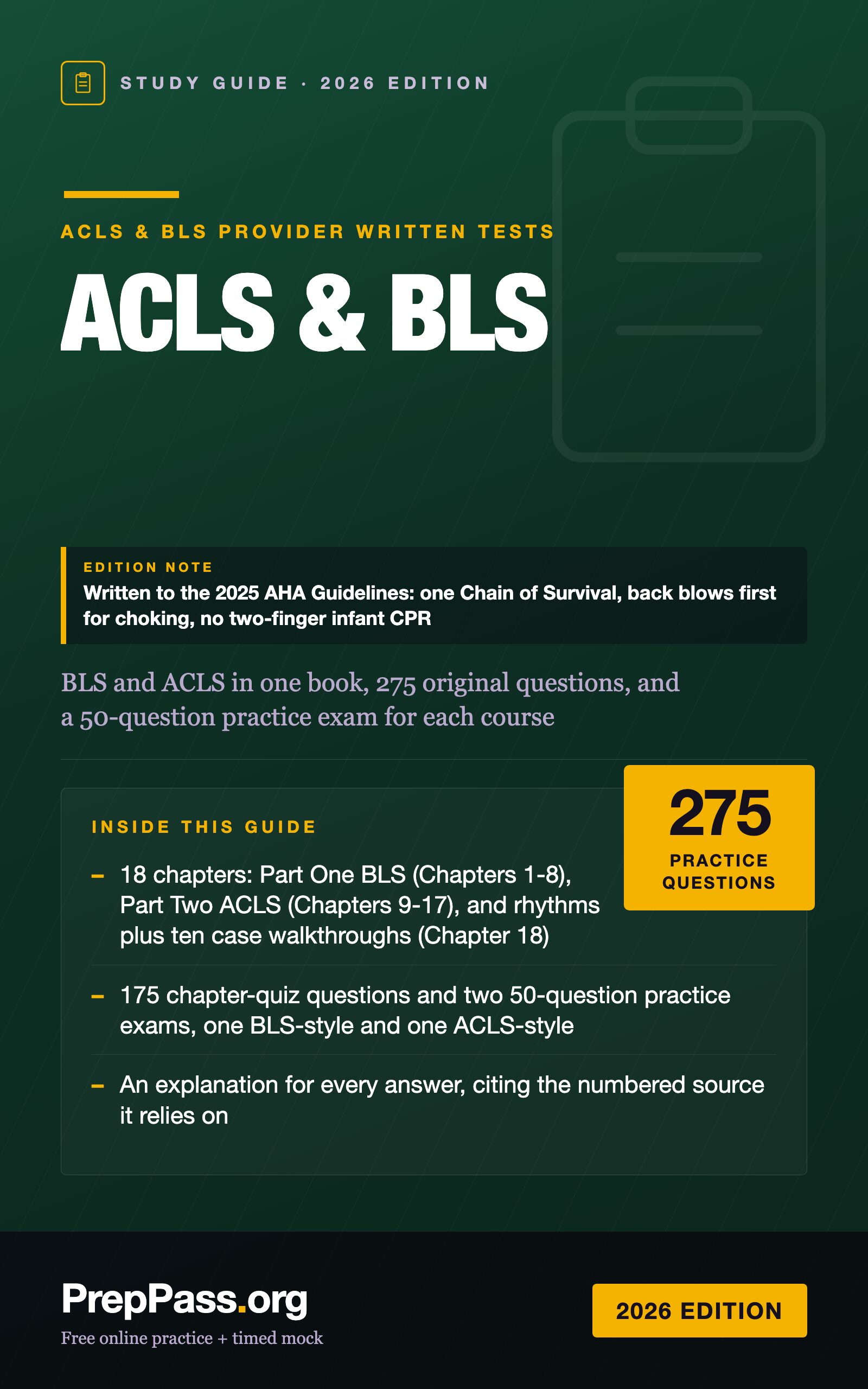
Practice stays free. The full ACLS & BLS Provider Written Tests study guide is the material itself, taught start to finish — a downloadable PDF + EPUB you keep.
Frequently asked questions
How many ACLS — Advanced Cardiovascular Life Support practice questions are here?+
A full bank of original ACLS — Advanced Cardiovascular Life Support practice questions across the official content areas, weighted like the real exam, with explanations. Free, no signup.
What is the ACLS — Advanced Cardiovascular Life Support exam like?+
A multiple-choice exam. Practice by topic here, then take the full timed mock exam to gauge readiness.
Are these the real exam questions?+
No. Every question is 100% original, written from public primary sources with explanations. We never copy real exam questions or paid prep material.
Can I study in Chinese or Spanish?+
PrepPass practice is in English, 中文 and Español. The official exam is in English — switch the question language to English any time to rehearse the exact terminology you'll see on test day.
Is there a study guide for the ACLS — Advanced Cardiovascular Life Support?+
Yes. PrepPass sells ACLS & BLS Study Guide — 2026 Edition, a PDF + EPUB download, $24.99 one-time; the practice on this page stays free without it. See the study guide →
Sample practice questions
A few real questions from this free bank, with full explanations. Use the practice tool above for the whole set.
- 1. High-Quality BLS & AED
What is the recommended chest compression rate for high-quality CPR in an adult?
- a.60 to 80 compressions per minute
- b.80 to 100 compressions per minute
- c.100 to 120 compressions per minute
- d.120 to 140 compressions per minute
Answer: c
Explanation: Current AHA guidelines call for a compression rate of 100 to 120 per minute. Rates slower than 100 reduce coronary and cerebral perfusion, while rates faster than 120 shorten the recoil/filling phase and reduce the depth actually achieved, so the diastolic filling of the heart suffers. Staying inside the 100-120 window balances forward blood flow with adequate ventricular filling.
- 2. Rhythm Recognition (ECG)
A stable patient has a regular narrow-complex tachycardia at 180 bpm; vagal maneuvers have not worked. The next appropriate step is:
- a.Defibrillate the patient
- b.Give adenosine 6 mg by rapid IV push
- c.Give atropine 1 mg IV
- d.Give epinephrine 1 mg IV push
Answer: b
Explanation: A regular narrow-complex tachycardia that persists after vagal maneuvers in a stable patient is treated with adenosine 6 mg rapid IV push (then 12 mg if needed). This most likely represents a re-entrant SVT, and adenosine's transient AV nodal block can break the circuit. Defibrillation, atropine, and arrest-dose epinephrine are all inappropriate for a stable, perfusing SVT.
- 3. High-Quality BLS & AED
During CPR the ETCO2 is 9 mm Hg. What adjustment is most likely to help?
- a.Give sodium bicarbonate
- b.Increase ventilations to 30 per minute
- c.Stop CPR for a rhythm check
- d.Improve compression depth and rate
Answer: d
Explanation: ETCO2 reflects cardiac output during CPR and rises with better compression depth; the Guidelines suggest targeting at least 10 and ideally 20 mm Hg. Faster ventilation risks harm and bicarbonate is not routine.
- 4. Airway Management & Ventilation
What basic airway strategy does resuscitation usually start with?
- a.Bag-mask ventilation
- b.Supraglottic airway only
- c.Surgical airway
- d.Intubation before CPR
Answer: a
Explanation: Airway management during cardiac arrest usually begins with bag-mask ventilation, with an advanced airway added according to skill and setting.
- 5. ACLS Pharmacology
For VF that persists after defibrillation, which antiarrhythmics improved survival to hospital admission in a large trial?
- a.Amiodarone and lidocaine
- b.Diltiazem and verapamil
- c.Magnesium and calcium
- d.Adenosine and atropine
Answer: a
Explanation: A large placebo-controlled prehospital trial found amiodarone and lidocaine each improved survival to admission, without a difference in survival to discharge.
- 6. ACLS Pharmacology
Which drug route for epinephrine did the 2025 Guidelines remove?
- a.Central venous
- b.Through the endotracheal tube
- c.Intraosseous
- d.Intravenous
Answer: b
Explanation: Administering intra-arrest medications via an endotracheal tube was removed because it produces low blood concentrations and unpredictable effects.
- 7. Rhythm Recognition (ECG)
Why does a narrow-complex tachycardia in a septic patient need careful interpretation?
- a.It may be a response
- b.It must be shocked at once
- c.It cannot occur with fever
- d.It is always VT in disguise
Answer: a
Explanation: There must be a reasonable expectation that a narrow-complex tachycardia is causing instability rather than being a manifestation of another illness such as sepsis.
- 8. Cardiac Arrest Algorithms
Which intervention for a suspected massive pulmonary embolism arrest do the Guidelines discuss?
- a.Atropine
- b.Systemic fibrinolysis
- c.Synchronized cardioversion
- d.Adenosine
Answer: b
Explanation: Treatments for arrest from PE include systemic and catheter-guided fibrinolysis, surgical and mechanical embolectomy, and ECMO.
- 9. Bradycardia & Tachycardia
Why is verapamil dangerous for a wide-complex tachycardia of ventricular origin?
- a.It is too slow to work
- b.It causes torsades only in children
- c.It speeds the ventricular rate to 300
- d.It can cause shock and arrest
Answer: d
Explanation: Verapamil will not terminate a WCT of ventricular origin and may cause profound hypotension leading to shock and cardiac arrest.
- 10. ACS, Stroke & Post-Arrest Care
When is supplemental oxygen indicated in suspected ACS?
- a.For every patient
- b.SpO2 below 90%
- c.Never
- d.SpO2 below 99%
Answer: b
Explanation: Oxygen may benefit patients with saturations below 90%, while routine oxygen shows no benefit at saturations of 90% or more.