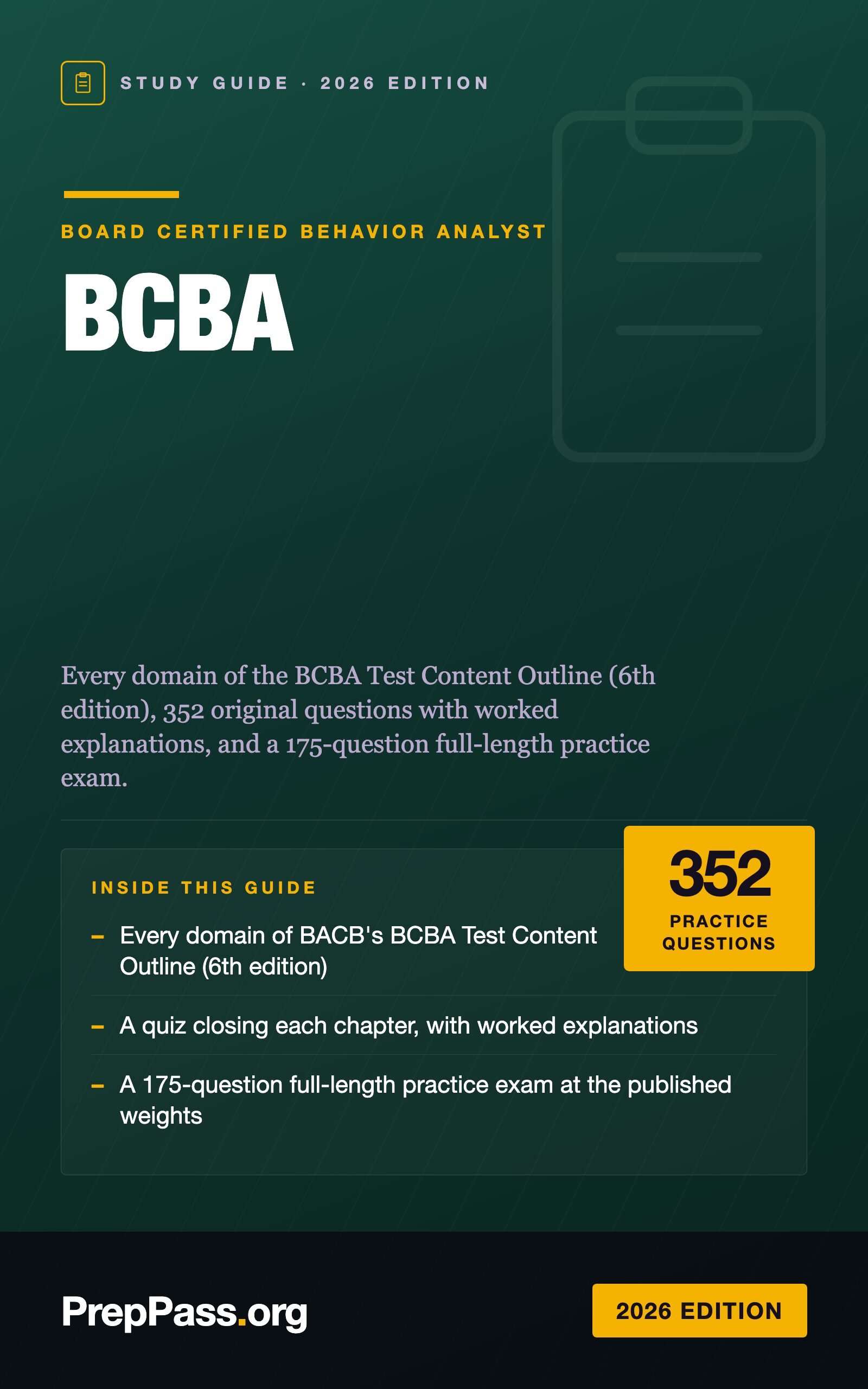
BCBA — Board Certified Behavior Analyst · 2026 Edition
BCBA Study Guide — 2026 Edition
Edition noteFrom January 1, 2027, BACB eligibility narrows from four pathways to two; check the rules for your application date.
Every domain of the BCBA Test Content Outline (6th edition), 352 original questions with worked explanations, and a 175-question full-length practice exam.
- 352 original practice questions, each with a worked explanation, in one PDF + EPUB you keep
PDF + EPUB · English · 259 pages · $19.99 one-time
This book is written in English.
Instant download after payment — no account needed, no subscription.
14-day money-back guarantee: not satisfied for any reason? Email support@preppass.org within 14 days of purchase for a full refund. Refund policy
Try 10 questions first — free
Answer all 10, then see every answer explained — with the section of this guide that teaches it. About 5 minutes, no sign-up.
Start 10 free questionsLook inside the book
Three real pages, rendered straight from the PDF you download — a reference page, a teaching page, and a worked question, always in that order. Nothing here was redrawn to look better.
- Quick referenceAppendix A: Glossary of Key Terms · PDF page 242
A page you can turn back to: the numbers, deadlines or terms gathered in one place.
- How it's taughtChapter 2: Concepts and Principles · PDF page 22
An explanation page: the material taught in prose, in the order the exam tests it.
- A question, workedChapter 3: Measurement, Data Display, and Interpretation · PDF page 55
A practice question with its answer and the reasoning behind it — not just a key.
About the exam itself
| Administering body | Behavior Analyst Certification Board, Inc. (BACB) — exam delivered by Pearson VUE Source: BACB — Board Certified Behavior Analyst Handbook (Updated 06/2026, PDF) |
|---|---|
| Questions | 185 questions (175 scored, 10 unscored pretest) Source: BACB — Board Certified Behavior Analyst Handbook (Updated 06/2026, PDF) |
| Time limit | 240 minutes Source: BACB — Board Certified Behavior Analyst Handbook (Updated 06/2026, PDF) |
| Passing score | Not published by BACB What we read and found nothing in: BACB — Board Certified Behavior Analyst Handbook (Updated 06/2026, PDF) |
| Fees |
Source: BACB — Board Certified Behavior Analyst Handbook (Updated 06/2026, PDF) |
| Languages offered | English Source: BACB — Board Certified Behavior Analyst Handbook (Updated 06/2026, PDF) |
Questions buyers ask
- What has changed on the BCBA — Board Certified Behavior Analyst exam?
- From January 1, 2027, BACB eligibility narrows from four pathways to two; check the rules for your application date. BCBA Test Content Outline (6th ed.) (in force from 2025-01-01): BACB describes modest changes from the BCBA Task List (5th ed.): the 9 content domains were kept with 2 minor title revisions, the Ethics domain (retitled Ethical and Professional Issues) now lists 12 specific tasks, and the outline has 104 tasks, a net increase of 12.
- Is a study guide enough for the BCBA — Board Certified Behavior Analyst exam, or do I need a course?
- Check eligibility first — per Behavior Analyst Certification Board, Inc. (BACB): you apply through one of four BACB pathways (an ABAI- or APBA-accredited degree, behavior-analytic coursework, faculty teaching and research, or postdoctoral experience), each requiring a qualifying graduate degree, supervised fieldwork and passing the exam. Starting January 1, 2027, only the accredited-degree and coursework pathways are offered. A book does not replace those requirements. For the exam content itself, this 259-page guide teaches the material chapter by chapter with 352 practice questions and explanations inside, and 116 more practice questions are free on PrepPass. A prep course adds live instruction and a set schedule; whether you need one beyond any required education is your call.
- What is the cheapest way to prepare for the BCBA — Board Certified Behavior Analyst exam?
- Start with what costs nothing: 116 practice questions on PrepPass, with explanations and no signup. If you want it taught in one file you keep, the full study guide is $19.99 once. No subscription on any of them.
- What happens if I fail the BCBA — Board Certified Behavior Analyst exam?
- You can retake it under Behavior Analyst Certification Board, Inc. (BACB)'s rule: you have two years from application approval to pass and may take the exam up to 8 times, at least 30 days apart. Each retake needs a new $140 retake application and a new $125 Pearson VUE appointment. Confirm the current policy with Behavior Analyst Certification Board, Inc. (BACB) before you book.
- Who administers the Board Certified Behavior Analyst (BCBA) Certification Examination?
- Behavior Analyst Certification Board, Inc. (BACB) — exam delivered by Pearson VUE. The exam is taken in person at authorized Pearson VUE testing sites and US military bases in the United States, Canada (except Quebec, and Ontario only until July 1, 2026) and Australia (until January 1, 2027); results are given on site. It follows the BCBA Test Content Outline (6th ed.), in use since January 1, 2025, over 175 scored questions: A. Behaviorism and Philosophical Foundations 8 (5%), B. Concepts and Principles 24 (14%), C. Measurement, Data Display, and Interpretation 21 (12%), D. Experimental Design 13 (7%), E. Ethical and Professional Issues 22 (13%), F. Behavior Assessment 23 (13%), G. Behavior-Change Procedures 25 (14%), H. Selecting and Implementing Interventions 20 (11%), I. Personnel Supervision and Management 19 (11%). BACB notes the percentages are rounded.
- How many questions are on the Board Certified Behavior Analyst (BCBA) Certification Examination?
- 185 questions (175 scored, 10 unscored pretest). Every question is multiple choice with 4 possible answers and only 1 correct answer. All scored questions are equally weighted, and the result is based on overall performance, not on each content area.
- How long is the Board Certified Behavior Analyst (BCBA) Certification Examination?
- 240 minutes. The 4 hours include reviewing the terms and conditions, the navigation tutorial and load time as well as the examination itself.
- What is the passing score for the Board Certified Behavior Analyst (BCBA) Certification Examination?
- Not published by BACB. BACB sets the passing score with the modified Angoff method, a criterion-referenced method in which a panel of BACB-certified subject matter experts sets the score and the BACB Board of Directors approves it. A new passing score is set when the exam content changes significantly. BACB does not publish the number.
- How much does the Board Certified Behavior Analyst (BCBA) Certification Examination cost?
- $245 — Certification application (BACB, one-time); $125 — Examination appointment (Pearson VUE, per attempt); $140 — Examination retake application (BACB, per attempt). Every retake needs a new retake application and a new examination appointment. BACB fees are nonrefundable and nontransferable; Pearson VUE may add applicable taxes when you schedule.
- What languages is the Board Certified Behavior Analyst (BCBA) Certification Examination offered in?
- English
- Does the BCBA — Board Certified Behavior Analyst study guide come as a PDF?
- Yes — BCBA Study Guide — 2026 Edition downloads as PDF and EPUB, 259 pages. The download link is emailed the moment payment clears and does not expire.
- How much does the BCBA — Board Certified Behavior Analyst study guide cost?
- $19.99, once. There is no subscription and no account to create; the PDF and EPUB files are yours to keep.
- Are there free BCBA — Board Certified Behavior Analyst practice questions?
- Yes — 116 of them, free to use with no signup and an explanation on every one. They are separate from this study guide, which is what you are buying here.
- Can I read part of the BCBA — Board Certified Behavior Analyst study guide before buying?
- Yes. A full chapter is free to read on this page — not a summary of one, the chapter itself.
- Is this the official BCBA — Board Certified Behavior Analyst study guide?
- No. This is an independent study guide and is not affiliated with or endorsed by the exam's awarding body. It is written from BACB's published BCBA Test Content Outline (6th edition) and candidate handbook. Always confirm current requirements with the body that issues your licence.
Free BCBA — Board Certified Behavior Analyst practice questions and study chapters →
What's included — and what isn't
Included
- Every domain of BACB's BCBA Test Content Outline (6th edition)
- A quiz closing each chapter, with worked explanations
- A 175-question full-length practice exam at the published weights
- 352 original questions, each explained and cited to its source
- Every task of the Test Content Outline under its own heading
- PDF + EPUB you keep
Not included
- No printed copy is shipped — this is a file you download and can print yourself
- No video course, instructor or tutoring comes with the book — the free videos on the site are separate
- Not your exam registration or the testing centre's fee, which you still pay to the official body
Contents
See 12 sections and the page each one starts on
- Chapter 1: Behaviorism and Philosophical Foundationsp. 7
- Chapter 2: Concepts and Principlesp. 17
- Chapter 3: Measurement, Data Display, and Interpretationp. 40
- Chapter 4: Experimental Designp. 60
- Chapter 5: Ethical and Professional Issuesp. 75
- Chapter 6: Behavior Assessmentp. 97
- Chapter 7: Behavior-Change Proceduresp. 118
- Chapter 8: Selecting and Implementing Interventionsp. 138
- Chapter 9: Personnel Supervision and Managementp. 155
- Section I: Personnel Supervision and Managementp. 234
- Appendix A: Glossary of Key Termsp. 242
- Appendix B: Quick-Reference Decision Tablesp. 246
Taken from the PDF you download, with the page each one starts on — not typed here.
Read a chapter free, in full
One complete chapter, exactly as it ships in the eBook. Scroll the window to read it right here; no download, no email.
Read chapter 2 here, without leaving the page
We didn't give you the easy intro — the free chapter opens on one of the hardest-working parts of the book, so you can judge the teaching where the exam gets difficult.
Domain B is the vocabulary the entire exam is written in: 24 of the 175 scored questions (14%) test these concepts directly[1], and every other domain assumes them. The BCBA examination presents 185 multiple-choice questions — 175 scored plus 10 unscored — in 4 hours, with 4 options per question and one correct answer each[2]. The trap running through this whole domain is terminology that sounds interchangeable but is not: the exam rewards candidates who sort by function, consequence direction, and controlling variables rather than by surface appearance.
B.1. Identify and distinguish among behavior, response, and response class.
Behavior is what an organism does — the subject matter of the science. A response is a single instance, one occurrence of behavior. A response class is a set of responses grouped by their common effect on the environment rather than by what they look like: different topographies, same function. The literature uses the term "functional response class" for exactly this function-based grouping[3]. Why it matters: assessment and treatment are organized by function, so topographies that look unrelated belong together when they produce the same consequence. How it is tested: a vignette lists crying, whining, and dropping to the floor, each previously followed by the end of a homework demand, and asks what the three topographies form. The trap: grouping by topography — they look different, so they must be different behaviors — instead of by the shared escape function.
B.2. Identify and distinguish between stimulus and stimulus class.
A stimulus is an environmental change that affects the organism. A stimulus class is a set of stimuli grouped by their common functional effect — different stimuli that all evoke the same response class, such as a doorbell, a knock, and an intercom buzz that each occasion answering the door. Michael's classic analysis defines stimulus functions by their measured effects on behavior, not by physical resemblance[4]. Why it matters: generalization and stimulus control operate on functional classes, so physically dissimilar stimuli can belong together. How it is tested: three different signals that all occasion the same behavior, asking what the signals form. The trap: insisting on physical similarity — functional classes can look nothing alike, a point stimulus equivalence (B.21) makes even sharper.
B.3. Identify and distinguish between respondent and operant conditioning.
Respondent behavior is elicited by antecedent stimuli — reflexive and Pavlovian. In the standard preparation, "a neutral stimulus is presented immediately before an unconditioned stimulus," where the unconditioned stimulus is "a stimulus that elicits a reflexive response" and the unconditioned response is "a natural (unlearned) reaction to a given stimulus"[5]. Operant behavior is emitted and controlled by its consequences — it operates on the environment to produce effects[6]. Why it matters: the two conditioning processes call for different change procedures, and the exam sorts vignettes by which process is running. How it is tested: sweating and tensing at the sight of the elevator (respondent, elicited) versus asking to take the stairs to avoid elevators (operant, consequence-controlled). The trap: treating "involuntary" or "emotional" as synonyms for respondent — the test is elicited-by-antecedent versus controlled-by-consequence, not how the behavior feels.
B.4. Identify and distinguish between positive and negative reinforcement contingencies.
Reinforcement always increases the future likelihood of the behavior it follows; positive and negative describe only what happened to the stimulus. Positive reinforcement: "something is added to increase the likelihood of a behavior." Negative reinforcement: "something is removed to increase the likelihood of a behavior" — the escape/avoidance contingency[6]. Why it matters: most clinical work is reinforcement-based, and mislabeling the contingency leads to the wrong procedure. How it is tested: a seatbelt chime that stops when the belt clicks (negative reinforcement — removal increases buckling) versus praise that increases studying (positive reinforcement). The trap, and it is the single most-tested confusion in the domain: "negative" means a stimulus was removed, not that anything was bad — negative reinforcement increases behavior and is never punishment.
B.5. Identify and distinguish between positive and negative punishment contingencies.
Punishment always decreases the future likelihood of the behavior it follows. Positive punishment: "something is added to decrease the likelihood of a behavior." Negative punishment: "something is removed to decrease the likelihood of a behavior" — response cost and time-out from reinforcement live here[6]. Why it matters: the four contingencies form the exam's favorite confusion matrix, and two of them share the word "negative." How it is tested: losing video-game time for skipping homework, with skipping decreasing (negative punishment), versus a reprimand that reduces swearing (positive punishment). The trap: negative punishment versus negative reinforcement — both involve removal, but one decreases behavior and the other increases it. Check the direction of the behavior change first, then whether something was added or removed.
B.6. Identify and distinguish between automatic and socially mediated contingencies.
In a socially mediated contingency, another person delivers or arranges the consequence — attention, tangibles, or escape that someone else provides. In an automatic contingency, the behavior itself produces the consequence directly, with no mediator needed — the sensory feedback of the movement itself. Iwata's extinction analysis distinguished exactly these functional variations: behavior "positively reinforced by attention from adults," behavior "negatively reinforced by escape from educational tasks," and behavior "automatically reinforced or 'self-stimulatory' in nature" — each requiring its own form of extinction[7]. Why it matters: a sensory consequence cannot be withheld the way attention can, so automatic reinforcement demands different procedures. How it is tested: rocking that persists when the child is completely alone (automatic) versus yelling that stops when the teacher leaves the room (socially mediated). The trap: assuming every problem behavior is socially mediated — persistence with no audience and no demands points to automatic reinforcement.
B.7. Identify and distinguish among unconditioned, conditioned, and generalized reinforcers.
Unconditioned (primary) reinforcers work with no learning history: they "have innate reinforcing qualities" and "are not learned" — food, water, warmth, sleep[6]. Conditioned (secondary) reinforcers acquire their value through pairing: a secondary reinforcer "has no inherent value and only has reinforcing qualities when linked with a primary reinforcer" — praise, money[6]. Generalized reinforcers are conditioned reinforcers paired with many different reinforcers: "When tokens are paired with multiple terminal reinforcers, they are said to be generalized reinforcers," and that breadth makes them "less dependent on specific motivational conditions"[8]. Why it matters: generalized reinforcers such as tokens, money, and praise keep working as motivating operations shift across the day. How it is tested: tokens exchangeable for many different items (generalized) versus food itself (unconditioned). The trap: calling money unconditioned, or forgetting that a conditioned reinforcer's power lives entirely in its pairing history — break the pairings and the value fades.
B.8. Identify and distinguish among unconditioned, conditioned, and generalized punishers.
The same three-way split applies to punishers, mirroring the reinforcer taxonomy. Unconditioned punishers decrease behavior with no learning required — intense or painful stimuli. Conditioned punishers acquire punishing value by being paired with unconditioned punishers — a sharp "no" or a frown that has repeatedly preceded lost privileges. Generalized punishers are conditioned punishers paired with a variety of punishers, effective across many motivational conditions — the same "paired with multiple" logic that makes generalized reinforcers durable[8]. The add-versus-remove distinction from the punishment contingencies still applies on top of this taxonomy: any of the three punisher types can be presented (positive punishment) or removed (negative punishment) to decrease behavior[6]. How it is tested: parallel to B.7 — which punisher needed no learning history, and which one works across many deprivation states. The trap: confusing a conditioned punisher (a stimulus type) with negative punishment (a contingency) — one describes the stimulus, the other describes what was done with it.
B.9. Identify and distinguish among simple schedules of reinforcement.
Four patterns, each with a signature on a cumulative record. Fixed ratio: "a set number of responses that must occur before the behavior is rewarded" — high rates with a brief post-reinforcement pause[6]. Variable ratio: "the number of responses needed for a reward varies," and it is "the most powerful partial reinforcement schedule" — high steady rates with no pause, the gambling schedule[6]. Fixed interval: "behavior is rewarded after a set amount of time," yielding "a scallop-shaped response pattern, reflecting a significant pause after reinforcement"[6]. Variable interval: reinforcement "based on varying amounts of time, which are unpredictable" — steady, moderate responding[6]. Why it matters: the schedule predicts the pattern you will see on the graph, and schedule effects are read straight off cumulative records. How it is tested: "scallop" points to FI; "highest steady rate, no pause" points to VR; "paid per unit completed" points to FR. The trap: ratio counts responses while interval watches the clock, and fixed means predictable — keep those two axes separate and the four schedules sort themselves.
B.10. Identify and distinguish among concurrent, multiple, mixed, and chained schedules of reinforcement.
Concurrent schedules make two or more schedules available at the same time, so the organism chooses between them moment to moment — "many problem situations in applied settings are best conceptualized as choice situations," and this is the arrangement the matching law describes[9]. Multiple schedules alternate two or more schedules in the same setting, each correlated with its own discriminative stimulus — the signal tells the organism which schedule is currently in effect. Mixed schedules also alternate schedules, but with no signal: the organism cannot tell which schedule is running. Chained schedules arrange a sequence of links in which completing one link produces the SD for the next, and only the final link produces the terminal reinforcer — each link's cue is the previous link's payoff. Why it matters: the signal (multiple), its absence (mixed), simultaneity (concurrent), and sequence (chained) each produce different patterns and call for different analyses. How it is tested: red light means FR while green light means VI, alternating (multiple); the same alternation with no lights (mixed); two tasks paying off side by side with free switching (concurrent); "finish A to unlock B to earn the reward" (chained). The trap: multiple versus mixed — the presence or absence of the signal is the entire difference, and it is the exam's favorite discrimination in this task.
B.11. Identify and distinguish between operant and respondent extinction as operations and processes.
Extinction is two things at once: an operation and a process. As an operation, it is the procedure — discontinuing the reinforcer that maintained the behavior: reductions occur "only when implementation of 'extinction' involved the discontinuation of reinforcement previously shown to be responsible for maintaining the behavior"[7]. As a process, it is the resulting decrease in responding over time: "when reinforcement is discontinued... the contingency between responses and reinforcers is suspended, and responding may decrease as a result"[10]. In operant extinction the consequence no longer follows the response; in respondent extinction the conditioned stimulus is presented without the unconditioned stimulus until the conditioned response weakens. Why it matters: extinction must match the maintaining reinforcer — withholding attention does nothing for escape-maintained behavior, which is why a functional analysis precedes the procedure. How it is tested: a parent who stops attending to attention-maintained whining (operant extinction as operation) versus a tone repeatedly presented without food (respondent extinction). The trap: calling it extinction when the wrong consequence is withheld, and reading the extinction burst or spontaneous recovery as failure — both are part of the process, not evidence the operation was wrong.
B.12. Identify examples of stimulus control.
Behavior is under stimulus control when it occurs more often in the presence of one stimulus than another because of a history of differential reinforcement. Michael's formulation: a discriminative stimulus is a stimulus condition that increases response frequency because it "has been correlated with an increase in the frequency with which that type of response has been followed by that type of reinforcement"[4]. The concept runs through verbal behavior as well, where "the primary distinction between the other verbal operants is in terms of the different types of stimulus control"[11]. Why it matters: stimulus control is the mechanism behind every discrimination repertoire and every cue-based intervention. How it is tested: a dog that sits to "sit" but not to "stay" — which stimulus controls sitting? The trap: stimulus control is demonstrated by differential responding across stimuli, not by a single response to a single stimulus — one instance proves nothing.
B.13. Identify examples of stimulus discrimination.
Stimulus discrimination is the performance: responding differently to different stimuli — responding in the presence of the SD and withholding in the presence of the S-delta — built by a history of differential reinforcement. The pigeon that pecks only when the key light is green, never when it is red, is discriminating. Why it matters: discrimination is the product the trainer is trying to produce, and the exam separates the performance from the procedure. How it is tested: "after training, the learner responds to A but not B" asks for the performance (discrimination), while "reinforcing A-responses and extinguishing B-responses" asks for the procedure (discrimination training). The trap: confusing the two — discrimination is what the organism does; discrimination training is what the behavior analyst arranges. It is also the direct opposite of stimulus generalization (B.14): telling stimuli apart versus treating them alike.
B.14. Identify and distinguish between stimulus and response generalization.
Stimulus generalization: an untrained, physically similar stimulus evokes the trained response — the stimuli vary, the response stays. Response generalization: untrained responses in the same functional class occur — the responses vary, the function stays. Stokes and Baer argued that generalization deserves "an active conceptualization and technology" rather than being treated as the passive residue of failed discrimination training[12]. Why it matters: generalization is programmed, not hoped for, and the exam checks whether candidates can name which dimension varied. How it is tested: a child taught to say "dog" to a beagle picture who also says "dog" to poodles and bulldogs (stimulus generalization — new stimuli) versus a child taught to wave "hi" who begins saying "hi" unprompted (response generalization — new responses, same greeting function). The trap: when a vignette varies both, ask which dimension the question is about — new stimuli evoking the old response is stimulus generalization; new responses serving the old function is response generalization.
B.15. Identify examples of response maintenance.
Response maintenance is the persistence of behavior change over time after the intervention ends — generalization across time rather than across stimuli or responses. Stokes and Baer list "maintenance" alongside "treatment-gain durability" as outcomes a technology of generalization must program deliberately[12]. Behavioral momentum theory adds the mechanism: persistence under disruption is governed by the rate of reinforcement experienced in a stimulus context, so rich reinforcement histories produce durable change — and durable problem behavior[10]. Why it matters: acquisition without maintenance is a failed intervention, and the exam treats durability as a programmed outcome. How it is tested: "six months after training ended, the child still uses the toilet independently" — maintenance, not acquisition. The trap: "train and hope" — Stokes and Baer's label for assuming maintenance will happen on its own — is the non-strategy; maintenance is programmed through natural maintaining contingencies, sufficient exemplars, and indiscriminable contingencies.
B.16. Identify examples of motivating operations.
A motivating operation is an environmental variable with two simultaneous effects: it changes the value of a reinforcer or punisher (the value-altering effect) and it changes the probability of behaviors that have produced those consequences (the behavior-altering effect) — "events are only classified as MOs when they meet the value- and behavior-altering features of its definition"[3]. An establishing operation increases the value and evokes the behavior (food deprivation makes food more reinforcing and evokes food-seeking); an abolishing operation decreases the value and abates the behavior (satiation). Michael introduced "establishing operation" as the general term for operations having these two effects[4]. Unconditioned MOs such as deprivation and satiation need no learning history; conditioned MOs acquire their effects through pairing. Why it matters: MOs explain why the same reinforcer works at 10 a.m. and fails at 3 p.m. — value is momentary, not a property of the stimulus. How it is tested: a client who has not eaten all day works far harder for snack rewards than usual — food deprivation is the establishing operation. The trap, previewing B.17: deprivation is an MO, never an SD — it changes value, it does not signal availability.
B.17. Distinguish between motivating operations and stimulus control.
The SD and the MO answer different questions. An SD signals that reinforcement is available for a response — differential availability. An MO changes how valuable the consequence is and evokes behavior aimed at it. Michael's SD definition builds the MO right into it: the discriminative stimulus works "given the momentary effectiveness of some particular type of reinforcement" — the signal only matters because the MO currently makes the reinforcer effective[4]. The canonical verbal-behavior case: "The mand is primarily evoked by motivating operations (MOs) rather than discriminative stimuli (SDs)"[11]. Why it matters: this is the most-tested single discrimination in Domain B, because everyday language calls everything a "cue." How it is tested: a thirsty hiker sees a vending machine and buys water — the thirst is the MO (it makes water valuable and evokes water-seeking), the sight of the machine is the SD (it signals that water is available here). The trap: any vignette that pairs deprivation or satiation with a signal — sort value (MO) from availability (SD), and never label deprivation itself as a discriminative stimulus.
B.18. Identify and distinguish between rule-governed and contingency-shaped behavior.
Contingency-shaped behavior is sculpted by direct contact with consequences — trial, error, and the resulting selection. Rule-governed behavior is controlled by verbal descriptions of contingencies: the learner follows the rule without having contacted the consequences it describes. Rules can move behavior fast: "providing a rule regarding consequences for behavior can increase the efficacy of differential reinforcement" procedures, with rules about reinforcer loss producing the strongest effects[13]. Why it matters: human behavior is saturated with instructions, warnings, and manuals, and rule-governed behavior can persist even when the actual contingencies contradict the rule — insensitivity to direct contingencies is its hallmark. How it is tested: a new employee who follows the written safety manual exactly on day one, before any feedback (rule-governed), versus a learner whose behavior was shaped across sessions of differential reinforcement (contingency-shaped). The trap: a rule that happens to describe the contingency accurately is still rule-governed if the person has not contacted the consequence — the test is the history, not the accuracy.
Sources cited in this excerpt
- BCBA Test Content Outline (6th ed.). Behavior Analyst Certification Board, 2022; updated 09/2024; governs examinations beginning 2025. https://www.bacb.com/wp-content/uploads/2022/01/BCBA-6th-Edition-Test-Content-Outline-231221-a.pdf
- Board Certified Behavior Analyst Handbook. Behavior Analyst Certification Board, Updated 06/2026. https://www.bacb.com/bcba-handbook
- Nosik, M. R., & Carr, J. E. (2015). On the distinction between the motivating operation and setting event concepts. The Behavior Analyst, 38(2), 219-223. https://pmc.ncbi.nlm.nih.gov/articles/PMC4883488/. https://pmc.ncbi.nlm.nih.gov/articles/PMC4883488/
- Michael, J. (1982). Distinguishing between discriminative and motivational functions of stimuli. Journal of the Experimental Analysis of Behavior, 37(1), 149-155. https://pmc.ncbi.nlm.nih.gov/articles/PMC1333126/. https://pmc.ncbi.nlm.nih.gov/articles/PMC1333126/
- OpenStax. (2020). Psychology 2e, Section 6.2: Classical Conditioning. OpenStax, Rice University. https://openstax.org/details/books/psychology-2e. https://openstax.org/books/psychology-2e/pages/6-2-classical-conditioning
- OpenStax. (2020). Psychology 2e, Section 6.3: Operant Conditioning. OpenStax, Rice University. https://openstax.org/details/books/psychology-2e. https://openstax.org/books/psychology-2e/pages/6-3-operant-conditioning
- Iwata, B. A., Pace, G. M., Cowdery, G. E., & Miltenberger, R. G. (1994). What makes extinction work: An analysis of procedural form and function. Journal of Applied Behavior Analysis, 27(1), 131-144. https://pmc.ncbi.nlm.nih.gov/articles/PMC1297782/. https://pmc.ncbi.nlm.nih.gov/articles/PMC1297782/
- Hackenberg, T. D. (2009). Token reinforcement: A review and analysis. Journal of the Experimental Analysis of Behavior, 91(2), 257-286. https://doi.org/10.1901/jeab.2009.91-257. https://pmc.ncbi.nlm.nih.gov/articles/PMC2648534/
- Myerson, J., & Hale, S. (1984). Practical implications of the matching law. Journal of Applied Behavior Analysis, 17(3), 367-380. https://pmc.ncbi.nlm.nih.gov/articles/PMC1307953/. https://pmc.ncbi.nlm.nih.gov/articles/PMC1307953/
- Nevin, J. A., & Shahan, T. A. (2011). Behavioral momentum theory: Equations and applications. Journal of Applied Behavior Analysis, 44(4), 683-694. https://pmc.ncbi.nlm.nih.gov/articles/PMC3251288/. https://pmc.ncbi.nlm.nih.gov/articles/PMC3251288/
- Axe, J. B. (2008). Conditional discrimination in the intraverbal relation: A review and recommendations for future research. The Analysis of Verbal Behavior, 24, 159-174. https://pmc.ncbi.nlm.nih.gov/articles/PMC6381337/. https://pmc.ncbi.nlm.nih.gov/articles/PMC6381337/
- Stokes, T. F., & Baer, D. M. (1977). An implicit technology of generalization. Journal of Applied Behavior Analysis, 10(2), 349-367. https://pmc.ncbi.nlm.nih.gov/articles/PMC1311194/. https://pmc.ncbi.nlm.nih.gov/articles/PMC1311194/
- Rules and statements of reinforcer loss in differential reinforcement of other behavior. https://pmc.ncbi.nlm.nih.gov/articles/PMC7070118/. https://pmc.ncbi.nlm.nih.gov/articles/PMC7070118/
Before you buy
- How do I get it?
- Pay, and the download appears on this page straight away. The links are also emailed to you. No account is required.
- What if it isn't for me?
- Email us within 14 days for a full refund, no questions asked.
- Is the free practice going away?
- No. Every practice question, the timed mock and the free chapters on this site stay free. This book is the studying half, not a gate around the free half.
- Can I read it on my phone?
- Yes — the EPUB is for phones and e-readers, the PDF is for printing and tabbing. You get both.
The details
Every domain of the BCBA Test Content Outline (6th edition), 352 original questions with worked explanations, and a 175-question full-length practice exam.
- Format: PDF + EPUB download · 259 pages
- 352 practice questions in the book, with a full answer key
- 116 free practice questions for this exam on PrepPass, included at no cost
- $19.99 one-time — no subscription
- 14-day money-back guarantee · refund policy
- Cross-referenced against: BACB's published BCBA Test Content Outline (6th edition) and candidate handbook
- Last updated: September 2026
- Verified from the official source(BACB's published BCBA Test Content Outline (6th edition) and candidate handbook)
- 116 free practice questions
- Instant download, yours for life
A BCBA exam prep program runs $399–$999. This book teaches the same exam — same rules, verified to current standards — for a one-time $19.99 you keep for life.
Why buy the book when the practice is free?
Our practice questions and timed mock stay free — nothing on the site moves behind this book. The $19.99 book is the studying half: the material itself, taught in order, in a file you own.
- Systematic teaching — every exam section explained chapter by chapter, start to finish, not just questions
- Print it & tab it — a paper-ready PDF you can highlight, mark up, and bring to your study table
- Study anywhere, offline — EPUB on your phone or e-reader; no wifi, no browser tabs
- Everything in one place — the chapters and the practice questions in one file
- Yours for life — one-time $19.99, instant download, no subscription
And it's risk-free: 14-day money-back guarantee — not satisfied? Email us for a full refund, no questions asked. See the refund policy.
14-day money-back guarantee · full refund, no questions asked.
One-time purchase, lifetime access to the download. The eBook is the full BCBA — Board Certified Behavior Analyst study guide in PDF and EPUB. Educational summary, not professional or legal advice — always confirm the current rules with the official source. Last updated: September 2026.