Study guide · 2026 Edition
Cisco CCNA 200-301 — Complete Study Guide (2026)
PrepPass's independent 2026 study guide for the Cisco CCNA 200-301 exam is 283 pages including 552 practice questions with a full answer key, PDF + EPUB, $14.99 one-time; it is not affiliated with the exam provider.
- Length
- 283 pages
- Practice questions in the book
- 552
- Exam facts last checked
- September 2026
- File last updated
- October 2026
- Delivery
- PDF + EPUB · English · instant download
What is in the Cisco CCNA 200-301 study guide?
The real exam: Cisco CCNA (200-301) — Questions: Not published by Cisco · 120 minutes · Passing score: Not published by Cisco.
The whole CCNA 200-301 blueprint — network fundamentals & subnetting, switching & VLANs, routing & OSPF, IP services, security, and automation — with subnetting, ACL, and OSPF-cost math worked step by step.
Exam price (or Cisco Learning Credits): $300 per attempt, paid to Cisco. A retake pays it again. This guide: $14.99, one time.
Exam facts, who it suits and what changed
About the exam itself
| Administering body | Cisco Systems Source: Cisco — 200-301 CCNA exam page (Implementing and Administering Cisco Solutions v1.1) |
|---|---|
| Questions | Not published by Cisco What we read and found nothing in: Cisco — 200-301 CCNA exam page (Implementing and Administering Cisco Solutions v1.1) |
| Time limit | 120 minutes |
| Passing score | Not published by Cisco What we read and found nothing in: Cisco — 200-301 CCNA exam page (Implementing and Administering Cisco Solutions v1.1) |
| Fees |
Source: Cisco — 200-301 CCNA exam page (Implementing and Administering Cisco Solutions v1.1) |
| Languages offered | English · Japanese Source: Cisco — 200-301 CCNA exam page (Implementing and Administering Cisco Solutions v1.1) |
Look inside the book
Three real pages, rendered straight from the PDF you download — a reference page, a teaching page, and a worked question, always in that order. Nothing here was redrawn to look better.
- Quick referenceAppendix — Question Bank 522 practice questions with answers and explanations · PDF page 249
A page you can turn back to: the numbers, deadlines or terms gathered in one place.
- How it's taughtChapter 4 — IP Services (Domain 4.0, 10%) · PDF page 60
An explanation page: the material taught in prose, in the order the exam tests it.
- A question, workedChapter 1 — Network Fundamentals (Domain 1.0, 20%) · PDF page 26
A practice question with its answer and the reasoning behind it — not just a key.
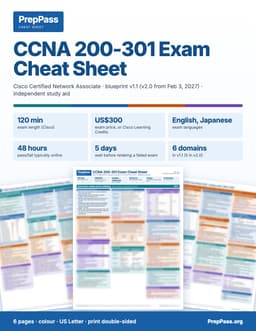
Exam inside two weeks?
This guide is the teaching, read over weeks. If your exam is inside two weeks, the printable colour cheat sheet is the other product: the figures the exam turns on, laid out by section.
See the Cisco CCNA 200-301 cheat sheet PDF — $9.99 →
6 pages · US Letter · printable PDF · yours to keep
What's included — and what isn't
Included
- All 6 domains at real weight, version-locked to 200-301
- Subnetting taught step-by-step + 89 worked math examples
Not included
- No printed copy is shipped — this is a file you download and can print yourself
- No video course, instructor or tutoring comes with the book — the free videos on the site are separate
Everything included, and everything that isn't
Included
- ACL wildcard masks & OSPF cost — computed with the steps shown
- Switching/VLANs/STP, routing/OSPF, security, and automation
- 30 practice questions in the chapters, with explanations
- A question bank of 522 practice questions, grouped by topic, with answers and explanations
- A subnetting quick-reference + command cheat-sheet — PDF + EPUB
Not included
- Not your exam registration or the testing centre's fee, which you still pay to the official body
Contents
See 7 sections and the page each one starts on
- Chapter 1 — Network Fundamentals (Domain 1.0, 20%)p. 8
- Chapter 2 — Network Access (Domain 2.0, 20%)p. 27
- Chapter 3 — IP Connectivity (Domain 3.0, 25%)p. 41
- Chapter 4 — IP Services (Domain 4.0, 10%)p. 57
- Chapter 5 — Security Fundamentals (Domain 5.0, 15%)p. 70
- Chapter 6 — Automation and Programmability (Domain 6.0, 10%)p. 84
- Appendix — Question Bank 522 practice questions with answers and explanationsp. 102
Taken from the PDF you download, with the page each one starts on — not typed here.
Read a chapter free, in full
One complete chapter, exactly as it ships in the eBook. Scroll the window to read it right here; no download, no email.
Read chapter 1 here, without leaving the page
This domain is the foundation for everything else on the exam. It covers the two reference models (OSI and TCP/IP), device roles, cabling and interfaces, Ethernet switching behavior, IPv4 addressing and — the single highest-yield skill on the whole exam — subnetting, plus the essentials of IPv6. If you can subnet fluently, you will pick up points in this domain and in IP Connectivity both.
The rule: two reference models, seven layers, one mnemonic
Networking is taught with two layered models. The OSI model has seven layers; the TCP/IP model collapses them into four. You must know the OSI layers cold, both by number and by what each does.
| # | OSI Layer | Job | Example PDU / device |
|---|---|---|---|
| 7 | Application | Interface to user apps | HTTP, DNS, DHCP data |
| 6 | Presentation | Format, encrypt, compress | TLS, JPEG, ASCII |
| 5 | Session | Set up / tear down dialogs | RPC, NetBIOS |
| 4 | Transport | End-to-end delivery, ports | Segment — TCP, UDP |
| 3 | Network | Logical addressing, routing | Packet — IP; router |
| 2 | Data Link | Local delivery, MAC, framing | Frame — Ethernet; switch |
| 1 | Physical | Bits on the wire | Cables, signals; hub |
A classic mnemonic, top to bottom: All People Seem To Need Data Processing. The unit of data — the PDU — has a name that changes per layer: Layer 4 = segment, Layer 3 = packet, Layer 2 = frame, Layer 1 = bits. That naming is itself an exam favorite.
The distinction the exam tests most is Layer 2 vs. Layer 3:
- Layer 3 (Network) does logical addressing (IPv4/IPv6) and routing — choosing the best path between networks. Routers live here.
- Layer 2 (Data Link) does physical addressing (MAC) and framing — delivery within a single segment/link. Switches live here.
So a question that says "responsible for logical addressing and determining the best path between networks" is Layer 3, the Network layer — routers, not switches.
The rule: TCP vs. UDP, and how encapsulation works
At Layer 4, two protocols matter:
- TCP is connection-oriented and reliable: it uses a three-way handshake (SYN, SYN-ACK, ACK), sequence numbers, acknowledgments, retransmission, and flow control with a sliding window. Use it when every byte must arrive — web, email, file transfer.
- UDP is connectionless and best-effort: no handshake, no acknowledgment, no retransmission, no flow control — just minimal overhead and low latency. Use it for real-time voice/video (VoIP), DNS queries, DHCP, and TFTP, where speed beats guaranteed delivery.
So a question that says "connectionless, best-effort, no retransmission, suitable for real-time voice" is describing UDP — not TCP (reliable), ICMP (diagnostics/errors), or ARP (MAC resolution).
| Feature | TCP | UDP |
|---|---|---|
| Connection | Connection-oriented (handshake) | Connectionless |
| Reliability | Acknowledged, retransmits | Best-effort, no retransmit |
| Ordering | Sequenced | No ordering |
| Flow control | Windowing | None |
| Overhead | Higher (20-byte header) | Lower (8-byte header) |
| Uses | Web, email, file transfer | VoIP, video, DNS, DHCP, TFTP |
Worked example — identify the protocol from behavior and port
An application opens a session that begins SYN / SYN-ACK / ACK, guarantees byte order, and uses port 443. That is TCP carrying HTTPS. Contrast: a query that fires a single datagram to port 53 with no handshake and no retransmission is UDP carrying DNS. And a lookup to port 67/68 with broadcasts is DHCP over UDP. The exam pairs a behavior ("no handshake, real-time") or a port number with a protocol — knowing both columns of the well-known-ports table lets you answer instantly.
Encapsulation is the process of wrapping data as it moves down the stack: the Transport layer adds a TCP/UDP header (making a segment), the Network layer adds an IP header (packet), the Data Link layer adds a frame header and trailer (frame), and the Physical layer sends bits. De-encapsulation unwraps it going up the stack at the receiver. Each layer talks to its peer layer on the far device.
The rule: switching behavior — learn, forward, flood
A switch builds a MAC address table (also called a CAM table) by learning the source MAC of every frame it receives and associating it with the port it arrived on. When it must forward a frame:
- Known unicast — destination MAC is in the table → forward out that one port.
- Unknown unicast — destination MAC not in the table → flood out all ports except the one it arrived on.
- Broadcast (destination FF:FF:FF:FF:FF:FF) or multicast → flood.
Two key domain concepts follow from this:
- A collision domain is a set of devices that could collide if they transmit at once. Each switch port is its own collision domain (full-duplex switching eliminates collisions). A hub puts everyone in one collision domain.
- A broadcast domain is the set of devices a broadcast reaches. A switch floods broadcasts, so by default all ports are one broadcast domain. A router does not forward broadcasts — so each router interface bounds a broadcast domain, and (as Chapter 2 shows) each VLAN is a separate broadcast domain.
Worked example — counting collision and broadcast domains
A router connects to two switches (one per interface). Switch A has 8 PCs; Switch B has 6 PCs; there are no VLANs beyond the default.
- Collision domains: each switch port (full-duplex) is its own collision domain, and each router-to-switch link is one too. Switch A: 8 PC ports + 1 uplink = 9; Switch B: 6 + 1 = 7. Total 16 collision domains. (If a hub joined several PCs, all of them would collapse into one shared collision domain.)
- Broadcast domains: the router separates the two sides, and each switch (default single VLAN) is one broadcast domain → 2 broadcast domains (one per router interface). Add a VLAN and you add a broadcast domain.
The rule to carry into the exam: switch ports multiply collision domains; routers (and VLANs) multiply broadcast domains; hubs merge collision domains.
The rule: IPv4 addressing anatomy
An IPv4 address is 32 bits, written as four octets (0–255) in dotted decimal, for example 192.168.1.100. A subnet mask (or its CIDR /prefix) marks which leading bits are the network portion and which trailing bits are the host portion. A 1 bit in the mask = network; a 0 bit = host.
Address classes still appear on the exam as vocabulary:
- Class A: 1–126 in the first octet, default /8.
- Class B: 128–191, default /16.
- Class C: 192–223, default /24.
- 127 is loopback; 224–239 is multicast (Class D); 240+ is experimental (Class E).
Private (RFC 1918) ranges — never routed on the public Internet:
10.0.0.0/8172.16.0.0–172.31.255.255(172.16.0.0/12)192.168.0.0/16
Also know: APIPA 169.254.0.0/16 is what a host self-assigns when DHCP fails.
Worked example — classify these addresses
10.55.1.1→ private (inside10.0.0.0/8); needs NAT to reach the Internet.172.20.5.1→ private (inside172.16.0.0–172.31.255.255). But172.32.1.1→ public (just outside the range).192.168.1.1→ private (192.168.0.0/16).169.254.10.10→ APIPA (DHCP failed — a symptom, not a usable Internet address).8.8.8.8→ public (routable). Being able to sort private vs. public at a glance drives NAT and troubleshooting questions.
Subnetting, taught step by step
Subnetting is the most valuable skill on the exam. The good news: it is pure pattern, and four questions answer everything.
For a given prefix /n:
- How many host bits?
H = 32 − n. - How many usable hosts?
2^H − 2(subtract 2 for the network address and the broadcast address). Exception: a /31 point-to-point link gives 2 usable hosts by special rule, and a /32 is a single host route. - What is the block size (increment) in the "interesting" octet?
256 − (mask value in that octet). Subnets step by that block size. - Which subnet does a host fall in? Round the interesting octet down to the nearest multiple of the block size. The network address has the host bits all 0; the broadcast address has them all 1 (the address just below the next subnet); usable hosts are everything in between.
Worked example — convert a prefix to a dotted-decimal mask in binary
What dotted-decimal mask is /28? A mask is 28 ones followed by 4 zeros. Group into octets: 11111111.11111111.11111111.11110000. The first three octets = 255. The last octet 11110000 = 128+64+32+16 = 240. So /28 = 255.255.255.240. Same method for /22: 11111111.11111111.11111100.00000000 → third octet 11111100 = 128+64+32+16+8+4 = 252 → 255.255.252.0. Knowing the eight bit-values (128, 64, 32, 16, 8, 4, 2, 1) lets you build any mask by hand — no table needed in a pinch.
Memorize this mask/prefix table for the last octet — it makes every question a lookup:
| Prefix | Mask (last octet) | Block size | Hosts/subnet (usable) |
|---|---|---|---|
| /24 | 0 | 256 | 254 |
| /25 | 128 | 128 | 126 |
| /26 | 192 | 64 | 62 |
| /27 | 224 | 32 | 30 |
| /28 | 240 | 16 | 14 |
| /29 | 248 | 8 | 6 |
| /30 | 252 | 4 | 2 |
Worked example — network address of a host (the /20 case)
Given 172.16.45.10/20, find the network (subnet) address.
- /20 =
255.255.240.0. The interesting octet is the third (the mask is 240 there). - Block size = 256 − 240 = 16. So third-octet subnets are 0, 16, 32, 48, 64…
- The host's third octet is 45. Round down to the nearest multiple of 16: 32 (because 32 ≤ 45 < 48).
- Zero the host bits (third-octet remainder and the whole fourth octet).
- Network address =
172.16.32.0. (Broadcast would be172.16.47.255, the address just below the next subnet172.16.48.0.)
Worked example — usable hosts on a /26
How many usable host addresses on a /26?
- H = 32 − 26 = 6 host bits.
- Usable = 2^6 − 2 = 64 − 2 = 62.
Worked example — broadcast address of a /27
Find the broadcast address of the subnet containing 192.168.1.100/27.
- /27 → last-octet mask 224 → block size 256 − 224 = 32. Subnets: 0, 32, 64, 96, 128…
- 100 rounds down to 96 → subnet
192.168.1.96. - Next subnet is
192.168.1.128; the broadcast is one below it. - Broadcast =
192.168.1.127. Usable range is.97–.126.
Worked example — the /28 subnet and range
For 192.168.10.75/28, find the subnet address and valid host range.
- /28 → last-octet mask 240 → block size 16. Subnets: 0, 16, 32, 48, 64, 80…
- 75 rounds down to 64 → subnet
192.168.10.64. - Broadcast is one below the next subnet (
.80) →192.168.10.79. - Usable hosts:
192.168.10.65through192.168.10.78(14 addresses = 2^4 − 2).
Worked example — the /30 WAN link
A point-to-point WAN link uses a /30. How many usable hosts?
- H = 32 − 30 = 2 → 2^2 − 2 = 2 usable hosts. Exactly right for a two-router link, which is why /30 is the classic WAN mask (a /31 is the modern two-host alternative).
Worked example — "how many subnets" and "borrow how many bits"
How many /26 subnets fit in a /24? Going from /24 to /26 borrows 26 − 24 = 2 host bits → 2^2 = 4 subnets.
A /24 must be divided into at least 6 subnets — minimum bits to borrow? You need 2^b ≥ 6. 2^2 = 4 (too few); 2^3 = 8 ≥ 6. Borrow 3 bits (giving eight /27 subnets, two spare).
Worked example — "are these two hosts in the same subnet?"
192.168.1.62/26 and 192.168.1.65/26 — same subnet?
- /26 block size = 64. Subnets: 0, 64, 128, 192.
.62rounds down to 0 → subnet192.168.1.0(range .1–.62, broadcast .63)..65rounds down to 64 → subnet192.168.1.64(range .65–.126).- Different subnets. No — and note
.62is the last usable host of the first subnet while.63is its broadcast, a favorite off-by-one trap.
The rule: IPv6 essentials
IPv6 addresses are 128 bits, written as eight groups of four hex digits, with two shortening rules: drop leading zeros in a group, and replace one run of all-zero groups with :: (only once per address). Example: 2001:0db8:0000:0000:0000:0000:0000:0001 → 2001:db8::1.
Key address types (know the prefix):
- Global unicast —
2000::/3— the routable, Internet-facing address (like a public IPv4). - Link-local —
FE80::/10— auto-generated on every IPv6 interface, valid only on the local link, never routed. Used for neighbor discovery and as the next-hop for routing. - Unique local —
FC00::/7(commonlyFD00::/8) — private, site-internal (like RFC 1918). - Multicast —
FF00::/8— IPv6 has no broadcast; it uses multicast instead (e.g.,FF02::1all-nodes,FF02::2all-routers).
So "automatically configured on every interface, valid only on a single link, never routed" is the link-local address, FE80::/10.
Worked example — classify IPv6 addresses by prefix
2001:db8:acad::10→ starts2000::/3→ global unicast (routable).FE80::1→ link-local (on-link only, auto-generated).FD00:1234::99→ inFC00::/7(theFD00::/8half) → unique local (private).FF02::1→FF00::/8→ multicast (this one = all-nodes).::1→ loopback;::→ unspecified.
Read the leading hextet and the type falls out: 2 or 3 = global, FE80 = link-local, FC/FD = unique local, FF = multicast.
IPv6 hosts can build an address automatically with SLAAC (Stateless Address Autoconfiguration), learning the /64 prefix from a router's RA (Router Advertisement) and generating the interface ID themselves — often via EUI-64, which inserts FFFE into the middle of the MAC and flips the 7th bit. NDP (Neighbor Discovery Protocol) replaces IPv4's ARP.
Questions buyers ask
How do I get it?
Pay, and the download appears on this page straight away. The links are also emailed to you. No account is required.
What if it isn't for me?
Email us within 14 days for a full refund, no questions asked.
Is the free practice going away?
No. Every practice question, the timed mock and the free chapters on this site stay free. This book is the studying half, not a gate around the free half.
More questions (15)
Can I read it on my phone?
Yes — the EPUB is for phones and e-readers, the PDF is for printing and tabbing. You get both.
Is a study guide enough for the Cisco CCNA 200-301 exam, or do I need a course?
A book is exam review: it does not replace any education, training or experience Cisco Systems requires before you may sit the exam, so check those requirements first. For the exam content itself, this 283-page guide teaches the material chapter by chapter with 552 practice questions and explanations inside, 522 of them in a question bank grouped by topic. A prep course adds live instruction and a set schedule; whether you need one beyond any required education is your call.
What is the cheapest way to prepare for the Cisco CCNA 200-301 exam?
Start with what costs nothing: 522 practice questions on PrepPass, with explanations and no signup. If you want it taught in one file you keep, the full study guide is $14.99 once; the printable cheat sheet for the last days is $9.99. No subscription on any of them.
Who administers the Cisco CCNA (200-301)?
Cisco Systems. The current exam is 200-301 CCNA v1.1, whose six weighted domains are Network Fundamentals 20%, Network Access 20%, IP Connectivity 25%, IP Services 10%, Security Fundamentals 15% and Automation and Programmability 10%. Cisco has also published exam topics for a v2.0 with five re-cut domains; Cisco's own changeover page could not be read, so PrepPass states no switch date.
How many questions are on the Cisco CCNA (200-301)?
Not published by Cisco. Neither Cisco's exam page nor either exam-topics PDF states how many questions the exam has.
How long is the Cisco CCNA (200-301)?
120 minutes
What is the passing score for the Cisco CCNA (200-301)?
Not published by Cisco. Cisco publishes no passing score for the CCNA on these pages.
How much does the Cisco CCNA (200-301) cost?
$300 — Exam price (or Cisco Learning Credits) (Cisco, per attempt)
What languages is the Cisco CCNA (200-301) offered in?
English · Japanese
Does the Cisco CCNA 200-301 study guide come as a PDF?
Yes — Cisco CCNA 200-301 — Complete Study Guide (2026) downloads as PDF and EPUB, 283 pages. The download link is emailed the moment payment clears and does not expire.
How much does the Cisco CCNA 200-301 study guide cost?
$14.99, once. There is no subscription and no account to create; the PDF and EPUB files are yours to keep.
Are there free Cisco CCNA 200-301 practice questions?
Yes — 522 of them, free to use with no signup and an explanation on every one. This study guide has 552 practice questions with answers and explanations. The same free, no-account system also has practice modes (adaptive, new questions, spaced review of misses, weak-topic focus, saved, my mistakes); a timed mock exam (50 questions, 120 minutes) with a score report by topic; a 10-question readiness check (about 5 minutes); 6 study chapters. None of it needs this study guide.
Can I read part of the Cisco CCNA 200-301 study guide before buying?
Yes. A full chapter is free to read on this page — not a summary of one, the chapter itself.
What is the difference between the Cisco CCNA 200-301 study guide and the cheat sheet?
The study guide ($14.99) teaches the material chapter by chapter and is meant to be read over weeks. The cheat sheet ($9.99, 6 pages) drops the teaching and keeps the figures: every number on the exam grouped by value so the confusable ones sit together, each reference page paired with a recall page that blanks the answers, and four routes by days left — 14, 7, 3, or tonight. They are separate purchases; neither replaces the other.
Is this the official Cisco CCNA 200-301 study guide?
No. This is an independent study guide and is not affiliated with or endorsed by the exam's awarding body. It is written from the public Cisco CCNA 200-301 exam topics. Always confirm current requirements with the body that issues your licence.
Why buy the book when the practice is free?
Our practice questions and timed mock stay free — nothing on the site moves behind this book. The $14.99 book is the studying half: the material itself, taught in order, in a file you own.
- Systematic teaching — every exam section explained chapter by chapter, start to finish, not just questions
- Print it & tab it — a paper-ready PDF you can highlight, mark up, and bring to your study table
- Study anywhere, offline — EPUB on your phone or e-reader; no wifi, no browser tabs
- Everything in one place — the chapters and the practice questions in one file
- Yours for life — one-time $14.99, instant download, no subscription
The details
- Verified from the official source(the public Cisco CCNA 200-301 exam topics)
- 522 free practice questions
A CCNA bootcamp/course runs $300–$800. This book teaches the same exam — same rules, verified to current standards — for a one-time $14.99 you keep for life.
Also free on PrepPass for Cisco CCNA 200-301
Beside this guide, PrepPass has a free study system for the same exam. It needs no account, and buying the guide does not unlock or change it: 522 practice questions with explanations; practice modes (adaptive, new questions, spaced review of misses, weak-topic focus, saved, my mistakes); a timed mock exam (50 questions, 120 minutes) with a score report by topic; a 10-question readiness check (about 5 minutes); 6 study chapters.
Progress is saved in your browser; a free account keeps it across devices. The readiness gauge reflects your own practice, not a prediction of the real exam result. How the practice works
One-time purchase, lifetime access to the download. The eBook is the full Cisco CCNA 200-301 study guide in PDF and EPUB. Educational summary, not professional or legal advice — always confirm the current rules with the official source. Last updated: October 2026.