Study guide · 2026 Edition
CSLB C-20 HVAC Trade Exam Study Guide (2026)
PrepPass's independent 2026 study guide for the CSLB C-20 HVAC exam is 290 pages including 200 practice questions with a full answer key, PDF + EPUB, $14.99 one-time; it is not affiliated with the exam provider. The book does not include PrepPass's separate online timed mock for this exam (100 questions, 210 minutes).
- Length
- 290 pages
- Practice questions in the book
- 200
- PrepPass online timed mock
- 100 questions · 210 min
- Exam facts checked, file updated
- October 2026
- Delivery
- PDF + EPUB · English · instant download
What is in the CSLB C-20 HVAC study guide?
The real exam: CSLB Warm-Air Heating, Ventilating and Air-Conditioning (C-20) Trade Examination — Questions: Not published by CSLB · 210 minutes · Passing score: Not published by CSLB. CSLB's C-20 HVAC study guide, form 13E-20 (01/2026) gives these approximate section weights: Planning and Estimating 22%, Fabrication, Installation, and Startup 38%, Troubleshooting, Repair, and Maintenance 20%, Safety 20%. CSLB publishes section weights but no question count and no passing score for this exam. Last checked 2026-10-12.
Planning and estimating, fabrication and installation, troubleshooting and repair, and safety — organized on CSLB’s four published exam sections, with worked calculations and 200 practice questions.
Examination registration (each registration, first attempt or retake): $51.43 per attempt, paid to PSI Services LLC. A retake pays it again. This guide: $14.99, one time.
Exam facts, who it suits and what changed
About the exam itself
| Administering body | Contractors State License Board (CSLB), California Department of Consumer Affairs — exam delivered by PSI Services LLC |
|---|---|
| Questions | Not published by CSLB What we read and found nothing in: CSLB — Step 7: Studying for the Examination |
| Time limit | 210 minutes |
| Passing score | Not published by CSLB What we read and found nothing in: CSLB — Step 7: Studying for the Examination |
| Fees |
Source: CSLB — List of All CSLB Fees |
| Languages offered | English |
Look inside the book
Three real pages, rendered straight from the PDF you download — a reference page, a teaching page, and a worked question, always in that order. Nothing here was redrawn to look better.
- Quick referenceChapter 1 — HVAC System Design and Evaluation · PDF page 25
A page you can turn back to: the numbers, deadlines or terms gathered in one place.
- How it's taughtANSWER KEY AND EXPLANATIONS · PDF page 261
An explanation page: the material taught in prose, in the order the exam tests it.
- A question, workedChapter 1 — HVAC System Design and Evaluation · PDF page 18
A practice question with its answer and the reasoning behind it — not just a key.
Exam inside two weeks?
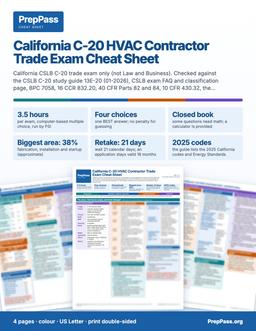
This guide is the teaching, read over weeks. If your exam is inside two weeks, the printable colour cheat sheet is the other product: the figures the exam turns on, laid out by section.
See the CSLB C-20 HVAC cheat sheet PDF — $9.99 →
4 pages · US Letter · printable PDF · yours to keep
What's included — and what isn't
Included
- Chapters follow CSLB’s four published sections and approximate weights: Planning and Estimating 22%, Fabrication, Installation, and Startup 38%, Troubleshooting, Repair, and Maintenance 20%, Safety 20%
- Worked calculations for airflow, load, psychrometrics, duct sizing, superheat and subcooling, plus refrigerant-management and A2L rules, with code-cycle-dependent figures flagged
Not included
- No printed copy is shipped — this is a file you download and can print yourself
- No video course, instructor or tutoring comes with the book — the free videos on the site are separate
Everything included, and everything that isn't
Included
- 200 original practice questions in the book, grouped by CSLB section, with a written explanation of the keyed answer for every question; 56 explain why each of the four options is right or wrong
- A worked example in 15 of the 16 chapters, and an exam-traps list in each chapter
- Quick-reference cheat sheet, glossary, and exam-day strategy appendices
- 284 pages, 6 x 9 in; PDF (print & tab it) + EPUB (phone / e-reader)
Not included
- Not your exam registration or the testing centre's fee, which you still pay to the official body
Contents
See 29 sections and the page each one starts on
- PART I — PLANNING AND ESTIMATING (CSLB: approximately 22%)p. 13
- Chapter 1 — HVAC System Design and Evaluationp. 14
- Chapter 2 — Load and Psychrometric Calculationsp. 27
- Chapter 3 — Duct System Design and Layoutp. 37
- Chapter 4 — Job Cost Estimationp. 45
- PART II — FABRICATION, INSTALLATION, AND STARTUP (CSLB: approximately 38%)p. 55
- Chapter 5 — Duct System Fabricationp. 56
- Chapter 6 — Equipment Installationp. 64
- Chapter 7 — Electrical and Mechanical Componentsp. 74
- Chapter 8 — Plumbing and Refrigeration Componentsp. 84
- Chapter 9 — Air Distribution and Duct Systemsp. 102
- Chapter 10 — HVAC System Startupp. 110
- PART III — TROUBLESHOOTING, REPAIR, AND MAINTENANCE (CSLB: approximately 20%)p. 118
- Chapter 11 — Diagnostic Tests and Evaluationp. 119
- Chapter 12 — Maintenance and Repairp. 137
- PART IV — SAFETY (CSLB: approximately 20%)p. 152
- Chapter 13 — Personal Protective Equipment (PPE)p. 153
- Chapter 14 — Job-Site Safety Requirements (Cal/OSHA)p. 160
- Chapter 15 — Handling Hazardous Materialsp. 172
- Chapter 16 — The C-20 Classification and Contractor Lawp. 182
- PART V — PRACTICE QUESTIONS (200)p. 188
- ANSWER KEY AND EXPLANATIONSp. 239
- Appendix A — Quick-Reference Cheat Sheetp. 278
- Part I: Planning and Estimating (22%)p. 278
- Part II: Fabrication, Installation, and Startup (38%)p. 279
- Part III: Troubleshooting, Repair, and Maintenance (20%)p. 280
- Part IV: Safety (20%)p. 281
- Appendix B — Glossary of Key Termsp. 283
- Appendix C — Exam-Day Strategyp. 288
Taken from the PDF you download, with the page each one starts on — not typed here.
Read a chapter free, in full
One complete chapter, exactly as it ships in the eBook. Scroll the window to read it right here; no download, no email.
Read chapter 2 here, without leaving the page
We didn't give you the easy intro — the free chapter opens on one of the hardest-working parts of the book, so you can judge the teaching where the exam gets difficult.
This is the chapter where you stop reciting and start calculating. CSLB's guide says some questions "require mathematical computation" and gives a calculator. The computations on the exam are almost always one of five kinds: a sensible, latent or total heat-flow calculation from airflow; an air-change or ventilation airflow calculation; a psychrometric property read or process; a conduction (U × A × ΔT) load; or a unit conversion. Master the five and the math is done.
2.1 The Units You Must Keep Straight
- BTU is a quantity of heat. BTU/hr is a rate. A ton of cooling is 12,000 BTU/hr.
- CFM is cubic feet of air per minute. A cubic foot of air is not a fixed weight: it depends on temperature and altitude. Standard air (sea level, about 70 °F) weighs about 0.075 lb per cubic foot.
- Dry-bulb (DB) temperature is what a regular thermometer reads. Wet-bulb (WB) is the temperature of a thermometer wrapped in a wet wick in moving air; it falls below dry-bulb by an amount that depends on how dry the air is.
- Humidity ratio is pounds of water vapor per pound of dry air. HVAC people usually express it in grains of moisture per pound of dry air, where 1 pound = 7,000 grains.
- Enthalpy (h) is the total heat in a pound of dry air plus its moisture, in BTU per pound of dry air, measured from an arbitrary reference. Only differences in enthalpy mean anything.
2.2 The Three Airflow Equations, and Where Their Constants Come From
Memorizing 1.08, 0.68 and 4.5 works until the exam changes the numbers on you or a choice looks wrong. Derive them once and you will never confuse them.
Sensible heat: Qs = 1.08 × CFM × ΔT (°F). Per minute, CFM cubic feet of standard air weighs CFM × 0.075 lb. Per hour that is 60 × 0.075 × CFM = 4.5 × CFM pounds. Air's specific heat is about 0.24 BTU per lb per °F. So Qs = 4.5 × 0.24 × CFM × ΔT = 1.08 × CFM × ΔT.
Total heat: Q_t = 4.5 × CFM × Δh (BTU/lb). It is the same mass flow, 4.5 × CFM pounds per hour, multiplied directly by the enthalpy change. The specific heat is already inside enthalpy, so no 0.24 appears.
Latent heat: QL = 0.68 × CFM × Δgrains. Mass flow is 4.5 × CFM lb of dry air per hour. Each grain of water removed is 1/7,000 lb. Condensing a pound of water vapor releases about 1,060 BTU. So QL = 4.5 × CFM × Δgrains × 1,060 ÷ 7,000 ≈ 0.68 × CFM × Δgrains. (Some references use latent heat values that give 0.69; use whatever the question states or your reference gives. The difference is about 1.5%.)
The memory aid. 1.08 goes with a temperature difference. 0.68 goes with a grains difference. 4.5 goes with an enthalpy difference. And sensible + latent = total.
Why mixing them is the classic trap. If you apply 1.08 to an enthalpy difference of 8 BTU/lb on 1,000 CFM you get 8,640, which is about a quarter of the true 36,000 (4.5 × 1,000 × 8). If you apply 4.5 to a dry-bulb difference you get a number roughly four times too large. Both wrong answers will be sitting in the option list, because the exam writer knows exactly which mistake you will make.
Altitude. All three constants assume sea-level air density. At altitude the air is thinner and carries less heat per cubic foot, so the constants shrink in proportion to density. Using the standard-atmosphere density relation, the density ratio is about 0.94 at 2,000 ft, 0.86 at 5,000 ft and 0.81 at 7,000 ft. At 5,000 ft the sensible constant becomes about 1.08 × 0.86 = 0.93. The practical consequence: a blower that moves a given CFM at altitude moves less mass, so it carries less heat, and a heat calculation done with sea-level constants overstates what the airflow can deliver.
2.3 Worked Calculations
Example A: sensible capacity. 1,800 CFM is cooled from 78 °F to 57 °F. Q_s = 1.08 × 1,800 × 21 = 40,824 BTU/hr.
Example B: total capacity from enthalpy. 1,000 CFM enters a coil at 30 BTU/lb and leaves at 22 BTU/lb. Q_t = 4.5 × 1,000 × 8 = 36,000 BTU/hr = 3 tons.
Example C: latent from grains. The same airstream loses 6 grains/lb. Q_L = 0.68 × 1,000 × 6 = 4,080 BTU/hr.
Example D: sensible, latent and total from one coil, cross-checked. A residential coil receives 1,800 CFM of air at 78 °F dry-bulb, 65 °F wet-bulb. Computing from the psychrometric equations at sea level, that air has a humidity ratio of about 71 grains/lb and an enthalpy of about 29.9 BTU/lb. It leaves at 57 °F dry-bulb, 56 °F wet-bulb: about 65 grains/lb and 23.8 BTU/lb.
- Sensible: 1.08 × 1,800 × (78 − 57) = 40,824 BTU/hr.
- Latent: 0.68 × 1,800 × (71 − 65) = about 7,300 BTU/hr (rounding grains to whole numbers).
- Sum: about 48,200 BTU/hr.
- Total by enthalpy: 4.5 × 1,800 × (29.9 − 23.8) = about 49,400 BTU/hr.
The two routes agree to within about 3%, which is as close as chart reading and rounded constants allow. The coil's sensible heat ratio is 40,824 ÷ 48,200 ≈ 0.85. (Your chart reading will differ by a grain or half a BTU/lb. The exam's choices are spread widely enough that this does not matter.)
Example E: the airflow that goes with a tonnage. A 3-ton system at the common residential design of about 400 CFM per ton moves 1,200 CFM. If the coil does 36,000 BTU/hr with an SHR of 0.75, sensible is 27,000 BTU/hr, and the required air temperature drop across the coil is ΔT = 27,000 ÷ (1.08 × 1,200) = 20.8 °F. This is the reason a normal residential split shows a temperature difference across the coil of roughly the high teens to low twenties, not 28 °F. If the system were pure sensible (SHR = 1), ΔT would be 36,000 ÷ (1.08 × 1,200) = 27.8 °F, which is what a dry-air process would show. The latent portion of the load takes up part of the capacity.
Example F: airflow versus latent removal. Slow a 3-ton system's blower from 1,200 to 900 CFM. The coil runs colder, so sensible capacity drops and latent capacity rises. That is how you buy dehumidification, and how you freeze a coil if you go too far. The design range of 350 to 450 CFM per ton is a convention, but the 2025 Energy Code's mandatory measures set a floor of 350 CFM per ton for ducted cooling in single-family buildings, and the Commission's duct leakage form instructions use 400 CFM per nominal ton to compute leakage percentages; the equipment's expanded performance data governs.
Example G: heating airflow from a furnace. A furnace is rated 90,000 BTU/hr input, 80% AFUE. Output = 72,000 BTU/hr. With a 50 °F temperature rise, CFM = 72,000 ÷ (1.08 × 50) = 1,333 CFM. The allowable rise comes from the equipment's rating plate and installation instructions, not from Manual J or the Title 24 forms.
Example H: finding temperature rise in the field. The same furnace measures 1,000 CFM of airflow. Rise = 72,000 ÷ (1.08 × 1,000) = 66.7 °F. If the rating plate's range tops out at 65 °F, the furnace is moving too little air. This is the calculation behind Chapter 11's furnace diagnosis.
2.4 Air Changes and Ventilation Airflow
CSLB's own sample question is an air-change calculation, so expect at least one.
Air changes per hour (ACH) tells you how many times per hour the full volume of a space is replaced. CFM = (volume in cubic feet × ACH) ÷ 60.
Example I. A parts warehouse bay is 90,000 ft³ and needs six air changes per hour. Required airflow = 90,000 × 6 ÷ 60 = 9,000 CFM. If each exhaust fan moves 1,500 CFM, you need 9,000 ÷ 1,500 = 6 fans. (This uses different numbers than CSLB's sample; the method is identical.)
Example J: going backwards. A 12-ft by 20-ft room with an 8-ft ceiling is 1,920 ft³. A 100 CFM bathroom-type exhaust fan produces 100 × 60 ÷ 1,920 = 3.1 ACH.
Rate-based ventilation. Codes also set outdoor air by a rate per person plus a rate per square foot of floor area, and the total is the sum. The rates themselves live in the adopted ventilation tables, which this book does not print, but the method is simple: outdoor air CFM = (people × CFM per person) + (floor area × CFM per square foot). Example: 30 people at a table rate of 5 CFM per person plus 3,000 ft² at 0.06 CFM per ft² gives 150 + 180 = 330 CFM (the rates here are illustrative, not code values).
Makeup air. Whatever you exhaust must be replaced. A kitchen hood exhausting 3,000 CFM requires roughly 3,000 CFM of makeup air from somewhere, or the building goes negative and pulls air backward through vents and flues. A return duct recirculates conditioned air; it does not replace air that left the building.
Ventilation is a load. Outdoor air that enters carries sensible and latent loads. Use the equations in 2.2 with the outdoor condition as the entering state. Example: 330 CFM of outdoor air at 95 °F DB entering a space held at 75 °F carries a sensible load of 1.08 × 330 × 20 = 7,128 BTU/hr before any latent load.
2.5 Reading the Psychrometric Chart
You will not be handed a chart in a closed-book exam without a question that tells you what to look for, but the exam does test the relationships the chart displays. Learn them as rules.
- Dry-bulb ≥ wet-bulb ≥ dew point. All three are equal only at saturation (100% relative humidity). The gap between dry-bulb and wet-bulb tells you how dry the air is.
- Dew point is the temperature at which the air's moisture begins to condense. It depends only on the moisture content (humidity ratio), not on dry-bulb. Warm air and cool air with the same humidity ratio share a dew point.
- Relative humidity is the moisture the air holds as a percentage of what it could hold at that dry-bulb. Warm the air without adding moisture and RH falls. Cool it and RH rises, reaching 100% at the dew point.
- Humidity ratio (grains/lb) is the true measure of how much water is in the air. Lines of constant humidity ratio run horizontal on the chart.
- Enthalpy lines slant down to the right, and they run almost parallel to the constant wet-bulb lines, which is why wet-bulb is such a good proxy for total heat content.
Four basic processes to recognize:
| Process | What happens on the chart | Example |
|---|---|---|
| Sensible heating | Moves horizontally right: DB up, humidity ratio constant, RH falls | Furnace or electric strip heat |
| Sensible cooling | Moves horizontally left: DB down, humidity ratio constant, RH rises | Chilled coil above the dew point |
| Cooling and dehumidifying | Moves down and left, toward the saturation curve | Air conditioning coil below the dew point |
| Humidifying | Moves up | Steam or evaporative humidifier |
Cooling and dehumidifying in more detail. When a coil surface temperature is below the air's dew point, moisture condenses. The process line on the chart runs roughly toward the coil's apparatus dew point (ADP), the effective surface condition of the coil, but never all the way there, because some air bypasses the coil. The air leaves cooler and drier but not saturated in a real residential coil, typically at high relative humidity. The steeper the line, the more latent the process; the flatter, the more sensible.
Why an A-coil can "sweat" without dehumidifying. If the coil surface stays above the entering air's dew point, no moisture condenses. All the cooling is sensible. That is what a very high airflow does: it keeps the coil warmer. This is the mirror of Example F.
Mixing two airstreams. Return air and outdoor air mixed in a plenum blend in proportion to their airflow. Dry-bulb, humidity ratio and enthalpy of the mix are, to a good approximation, the CFM-weighted averages of the two streams. Example: 25% outdoor air at 95 °F DB, 75 °F WB (about 98.5 grains/lb, 38.3 BTU/lb) mixed with 75% return air at 75 °F DB, 63 °F WB (about 66.7 grains/lb, 28.4 BTU/lb):
- Mixed DB ≈ 0.25 × 95 + 0.75 × 75 = 80 °F.
- Mixed moisture ≈ 0.25 × 98.5 + 0.75 × 66.7 = 74.7 grains/lb.
- Mixed enthalpy ≈ 0.25 × 38.3 + 0.75 × 28.4 = 30.9 BTU/lb, which corresponds to a wet-bulb near 66 °F (an 80 °F DB mixed state at about 49% RH).
The exam version is usually: "A mixed-air temperature is 80 °F; the return is 75 °F, outdoors 95 °F; what fraction is outdoor air?" Fraction = (80 − 75) ÷ (95 − 75) = 25%.
Using the sensible heat ratio. A cooling load of 30,000 BTU/hr with 22,500 sensible has SHR = 0.75. Equipment is chosen so its coil SHR at the design conditions matches or exceeds the room's, otherwise the humidity runs high. A coil with SHR 0.85 on a room load with SHR 0.70 leaves the room humid.
Dew point and duct sweat. If a duct or pipe surface is colder than the dew point of the surrounding air, water condenses on it. A 55 °F supply duct in a 95 °F, 75 °F-wet-bulb attic (dew point near 67 °F) will sweat unless it is insulated and the insulation's vapor jacket is intact. This is why the exam links duct insulation, vapor barriers and sealing to humidity, not only to energy.
Key numbers and facts: psychrometrics - 1.08 with a temperature difference; 0.68 with grains; 4.5 with enthalpy. Sensible + latent = total. - 1.08 = 60 × 0.075 × 0.24. 4.5 = 60 × 0.075. 0.68 ≈ 4.5 × 1,060 ÷ 7,000. - 1 pound = 7,000 grains. 1 ton = 12,000 BTU/hr. - Altitude reduces the constants in proportion to air density (about 0.86 at 5,000 ft). - CFM = volume × ACH ÷ 60. - Dew point depends only on moisture content. DB ≥ WB ≥ DP, equal only at saturation. - Heating: horizontal right. Cooling: horizontal left. Cool + dehumidify: down and left. Humidify: up. - Mix fraction = (mixed − return) ÷ (outdoor − return). - SHR = sensible ÷ total. Lower airflow → colder coil → more latent.
Questions buyers ask
How do I get it?
Pay, and the download appears on this page straight away. The links are also emailed to you. No account is required.
What if it isn't for me?
Email us within 14 days for a full refund, no questions asked.
Is the free practice going away?
No. Every practice question, the timed mock and the free chapters on this site stay free. This book is the studying half, not a gate around the free half.
More questions (17)
Can I read it on my phone?
Yes — the EPUB is for phones and e-readers, the PDF is for printing and tabbing. You get both.
Is a study guide enough for the CSLB C-20 HVAC exam, or do I need a course?
A book is exam review: it does not replace any education, training or experience Contractors State License Board (CSLB), California Department of Consumer Affairs requires before you may sit the exam, so check those requirements first. For the exam content itself, this 290-page guide teaches the material chapter by chapter with 200 practice questions and explanations inside, and 400 more practice questions are free on PrepPass. A prep course adds live instruction and a set schedule; whether you need one beyond any required education is your call.
What is the cheapest way to prepare for the CSLB C-20 HVAC exam?
Start with what costs nothing: 400 practice questions on PrepPass, with explanations and no signup. If you want it taught in one file you keep, the full study guide is $14.99 once; the printable cheat sheet for the last days is $9.99. No subscription on any of them.
What happens if I fail the CSLB C-20 HVAC exam?
You can retake it under Contractors State License Board (CSLB), California Department of Consumer Affairs's rule: CSLB gives you 18 months after it accepts your application to pass; within that window you may take an exam as many times as you need, but you must wait 21 calendar days after each attempt. Confirm the current policy with Contractors State License Board (CSLB), California Department of Consumer Affairs before you book.
Who administers the CSLB Warm-Air Heating, Ventilating and Air-Conditioning (C-20) Trade Examination?
Contractors State License Board (CSLB), California Department of Consumer Affairs — exam delivered by PSI Services LLC. CSLB's legal existence is set by Business and Professions Code § 7000.5. CSLB states it has contracted with PSI to administer its examinations.
How many questions are on the CSLB Warm-Air Heating, Ventilating and Air-Conditioning (C-20) Trade Examination?
Not published by CSLB. CSLB says only that “All trade examinations consist of multiple-choice questions.” No count appears in the study guide, the Examinations FAQ, or PSI's candidate bulletin.
How long is the CSLB Warm-Air Heating, Ventilating and Air-Conditioning (C-20) Trade Examination?
210 minutes. CSLB: “You will be given 3-1/2 hours to complete each examination.” It is per examination, not per sitting — a candidate taking Law and Business plus a trade exam gets 3-1/2 hours for each.
What is the passing score for the CSLB Warm-Air Heating, Ventilating and Air-Conditioning (C-20) Trade Examination?
Not published by CSLB. CSLB: “You will be informed at the test site about the percentage of correct answers needed to pass each examination,” and, in Get Licensed to Build Q14, that the percentage “varies for each exam”. Passing candidates are never shown their own score. PrepPass states no passing score for this exam.
How much does the CSLB Warm-Air Heating, Ventilating and Air-Conditioning (C-20) Trade Examination cost?
$450 — Original application (exam or waiver, one classification) (CSLB, one-time); $51.43 — Examination registration (each registration, first attempt or retake) (PSI Services LLC, per attempt); $200 — Initial license fee (sole owner) (CSLB, one-time); $350 — Initial license fee (non-sole owner: partnership, corporation, LLC, joint venture) (CSLB, one-time). Two payees: application and license fees go to CSLB, the per-exam registration fee to PSI. CSLB's 2023 “Get Licensed to Build” PDF still names a $100 rescheduling fee; it appears neither on CSLB's current fee list nor in Business and Professions Code § 7137 as amended effective 1 January 2026, so it is not stated here. The application fee is charged once per original license application and covers both required exams.
What languages is the CSLB Warm-Air Heating, Ventilating and Air-Conditioning (C-20) Trade Examination offered in?
English. CSLB names ten exams that have Spanish versions and C-20 is not one of them, so the C-20 exam is English only. For trade exams without a Spanish version, CSLB says accommodations may be made for a candidate to be joined by an approved translator.
Does the CSLB C-20 HVAC study guide come as a PDF?
Yes — CSLB C-20 HVAC Trade Exam Study Guide (2026) downloads as PDF and EPUB, 290 pages. The download link is emailed the moment payment clears and does not expire.
How much does the CSLB C-20 HVAC study guide cost?
$14.99, once. There is no subscription and no account to create; the PDF and EPUB files are yours to keep.
Are there free CSLB C-20 HVAC practice questions?
Yes — 400 of them, free to use with no signup and an explanation on every one. They are separate from this study guide, which is what you are buying here. The same free, no-account system also has practice modes (adaptive, new questions, spaced review of misses, weak-topic focus, saved, my mistakes); a timed mock exam (100 questions, 210 minutes) with a score report by topic; a 10-question readiness check (about 5 minutes); 10 study chapters. None of it needs this study guide.
Can I read part of the CSLB C-20 HVAC study guide before buying?
Yes. A full chapter is free to read on this page — not a summary of one, the chapter itself.
What is the difference between the CSLB C-20 HVAC study guide and the cheat sheet?
The study guide ($14.99) teaches the material chapter by chapter and is meant to be read over weeks. The cheat sheet ($9.99, 4 pages) drops the teaching and keeps the figures: every number on the exam grouped by value so the confusable ones sit together, each reference page paired with a recall page that blanks the answers, and four routes by days left — 14, 7, 3, or tonight. They are separate purchases; neither replaces the other.
Is there a cheaper way to buy the CSLB C-20 HVAC study guide with anything else?
Yes. CSLB Law & Business + CSLB C-20 HVAC is $30.99 for 4 files in one checkout — 50% less than the $62.96 those items cost bought separately today. It adds CSLB Law & Business — Complete Study Guide (2026), CSLB Law & Business — Cheat Sheet (2026), CSLB C-20 HVAC — Cheat Sheet (2026). The saving is measured against the items' real current prices; there is no struck-through "original" price on this site.
Is this the official CSLB C-20 HVAC study guide?
No. This is an independent study guide and is not affiliated with or endorsed by the exam's awarding body. It is written from California Mechanical Code · Title 24 · EPA 608 · Cal/OSHA Title 8 · 16 CCR §832.20. Always confirm current requirements with the body that issues your licence.
Why buy the book when the practice is free?
Our practice questions and timed mock stay free — nothing on the site moves behind this book. The $14.99 book is the studying half: the material itself, taught in order, in a file you own.
- Systematic teaching — every exam section explained chapter by chapter, start to finish, not just questions
- Print it & tab it — a paper-ready PDF you can highlight, mark up, and bring to your study table
- Study anywhere, offline — EPUB on your phone or e-reader; no wifi, no browser tabs
- Everything in one place — the chapters and the practice questions in one file
- Yours for life — one-time $14.99, instant download, no subscription
The details
- Verified from the official source(California Mechanical Code · Title 24 · EPA 608 · Cal/OSHA Title 8 · 16 CCR §832.20)
- 400 free practice questions
A CSLB exam prep course runs $200–$800. This book teaches the same exam — same rules, verified to current standards — for a one-time $14.99 you keep for life.
Also free on PrepPass for CSLB C-20 HVAC
Beside this guide, PrepPass has a free study system for the same exam. It needs no account, and buying the guide does not unlock or change it: 400 practice questions with explanations; practice modes (adaptive, new questions, spaced review of misses, weak-topic focus, saved, my mistakes); a timed mock exam (100 questions, 210 minutes) with a score report by topic; a 10-question readiness check (about 5 minutes); 10 study chapters.
Progress is saved in your browser; a free account keeps it across devices. The readiness gauge reflects your own practice, not a prediction of the real exam result. How the practice works
One-time purchase, lifetime access to the download. The eBook is the full CSLB C-20 HVAC study guide in PDF and EPUB. Educational summary, not professional or legal advice — always confirm the current rules with the official source. Last updated: October 2026.